
Mode of Grouped Data — the Modal Class
The mode is the value that occurs most often. For ungrouped data you just spot the value with the highest frequency. For grouped data you cannot see individual values, so first find the modal class — the class with the highest frequency. The mode is a value inside that class.
The Mode Formula
where
- = lower limit of the modal class,
- = frequency of the modal class,
- = frequency of the class just before the modal class,
- = frequency of the class just after the modal class,
- = class size.
Key Point: Identify the modal class first (highest frequency), then read off and substitute carefully — the denominator is .
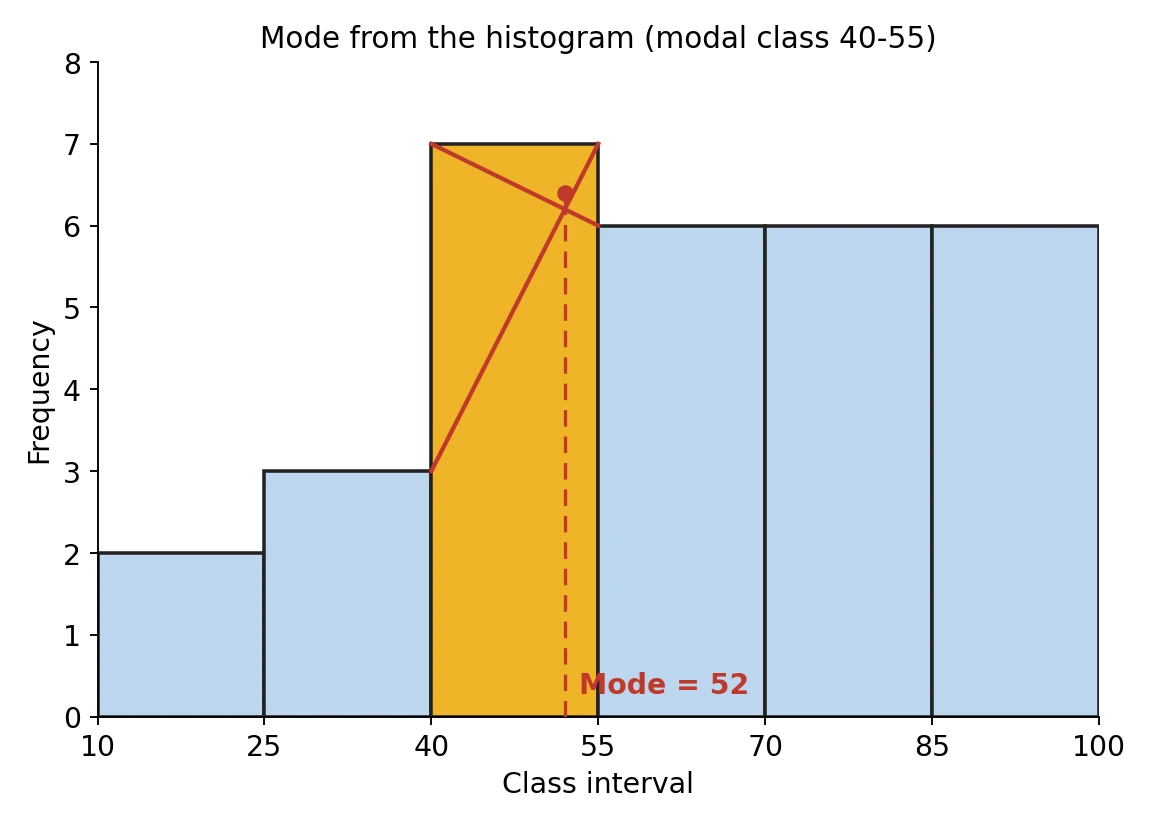
Reading Off the Values
The commonest slips are in and . Remember:
- is the frequency of the class immediately above the modal class in the table (the preceding class),
- is the frequency of the class immediately below it (the succeeding class).
If the modal class is the first class, take ; if it is the last, take .
Key Point: Line up the three frequencies in order and the formula almost fills itself in.
Mode vs Mean
The mode tells you the most typical value; the mean tells you the average. They answer different questions. For the marks data, the mode is 52 (most students scored around there) while the mean is 62 (the overall average) — both are useful, depending on what you want to know.
[Board Important] "Most frequent / most common / typical" mode. "Average / per student" mean.
Solved Examples
Example 1: Mode of the marks data
Find the mode: classes with frequencies .
Solution:
- Highest frequency is 7 modal class . So , , , , .
- Mode .
Final Answer: Mode .
Takeaway: Denominator .
Example 2: Family size
Find the mode: family size with frequencies .
Solution:
- Highest frequency is 8 modal class ; , , , , .
- Mode .
Final Answer: Mode .
Takeaway: Even when is close to , follow the formula exactly.
Example 3: First class is modal
Find the mode: with frequencies .
Solution:
- Modal class is (frequency 15). , , (no class before), , .
- Mode .
Final Answer: Mode .
Takeaway: When the modal class is first, use .
Example 4: Identify only the modal class
For the distribution with frequencies , name the modal class and .
Solution:
- Highest frequency 20 modal class .
- , (class ), (class ).
Final Answer: Modal class ; .
Takeaway: Getting and right is half the battle.