
What Changes Enzyme Activity - Temperature and pH
The activity of an enzyme can be affected by a change in the conditions which can alter the tertiary structure of the protein. That single sentence is the reason every factor below works. These include:
- Temperature
- pH
- Change in substrate concentration
- Binding of specific chemicals that regulate its activity
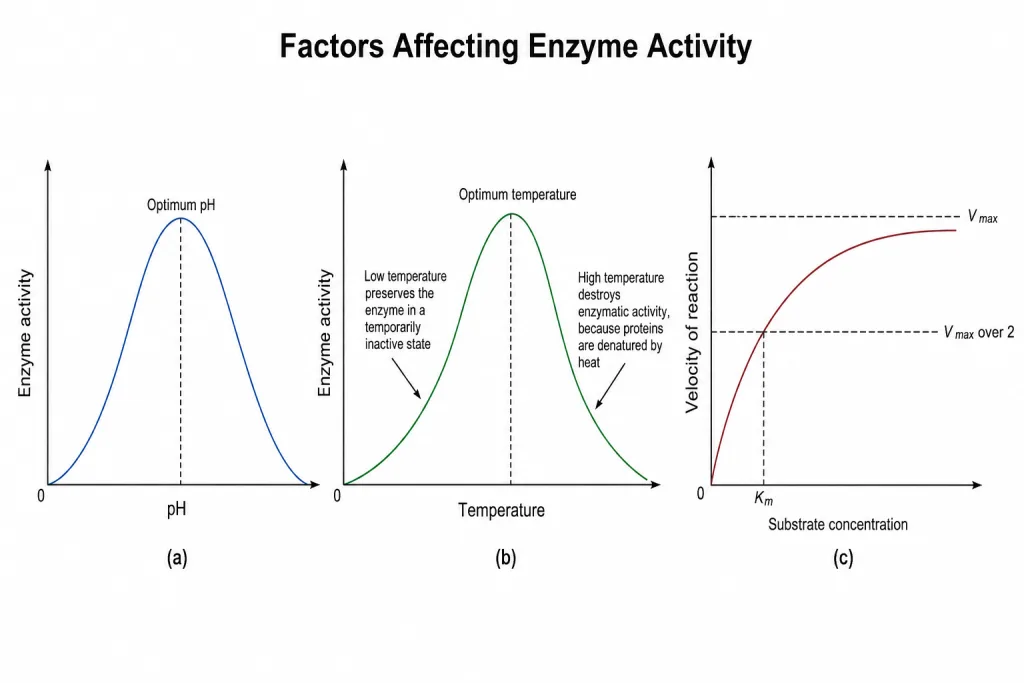
Enzymes generally function in a narrow range of temperature and pH. Each enzyme shows its highest activity at a particular temperature and pH called the optimum temperature and optimum pH. Activity declines both below and above the optimum value - so the graph is a bell shape, not a rising line.
The two ends of the temperature range are not the same thing:
| Condition | What it does to the enzyme |
|---|---|
| Low temperature | Preserves the enzyme in a temporarily inactive state |
| High temperature | Destroys enzymatic activity, because proteins are denatured by heat |
[NEET Important] The one distinction asked again and again: low temperature is temporary and reversible - the enzyme is only preserved in an inactive state; high temperature destroys activity, because proteins are denatured by heat. Any option that calls cold "denaturation" is wrong.
Substrate Concentration, V max, and Inhibition
With the increase in substrate concentration, the velocity of the enzymatic reaction rises at first. The reaction ultimately reaches a maximum velocity, , which is not exceeded by any further rise in the concentration of the substrate.
Why the curve flattens. This is because the enzyme molecules are fewer than the substrate molecules, and after saturation of these molecules there are no free enzyme molecules to bind with the additional substrate molecules. On the graph, the substrate concentration at which the velocity is half of is marked .
Inhibition. The activity of an enzyme is also sensitive to the presence of specific chemicals that bind to the enzyme. When the binding of the chemical shuts off enzyme activity, the process is called inhibition and the chemical is called an inhibitor.
Competitive inhibition. When the inhibitor closely resembles the substrate in its molecular structure and inhibits the activity of the enzyme, it is known as a competitive inhibitor. Due to its close structural similarity with the substrate, the inhibitor competes with the substrate for the substrate-binding site of the enzyme. Consequently the substrate cannot bind, and as a result the enzyme action declines.
| The standard example | |
|---|---|
| Enzyme inhibited | Succinic dehydrogenase |
| The real substrate | Succinate |
| The competitive inhibitor | Malonate, which closely resembles succinate in structure |
Such competitive inhibitors are often used in the control of bacterial pathogens.
[NEET Important] Do not misread why is a ceiling: it is not that the substrate runs out - it is that the enzyme molecules are fewer than the substrate molecules and get saturated, so no free enzyme is left to bind more substrate. And keep the trio straight: malonate inhibits succinic dehydrogenase because malonate resembles succinate.
The Six Classes of Enzymes
Thousands of enzymes have been discovered, isolated and studied. Most of these enzymes have been classified into different groups based on the type of reactions they catalyse. Enzymes are divided into 6 classes, each with 4 to 13 subclasses, and named accordingly by a four-digit number.
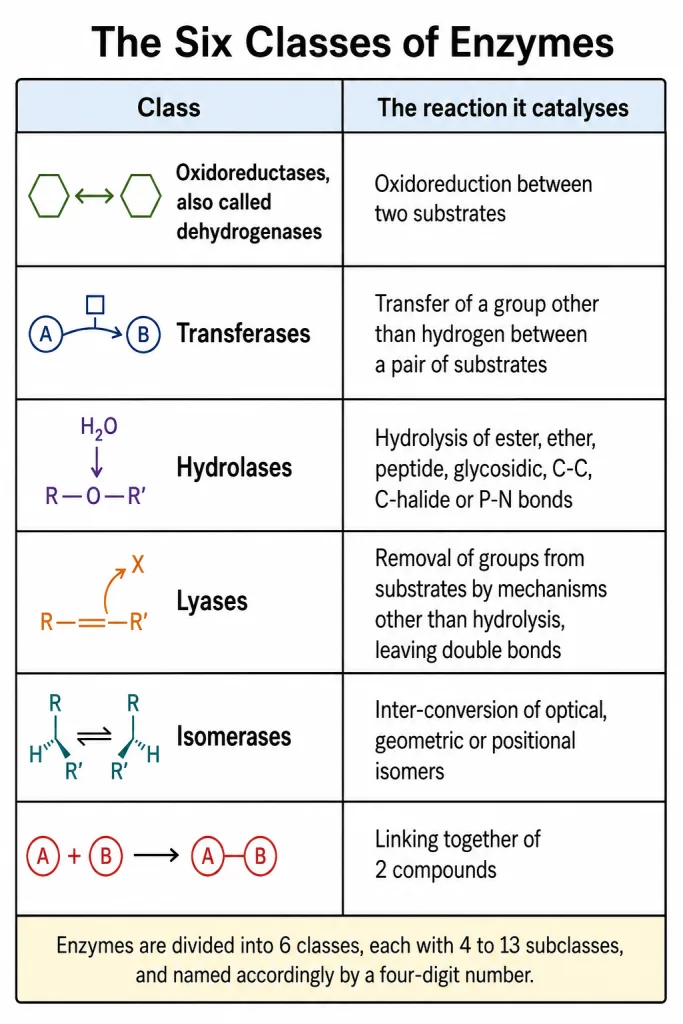
- Oxidoreductases, also called dehydrogenases. Enzymes which catalyse oxidoreduction between two substrates and :
- Transferases. Enzymes catalysing a transfer of a group , other than hydrogen, between a pair of substrates and :
Hydrolases. Enzymes catalysing hydrolysis of ester, ether, peptide, glycosidic, C-C, C-halide or P-N bonds.
Lyases. Enzymes that catalyse removal of groups from substrates by mechanisms other than hydrolysis, leaving double bonds.
Isomerases. Includes all enzymes catalysing inter-conversion of optical, geometric or positional isomers.
Ligases. Enzymes catalysing the linking together of 2 compounds, for example enzymes which catalyse joining of C-O, C-S, C-N and P-O bonds.
[NEET Important] The two numbers are asked directly - 6 classes, 4 to 13 subclasses, a four-digit number as the name. After that it is pure pairing work, and the pair most often confused is hydrolases (hydrolysis) against lyases (removal of groups by mechanisms other than hydrolysis, leaving double bonds). Remember ligases link and isomerases inter-convert isomers.
Co-factors - Apoenzyme, Prosthetic Groups, Co-enzymes and Metal Ions
Enzymes are composed of one or several polypeptide chains. However, there are a number of cases in which non-protein constituents called co-factors are bound to the enzyme to make the enzyme catalytically active. In these instances, the protein portion of the enzyme is called the apoenzyme.
Three kinds of cofactors may be identified: prosthetic groups, co-enzymes and metal ions.
Prosthetic groups. Prosthetic groups are organic compounds, and are distinguished from other cofactors in that they are tightly bound to the apoenzyme. For example, in peroxidase and catalase, which catalyse the breakdown of hydrogen peroxide to water and oxygen, haem is the prosthetic group, and it is a part of the active site of the enzyme.
Co-enzymes. Co-enzymes are also organic compounds, but their association with the apoenzyme is only transient, usually occurring during the course of catalysis. Co-enzymes serve as co-factors in a number of different enzyme catalysed reactions. The essential chemical components of many coenzymes are vitamins - for example the coenzyme nicotinamide adenine dinucleotide, NAD, and NADP, which contain the vitamin niacin.
Metal ions. A number of enzymes require metal ions for their activity, which form coordination bonds with side chains at the active site and at the same time form one or more coordination bonds with the substrate. For example, zinc is a cofactor for the proteolytic enzyme carboxypeptidase.
| Cofactor | Nature | Binding | Example |
|---|---|---|---|
| Prosthetic group | Organic compound | Tightly bound | Haem in peroxidase and catalase |
| Co-enzyme | Organic compound | Transient | NAD and NADP, containing niacin |
| Metal ion | Inorganic ion | Coordination bonds | Zinc in carboxypeptidase |
Catalytic activity is lost when the co-factor is removed from the enzyme, which testifies that they play a crucial role in the catalytic activity of the enzyme.
[NEET Important] The whole block turns on one word pair: prosthetic groups are TIGHTLY bound to the apoenzyme, co-enzymes are only TRANSIENTLY associated. Both are organic. The three examples come up as bare matching items - haem with peroxidase and catalase, NAD and NADP with niacin, zinc with carboxypeptidase - and remember the protein portion alone is the apoenzyme.
Quick Recap
- Enzyme activity is affected by any change in conditions that can alter the tertiary structure of the protein - temperature, pH, change in substrate concentration, or binding of specific chemicals that regulate its activity.
- Enzymes generally function in a narrow range of temperature and pH.
- Each enzyme shows its highest activity at a particular temperature and pH, called the optimum temperature and optimum pH, and activity declines both below and above the optimum value.
- Low temperature preserves the enzyme in a temporarily inactive state; high temperature destroys enzymatic activity, because proteins are denatured by heat.
- With an increase in substrate concentration the velocity rises at first and ultimately reaches a maximum velocity, , which is not exceeded by any further rise in substrate concentration.
- The reason is that the enzyme molecules are fewer than the substrate molecules, and after saturation there are no free enzyme molecules to bind additional substrate. On the graph, marks the substrate concentration giving half of .
- When the binding of a chemical shuts off enzyme activity the process is called inhibition and the chemical is called an inhibitor.
- A competitive inhibitor closely resembles the substrate in molecular structure and competes with the substrate for the substrate-binding site, so the substrate cannot bind and enzyme action declines.
- Example - inhibition of succinic dehydrogenase by malonate, which closely resembles the substrate succinate in structure. Such competitive inhibitors are often used in the control of bacterial pathogens.
- Enzymes are divided into 6 classes, each with 4 to 13 subclasses, and named by a four-digit number.
- Oxidoreductases or dehydrogenases - catalyse oxidoreduction between two substrates: .
- Transferases - catalyse the transfer of a group , other than hydrogen, between a pair of substrates: .
- Hydrolases - catalyse hydrolysis of ester, ether, peptide, glycosidic, C-C, C-halide or P-N bonds.
- Lyases - catalyse removal of groups from substrates by mechanisms other than hydrolysis, leaving double bonds.
- Isomerases - catalyse inter-conversion of optical, geometric or positional isomers.
- Ligases - catalyse the linking together of 2 compounds, for example joining of C-O, C-S, C-N and P-O bonds.
- Non-protein constituents called co-factors are bound to the enzyme to make it catalytically active; the protein portion is then called the apoenzyme.
- Three kinds of cofactors - prosthetic groups, co-enzymes and metal ions.
- Prosthetic groups are organic compounds tightly bound to the apoenzyme - haem in peroxidase and catalase, which catalyse the breakdown of hydrogen peroxide to water and oxygen; haem is a part of the active site.
- Co-enzymes are organic compounds whose association with the apoenzyme is only transient, usually during catalysis; many contain vitamins, for example NAD and NADP contain niacin.
- Metal ions form coordination bonds with side chains at the active site and with the substrate - zinc is a cofactor for the proteolytic enzyme carboxypeptidase.
- Catalytic activity is lost when the co-factor is removed, which testifies that co-factors play a crucial role.
Solved Examples
Question 1
Q. Which conditions affect the activity of an enzyme, and what do they all have in common?
Answer. Temperature, pH, change in substrate concentration, and the binding of specific chemicals that regulate its activity. What they share is the mechanism - each is a change in conditions which can alter the tertiary structure of the protein.
Question 2
Q. What is meant by the optimum temperature and optimum pH of an enzyme?
Answer. Enzymes generally function in a narrow range of temperature and pH. The particular temperature and pH at which an enzyme shows its highest activity are called the optimum temperature and the optimum pH. Activity declines both below and above the optimum value.
Question 3
Q. How does a low temperature differ from a high temperature in its effect on an enzyme?
Answer. Low temperature preserves the enzyme in a temporarily inactive state. High temperature destroys enzymatic activity, because proteins are denatured by heat. So cold is reversible, heat is destructive.
Question 4
Q. Describe what happens to the velocity of an enzymatic reaction as substrate concentration is raised.
Answer. With the increase in substrate concentration the velocity of the enzymatic reaction rises at first. The reaction ultimately reaches a maximum velocity, , which is not exceeded by any further rise in the concentration of the substrate.
Question 5
Q. Why is V max not exceeded, however much substrate you add?
Answer. Because the enzyme molecules are fewer than the substrate molecules, and after saturation of these molecules there are no free enzyme molecules to bind with the additional substrate molecules.
Question 6
Q. What is inhibition, and what is an inhibitor?
Answer. The activity of an enzyme is sensitive to the presence of specific chemicals that bind to the enzyme. When the binding of the chemical shuts off enzyme activity, the process is called inhibition and the chemical is called an inhibitor.
Question 7
Q. What is a competitive inhibitor? Give the standard example.
Answer. When the inhibitor closely resembles the substrate in its molecular structure and inhibits the activity of the enzyme, it is known as a competitive inhibitor. Due to its close structural similarity with the substrate, the inhibitor competes with the substrate for the substrate-binding site of the enzyme. Consequently the substrate cannot bind, and the enzyme action declines. The example is the inhibition of succinic dehydrogenase by malonate, which closely resembles the substrate succinate in structure. Such competitive inhibitors are often used in the control of bacterial pathogens.
Question 8
Q. On what basis are enzymes classified, and how are they named?
Answer. Most enzymes have been classified into different groups based on the type of reactions they catalyse. Enzymes are divided into 6 classes, each with 4 to 13 subclasses, and named accordingly by a four-digit number.
Question 9
Q. Name the six classes of enzymes and say what each one catalyses.
Answer.
- Oxidoreductases or dehydrogenases - catalyse oxidoreduction between two substrates and : .
- Transferases - catalyse a transfer of a group , other than hydrogen, between a pair of substrates: .
- Hydrolases - catalyse hydrolysis of ester, ether, peptide, glycosidic, C-C, C-halide or P-N bonds.
- Lyases - catalyse removal of groups from substrates by mechanisms other than hydrolysis, leaving double bonds.
- Isomerases - catalyse inter-conversion of optical, geometric or positional isomers.
- Ligases - catalyse the linking together of 2 compounds, for example joining of C-O, C-S, C-N and P-O bonds.
Question 10
Q. What is a co-factor, and what is the apoenzyme?
Answer. Enzymes are composed of one or several polypeptide chains, but in a number of cases non-protein constituents called co-factors are bound to the enzyme to make the enzyme catalytically active. In these instances the protein portion of the enzyme is called the apoenzyme.
Question 11
Q. Distinguish a prosthetic group from a co-enzyme.
Answer. Both are organic compounds. Prosthetic groups are distinguished from other cofactors in that they are tightly bound to the apoenzyme - for example haem in peroxidase and catalase, which catalyse the breakdown of hydrogen peroxide to water and oxygen; haem is a part of the active site. Co-enzymes are also organic compounds, but their association with the apoenzyme is only transient, usually occurring during the course of catalysis, and they serve as co-factors in a number of different enzyme catalysed reactions.
Question 12
Q. How are vitamins related to co-enzymes?
Answer. The essential chemical components of many coenzymes are vitamins. For example, the coenzyme nicotinamide adenine dinucleotide, NAD, and NADP contain the vitamin niacin.
Question 13
Q. How do metal ions act as co-factors? Give an example.
Answer. A number of enzymes require metal ions for their activity. The metal ion forms coordination bonds with side chains at the active site and at the same time forms one or more coordination bonds with the substrate. For example, zinc is a cofactor for the proteolytic enzyme carboxypeptidase.
Question 14
Q. What happens if a co-factor is removed from an enzyme?
Answer. Catalytic activity is lost when the co-factor is removed from the enzyme, which testifies that co-factors play a crucial role in the catalytic activity of the enzyme.
Question 15
Q. Describe the important properties of enzymes. This is one of the chapter-end exercises.
Answer.
1. Chemical nature. Almost all enzymes are proteins. There are also some nucleic acids that behave like enzymes, and these are called ribozymes.
2. Structure. An enzyme, like any protein, has a primary structure - the amino acid sequence - and also a secondary and a tertiary structure. In the tertiary structure the chain criss-crosses itself, so many crevices or pockets are made.
3. An active site. One such pocket is the active site - a crevice or pocket into which the substrate fits. Through their active site, enzymes catalyse reactions at a high rate.
4. Specificity. Because the substrate must fit into that pocket, each enzyme has a substrate binding site and catalyses a unique chemical or metabolic reaction. There are thousands of types of enzymes.
5. Very high catalytic rate. Catalysed reactions proceed at rates vastly higher than uncatalysed ones. Without an enzyme, about 200 molecules of carbonic acid are formed in an hour; with carbonic anhydrase about 600,000 molecules are formed every second - an acceleration of about 10 million times.
6. They lower the activation energy. The substrate has to go through a much higher energy state, the transition state, and the difference in average energy content of from that of the transition state is the activation energy. Enzymes bring down this energy barrier, making the transition of to more easy.
- They form a transient ES complex and come out unchanged. There is an obligatory formation of an complex, which is short-lived, and it dissociates into the products and the unchanged enzyme through an enzyme-product complex: . The free enzyme is then ready to bind another substrate molecule.
8. A narrow range of temperature and pH. Enzymes generally function in a narrow range of temperature and pH, and each shows its highest activity at an optimum temperature and optimum pH, with activity declining both below and above the optimum.
9. Sensitivity to heat. High temperature destroys enzymatic activity because proteins are denatured by heat, while low temperature only preserves the enzyme in a temporarily inactive state. Inorganic catalysts, in contrast, work efficiently at high temperatures and high pressures, and enzymes get damaged above about . The exception is the enzymes of thermophilic organisms from hot vents and sulphur springs, which stay stable up to to .
10. Saturation. With increasing substrate concentration the velocity rises at first and then reaches a maximum velocity, , because the enzyme molecules are fewer than the substrate molecules and after saturation no free enzyme is left.
11. They can be inhibited. When the binding of a chemical shuts off enzyme activity, the process is inhibition. A competitive inhibitor closely resembles the substrate and competes for the substrate-binding site, as malonate does against succinate on succinic dehydrogenase.
12. Many need co-factors. Non-protein co-factors - prosthetic groups, co-enzymes and metal ions - are bound to the apoenzyme to make it catalytically active, and catalytic activity is lost when the co-factor is removed.