
The Chapter in One Read
Although there is a bewildering diversity of living organisms, their chemical composition and metabolic reactions appear to be remarkably similar. The elemental composition of living tissues and of non-living matter appears similar when analysed qualitatively, and yet a closer examination reveals that the relative abundance of carbon, hydrogen and oxygen is higher in living systems than in inanimate matter. That one difference is what the whole chapter is built on. The most abundant chemical in living organisms is water.
There are thousands of small molecular weight biomolecules, below 1000 Da. Amino acids, monosaccharide and disaccharide sugars, fatty acids, glycerol, nucleotides, nucleosides and nitrogen bases are some of the organic compounds seen in living organisms. Two numbers hold this whole group together - there are 20 types of amino acids and 5 types of nucleotides. Fats and oils are glycerides in which fatty acids are esterified to glycerol, and phospholipids contain, in addition, a phosphorylated nitrogenous compound.
Only three types of macromolecules, that is proteins, nucleic acids and polysaccharides, are found in living systems. Lipids, because of their association with membranes, separate in the macromolecular fraction even though they are small. Biomacromolecules are polymers. They are made of building blocks which are different - proteins are heteropolymers made of amino acids, and nucleic acids, RNA and DNA, are composed of nucleotides. Biomacromolecules have a hierarchy of structures - primary, secondary, tertiary and quaternary.
Nucleic acids serve as genetic material. Polysaccharides are components of the cell wall in plants and fungi and also of the exoskeleton of arthropods, and they are also storage forms of energy, starch and glycogen being the two to name. Proteins serve a variety of cellular functions. Many of them are enzymes, some are antibodies, some are receptors, some are hormones and some others are structural proteins. Collagen is the most abundant protein in the animal world and Ribulose bisphosphate Carboxylase-Oxygenase (RuBisCO) is the most abundant protein in the whole of the biosphere.
Enzymes are proteins which catalyse biochemical reactions in the cells, and ribozymes are nucleic acids with catalytic power. Proteinaceous enzymes exhibit substrate specificity and require optimum temperature and pH for maximal activity, and they are denatured at high temperatures. Enzymes lower the activation energy of reactions and enhance greatly the rate of the reactions. Nucleic acids carry hereditary information and are passed on from parental generation to progeny.
Master Quick Recap
Analysing the chemical composition
- Grind a living tissue in trichloroacetic acid, , and strain the slurry: the filtrate is the acid-soluble pool and the retentate is the acid-insoluble fraction.
- Thousands of organic compounds are in the acid-soluble pool. To identify one you extract, separate, isolate and purify it, then use analytical techniques to get its molecular formula and probable structure.
- All the carbon compounds we get from living tissues can be called biomolecules.
- Wet weight - the fresh tissue. Dry weight - after all the water evaporates. Ash - after full burning, when all carbon compounds are oxidised to and water vapour and removed.
- Ash contains the inorganic elements such as calcium and magnesium; sulphate and phosphate also appear in the acid-soluble fraction.
- Elemental analysis gives elemental composition; analysis for compounds gives the organic and inorganic constituents.
- From a chemistry view - functional groups. From a biological view - amino acids, nucleotide bases, fatty acids.
- The same elements are present in the crust and in living tissue, but carbon and hydrogen are relatively far more abundant in living organisms.
- Oxygen 65.0 per cent of the human body, carbon 18.5, hydrogen 9.5. Silicon 27.7 per cent of the crust and negligible in the body.
- Inorganic constituents - , , , , , and compounds such as , , and .
Amino acids
- An amino group and an acidic group as substituents on the same carbon, the -carbon - hence -amino acids.
- They are substituted methanes, with four substituent groups on the four valency positions: hydrogen, carboxyl group, amino group and a variable R group.
- Many amino acids exist, but only twenty types occur in proteins.
- R group hydrogen - glycine. R group methyl - alanine. R group hydroxy methyl - serine.
- The chemical and physical properties are essentially those of the amino, carboxyl and R groups.
- Acidic - glutamic acid. Basic - lysine. Neutral - valine, classified by the number of amino and carboxyl groups.
- Aromatic amino acids - tyrosine, phenylalanine, tryptophan.
- The and groups are ionizable, so the structure of an amino acid changes with the pH of the solution; the zwitterionic form carries both a positive and a negative charge on the same molecule.
Lipids
- Lipids are generally water insoluble.
- A simple fatty acid has a carboxyl group attached to an R group, and the R group may be a methyl , an ethyl , or a higher number of groups, from 1 carbon to 19 carbons.
- Palmitic acid has 16 carbons including the carboxyl carbon. Arachidonic acid has 20 carbon atoms including the carboxyl carbon.
- Saturated - without a double bond. Unsaturated - with one or more double bonds.
- Glycerol is another simple lipid; chemically it is trihydroxy propane.
- Many lipids have both glycerol and fatty acids, with the fatty acids esterified with glycerol, giving monoglycerides, diglycerides and triglycerides.
- They are called fats and oils based on melting point. Oils have a lower melting point, for example gingelly oil, and hence remain as oil in winters.
- Fats and oils are glycerides in which fatty acids are esterified to glycerol.
- Phospholipids have phosphorous and a phosphorylated organic compound in them, are found in the cell membrane, and lecithin is one example; they contain, in addition, a phosphorylated nitrogenous compound.
- Some tissues, especially the neural tissues, have lipids with more complex structures.
Nitrogen bases, nucleosides and nucleotides
- Living organisms have a number of carbon compounds in which heterocyclic rings can be found.
- Some of these are the nitrogen bases - adenine, guanine, cytosine, uracil and thymine.
- Adenine and guanine are substituted purines; cytosine, uracil and thymine are substituted pyrimidines; the skeletal heterocyclic rings themselves are called purine and pyrimidine respectively.
- When a nitrogen base is found attached to a sugar, it is called a nucleoside. If a phosphate group is also found esterified to the sugar, it is called a nucleotide.
- The nucleosides are adenosine, guanosine, thymidine, uridine and cytidine.
- The nucleotides are adenylic acid, thymidylic acid, guanylic acid, uridylic acid and cytidylic acid.
- Nucleic acids like DNA and RNA consist of nucleotides only, and DNA and RNA function as genetic material.
Primary and secondary metabolites
- A list of biomolecules would run to thousands of organic compounds including amino acids and sugars; we can call these biomolecules metabolites.
- In animal tissues one notices amino acids, sugars, fatty acids, glycerol, nucleotides, nucleosides and nitrogen bases. These are primary metabolites.
- On analysing plant, fungal and microbial cells one sees thousands of compounds other than these - alkaloids, flavonoids, rubber, essential oils, antibiotics, coloured pigments, scents, gums and spices. These are secondary metabolites.
- Pigments - carotenoids, anthocyanins. Alkaloids - morphine, codeine. Terpenoides - monoterpenes, diterpenes. Essential oils - lemon grass oil. Toxins - abrin, ricin. Lectins - concanavalin A. Drugs - vinblastin, curcumin. Polymeric substances - rubber, gums, cellulose.
- Primary metabolites have identifiable functions and play known roles in normal physiological processes.
- We do not at the moment understand the role or functions of all the secondary metabolites in host organisms, but many are useful to human welfare - rubber, drugs, spices, scents and pigments - and some have ecological importance.
Biomacromolecules
- All compounds found in the acid soluble pool have molecular weights ranging from 18 to around 800 daltons (Da) approximately.
- The acid insoluble fraction has only four types of organic compounds - proteins, nucleic acids, polysaccharides and lipids, and these classes, with the exception of lipids, have molecular weights in the range of ten thousand daltons and above.
- Those with molecular weights less than one thousand dalton are usually referred to as micromolecules or simply biomolecules; those found in the acid insoluble fraction are called macromolecules or biomacromolecules.
- The molecules in the insoluble fraction, with the exception of lipids, are polymeric substances.
- Lipids are small molecular weight compounds whose molecular weights do not exceed 800 Da, and they are present not only as such but also arranged into structures like the cell membrane.
- On grinding a tissue the cell structure is disrupted, the membranes break into pieces and form vesicles which are not water soluble, and these vesicles get separated along with the acid insoluble pool, so lipids are not strictly macromolecules.
- The acid soluble pool represents roughly the cytoplasmic composition, and the macromolecules from cytoplasm and organelles become the acid insoluble fraction; together the two represent the entire chemical composition of living tissues or organisms.
- Water is the most abundant chemical in living organisms.
- Average composition of cells, as per cent of total cellular mass - water 70 to 90, proteins 10 to 15, carbohydrates 3, lipids 2, nucleic acids 5 to 7, ions 1.
Proteins
- Proteins are polypeptides - linear chains of amino acids linked by peptide bonds - and each protein is a polymer of amino acids.
- There are 20 types of amino acids - alanine, cysteine, proline, tryptophan, lysine and so on.
- A protein is a heteropolymer and not a homopolymer, because a homopolymer has only one type of monomer repeating "n" number of times.
- Non-essential amino acids are those which our body can make; essential ones we get through our diet or food, and dietary proteins are the source of essential amino acids.
- Some proteins transport nutrients across the cell membrane, some fight infectious organisms, some are hormones, some are enzymes.
- Collagen - intercellular ground substance. Trypsin - enzyme. Insulin - hormone. Antibody - fights infectious agents. Receptor - sensory reception of smell, taste and hormone. GLUT-4 - enables glucose transport into cells.
- Collagen is the most abundant protein in the animal world. Ribulose bisphosphate Carboxylase-Oxygenase (RuBisCO) is the most abundant protein in the whole of the biosphere.
Polysaccharides
- The acid insoluble pellet also has polysaccharides (carbohydrates) as another class of macromolecules, and they are long chains of sugars, threads containing different monosaccharides as building blocks.
- Cellulose is a polymeric polysaccharide consisting of only one type of monosaccharide, glucose, so cellulose is a homopolymer.
- Starch is a variant of this, present as a store house of energy in plant tissues. Animals have another variant called glycogen. Inulin is a polymer of fructose.
- In a polysaccharide chain such as glycogen, the right end is the reducing end and the left end is the non-reducing end, and it has branches.
- Starch forms helical secondary structures and can hold molecules in the helical portion; the starch- complex is blue in colour. Cellulose does not contain complex helices and hence cannot hold .
- Plant cell walls are made of cellulose, and paper made from plant pulp and cotton fibre are cellulosic.
- More complex polysaccharides have as building blocks amino-sugars and chemically modified sugars such as glucosamine and N-acetyl galactosamine.
- Exoskeletons of arthropods have a complex polysaccharide called chitin, and these complex polysaccharides are mostly homopolymers.
Nucleic acids
- The other type of macromolecule in the acid insoluble fraction of any living tissue is the nucleic acid, and nucleic acids are polynucleotides.
- Together with polysaccharides and polypeptides, these comprise the true macromolecular fraction of any living tissue or cell.
- For nucleic acids, the building block is a nucleotide, and a nucleotide has three chemically distinct components - a heterocyclic compound, a monosaccharide, and a phosphoric acid or phosphate.
- The heterocyclic compounds in nucleic acids are the nitrogenous bases - adenine, guanine, uracil, cytosine and thymine.
- The sugar found in polynucleotides is either ribose, a monosaccharide pentose, or 2-deoxyribose.
- A nucleic acid containing deoxyribose is called deoxyribonucleic acid (DNA); one containing ribose is called ribonucleic acid (RNA).
- Nucleic acids serve as genetic material. They carry hereditary information and are passed on from parental generation to progeny.
Structure of proteins
- Structure of molecules means different things in different contexts - inorganic chemistry uses molecular formulae such as and , organic chemists write a two dimensional view, physicists conjure up three dimensional views, and biologists describe protein structure at four levels.
- Primary structure - the sequence of amino acids, the positional information in a protein, which is the first amino acid, which is second and so on.
- A protein is imagined as a line, the left end represented by the first amino acid and the right end by the last; the first is the N-terminal amino acid and the last is the C-terminal amino acid.
- A protein thread does not exist throughout as an extended rigid rod.
- Secondary structure - the thread is folded in the form of a helix, similar to a revolving staircase; only some portions of the thread are arranged as a helix and other regions are folded into other forms.
- In proteins, only right handed helices are observed. The named forms are the -helix and the -pleated sheet.
- Tertiary structure - the long protein chain is folded upon itself like a hollow woolen ball, which gives a three dimensional view, and tertiary structure is absolutely necessary for the many biological activities of proteins.
- Quaternary structure - some proteins are an assembly of more than one polypeptide or subunits, and the manner in which these folded subunits are arranged with respect to each other is the architecture of the protein - a linear string of spheres, or spheres arranged one upon each other in the form of a cube or plate.
- Adult human haemoglobin consists of 4 subunits, two of which are identical - two of type and two of type together constitute human haemoglobin, .
Enzymes and the reactions they speed up
- Almost all enzymes are proteins. Some nucleic acids behave like enzymes and are called ribozymes.
- An enzyme has a primary structure, the amino acid sequence, and also a secondary and a tertiary structure.
- In the tertiary structure the chain criss-crosses itself, so many crevices or pockets are made, and one such pocket is the active site.
- An active site is a crevice or pocket into which the substrate fits, and through their active site, enzymes catalyse reactions at a high rate.
- Inorganic catalysts work efficiently at high temperatures and high pressures; enzymes get damaged at high temperatures, say above .
- Enzymes isolated from organisms living in hot vents and sulphur springs are stable and retain catalytic power up to to ; thermal stability is an important quality of enzymes from thermophilic organisms.
- A physical change is a change in shape without breaking of bonds, and a change in state of matter is also a physical process.
- A chemical reaction is when bonds are broken and new bonds are formed, for example , an inorganic reaction, and hydrolysis of starch into glucose, an organic reaction.
- Rate is the amount of product formed per unit time, and rate is called velocity if the direction is specified. Rate doubles or decreases by half for every change in either direction.
- Without enzyme, about 200 molecules of carbonic acid form in an hour; with carbonic anhydrase, about 600,000 molecules form every second - an acceleration of about 10 million times.
- A metabolic pathway is a multistep chemical reaction in which each step is catalysed by the same enzyme complex or by different enzymes.
- Glucose becomes pyruvic acid through ten different enzyme catalysed metabolic reactions, and the same pathway gives lactic acid in skeletal muscle under anaerobic conditions, pyruvic acid under normal aerobic conditions, and ethanol in yeast during fermentation.
Activation energy and the nature of enzyme action
- The chemical which is converted into a product is called a substrate, and enzymes convert a substrate into a product .
- The substrate has to bind the enzyme at its active site within a given cleft or pocket, and has to diffuse towards the active site.
- There is an obligatory formation of an complex, and this complex formation is a transient phenomenon.
- While the substrate is bound to the active site, a new structure of the substrate called the transition state structure is formed, and soon after the expected bond breaking and making is completed, the product is released.
- The pathway of the transformation must go through the transition state structure, and all other intermediate structural states are unstable.
- If is at a lower level than , the reaction is exothermic and no energy need be supplied by heating; whether exothermic or endothermic, has to go through a much higher energy state, the transition state.
- Activation energy is the difference in average energy content of from that of the transition state, and enzymes eventually bring down this energy barrier.
- The complex is short-lived and dissociates into the products and the unchanged enzyme, with an intermediate formation of the enzyme-product complex : .
- The catalytic cycle: (1) the substrate binds to the active site, fitting into it; (2) the binding induces the enzyme to alter its shape, fitting more tightly around the substrate; (3) the active site breaks the chemical bonds and the enzyme-product complex is formed; (4) the enzyme releases the products and the free enzyme is ready to bind another substrate molecule.
Factors affecting enzyme activity, classification and co-factors
- Enzyme activity is affected by any change in conditions that can alter the tertiary structure of the protein - temperature, pH, change in substrate concentration, or binding of specific chemicals.
- Each enzyme shows its highest activity at a particular optimum temperature and optimum pH, and activity declines both below and above the optimum value.
- Low temperature preserves the enzyme in a temporarily inactive state; high temperature destroys enzymatic activity, because proteins are denatured by heat.
- With an increase in substrate concentration the velocity rises at first and ultimately reaches a maximum velocity, , which is not exceeded by any further rise in substrate concentration, because the enzyme molecules are fewer than the substrate molecules and after saturation there are no free enzyme molecules left. On the graph, marks the substrate concentration giving half of .
- When the binding of a chemical shuts off enzyme activity the process is called inhibition and the chemical is called an inhibitor.
- A competitive inhibitor closely resembles the substrate in molecular structure and competes with the substrate for the substrate-binding site - malonate inhibits succinic dehydrogenase because it closely resembles succinate; such inhibitors are often used in the control of bacterial pathogens.
- Enzymes are divided into 6 classes, each with 4 to 13 subclasses, and named by a four-digit number.
- Oxidoreductases or dehydrogenases - oxidoreduction between two substrates. Transferases - transfer of a group other than hydrogen. Hydrolases - hydrolysis of ester, ether, peptide, glycosidic, C-C, C-halide or P-N bonds. Lyases - removal of groups by mechanisms other than hydrolysis, leaving double bonds. Isomerases - inter-conversion of optical, geometric or positional isomers. Ligases - linking together of 2 compounds, joining C-O, C-S, C-N and P-O bonds.
- Non-protein constituents called co-factors are bound to the enzyme to make it catalytically active; the protein portion is then called the apoenzyme.
- Three kinds of cofactors - prosthetic groups, co-enzymes and metal ions.
- Prosthetic groups are organic compounds tightly bound to the apoenzyme - haem in peroxidase and catalase, which break down hydrogen peroxide to water and oxygen; haem is a part of the active site.
- Co-enzymes are organic compounds whose association with the apoenzyme is only transient, usually during catalysis; many contain vitamins, for example NAD and NADP contain niacin.
- Metal ions form coordination bonds with side chains at the active site and with the substrate - zinc is a cofactor for the proteolytic enzyme carboxypeptidase.
- Catalytic activity is lost when the co-factor is removed, which testifies that co-factors play a crucial role.
The Biomolecules at a Glance
This is the table to be able to reproduce from memory. Building block first, then the one or two facts the paper actually asks for.
| Biomolecule | Building block | Key facts |
|---|---|---|
| Proteins | Amino acids, linked by peptide bonds | Polypeptides; heteropolymers, since 20 types of amino acid go in; four levels of structure, and tertiary structure is absolutely necessary for biological activity; collagen most abundant in the animal world, RuBisCO most abundant in the whole biosphere; enzymes, antibodies, receptors, hormones and structural proteins |
| Nucleic acids | Nucleotides - base, sugar and phosphate | Polynucleotides; DNA has 2-deoxyribose, RNA has ribose; bases are adenine, guanine, cytosine, uracil, thymine; serve as genetic material and carry hereditary information from parental generation to progeny |
| Polysaccharides | Monosaccharides, mostly glucose | Cellulose is a homopolymer of glucose; starch stores energy in plants, glycogen in animals, inulin is a polymer of fructose; starch holds in its helices and turns blue, cellulose cannot; chitin in the exoskeleton of arthropods; cell wall of plants and fungi |
| Lipids | Fatty acids and glycerol - not polymers | Generally water insoluble; molecular weight does not exceed 800 Da, so not strictly macromolecules; separate with the acid insoluble fraction only because membranes break into vesicles; fats and oils are glycerides; phospholipids are in the cell membrane |
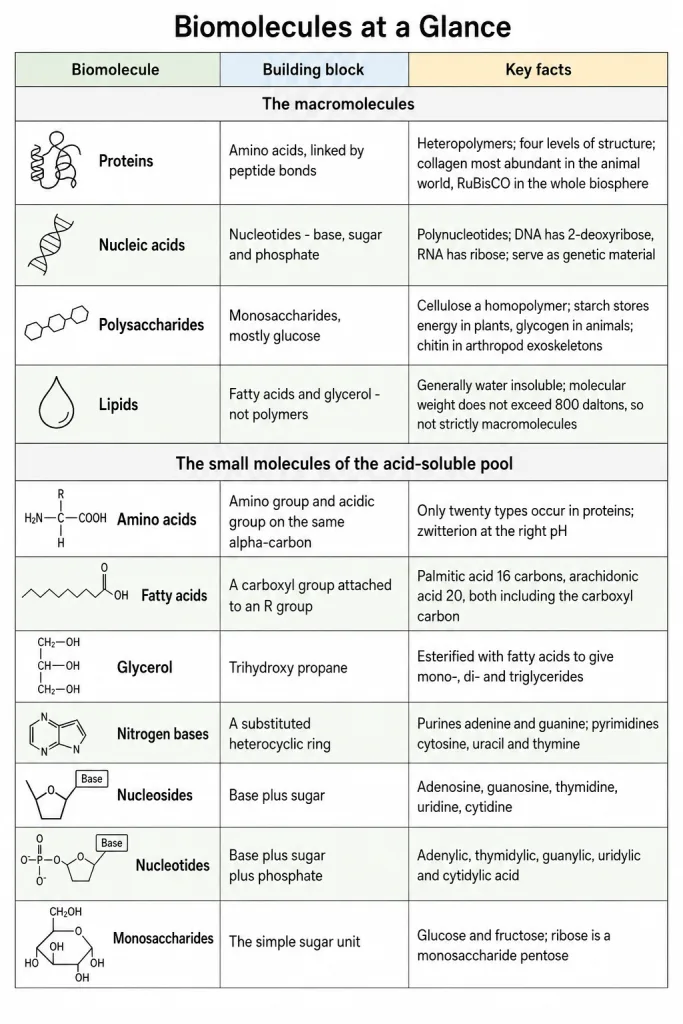
Now the small molecules of the acid-soluble pool, one row each.
| Small molecule | What it is | Key facts |
|---|---|---|
| Amino acid | An amino group and an acidic group on the same -carbon | Substituted methane with hydrogen, , and a variable R group; only twenty types occur in proteins; glycine, alanine, serine by R group; acidic glutamic acid, basic lysine, neutral valine; aromatic tyrosine, phenylalanine, tryptophan; zwitterion at the right pH |
| Fatty acid | A carboxyl group attached to an R group | R group from 1 to 19 carbons; palmitic acid 16 carbons, arachidonic acid 20 carbons, both including the carboxyl carbon; saturated without a double bond, unsaturated with one or more |
| Glycerol | A simple lipid, trihydroxy propane | Esterified with fatty acids to give monoglycerides, diglycerides and triglycerides; fats and oils separated by melting point |
| Nitrogen base | A substituted heterocyclic ring | Purines - adenine and guanine. Pyrimidines - cytosine, uracil and thymine. The skeletal rings are purine and pyrimidine |
| Nucleoside | Base plus sugar | Adenosine, guanosine, thymidine, uridine, cytidine |
| Nucleotide | Base plus sugar plus phosphate esterified to the sugar | Adenylic acid, thymidylic acid, guanylic acid, uridylic acid, cytidylic acid; 5 types of nucleotides; the building block of nucleic acids |
| Monosaccharide | The simple sugar unit | Glucose and fructose; ribose is a monosaccharide pentose; the building block of every polysaccharide; glucosamine and N-acetyl galactosamine are the modified sugars of complex polysaccharides |
The Eight Comparisons Worth Memorising
- Acid-soluble pool against acid-insoluble fraction - the filtrate after grinding in trichloroacetic acid, holding thousands of small compounds of 18 to about 800 Da, and roughly representing the cytoplasmic composition, against the retentate, holding only four types of organic compound - proteins, nucleic acids, polysaccharides and lipids, the macromolecules from cytoplasm and organelles.
- Micromolecule against macromolecule - molecular weight less than one thousand dalton, found in the acid-soluble pool, called micromolecules or simply biomolecules, against found in the acid-insoluble fraction, ten thousand daltons and above, polymeric, called macromolecules or biomacromolecules.
- Primary against secondary metabolite - amino acids, sugars, fatty acids, glycerol, nucleotides, nucleosides and nitrogen bases, seen in animal tissues, with identifiable functions and known roles in normal physiological processes, against alkaloids, flavonoids, rubber, essential oils, antibiotics, coloured pigments, scents, gums and spices, seen in plant, fungal and microbial cells, whose roles in the host organism we do not at the moment understand.
- Homopolymer against heteropolymer - only one type of monomer repeating "n" number of times, as in cellulose, a polymer of glucose alone, against more than one type of monomer, as in a protein, built from 20 types of amino acid.
- Nucleoside against nucleotide - a nitrogen base attached to a sugar - adenosine, guanosine, thymidine, uridine, cytidine - against the same thing with a phosphate group esterified to the sugar - adenylic acid, thymidylic acid, guanylic acid, uridylic acid, cytidylic acid. The phosphate is the whole difference.
- Purine against pyrimidine - adenine and guanine, two substituted purines, against cytosine, uracil and thymine, three substituted pyrimidines; the skeletal heterocyclic rings themselves are called purine and pyrimidine respectively.
- Starch against cellulose - a store house of energy in plant tissues, which forms helical secondary structures, holds molecules in the helical portion and gives a blue starch- complex, against the material of plant cell walls, paper and cotton fibre, a homopolymer of glucose which does not contain complex helices and hence cannot hold .
- Prosthetic group against co-enzyme - an organic compound tightly bound to the apoenzyme, a part of the active site, as haem is in peroxidase and catalase, against an organic compound whose association with the apoenzyme is only transient, usually during catalysis, as NAD and NADP are, both containing the vitamin niacin.
Writing the Chapter-End Exercises Well
Class 11 has no board paper, but the eleven chapter-end exercises are the best test of this chapter that exists, because between them they cover the structure work, the composition work and the enzyme work in one pass. Marks here are lost cheaply - by drawing a structure and not labelling it, or by naming a molecule and stopping there.
Drawing the structure of alanine. The drawing itself takes ten seconds; the labels are the whole answer. Show the central -carbon and, on its four valency positions, all four substituents named: a hydrogen atom, the carboxyl group , the amino group , and the R group, which in alanine is a methyl group . Then add the two lines that turn a diagram into a full answer - both the amino group and the acidic group are substituents on the same carbon, which is why these are called -amino acids, and alanine is the amino acid whose R group is a methyl group. If you write nothing else, write the words alpha carbon and R group on the sheet.
Explaining the composition of a triglyceride. A complete answer has three parts, in this order. First the components: one molecule of glycerol, which is chemically trihydroxy propane, and three fatty acid molecules. Second the linkage: the fatty acids are esterified with glycerol, each of the three hydroxyl groups of glycerol taking one fatty acid, which is what makes it a triglyceride - and the same scheme with one or two fatty acids gives monoglycerides and diglycerides. Third the identity: fats and oils are glycerides in which fatty acids are esterified to glycerol, and they are called fats or oils on the basis of melting point - oils have a lower melting point, for example gingelly oil, and hence remain as oil in winters. Mention as well that a fatty acid is a carboxyl group attached to an R group of 1 to 19 carbons and that it may be saturated, without a double bond, or unsaturated, with one or more double bonds.
Describing the important properties of enzymes. This is the longest answer in the chapter and it is marked point by point, so write it as a numbered list and do not merge points. It must carry: almost all enzymes are proteins, and some nucleic acids that behave like enzymes are called ribozymes; an enzyme has a primary, a secondary and a tertiary structure, and the criss-crossing of the chain in the tertiary structure makes crevices, one of which is the active site; the substrate fits into the active site, so enzymes show substrate specificity; enzymes catalyse reactions at a high rate, carbonic anhydrase running about 10 million times faster than the uncatalysed reaction; enzymes lower the activation energy, the difference in average energy content of from that of the transition state; there is an obligatory, transient complex, and the enzyme is released unchanged at the end; enzymes need an optimum temperature and an optimum pH, with activity declining on both sides; low temperature preserves the enzyme in a temporarily inactive state while high temperature denatures the protein and destroys activity, though enzymes from thermophilic organisms stay stable up to to ; velocity rises with substrate concentration up to and no further, because the enzyme molecules become saturated; activity can be shut off by an inhibitor, and a competitive inhibitor resembles the substrate, as malonate resembles succinate; enzymes fall into 6 classes with a four-digit number each; and many need co-factors - prosthetic groups, co-enzymes or metal ions - and lose catalytic activity when the co-factor is removed.
The habit all eleven exercises reward. Give the name, then the composition, then the function, in that order, for every molecule you mention. "What are macromolecules? Give examples" is asking for exactly that sequence: the name and the definition, then what they are built from, then examples with what each does. Most of the marks lost in this chapter are lost by naming a molecule correctly and then never saying what it is made of or what it does. The same habit answers the "find out and make a list" exercises: gums are complex polysaccharides, therapeutic proteins are named with the job they do - insulin as a hormone, antibodies against infectious agents, enzymes such as trypsin - and a qualitative test is written as reagent, procedure, positive result.
NEET Strategy
What the paper asks. One molecule, one number, one building block, one odd-one-out - with the wrong option pulled from a neighbouring molecule. There is nothing here to work out, so speed comes from certainty, not from technique. This chapter usually contributes more questions than its page count suggests, so the time you save here is time you keep for physiology.
The marking is +4 and -1. On a pure-recall question a coin-flip between two options loses marks on average. If the pair has genuinely gone, skip it and bank the time.
Budget. Aim for 25 to 30 seconds per question in this chapter. If a question is still open at forty seconds, it is not going to be solved by staring at it - mark it and move.
The four shapes, in the order they are easiest.
- Give the number, the range or the example - 20 amino acids, 5 nucleotides, 16 and 20 carbons, 18 to 800 Da, 6 enzyme classes, water 70 to 90 per cent, 10 million times. These are instant if you know them and hopeless if you do not, so decide in five seconds.
- State the one function or property - genetic material, store house of energy, most abundant in the biosphere, absolutely necessary for biological activity. Answer from the name and move on.
- Name the compound or the class from a description - stop reading as soon as one clue identifies it: "closely resembles the substrate and competes for the binding site" is a competitive inhibitor and nothing else.
- Spot the odd one out - leave these for last, since a "which is NOT" question forces you to check all four options.
Read the direction word before you read the options. NOT, INCORRECT and respectively are the three words that turn a fact you know into a mark you lose. Underline them as you read. In a respectively question, match the first pair first - it eliminates two options in one step more often than not.
The Mistakes That Cost the Most Marks
- Filtrate and retentate swapped. The filtrate is the acid-soluble pool; the retentate is the acid-insoluble fraction.
- Nucleoside called nucleotide. Base plus sugar is a nucleoside. Base plus sugar plus phosphate is a nucleotide. The phosphate is the whole difference, and the names give it away - adenosine against adenylic acid.
- Thymine listed as a purine. Two purines - adenine and guanine. Three pyrimidines - cytosine, uracil and thymine.
- Ribose and 2-deoxyribose mixed up. Ribose gives RNA. 2-deoxyribose gives DNA. Read the prefix, not the word.
- Calling a protein a homopolymer. A homopolymer has only one type of monomer repeating "n" number of times, as cellulose has glucose. A protein is a heteropolymer, built from 20 types of amino acid.
- Saying cellulose gives a blue colour with iodine. Starch forms helices and holds ; cellulose has no complex helices and hence cannot hold .
- Collagen and RuBisCO swapped. Collagen is the most abundant protein in the animal world. RuBisCO is the most abundant protein in the whole of the biosphere.
- Calling lipids macromolecules without the qualification. They are in the acid-insoluble fraction, but their molecular weight does not exceed 800 Da and they are not polymers - they separate there only because membranes break into vesicles that are not water soluble.
- Naming the wrong level of protein structure as the one needed for activity. Tertiary structure is absolutely necessary for the many biological activities of proteins, and only right handed helices are observed in the secondary structure.
- Defining activation energy as the difference between and . It is the difference in average energy content of from that of the transition state. In the same breath, remember that low temperature only inactivates temporarily while high temperature denatures, and that a prosthetic group is tightly bound while a co-enzyme is only transiently associated.
A Short Revision Plan
First pass - one hour and twenty minutes. Read sections 1 to 13 straight through without stopping to memorise. You are building the map: how a tissue is analysed, then the small molecules one class at a time, then the divide between micromolecule and macromolecule, then the three true macromolecules, then protein structure, then enzymes. Do not stop to learn numbers on this pass.
Second pass - one hour and thirty minutes. Work the Solved Examples in each section, writing the answers out rather than reading them, then check your wording against the answer given and mark only the words you missed. The marking-scheme keywords are in bold in every answer for exactly this purpose.
Third pass - forty minutes. Learn the two tables in this section - the four biomolecules with their building blocks, and the small molecules of the acid-soluble pool - and the eight comparisons above. Then say the numbers out loud in one run: 20 amino acids, 5 nucleotides, 16 carbons in palmitic acid, 20 in arachidonic acid, 1 to 19 carbons in an R group, 18 to 800 Da, less than 1000 Da for a micromolecule, ten thousand Da and above for a macromolecule, water 70 to 90 per cent, proteins 10 to 15, nucleic acids 5 to 7, carbohydrates 3, lipids 2, ions 1, oxygen 65.0 per cent, carbon 18.5, hydrogen 9.5, silicon 27.7 per cent of the crust, four levels of structure, 4 subunits of haemoglobin, above enzymes are damaged, to for thermophiles, ten reactions from glucose to pyruvic acid, 200 molecules an hour against 600,000 a second, 10 million times, 6 enzyme classes, 4 to 13 subclasses, a four-digit number.
Fourth pass - one hour. Sit the 45 NEET-Pattern Practice Questions under time, then go back only to the rows of the tables that your wrong answers came from. Redo the same questions three days later; the second attempt is what tells you whether the fact stuck.
The night before. Read the Master Quick Recap and the eight comparisons once, then the ten mistakes. Nothing else, and no new material. This chapter rewards a clean recent pass far more than a long one.