
Same Syllabus. A Different Exam.
The Solved Examples section worked this chapter the way a written paper does - define the compound, explain the composition, describe the structure. NEET does not ask you to describe anything. It shows you one line about one molecule and gives you four names, and you have about half a minute to pick.
The marking is +4 for a correct answer and -1 for a wrong one. In a written answer, naming three of the four components of a nucleotide still earns most of the marks. Here, a half-remembered fact is worth -1, which is five marks behind the person who skipped it.
Biomolecules rewards preparation more than almost any other chapter, because there is nothing to reason out. Every mark is a name, a number, a range, a pairing or a one-line property, and every one of them can be nailed down in advance.
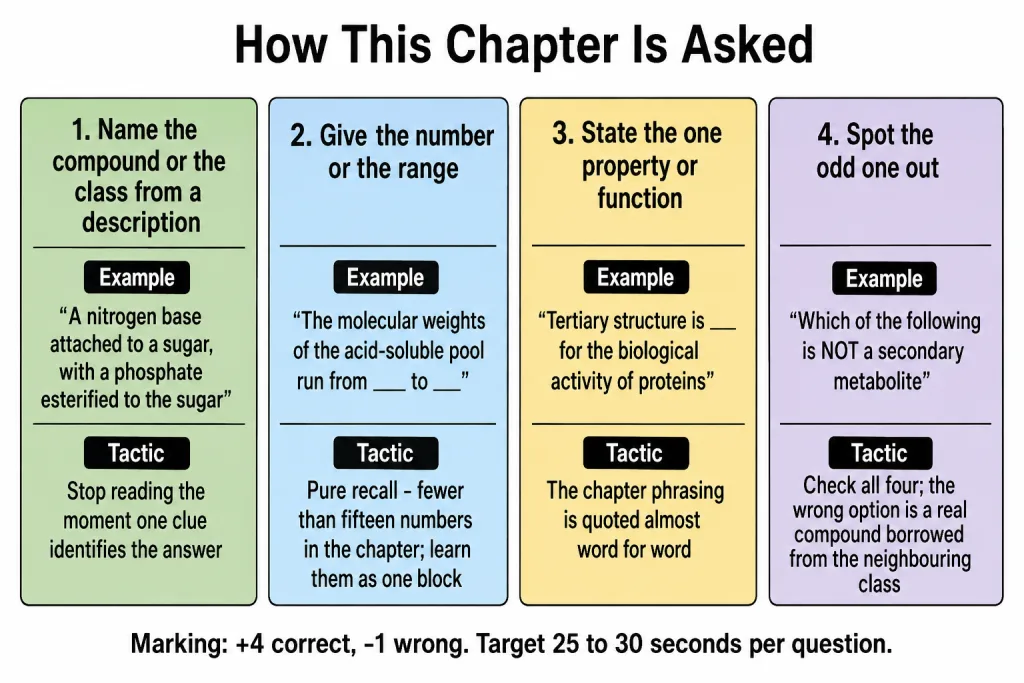
The Four Shapes This Chapter Is Asked In
Shape 1 - Name the compound or the class from a description. "A nitrogen base attached to a sugar, with a phosphate esterified to the sugar." You are given a short structural definition, and one clause of it is usually enough. Stop reading the moment one clue identifies the answer.
Shape 2 - Give the number or the range. "The molecular weights of the acid-soluble pool run from _ to _." Pure recall, and the chapter has fewer than fifteen numbers worth learning. They are listed below as one block.
Shape 3 - State the one property or function. "Tertiary structure is _ for the biological activity of proteins." The chapter's own phrasing gets quoted almost word for word.
Shape 4 - The odd one out, or the incorrect statement. "Which of the following is NOT a secondary metabolite?" You must check all four, so budget the extra time. The wrong option is almost never invented - it is a real compound borrowed from the neighbouring class.
One Compound, One Address
Most of this chapter is a set of pairings. Fix each name to one address and the recall questions become instant.
| Name | The one address to remember |
|---|---|
| Acid-soluble pool | The filtrate; small molecules, 18 to about 800 Da |
| Acid-insoluble fraction | The retentate; proteins, nucleic acids, polysaccharides, lipids |
| Ash | What is left after full burning; inorganic elements only |
| Glycine | The amino acid whose R group is hydrogen |
| Alanine | R group is a methyl group |
| Serine | R group is hydroxy methyl |
| Glutamic acid / lysine / valine | Acidic / basic / neutral |
| Tyrosine, phenylalanine, tryptophan | The aromatic amino acids |
| Zwitterion | Both a positive and a negative charge on one molecule |
| Palmitic acid | 16 carbons, including the carboxyl carbon |
| Arachidonic acid | 20 carbons, including the carboxyl carbon |
| Glycerol | Trihydroxy propane |
| Lecithin | A phospholipid, found in the cell membrane |
| Nucleoside | Base + sugar |
| Nucleotide | Base + sugar + phosphate |
| Adenine, guanine | Substituted purines |
| Cytosine, uracil, thymine | Substituted pyrimidines |
| Ribose | The sugar of RNA; a monosaccharide pentose |
| 2-deoxyribose | The sugar of DNA |
| Collagen | Most abundant protein in the animal world |
| RuBisCO | Most abundant protein in the whole biosphere |
| Cellulose | A homopolymer of glucose; plant cell walls; cannot hold iodine |
| Starch | The plant store house of energy; helical; holds iodine, blue colour |
| Glycogen | The animal variant; branched; right end reducing, left end non-reducing |
| Inulin | A polymer of fructose |
| Chitin | The complex polysaccharide of arthropod exoskeletons |
| Active site | A crevice or pocket into which the substrate fits |
| Apoenzyme | The protein portion of an enzyme with a cofactor |
| Prosthetic group | Tightly bound; haem in peroxidase and catalase |
| Co-enzyme | Association is transient; NAD and NADP contain niacin |
| Metal ion | Zinc for carboxypeptidase |
| Malonate | The competitive inhibitor of succinic dehydrogenase |
The rule that saves the most marks here: whenever a question names a sugar-and-base thing, ask is there a phosphate. No phosphate is a nucleoside; phosphate is a nucleotide. That one question settles more items in this chapter than any other.
The Numbers, and the Negatives
Every number in the chapter
- Acid-soluble pool - molecular weights 18 to around 800 daltons.
- Acid-insoluble fraction - ten thousand daltons and above, lipids excepted.
- Micromolecule - less than one thousand dalton.
- Amino acids in proteins - twenty types.
- Nitrogen bases - five: adenine, guanine, cytosine, uracil, thymine.
- Palmitic acid 16 carbons, arachidonic acid 20 carbons, both including the carboxyl carbon.
- Fatty acid R group - 1 carbon to 19 carbons.
- Cellular mass - water 70 to 90 per cent, proteins 10 to 15, nucleic acids 5 to 7, carbohydrates 3, lipids 2, ions 1.
- Nucleotide has three chemically distinct components.
- Protein structure - four levels.
- Haemoglobin - 4 subunits, two and two .
- Enzymes damaged above ; thermophile enzymes stable up to to .
- Rate doubles or halves for every change.
- Carbonic anhydrase - about 200 molecules an hour without the enzyme, about 600,000 a second with it, an acceleration of about 10 million times.
- Glucose to pyruvic acid - ten enzyme-catalysed steps.
- Enzyme classification - 6 classes, 4 to 13 subclasses each, named by a four-digit number.
The lists the "which is NOT" questions come from
- The acid-insoluble fraction: proteins, nucleic acids, polysaccharides, lipids - only four.
- The four groups on the -carbon: hydrogen, carboxyl, amino, R group. (A phosphate here is the wrong option.)
- The three components of a nucleotide: a heterocyclic compound, a monosaccharide, a phosphoric acid or phosphate.
- Secondary metabolites: pigments, alkaloids, terpenoides, essential oils, toxins, lectins, drugs, polymeric substances. (Glycerol, amino acids and sugars are primary.)
- The six enzyme classes: oxidoreductases, transferases, hydrolases, lyases, isomerases, ligases.
- The three cofactors: prosthetic groups, co-enzymes, metal ions.
The pairs that get swapped
- Filtrate is the acid-soluble pool; retentate is the acid-insoluble fraction.
- Nucleoside is base plus sugar; nucleotide adds the phosphate.
- Adenine and guanine are purines; cytosine, uracil and thymine are pyrimidines.
- Ribose is RNA; 2-deoxyribose is DNA.
- Cellulose is a homopolymer; a protein is a heteropolymer.
- Collagen is the animal world; RuBisCO is the whole biosphere.
- Low temperature only inactivates temporarily; high temperature denatures and destroys.
- Activation energy is measured from S to the transition state, not from S to P.
- Prosthetic group is tightly bound; co-enzyme association is transient.
Solved Examples at NEET Pace
Each item names the shortcut it uses, because the shortcut is the thing worth carrying into the exam hall.
Question 1
Q. A nitrogen base attached to a sugar, with a phosphate esterified to the sugar, is (a) a nucleoside (b) a nucleotide (c) a purine (d) a polynucleotide
Answer. (b) a nucleotide. Shortcut - ask "is there a phosphate". When a nitrogen base is found attached to a sugar it is a nucleoside; if a phosphate group is also esterified to the sugar it is a nucleotide. That single question separates the two options the paper offers most often.
Question 2
Q. Which of the following is NOT a secondary metabolite? (a) morphine (b) concanavalin A (c) glycerol (d) abrin
Answer. (c) glycerol. Shortcut - on a "which is NOT", ask which class the odd option really belongs to. Glycerol is a primary metabolite - a small molecule of the acid-soluble pool, trihydroxy propane, found in animal tissues along with amino acids, sugars and fatty acids. Morphine is an alkaloid, concanavalin A a lectin and abrin a toxin, all listed among the secondary metabolites.
Question 3
Q. Lipids are placed in the acid-insoluble fraction because (a) their molecular weight exceeds ten thousand daltons (b) they are polymers (c) they form water insoluble membrane vesicles on grinding (d) they dissolve in trichloroacetic acid
Answer. (c) they form water insoluble membrane vesicles on grinding. Shortcut - this is the one place in the chapter where a compound is classified by an accident of method rather than by size. Lipids are small, with molecular weights not exceeding 800 Da, but they are arranged into structures like the cell membrane; grinding breaks the membranes into vesicles which are not water soluble, so they separate along with the acid insoluble pool. Lipids are not strictly macromolecules - option (a) is exactly the claim the chapter denies.
Question 4
Q. The most abundant protein in the whole of the biosphere is (a) collagen (b) RuBisCO (c) trypsin (d) insulin
Answer. (b) RuBisCO. Shortcut - two superlatives, two scopes; read the scope word. Collagen is the most abundant protein in the animal world and Ribulose bisphosphate Carboxylase-Oxygenase (RuBisCO) is the most abundant protein in the whole of the biosphere. Whichever one the stem asks for, the other is sitting in the options.
Question 5
Q. Starch gives a blue colour with iodine but cellulose does not, because (a) cellulose is a heteropolymer (b) starch is made of fructose (c) starch forms helices that hold iodine while cellulose has no complex helices (d) cellulose is not a polysaccharide
Answer. (c) starch forms helices that hold iodine while cellulose has no complex helices. Shortcut - the reason is structural, not chemical; both are glucose polymers. Starch forms helical secondary structures and can hold molecules in the helical portion, and the starch-iodine complex is blue. Cellulose does not contain complex helices and hence cannot hold .
Question 6
Q. Which level of protein structure is described as absolutely necessary for the many biological activities of proteins? (a) primary (b) secondary (c) tertiary (d) quaternary
Answer. (c) tertiary. Shortcut - the phrase "absolutely necessary" belongs to exactly one level. The tertiary structure, in which the long protein chain is folded upon itself like a hollow woolen ball, gives the three dimensional view of the protein and is absolutely necessary for the many biological activities of proteins. It is also the structure an enzyme's active site is made of, which is why altering it destroys enzyme activity.
Question 7
Q. Activation energy is the difference in energy between (a) the substrate and the product (b) the substrate and the transition state (c) the product and the transition state (d) the enzyme and the ES complex
Answer. (b) the substrate and the transition state. Shortcut - activation energy is measured upward from S, never across to P. The difference in average energy content of S from that of the transition state is called activation energy. Option (a) describes something else entirely - the energy level difference between S and P is what makes a reaction exothermic or endothermic, and it is a separate fact on the same graph.
Question 8
Q. Low temperature affects an enzyme by (a) denaturing it permanently (b) preserving it in a temporarily inactive state (c) raising its optimum pH (d) increasing its maximum velocity
Answer. (b) preserving it in a temporarily inactive state. Shortcut - low is reversible, high is not. Low temperature preserves the enzyme in a temporarily inactive state, whereas high temperature destroys enzymatic activity because proteins are denatured by heat. Learn the two halves as one sentence and both directions are covered.
Question 9
Q. Malonate inhibits succinic dehydrogenase because malonate (a) binds an allosteric site (b) destroys the apoenzyme (c) closely resembles succinate and competes for the substrate-binding site (d) removes the metal ion cofactor
Answer. (c) closely resembles succinate and competes for the substrate-binding site. Shortcut - "competitive" means "looks like the substrate". When the inhibitor closely resembles the substrate in its molecular structure and inhibits the activity of the enzyme, it is known as a competitive inhibitor. Note which name is the enzyme and which the substrate: succinic dehydrogenase is the enzyme, succinate the substrate, malonate the inhibitor.
Question 10
Q. Which statement about cofactors is correct? (a) prosthetic groups are transiently associated with the apoenzyme (b) co-enzymes are metal ions (c) haem is a co-enzyme of catalase (d) the association of a co-enzyme with the apoenzyme is only transient
Answer. (d) the association of a co-enzyme with the apoenzyme is only transient. Shortcut - tightly bound is prosthetic, transient is co-enzyme. Prosthetic groups are organic compounds distinguished from other cofactors in that they are tightly bound to the apoenzyme, and haem is the prosthetic group of peroxidase and catalase. Co-enzymes are also organic compounds but their association with the apoenzyme is only transient, usually during catalysis. Options (a) and (c) are the same two facts stated backwards.
Question 11
Q. Enzymes are divided into how many classes, and are named by a number of how many digits? (a) 4 classes, three-digit (b) 6 classes, four-digit (c) 6 classes, three-digit (d) 8 classes, four-digit
Answer. (b) 6 classes, four-digit. Shortcut - two numbers in one stem means the question is testing whether you learned them as a pair. Enzymes are divided into 6 classes, each with 4 to 13 subclasses, and named accordingly by a four-digit number. The six are oxidoreductases, transferases, hydrolases, lyases, isomerases and ligases, in that order.
Question 12
Q. The sugar found in a polynucleotide is (a) glucose or fructose (b) ribose or 2-deoxyribose (c) always ribose (d) always 2-deoxyribose
Answer. (b) ribose or 2-deoxyribose. Shortcut - the sugar is what names the nucleic acid. The sugar found in polynucleotides is either ribose, a monosaccharide pentose, or 2-deoxyribose. A nucleic acid containing deoxyribose is deoxyribonucleic acid (DNA), and one containing ribose is ribonucleic acid (RNA). Options (c) and (d) each name half the truth, which is what makes them tempting.
A Drill Before You Move On
Decide each one before you read the verdict. Aim for 25 to 30 seconds per question.
Mark yourself honestly. A wrong answer here is worth -1 in the hall, so treat "I think it is B" as a skip, not an answer, and go back to the address table for that row.