
🌺 Semi-Technical Description of a Flowering Plant
A semi-technical description is a scientific, concise, and systematically arranged account of all morphological features of a flowering plant. It follows a fixed sequence so that any botanist can immediately visualize the plant from the description.
A proper description includes the following order:
- Habit – Whether the plant is a herb, shrub, or tree.
- Root – Type (taproot/fibrous/adventitious) and modifications.
- Stem – Aerial or underground, branching, modifications, surface features.
- Leaves – Arrangement, venation, shape, margin, type.
- Inflorescence – Racemose/cymose, solitary, axillary, terminal.
- Flower – Symmetry, sexuality, calyx, corolla, androecium, gynoecium.
- Fruit – Type and structure.
- Seed – Shape, endospermic or non-endospermic.
This format ensures that even without an image, a student can reconstruct the plant using only the description.
🌸 Floral Formula – The Short-Hand Language of Flowers
A floral formula represents all floral characteristics using symbols and numbers. It allows rapid identification and comparison of families.
Common symbols include:
- Br / Ebr: Bracteate / Ebracteate
- K: Calyx (sepals)
- C: Corolla (petals)
- P: Perianth (undifferentiated petaloid structures)
- A: Androecium (stamens)
- G: Gynoecium (carpels)
- ⊕: Actinomorphic (radial symmetry)
- %: Zygomorphic (bilateral symmetry)
- ⚥: Bisexual
- ♂ / ♀: Male / Female flowers
- ( ) Parentheses indicate fusion within a whorl (cohesion)
- Lines above/below G: Ovary position (superior/inferior)
- Curved line ⌒ connecting symbols: Fusion between whorls (adnation)
⭐ Example – Mustard (Brassicaceae)
Floral Formula: ✳ ⚥ K₄ C₄ A₂₊₄ G(₂)
Meaning:
- Actinomorphic
- Bisexual
- 4 sepals, 4 petals
- 6 stamens arranged as 2 short + 4 long (tetradynamous)
- Bicarpellary, syncarpous ovary
🌿 Floral Diagram – A Picture of the Entire Flower
A floral diagram is a graphical representation of a flower, showing:
- Number and arrangement of floral organs
- Aestivation (overlapping pattern)
- Whether stamens are free/fused, epipetalous/epiphyllous
- Position of ovary (superior/inferior)
- Relation to mother axis (a dot at top indicates posterior side)
Floral diagrams help students visualize the 3D structure of flowers from a single 2D schematic.
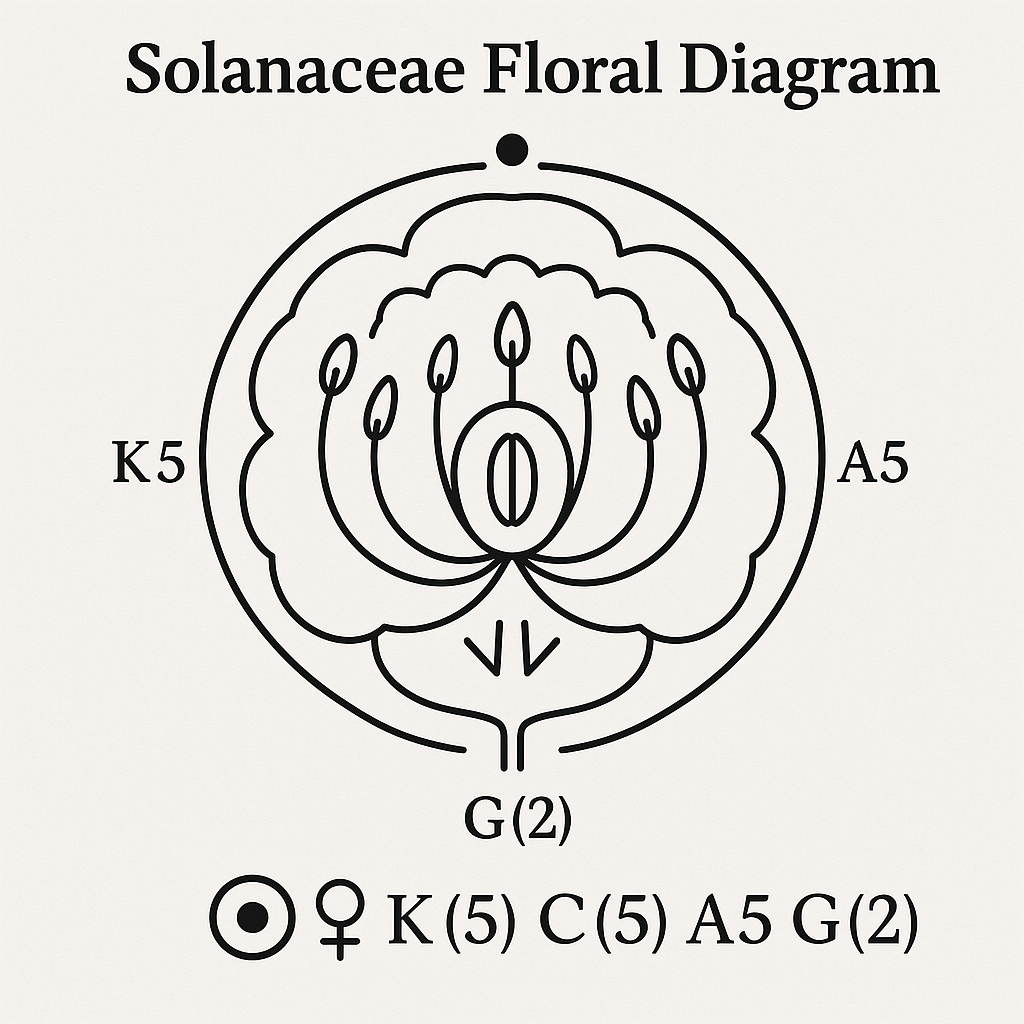
🌺 FAMILY 1: SOLANACEAE (Nightshade Family)
This is a large dicot family containing many food, medicinal, and ornamental plants.
Vegetative Characters
- Habit: Mostly herbs or shrubs; some trees.
- Roots: Taproot system.
- Stem: Herbaceous, cylindrical, branched; sometimes with hairs; potato has an underground modified stem (tuber).
- Leaves: Alternate, simple, entire or lobed, exstipulate, reticulate venation.
Floral Characteristics
- Inflorescence: Typically cymose; sometimes solitary axillary.
- Flower: Actinomorphic (⊕), bisexual (⚥), hypogynous.
- Calyx: 5 gamosepalous sepals (K(5)), persistent.
- Corolla: 5 gamopetalous petals (C(5)), valvate.
- Androecium: 5 epipetalous stamens (A5).
- Gynoecium: Bicarpellary, syncarpous, superior ovary (G(2)), bilocular, axile placentation.
- Fruit: Berry (tomato) or capsule (datura).
- Seeds: Many, endospermic.
Floral Formula: ⊕ ⚥ K(5) C(5) A5 G(2)
🖼️ Solanaceae Diagram
🌱 FAMILY 2: FABACEAE (Legume/Pea Family)
A large family economically important for pulses, fodder, and nitrogen fixation.
Vegetative Characters
- Habit: Herbs, shrubs, or trees.
- Root: Taproot with nodules containing Rhizobium for nitrogen fixation.
- Stem: Erect or climbing.
- Leaves: Alternate, pinnately compound, stipulate.
Floral Characteristics
- Inflorescence: Racemose.
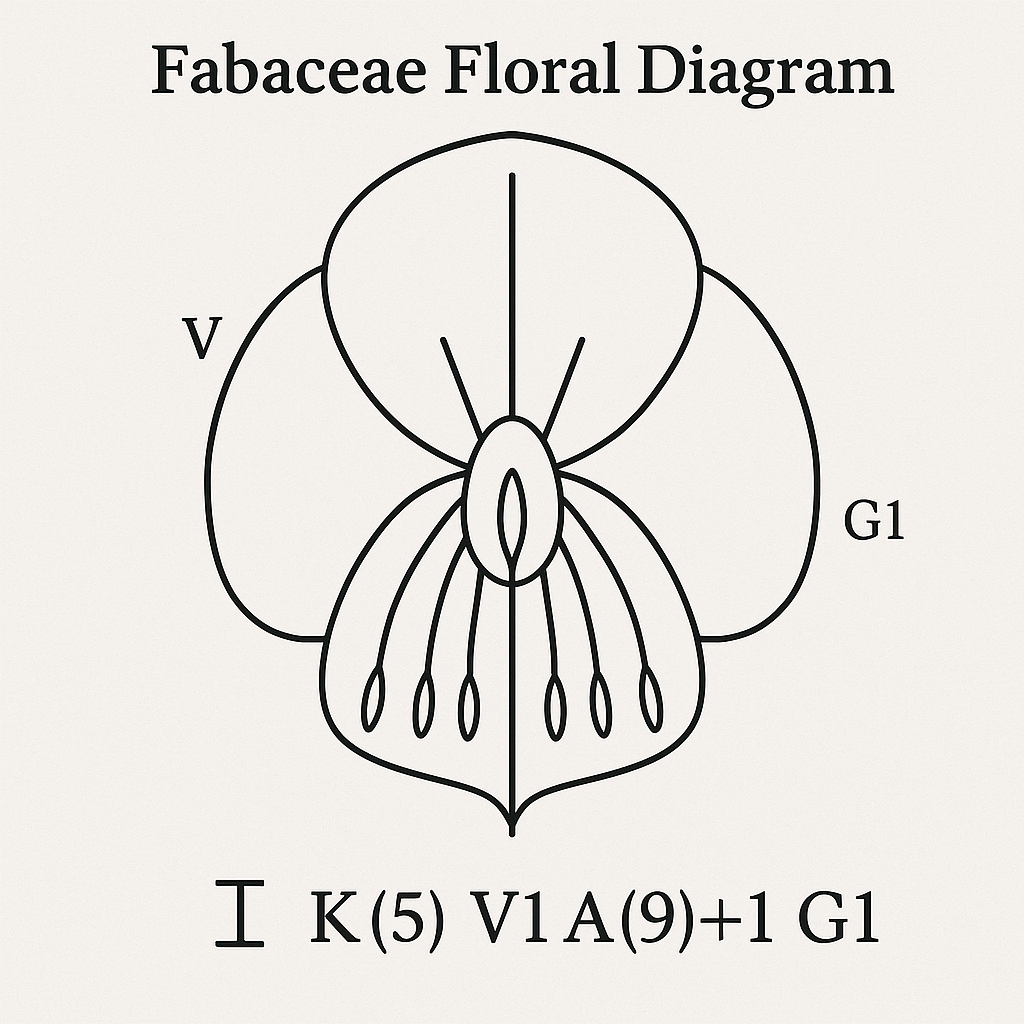
- Flower: Zygomorphic (%), bisexual.
- Calyx: 5 gamosepalous sepals.
- Corolla: Papilionaceous – standard, wings, keel.
- Androecium: Diadelphous (9+1).
- Gynoecium: Monocarpellary, superior ovary, marginal placentation.
- Fruit: Legume.
Floral Formula: % ⚥ K(5) C(1+2+(2)) A(9)+1 G1
🖼️ Fabaceae Diagram
🌸 FAMILY 3: LILIACEAE (Lily Family)
A monocot family characterized by petaloid perianth and underground stem modifications.
Vegetative Characters
- Habit: Perennial herbs.
- Root: Adventitious.
- Stem: Bulb, rhizome, or corm.
- Leaves: Long, linear, parallel venation.
Floral Characteristics
- Inflorescence: Racemose.
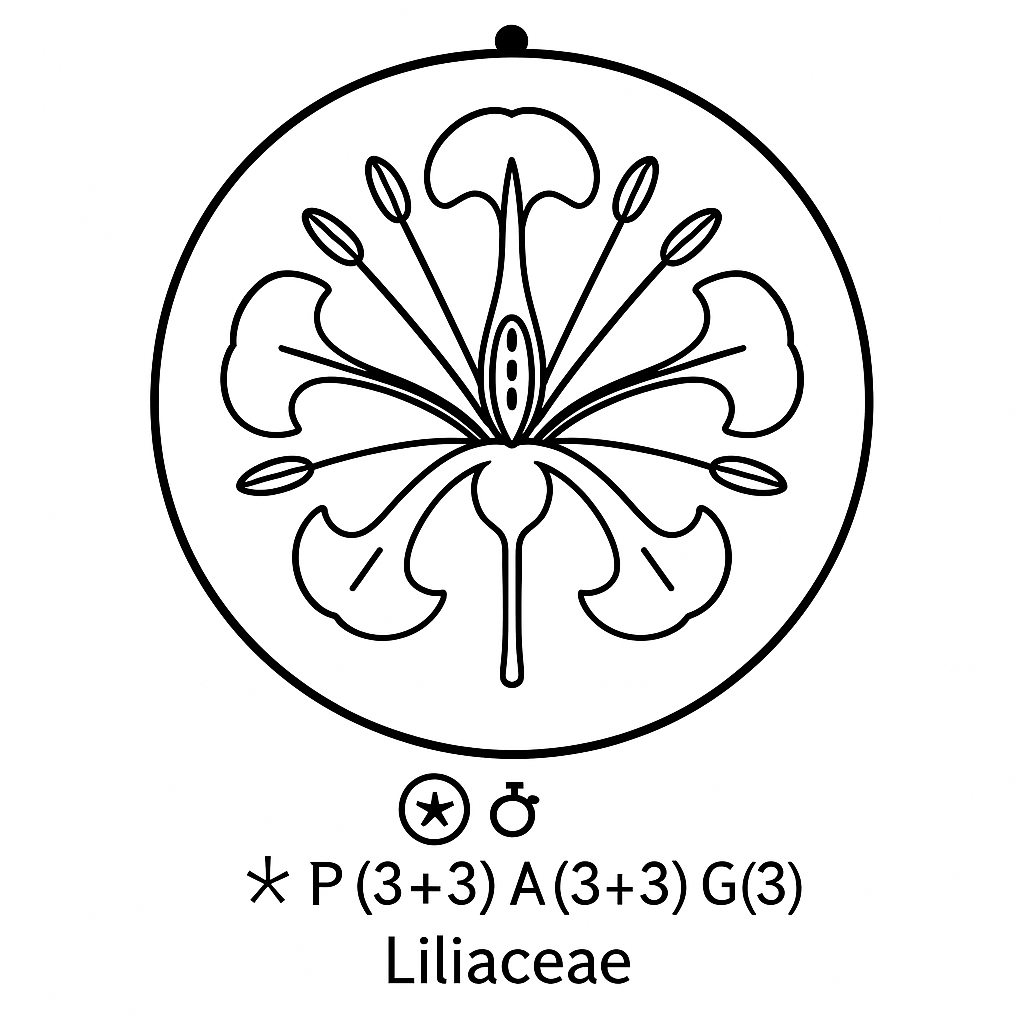
- Flower: Actinomorphic, bisexual.
- Perianth: 6 petaloid tepals arranged in two whorls of 3.
- Androecium: 6 stamens (3+3).
- Gynoecium: Tricarpellary, syncarpous, superior ovary, axile placentation.
- Fruit: Berry or capsule.
Floral Formula: ✳ ⚥ P(3+3) A(3+3) G(3)
🖼️ Liliaceae Diagram
These three families are extremely important for NEET and appear frequently in PYQs. Understanding their characteristics, floral formulas, and diagrams helps students score full marks in taxonomy-based questions.
💡 Questions and Answers
Q1. Write the floral formula of Solanaceae family.
A1. ⊕ ⚥ K(5) C(5) A5 G(2).
Q2. In Fabaceae family, explain the type of corolla.
A2. Papilionaceous corolla with one standard, two wings, and two fused keel petals.
Q3. Name two plants belonging to Liliaceae family.
A3. Aloe vera and Lilium.
Q4. Which type of corolla is found in Fabaceae family?
A4. Papilionaceous – consisting of one standard, two wings, and two keel petals.
Q5. What is the type of ovary in Solanaceae?
A5. Superior ovary, bilocular, with axile placentation.
Q6. Name two plants belonging to Liliaceae and their uses.
A6. Aloe vera (medicinal), Lilium (ornamental).
Q7. What information does a floral diagram provide that a floral formula does not?
A7. Orientation relative to mother axis, aestivation patterns, placentation, and spatial relationship between whorls.
Q8. What is an epipetalous condition?
A8. Fusion of stamens to petals, shown by a curved line linking C and A.
Q9. Describe the key features of the gynoecium in Solanaceae.
A9. Bicarpellary, syncarpous, superior ovary, bilocular with axile placentation.