
A Flower Is a Modified Shoot
Start from what a flower actually is, because the definition explains everything that follows.
- The shoot apical meristem changes to a floral meristem.
- Internodes do not elongate and the axis gets condensed.
- The apex produces different kinds of floral appendages laterally at successive nodes instead of leaves.
That is why the four whorls of a flower sit stacked on top of one another rather than spread along a stem - the internodes between them simply stopped growing.
When a shoot tip transforms into a flower, it is always solitary.
[NEET Important] "A flower is a modified shoot" is not a slogan, it is an answer. If a question asks why the floral parts appear in whorls, the reason is that the internodes do not elongate and the axis gets condensed, so appendages produced at successive nodes end up crowded together.
Racemose and Cymose Inflorescence
Inflorescence is the arrangement of flowers on the floral axis.
The two major types are separated by one question - does the apex become a flower, or does it keep growing?
Racemose. The main axis continues to grow and the flowers are borne laterally in an acropetal succession. The oldest flowers are at the base and the youngest near the growing tip.
Cymose. The main axis terminates in a flower, so it is limited in growth. The flowers are borne in a basipetal order, the oldest at the top.
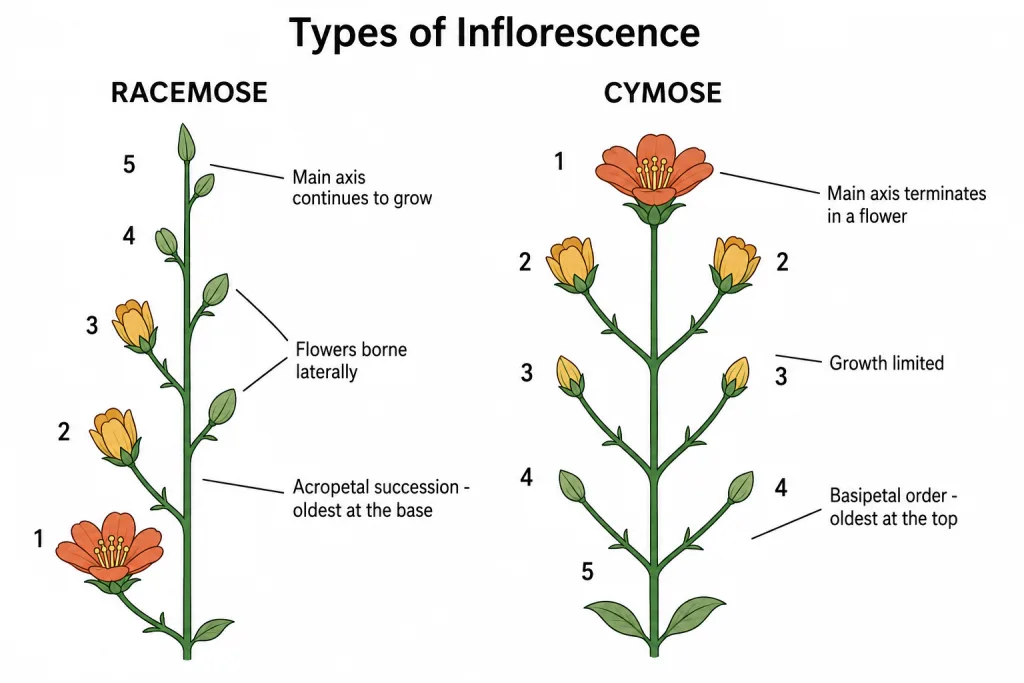
| Racemose | Cymose | |
|---|---|---|
| Main axis | Continues to grow | Terminates in a flower, so growth is limited |
| Flowers borne | Laterally, in acropetal succession | In basipetal order |
| Oldest flower | At the base | At the top |
| Youngest flower | Near the apex | Towards the base |
Acropetal means towards the apex; basipetal means towards the base. Fix those two words and this whole section is done.
[NEET Important] This is one of the chapter's most reliable two-mark questions and one of its easiest NEET items. The trap is the direction word: racemose is acropetal and cymose is basipetal, and a distractor will simply swap them.
Quick Recap
- A flower is a modified shoot: the shoot apical meristem becomes a floral meristem, internodes do not elongate, the axis gets condensed, and the apex produces floral appendages laterally at successive nodes instead of leaves.
- A shoot tip that turns into a flower gives a solitary flower.
- Inflorescence - the arrangement of flowers on the floral axis.
- Racemose - main axis continues to grow, flowers lateral and acropetal, oldest at the base.
- Cymose - main axis terminates in a flower, growth limited, flowers basipetal, oldest at the top.
Solved Examples
Question 1
Q. Define inflorescence.
Answer. The arrangement of flowers on the floral axis.
Question 2
Q. What happens to the shoot apical meristem when a flower forms?
Answer. It changes into a floral meristem.
Question 3
Q. Why are the floral parts crowded into whorls rather than spread out along an axis?
Answer. Because the internodes do not elongate and the axis gets condensed. The appendages are still produced at successive nodes, as leaves would be, but with the internodes unelongated, so they end up stacked as whorls.
Question 4
Q. When is a flower solitary?
Answer. When the shoot tip itself transforms into a flower. That always gives a single flower.
Question 5
Q. Differentiate between racemose and cymose inflorescence.
Answer.
| Racemose | Cymose | |
|---|---|---|
| Main axis | Continues to grow | Terminates in a flower, growth limited |
| Position of flowers | Borne laterally | Borne on a terminated axis |
| Order of opening | Acropetal - towards the apex | Basipetal - towards the base |
| Oldest flower | At the base | At the top |
This is one of the chapter-end exercises.
Question 6
Q. What do acropetal and basipetal mean?
Answer. Acropetal means towards the apex, so the youngest flowers are nearest the growing tip. Basipetal means towards the base, so the youngest flowers are lowest down.
Question 7
Q. Define the term inflorescence and explain the basis for the different types of inflorescence in flowering plants.
Answer. Inflorescence is the arrangement of flowers on the floral axis.
The basis for the two major types is whether the apex of the main axis gets developed into a flower or continues to grow.
- If the apex keeps growing, the inflorescence is racemose. The flowers are then borne laterally in acropetal succession, so the oldest are at the base.
- If the apex terminates in a flower, the axis is limited in growth and the inflorescence is cymose. The flowers are borne in basipetal order, so the oldest is at the top.
This is one of the chapter-end exercises.
Question 8
Q. In an inflorescence the flower at the very top is the oldest and fully open, while those lower down are still buds. Which type is it?
Answer. Cymose. The oldest flower sitting at the top means the apex terminated in a flower first, and the rest opened basipetally below it.
Question 9
Q. An inflorescence keeps producing new buds at its tip while the lowest flowers have already set fruit. Name the type and the order of opening.
Answer. Racemose, with acropetal succession. The main axis is still growing, so new flowers keep appearing near the apex while the oldest ones at the base are already ahead.
Question 10
Q. Why can a racemose inflorescence go on producing flowers while a cymose one cannot?
Answer. Because in the racemose type the main axis continues to grow, so there is always an apex left to produce more flowers. In the cymose type the apex itself became a flower, and once that happens the axis has nowhere left to grow.