
Venation
Venation is the arrangement of veins and the veinlets in the lamina of a leaf. There are two types.
- Reticulate - the veinlets form a network. Leaves of dicotyledonous plants generally possess reticulate venation.
- Parallel - the veins run parallel to each other within a lamina. Parallel venation is the characteristic of most monocotyledons.
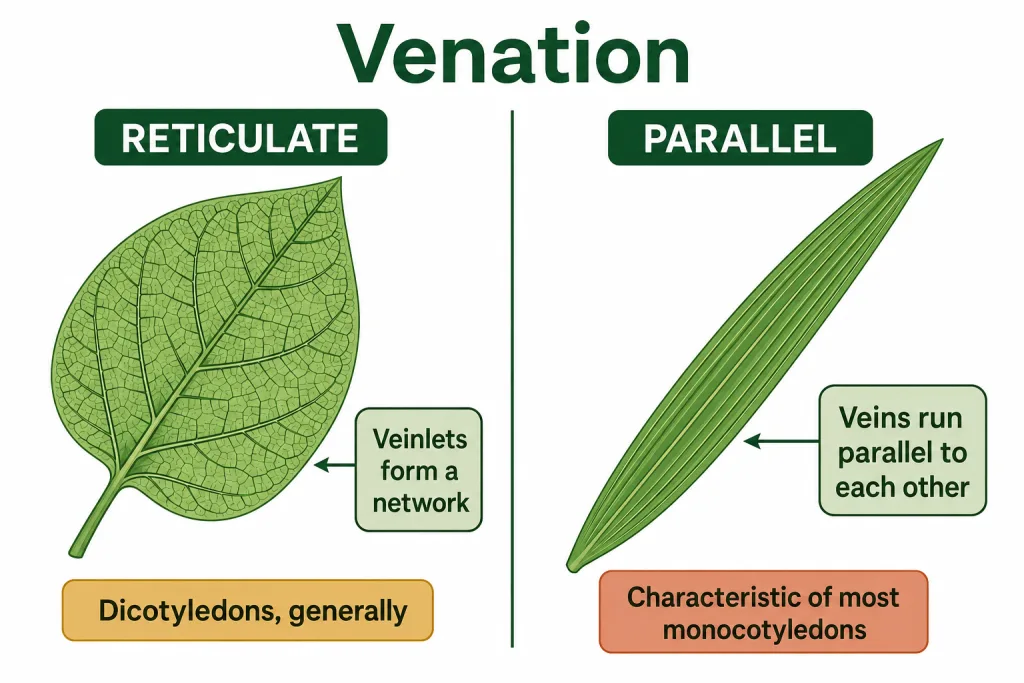
[NEET Important] Venation is the fastest way to call a leaf dicot or monocot, and questions use it in both directions - they will give you the venation and ask for the class, or give you the plant and ask for the venation. Note the hedge words: dicots generally have reticulate, and parallel is the characteristic of most monocotyledons.
Simple and Compound Leaves
Simple leaf. A leaf is simple when its lamina is entire, or when incised, the incisions do not touch the midrib.
Compound leaf. When the incisions of the lamina reach up to the midrib, breaking it into a number of leaflets, the leaf is compound.
The test that settles it: a bud is present in the axil of the petiole in both simple and compound leaves, but not in the axil of the leaflets of a compound leaf.
The compound leaves are of two types.
- Pinnately compound - a number of leaflets are present on a common axis, the rachis, which represents the midrib of the leaf, as in neem.
- Palmately compound - the leaflets are attached at a common point, that is, at the tip of the petiole, as in silk cotton.
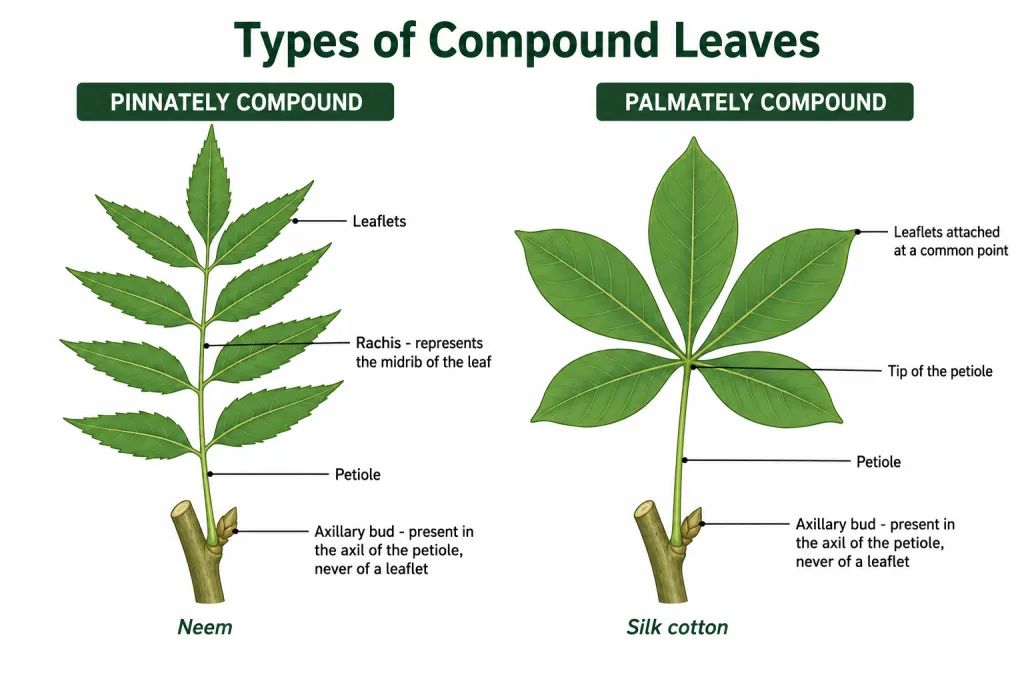
| Pinnately compound | Palmately compound | |
|---|---|---|
| Leaflets attached to | A common axis, the rachis | A common point at the tip of the petiole |
| The rachis | Present, representing the midrib | Absent |
| Look of it | Leaflets in two rows along an axis, like a feather | Leaflets spreading from one point, like fingers from a palm |
| Example | Neem | Silk cotton |
[NEET Important] The axillary bud test is the single most useful line in this section. A cluster of small green blades might be several simple leaves or one compound leaf, and only the bud tells you: a bud sits in the axil of a petiole, never in the axil of a leaflet.
Phyllotaxy
Phyllotaxy is the pattern of arrangement of leaves on the stem or branch. It is usually of three types.
- Alternate - a single leaf arises at each node in alternate manner, as in china rose, mustard and sunflower.
- Opposite - a pair of leaves arise at each node and lie opposite to each other, as in Calotropis and guava.
- Whorled - more than two leaves arise at a node and form a whorl, as in Alstonia.
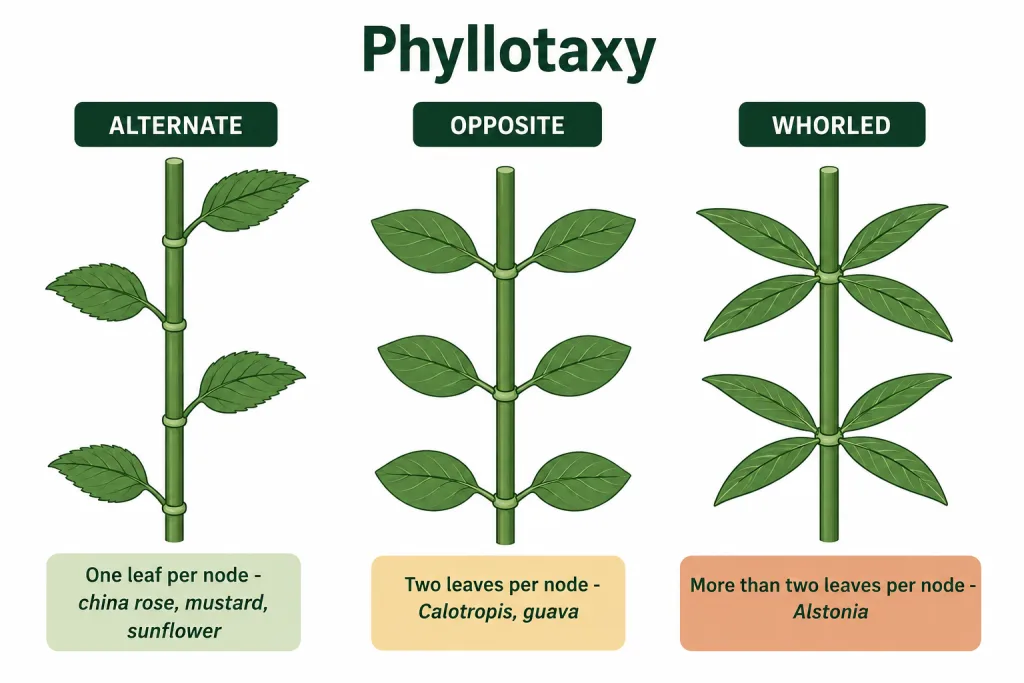
| Type | Leaves per node | Examples |
|---|---|---|
| Alternate | One | China rose, mustard, sunflower |
| Opposite | Two, facing each other | Calotropis, guava |
| Whorled | More than two, in a whorl | Alstonia |
[NEET Important] This is pure counting - one, two, more than two leaves at a node - and the examples are fixed. Alstonia is the only whorled example named, so any question mentioning it is asking about whorled phyllotaxy.
Quick Recap
Venation - arrangement of veins and veinlets in the lamina.
- Reticulate - veinlets form a network; dicots generally.
- Parallel - veins run parallel; characteristic of most monocotyledons.
Simple against compound
- Simple - lamina entire, or incisions do not touch the midrib.
- Compound - incisions reach the midrib, breaking it into leaflets.
- Bud test - a bud sits in the axil of the petiole in both, and never in the axil of a leaflet.
Compound leaf types
- Pinnately compound - leaflets on a common axis, the rachis, which represents the midrib; neem.
- Palmately compound - leaflets attached at a common point at the tip of the petiole; silk cotton.
Phyllotaxy - pattern of arrangement of leaves on the stem or branch.
- Alternate - one leaf per node; china rose, mustard, sunflower.
- Opposite - a pair per node; Calotropis, guava.
- Whorled - more than two per node; Alstonia.
Solved Examples
Question 1
Q. Define venation.
Answer. The arrangement of the veins and the veinlets in the lamina of a leaf.
Question 2
Q. Which venation goes with which class of plant?
Answer. Reticulate venation, where the veinlets form a network, is what dicotyledons generally have. Parallel venation, where the veins run parallel to each other, is the characteristic of most monocotyledons.
Question 3
Q. When is a leaf called simple?
Answer. When the lamina is entire, or when it is incised but the incisions do not touch the midrib.
Question 4
Q. When is a leaf called compound?
Answer. When the incisions of the lamina reach up to the midrib and break it into a number of leaflets.
Question 5
Q. How is a pinnately compound leaf different from a palmately compound leaf?
Answer.
| Pinnately compound | Palmately compound | |
|---|---|---|
| Where the leaflets attach | To a common axis, the rachis, which represents the midrib of the leaf | At a common point, the tip of the petiole |
| Rachis | Present | Absent |
| Example | Neem | Silk cotton |
This is one of the chapter-end exercises.
Question 6
Q. What is the rachis?
Answer. The common axis of a pinnately compound leaf, on which the leaflets sit. It represents the midrib of the leaf.
Question 7
Q. How would you decide whether you are holding one compound leaf or several simple leaves?
Answer. Look for the bud. A bud sits in the axil of the petiole in both simple and compound leaves, but never in the axil of a leaflet. So if the small blades have no bud in their axils and the whole cluster has one bud at its base, it is a single compound leaf.
Question 8
Q. Define phyllotaxy.
Answer. The pattern of arrangement of leaves on the stem or branch.
Question 9
Q. Explain with suitable examples the different types of phyllotaxy.
Answer. There are three.
- Alternate - a single leaf arises at each node in alternate manner. China rose, mustard and sunflower.
- Opposite - a pair of leaves arise at each node and lie opposite to each other. Calotropis and guava.
- Whorled - more than two leaves arise at a node and form a whorl. Alstonia.
This is one of the chapter-end exercises.
Question 10
Q. Name the phyllotaxy of Alstonia, guava and mustard.
Answer. Alstonia - whorled. Guava - opposite. Mustard - alternate.
Question 11
Q. A leaf has a network of veinlets and is deeply incised, but the incisions stop short of the midrib. Name the venation, say whether the leaf is simple or compound, and say which class the plant probably belongs to.
Answer. The venation is reticulate, so the plant is probably a dicotyledon. The leaf is simple, because the incisions do not reach the midrib - however deep they look, that is the only test.
Question 12
Q. A plant bears two leaves at every node and its leaves show parallel venation. What can you say about it?
Answer. The phyllotaxy is opposite, and the parallel venation points to a monocotyledon. The two facts are independent of each other - phyllotaxy is about the stem, venation about the lamina.