
The Flower and Its Four Whorls
The flower is the reproductive unit in the angiosperms, and it is meant for sexual reproduction.
A typical flower has four different kinds of whorls arranged successively on the swollen end of the stalk or pedicel, called the thalamus or receptacle. They are, from outside in:
- Calyx
- Corolla
- Androecium
- Gynoecium
Calyx and corolla are accessory organs, while androecium and gynoecium are reproductive organs.
In some flowers like lily, the calyx and corolla are not distinct and are together termed the perianth.
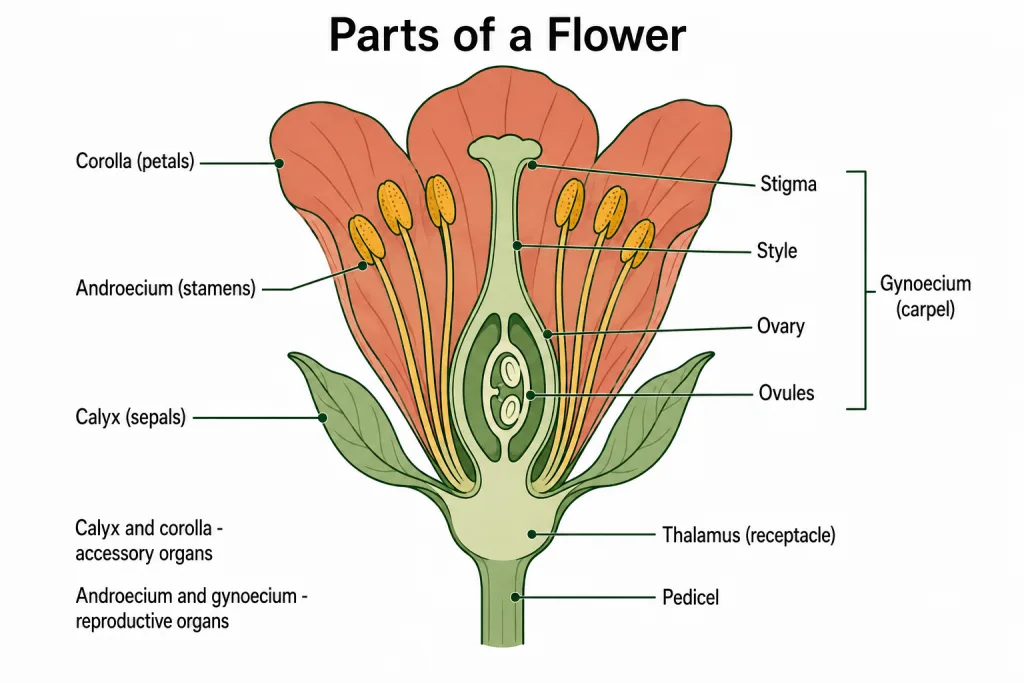
Sexuality. When a flower has both androecium and gynoecium it is bisexual. A flower having either only stamens or only carpels is unisexual.
[NEET Important] Two labels to keep apart. Accessory organs are the calyx and corolla; reproductive organs are the androecium and gynoecium. And perianth is not a fifth whorl - it is the name used when calyx and corolla cannot be told apart, as in lily.
Symmetry of the Flower
Actinomorphic (radial symmetry). The flower can be divided into two equal radial halves in any radial plane passing through the centre. Examples: mustard, datura, chilli.
Zygomorphic (bilateral symmetry). It can be divided into two similar halves only in one particular vertical plane. Examples: pea, gulmohur, bean, Cassia.
Asymmetric (irregular). It cannot be divided into two similar halves by any vertical plane passing through the centre. Example: canna.
| Symmetry | The test | Examples |
|---|---|---|
| Actinomorphic | Equal halves in any radial plane | Mustard, datura, chilli |
| Zygomorphic | Equal halves in only one vertical plane | Pea, gulmohur, bean, Cassia |
| Asymmetric | Equal halves in no plane | Canna |
Merosity. A flower is trimerous, tetramerous or pentamerous when the floral appendages are in multiples of 3, 4 or 5 respectively.
Bracts. A bract is a reduced leaf found at the base of the pedicel. Flowers with bracts are bracteate; those without bracts are ebracteate.
[NEET Important] The count of planes is the whole idea: any plane gives actinomorphic, one plane gives zygomorphic, no plane gives asymmetric. Canna is the only asymmetric example named, so any question mentioning canna is asking about asymmetry.
Position of the Floral Parts on the Thalamus
This is decided by where the calyx, corolla and androecium sit in relation to the ovary on the thalamus. Three arrangements, and each one fixes the name of the ovary.
Hypogynous. The gynoecium occupies the highest position and the other parts are situated below it. The ovary is superior. Examples: mustard, china rose, brinjal.
Perigynous. The gynoecium is situated in the centre and the other parts of the flower are located on the rim of the thalamus almost at the same level. The ovary is half inferior. Examples: plum, rose, peach.
Epigynous. The margin of the thalamus grows upward, enclosing the ovary completely and getting fused with it, and the other parts of the flower arise above the ovary. The ovary is inferior. Examples: guava, cucumber, and the ray florets of sunflower.
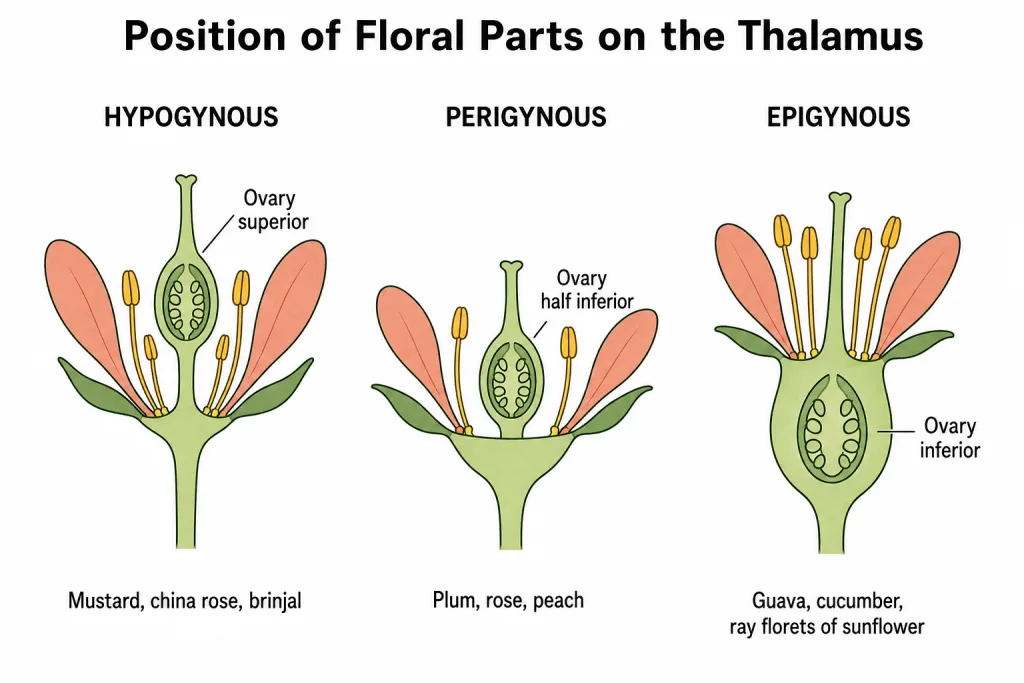
| Flower | Where the other parts sit | Ovary | Examples |
|---|---|---|---|
| Hypogynous | Below the gynoecium | Superior | Mustard, china rose, brinjal |
| Perigynous | On the rim of the thalamus, at about the same level | Half inferior | Plum, rose, peach |
| Epigynous | Above the ovary, thalamus fused around it | Inferior | Guava, cucumber, ray florets of sunflower |
The memory hook is in the Greek. Hypo means below, peri means around, epi means above - and each one describes where the other floral parts sit relative to the ovary. Then the ovary name is simply the opposite: parts below means the ovary is superior, parts above means it is inferior.
[NEET Important] This is asked in both directions - name the flower type given the ovary, or name the ovary given the flower type. The pair that is missed most often is perigynous with a half inferior ovary, because students remember only superior and inferior. And sunflower appears here as its ray florets, not the whole head.
Quick Recap
- Flower - the reproductive unit in angiosperms, meant for sexual reproduction.
- Four whorls on the thalamus or receptacle, the swollen end of the pedicel: calyx, corolla, androecium, gynoecium.
- Calyx and corolla - accessory. Androecium and gynoecium - reproductive.
- Perianth - calyx and corolla not distinct, as in lily.
- Bisexual - both androecium and gynoecium. Unisexual - only stamens or only carpels.
- Actinomorphic - equal halves in any radial plane; mustard, datura, chilli.
- Zygomorphic - equal halves in one vertical plane; pea, gulmohur, bean, Cassia.
- Asymmetric - equal halves in no plane; canna.
- Trimerous / tetramerous / pentamerous - appendages in multiples of 3 / 4 / 5.
- Bracteate - with a bract, a reduced leaf at the base of the pedicel; ebracteate - without.
- Hypogynous - other parts below; ovary superior; mustard, china rose, brinjal.
- Perigynous - other parts on the rim, same level; ovary half inferior; plum, rose, peach.
- Epigynous - other parts above, thalamus fused round the ovary; ovary inferior; guava, cucumber, ray florets of sunflower.
Solved Examples
Question 1
Q. What is a flower?
Answer. The reproductive unit in the angiosperms, meant for sexual reproduction.
Question 2
Q. Name the four whorls of a flower and say what they sit on.
Answer. Calyx, corolla, androecium and gynoecium, arranged successively on the thalamus or receptacle - the swollen end of the stalk or pedicel.
Question 3
Q. Which whorls are accessory and which are reproductive?
Answer. Calyx and corolla are the accessory organs. Androecium and gynoecium are the reproductive organs.
Question 4
Q. What is a perianth, and in which plant do you find one?
Answer. When the calyx and corolla are not distinct from each other, the two together are called the perianth. Lily is the example.
Question 5
Q. Define actinomorphic and give three examples.
Answer. A flower is actinomorphic when it can be divided into two equal radial halves in any radial plane passing through the centre. Mustard, datura and chilli. This is one of the chapter-end exercises.
Question 6
Q. Define zygomorphic and give examples.
Answer. A flower is zygomorphic when it can be divided into two similar halves only in one particular vertical plane. Pea, gulmohur, bean and Cassia. This is one of the chapter-end exercises.
Question 7
Q. Which flower is named as asymmetric, and what makes it so?
Answer. Canna. It cannot be divided into two similar halves by any vertical plane passing through the centre.
Question 8
Q. What is a bract, and what do bracteate and ebracteate mean?
Answer. A bract is a reduced leaf found at the base of the pedicel. A flower with bracts is bracteate; one without them is ebracteate.
Question 9
Q. What does it mean to call a flower pentamerous?
Answer. Its floral appendages are in multiples of five. Multiples of three give trimerous and multiples of four give tetramerous.
Question 10
Q. Define a superior ovary and name the kind of flower that has one.
Answer. In a hypogynous flower the gynoecium occupies the highest position and all the other parts sit below it. The ovary in such a flower is said to be superior - as in mustard, china rose and brinjal. This is one of the chapter-end exercises.
Question 11
Q. Define a perigynous flower.
Answer. One in which the gynoecium is situated in the centre and the other parts of the flower are located on the rim of the thalamus almost at the same level. Its ovary is half inferior, as in plum, rose and peach. This is one of the chapter-end exercises.
Question 12
Q. Describe the arrangement of floral members in relation to their insertion on the thalamus.
Answer. Three arrangements, named by where the calyx, corolla and androecium sit relative to the ovary.
| Type | Arrangement | Ovary | Examples |
|---|---|---|---|
| Hypogynous | Gynoecium highest, other parts below it | Superior | Mustard, china rose, brinjal |
| Perigynous | Gynoecium central, other parts on the rim of the thalamus at almost the same level | Half inferior | Plum, rose, peach |
| Epigynous | Thalamus grows up, encloses the ovary completely and fuses with it; other parts arise above the ovary | Inferior | Guava, cucumber, ray florets of sunflower |
This is one of the chapter-end exercises.
Question 13
Q. A flower has its sepals, petals and stamens arising from above the ovary. Name the type of flower and the type of ovary, and give two examples.
Answer. It is epigynous, and the ovary is inferior. The thalamus has grown up around the ovary and fused with it, so everything else is pushed above. Guava and cucumber.
Question 14
Q. A flower can be cut into two matching halves along one vertical plane only, and it has a small reduced leaf at the base of its stalk. Describe it in two technical words.
Answer. It is zygomorphic and bracteate. Pea and bean flowers fit both descriptions.