
The Two Systems of a Flowering Plant
A flowering plant is built in two halves, and the dividing line is the soil surface.
- The underground part is the root system.
- The portion above the ground is the shoot system - stem, leaves, flowers and fruits.
On the shoot, the region where leaves are born is a node, and the portion between two nodes is an internode.
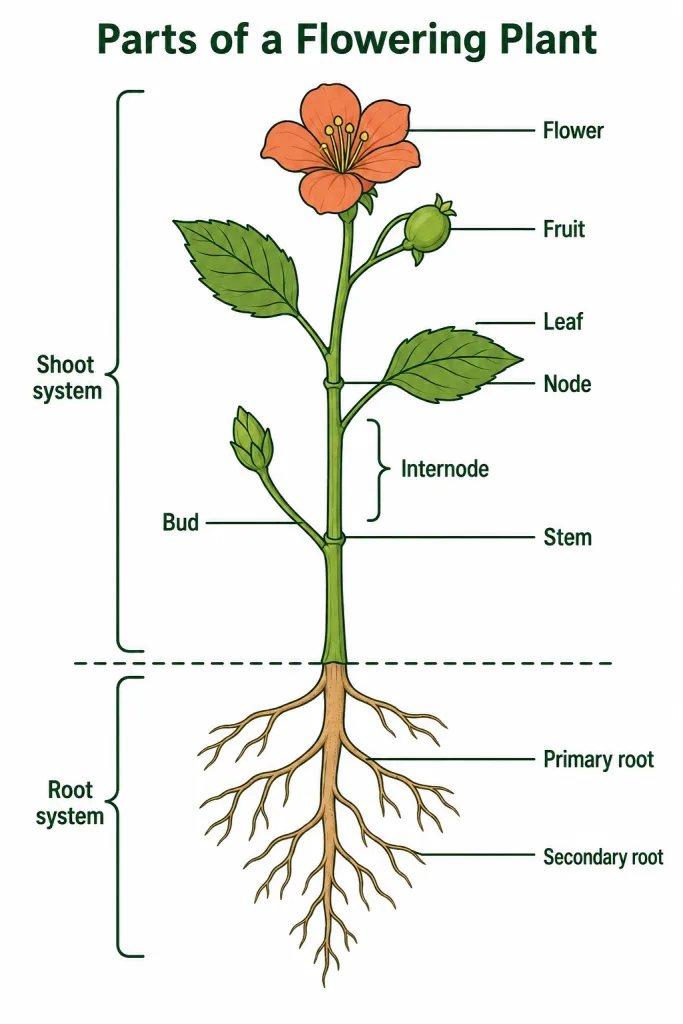
[NEET Important] Keep the two systems and the node-internode pair separate in your head. Node is a place, not a thing - it is where a leaf is attached. Almost every question that mentions "develops at the node" is talking about a leaf or an axillary bud.
The Three Root Systems
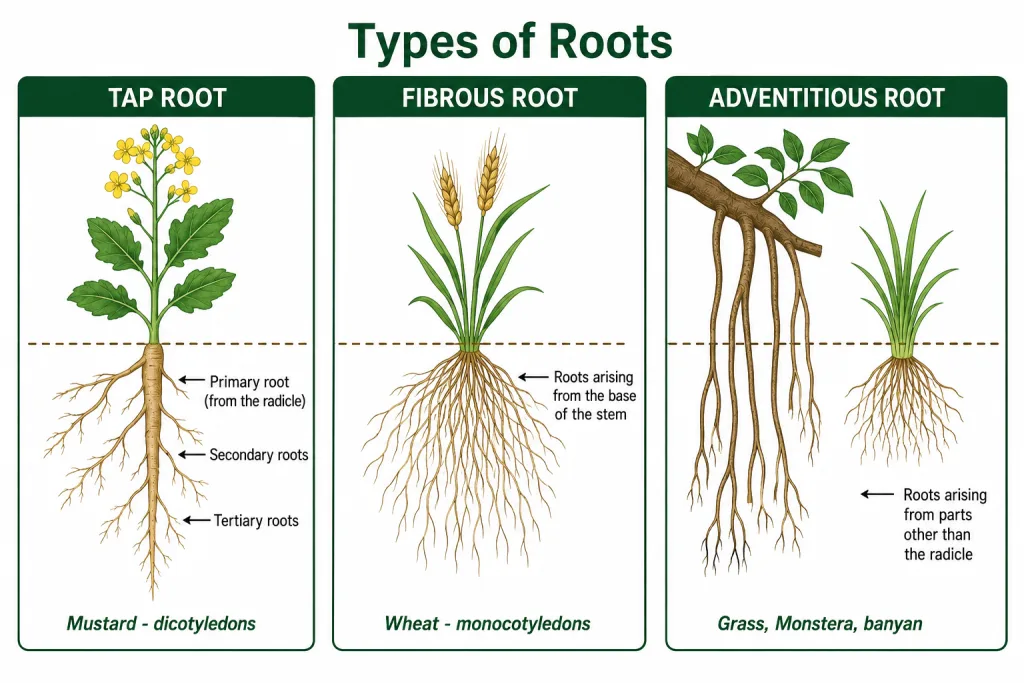
Tap root system. In the majority of dicotyledonous plants the radicle elongates directly into the primary root, which grows down into the soil. It bears lateral roots of several orders - secondary, tertiary and so on. The primary root together with its branches is the tap root system, as in the mustard plant.
Fibrous root system. In monocotyledonous plants the primary root is short lived and is replaced by a large number of roots which originate from the base of the stem. These make up the fibrous root system, as in the wheat plant.
Adventitious roots. In some plants the roots arise from parts of the plant other than the radicle. These are adventitious roots, as in grass, Monstera and the banyan tree.
| Tap root | Fibrous root | Adventitious root | |
|---|---|---|---|
| Origin | Radicle, elongating directly | Base of the stem, after the primary root dies | Any part other than the radicle |
| Typical in | Dicotyledons | Monocotyledons | Either |
| Example | Mustard | Wheat | Grass, Monstera, banyan |
[NEET Important] The definition of an adventitious root is the one students get wrong. It is not "a root above the ground" - it is a root arising from any part of the plant other than the radicle. That is why grass roots and banyan prop roots both count.
What the Root System Does
The main functions of the root system are:
- Absorption of water and minerals from the soil.
- Providing a proper anchorage to the plant parts.
- Storing reserve food material.
- Synthesis of plant growth regulators.
[NEET Important] The fourth one is the one that gets left out of answers. Synthesis of plant growth regulators is a root function, and a four-mark question asking for the functions of the root expects all four.
The Regions of the Root Tip
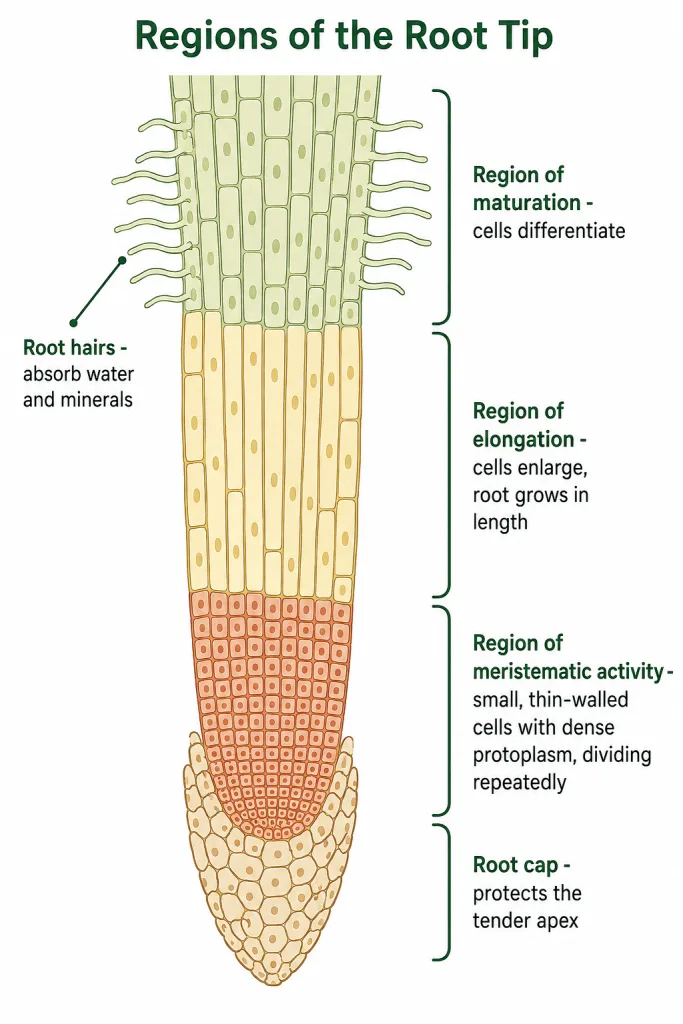
Work down from the tip. The order never changes, and questions are usually just asking you to place one region in that order.
1. Root cap. A thimble-like structure covering the apex. It protects the tender apex of the root as it makes its way through the soil.
2. Region of meristematic activity. A few millimetres above the root cap. Its cells are very small, thin-walled and with dense protoplasm, and they divide repeatedly.
3. Region of elongation. The cells proximal to the meristematic region undergo rapid elongation and enlargement, and they are responsible for the growth of the root in length.
4. Region of maturation. Proximal to the region of elongation, the cells of the elongation zone gradually differentiate and mature. From this region some of the epidermal cells form very fine and delicate, thread-like structures called root hairs, and these root hairs absorb water and minerals from the soil.
| Region | What its cells are doing | The one fact asked |
|---|---|---|
| Root cap | - | Protects the tender apex |
| Meristematic | Small, thin-walled, dense protoplasm; divide repeatedly | It is the dividing zone |
| Elongation | Rapid elongation and enlargement | Gives growth in length |
| Maturation | Differentiate and mature | Bears the root hairs, which absorb |
[NEET Important] Two traps live here. Growth in length belongs to the region of elongation, not the meristematic region, which supplies the cells. And root hairs are in the region of maturation, not at the tip - the tip is covered by the root cap and has no hairs at all.
Quick Recap
- Plant = root system (underground) + shoot system (stem, leaves, flowers, fruits).
- Node - where a leaf is born. Internode - the portion between two nodes.
- Tap root - from the radicle, with secondary and tertiary branches; dicots; mustard.
- Fibrous root - primary root short lived, replaced by many roots from the base of the stem; monocots; wheat.
- Adventitious root - from any part other than the radicle; grass, Monstera, banyan.
- Root functions: absorption, anchorage, storage of reserve food, synthesis of plant growth regulators.
- Root regions from the tip: root cap (protects) - meristematic (divides) - elongation (growth in length) - maturation (root hairs, absorb).
Solved Examples
Question 1
Q. Name the two systems into which a flowering plant is divided.
Answer. The root system, which is underground, and the shoot system, which is above ground and carries the stem, leaves, flowers and fruits.
Question 2
Q. What is a node?
Answer. The region of the stem where leaves are born. The stretch between two nodes is the internode.
Question 3
Q. Which root system does mustard have, and which does wheat have?
Answer. Mustard has a tap root system; wheat has a fibrous root system.
Question 4
Q. Where does a tap root come from?
Answer. From the radicle, which elongates directly into the primary root. That root then branches into secondary, tertiary and further orders, and the whole thing is the tap root system.
Question 5
Q. How does a fibrous root system form?
Answer. In monocots the primary root is short lived. It dies back and a large number of roots take over, growing from the base of the stem. Wheat is the example.
Question 6
Q. Define an adventitious root and give three examples.
Answer. A root that arises from any part of the plant other than the radicle. Grass, Monstera and the banyan tree.
Question 7
Q. List the functions of the root system.
Answer. Four of them.
- Absorption of water and minerals from the soil.
- Anchorage - holding the plant parts in place.
- Storage of reserve food material.
- Synthesis of plant growth regulators.
Question 8
Q. Name the regions of the root tip in order, starting from the apex.
Answer. Root cap, then the region of meristematic activity, then the region of elongation, then the region of maturation.
Question 9
Q. What does the root cap do?
Answer. It is a thimble-like structure over the apex, and it protects the tender apex of the root as it pushes its way through the soil.
Question 10
Q. Describe the cells of the meristematic region.
Answer. They are very small, thin-walled and full of dense protoplasm, and they divide repeatedly.
Question 11
Q. Which region makes the root grow longer, and why is it not the meristematic region?
Answer. The region of elongation. The meristematic region only supplies new cells by dividing; the actual increase in length comes from those cells elongating and enlarging in the next zone up.
Question 12
Q. Where are root hairs found, what are they, and what do they do?
Answer. In the region of maturation. Some epidermal cells there grow out into very fine, delicate, thread-like structures, and these absorb water and minerals from the soil. There are none at the tip, because the tip is covered by the root cap.
Question 13
Q. A plant has roots growing out from the base of its stem after the first root died away. Name the root system and the class of plant.
Answer. A fibrous root system, so the plant is a monocotyledon - wheat is the standard example.
Question 14
Q. Banyan roots hang down from the branches and grass roots come off the stem. Are they the same kind of root? Explain.
Answer. Yes, both are adventitious roots. Neither of them came from the radicle, and that is the only test that matters. Where they hang or how they look does not change the name.