
Family Solanaceae - the Potato Family
It is a large family, commonly called the potato family. It is widely distributed in tropics, subtropics and even temperate zones.
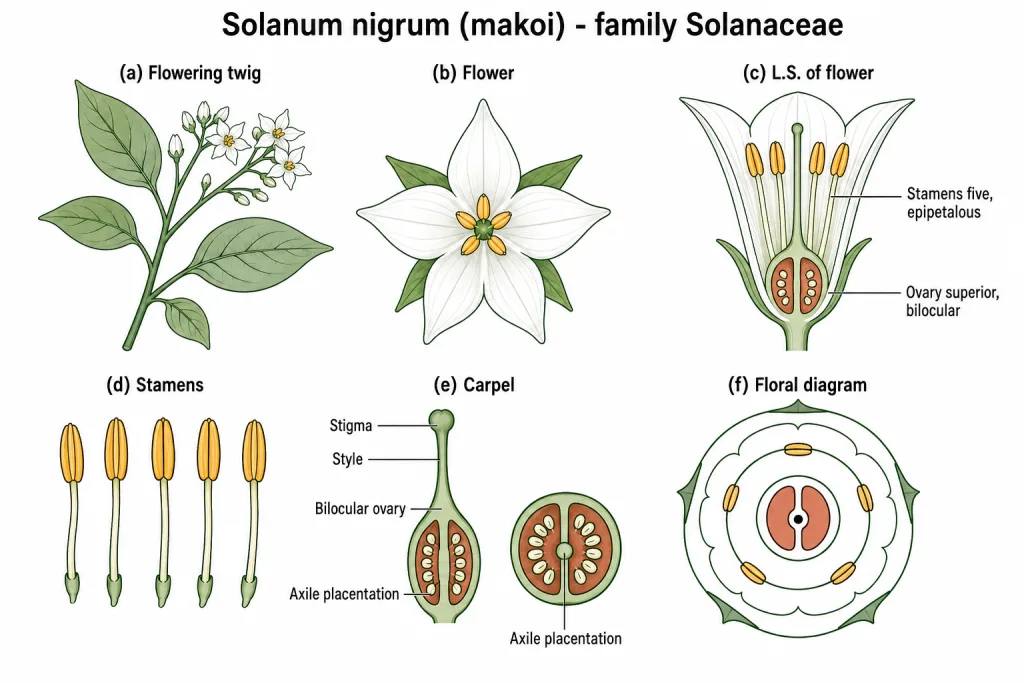
Vegetative Characters
Plants: mostly herbs, shrubs and rarely small trees.
Stem: herbaceous, rarely woody; aerial; erect, cylindrical, branched, solid or hollow, hairy or glabrous; underground stem in potato (Solanum tuberosum).
Leaves: alternate, simple, rarely pinnately compound, exstipulate; venation reticulate.
Floral Characters
Inflorescence: solitary, axillary or cymose, as in Solanum.
Flower: bisexual, actinomorphic.
Calyx: sepals five, united, persistent, valvate aestivation.
Corolla: petals five, united; valvate aestivation.
Androecium: stamens five, epipetalous.
Gynoecium: bicarpellary, obliquely placed, syncarpous; ovary superior, bilocular, placenta swollen with many ovules, axile.
Fruits: berry or capsule.
Seeds: many, endospermous.
Floral formula: the flower is actinomorphic and bisexual, and the formula is K(5) C(5) A5 G(2) - with the brackets on K and C showing the sepals and petals are united, a line joining C and A showing the stamens are epipetalous, and a line under the G showing the ovary is superior.
Economic Importance
- Food: tomato, brinjal, potato.
- Spice: chilli.
- Medicine: belladonna, ashwagandha.
- Fumigatory: tobacco.
- Ornamentals: petunia.
The Three Fives
Solanaceae is the easiest family to remember in the whole syllabus, because three of its four whorls count five.
| Whorl | Number | Condition |
|---|---|---|
| Calyx | Five sepals | United, persistent, valvate |
| Corolla | Five petals | United, valvate |
| Androecium | Five stamens | Epipetalous |
| Gynoecium | Two carpels | Syncarpous, obliquely placed, ovary superior and bilocular, placentation axile |
The one that is not five is the gynoecium - it is bicarpellary, and it is obliquely placed, which is the single most distinctive thing about a Solanaceae flower.
[NEET Important] Four details carry this family in an examination: stamens five and epipetalous, ovary superior and bilocular with axile placentation, the obliquely placed bicarpellary gynoecium, and a persistent calyx - the calyx that stays attached and is still visible on a ripe tomato or brinjal. If you have seen a tomato, you have seen the persistent calyx.
Quick Recap
Solanaceae - the potato family; large, widely distributed in tropics, subtropics and even temperate zones.
Vegetative
- Herbs, shrubs, rarely small trees.
- Stem - herbaceous rarely woody, aerial, erect, cylindrical, branched, solid or hollow, hairy or glabrous; underground in potato (Solanum tuberosum).
- Leaves - alternate, simple, rarely pinnately compound, exstipulate; reticulate venation.
Floral
- Inflorescence - solitary, axillary or cymose.
- Flower - bisexual, actinomorphic.
- Calyx - five, united, persistent, valvate.
- Corolla - five, united, valvate.
- Androecium - five, epipetalous.
- Gynoecium - bicarpellary, obliquely placed, syncarpous; ovary superior, bilocular; placenta swollen with many ovules; axile placentation.
- Fruit - berry or capsule. Seeds - many, endospermous.
- Formula - K(5) C(5) A5 G(2), ovary superior, stamens epipetalous.
Economic importance - food (tomato, brinjal, potato), spice (chilli), medicine (belladonna, ashwagandha), fumigatory (tobacco), ornamental (petunia).
Solved Examples
Question 1
Q. What is the common name of the family Solanaceae, and where is it found?
Answer. The potato family. It is widely distributed in the tropics, subtropics and even temperate zones.
Question 2
Q. Describe the stem of a Solanaceae plant.
Answer. Herbaceous, rarely woody, and aerial. It is erect, cylindrical, branched, solid or hollow, and hairy or glabrous. In potato, Solanum tuberosum, the stem is underground.
Question 3
Q. Describe the leaves of the family.
Answer. Alternate, simple, rarely pinnately compound, and exstipulate, with reticulate venation.
Question 4
Q. What kind of inflorescence and flower does the family have?
Answer. The inflorescence is solitary, axillary or cymose, as in Solanum. The flower is bisexual and actinomorphic.
Question 5
Q. Describe the calyx and the corolla of Solanaceae.
Answer. Calyx - five sepals, united, persistent, with valvate aestivation. Corolla - five petals, united, also with valvate aestivation.
Question 6
Q. Describe the androecium.
Answer. Five stamens, and they are epipetalous - attached to the petals.
Question 7
Q. Describe the gynoecium of Solanaceae fully.
Answer. It is bicarpellary and the carpels are obliquely placed. It is syncarpous, the ovary is superior and bilocular, and the placenta is swollen with many ovules, arranged in axile placentation.
Question 8
Q. What are the fruit and the seeds of this family like?
Answer. The fruit is a berry or a capsule, and the seeds are many and endospermous.
Question 9
Q. Write the floral formula of a Solanaceae flower and explain each part of it.
Answer. The flower is actinomorphic and bisexual, and the formula is K(5) C(5) A5 G(2).
- K(5) - five sepals, united, so the number is bracketed.
- C(5) - five petals, united.
- A5 - five stamens, joined by a line to C above the formula to show they are epipetalous.
- G(2) - two carpels, fused, with a line under the G to show the ovary is superior.
Question 10
Q. Take one flower of the family Solanaceae and write its semi-technical description.
Answer. Take Solanum nigrum, the makoi plant.
Habit. A herb.
Vegetative characters. Stem - herbaceous, aerial, erect, cylindrical, branched, solid or hollow, hairy or glabrous. Leaves - alternate, simple, exstipulate, with reticulate venation.
Floral characters. Inflorescence - solitary, axillary or cymose. Flower - bisexual, actinomorphic. Calyx - five, united, persistent, valvate. Corolla - five, united, valvate. Androecium - five, epipetalous. Gynoecium - bicarpellary, obliquely placed, syncarpous; ovary superior, bilocular, with axile placentation on a swollen placenta bearing many ovules. Fruit - a berry. Seeds - many, endospermous.
Floral formula. K(5) C(5) A5 G(2), ovary superior, stamens epipetalous.
This is one of the chapter-end exercises, and it also asks you to draw the floral diagram - four whorls with the calyx outermost, the epipetalous stamens marked against the corolla, and the two obliquely placed carpels in the centre.
Question 11
Q. Give the economic importance of Solanaceae with examples under each heading.
Answer. Food - tomato, brinjal, potato. Spice - chilli. Medicine - belladonna, ashwagandha. Fumigatory - tobacco. Ornamental - petunia.
Question 12
Q. A ripe tomato still carries a small green star-shaped structure at the top of the fruit. What is it, and what does it tell you about the family?
Answer. It is the persistent calyx. The sepals of Solanaceae are united and persistent, so they stay on the plant after the flower has become a fruit. It is the quickest field check for the family.