
Placentation
Placentation is the arrangement of ovules within the ovary.
There are different types, namely marginal, axile, parietal, basal, central and free central. Only five of those are described and figured - marginal, axile, parietal, free central and basal - and those five are the ones that are examined.
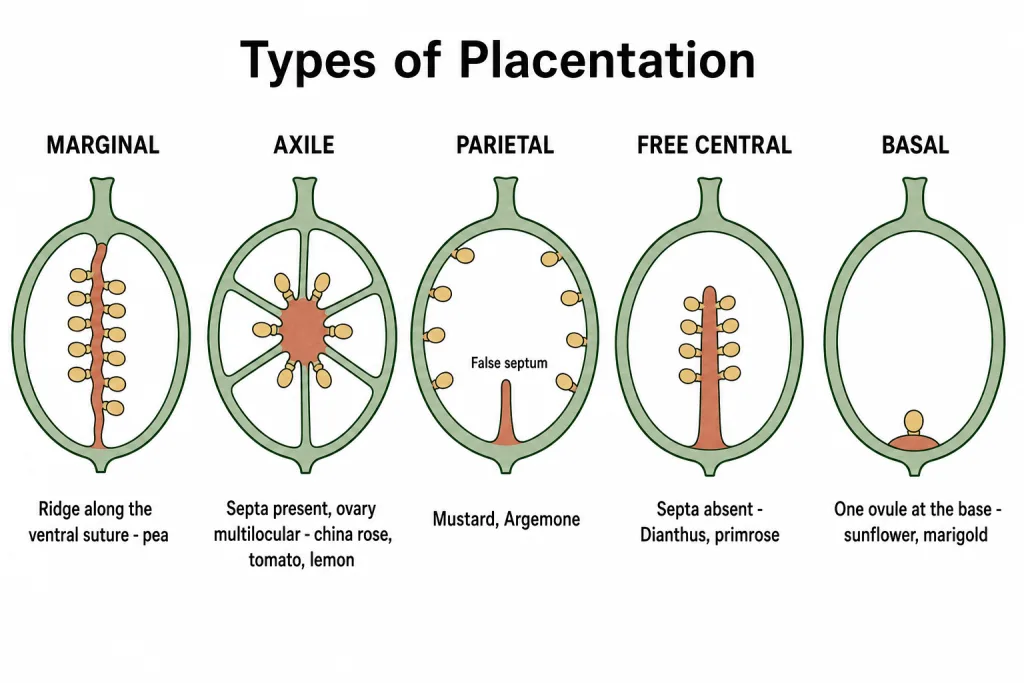
Marginal. The placenta forms a ridge along the ventral suture of the ovary and the ovules are borne on this ridge forming two rows, as in pea.
Axile. The placenta is axial and the ovules are attached to it in a multilocular ovary, as in china rose, tomato and lemon.
Parietal. The ovules develop on the inner wall of the ovary or on the peripheral part. The ovary is one-chambered but it becomes two-chambered due to the formation of the false septum, as in mustard and Argemone.
Free central. The ovules are borne on the central axis and septa are absent, as in Dianthus and primrose.
Basal. The placenta develops at the base of the ovary and a single ovule is attached to it, as in sunflower and marigold.
| Type | Where the ovules sit | Chambers | Examples |
|---|---|---|---|
| Marginal | On a ridge along the ventral suture, in two rows | One | Pea |
| Axile | On an axial placenta | Multilocular | China rose, tomato, lemon |
| Parietal | On the inner wall or peripheral part | One, becoming two by a false septum | Mustard, Argemone |
| Free central | On the central axis, septa absent | One | Dianthus, primrose |
| Basal | At the base, a single ovule | One | Sunflower, marigold |
[NEET Important] Axile and free central are the pair that decides most questions, and the septa settle it: axile has septa and a multilocular ovary, free central has no septa. The other giveaway line is the false septum - it belongs to parietal placentation and to nothing else, which is why mustard turns up so often as the answer.
Quick Recap
Placentation - the arrangement of ovules within the ovary.
- Marginal - placenta as a ridge along the ventral suture, ovules in two rows; pea.
- Axile - axial placenta, ovules attached to it in a multilocular ovary; china rose, tomato, lemon.
- Parietal - ovules on the inner wall or peripheral part; ovary one-chambered, becoming two-chambered by a false septum; mustard, Argemone.
- Free central - ovules on the central axis, septa absent; Dianthus, primrose.
- Basal - placenta at the base, a single ovule attached; sunflower, marigold.
The one-line separators
- Septa present, many chambers - axile.
- Septa absent, central axis - free central.
- False septum - parietal.
- One ovule only - basal.
- Two rows on a suture ridge - marginal.
Solved Examples
Question 1
Q. Define placentation.
Answer. The arrangement of ovules within the ovary. This is one of the chapter-end exercises.
Question 2
Q. Name the types of placentation.
Answer. Marginal, axile, parietal, basal, central and free central.
Question 3
Q. Describe marginal placentation.
Answer. The placenta forms a ridge along the ventral suture of the ovary, and the ovules are borne on this ridge in two rows. Pea is the example.
Question 4
Q. What is axile placentation and where is it found?
Answer. The placenta is axial and the ovules are attached to it in a multilocular ovary. China rose, tomato and lemon.
Question 5
Q. Explain parietal placentation.
Answer. The ovules develop on the inner wall of the ovary or on the peripheral part. The ovary starts one-chambered but becomes two-chambered because a false septum forms. Mustard and Argemone show it.
Question 6
Q. What is a false septum, and which placentation has one?
Answer. A partition that is not part of the original ovary wall arrangement but forms later and divides a one-chambered ovary into two chambers. It belongs to parietal placentation, as in mustard.
Question 7
Q. Describe free central placentation.
Answer. The ovules are borne on the central axis and the septa are absent. Dianthus and primrose.
Question 8
Q. Describe basal placentation.
Answer. The placenta develops at the base of the ovary and a single ovule is attached to it. Sunflower and marigold.
Question 9
Q. Describe the various types of placentations found in flowering plants.
Answer.
| Type | Description | Examples |
|---|---|---|
| Marginal | Placenta forms a ridge along the ventral suture; ovules in two rows | Pea |
| Axile | Placenta is axial, ovules attached to it in a multilocular ovary | China rose, tomato, lemon |
| Parietal | Ovules on the inner wall or peripheral part; ovary one-chambered, becoming two-chambered by a false septum | Mustard, Argemone |
| Free central | Ovules on the central axis, septa absent | Dianthus, primrose |
| Basal | Placenta at the base, with a single ovule attached | Sunflower, marigold |
This is one of the chapter-end exercises.
Question 10
Q. How do you separate axile from free central placentation in a section of an ovary?
Answer. Look for the septa. Both have the ovules on a central axis, but axile has septa, so the ovary is multilocular, while in free central the septa are absent and the ovary stays one chamber with a bare column running up the middle.
Question 11
Q. An ovary is one-chambered, the ovules are on its inner wall, and a partition has appeared that splits it into two. Name the placentation and give two examples.
Answer. Parietal. The partition is the false septum, which is the deciding clue. Mustard and Argemone.
Question 12
Q. An ovary contains just one ovule, sitting at its base. Name the placentation and the plants that show it.
Answer. Basal. Sunflower and marigold.