
Androecium
Androecium is composed of stamens.
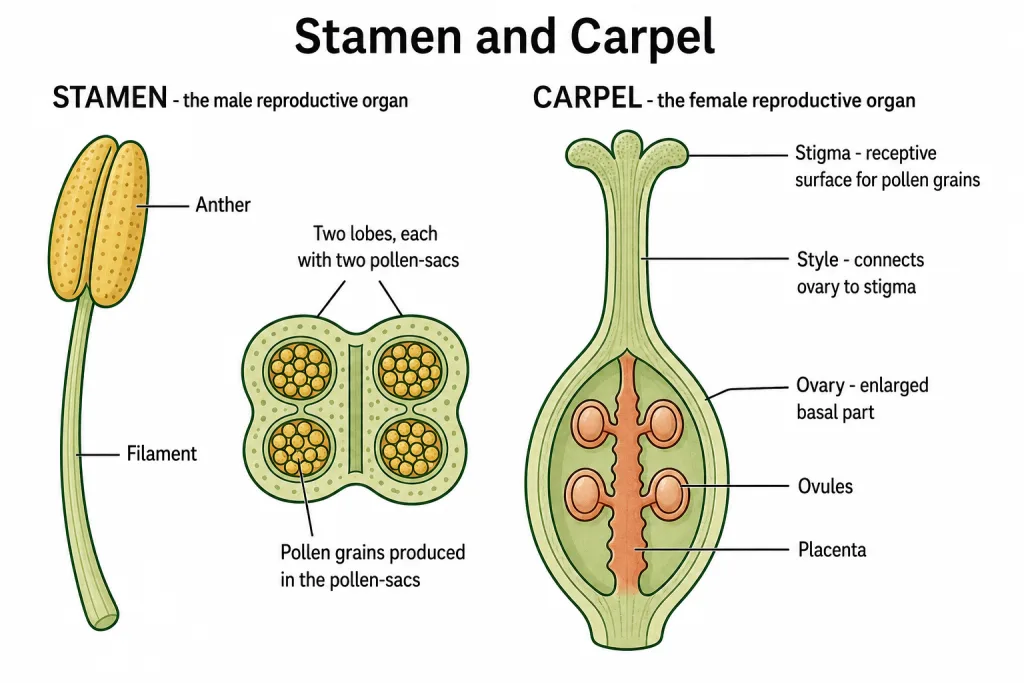
Each stamen represents the male reproductive organ and consists of a stalk or a filament and an anther.
- Each anther is usually bilobed and each lobe has two chambers, the pollen-sacs.
- The pollen grains are produced in pollen-sacs.
- A sterile stamen is called a staminode.
How stamens attach to other whorls (adhesion):
- Epipetalous - stamens attached to the petals, as in brinjal.
- Epiphyllous - stamens attached to the perianth, as in the flowers of lily.
How stamens join one another (cohesion):
- Polyandrous - the stamens remain free.
- Monoadelphous - united into one bunch or one bundle, as in china rose.
- Diadelphous - united into two bundles, as in pea.
- Polyadelphous - united into more than two bundles, as in citrus.
There may also be a variation in the length of filaments within a flower, as in Salvia and mustard.
| Term | What is joined to what | Example |
|---|---|---|
| Epipetalous | Stamens to petals | Brinjal |
| Epiphyllous | Stamens to perianth | Lily |
| Polyandrous | Stamens free from each other | - |
| Monoadelphous | Stamens in one bundle | China rose |
| Diadelphous | Stamens in two bundles | Pea |
| Polyadelphous | Stamens in more than two bundles | Citrus |
[NEET Important] Two different ideas share this block and a question will test whether you can keep them apart. Epipetalous and epiphyllous describe a stamen sticking to another whorl. Mono-, di- and polyadelphous describe stamens sticking to each other. Count the bundles: one, two, more than two.
Gynoecium
Gynoecium is the female reproductive part of the flower and is made up of one or more carpels.
A carpel consists of three parts: stigma, style and ovary.
- The ovary is the enlarged basal part.
- On it lies the elongated tube, the style, which connects the ovary to the stigma.
- The stigma is usually at the tip of the style and is the receptive surface for pollen grains.
Each ovary bears one or more ovules attached to a flattened, cushion-like placenta.
When more than one carpel is present:
- They may be free, as in lotus and rose, and are then called apocarpous.
- They are syncarpous when the carpels are fused, as in mustard and tomato.
After fertilisation, the ovules develop into seeds and the ovary matures into a fruit.
[NEET Important] Apocarpous is free, syncarpous is fused - and the examples are fixed: lotus and rose free, mustard and tomato fused. Also learn the last line as a pair, because it comes back in the fruit and seed section: ovule to seed, ovary to fruit.
Quick Recap
Androecium - made of stamens, the male reproductive organ.
- A stamen = filament + anther; the anther is usually bilobed, each lobe has two pollen-sacs, and pollen grains are produced in the pollen-sacs.
- A sterile stamen is a staminode.
- Epipetalous - attached to petals; brinjal. Epiphyllous - attached to the perianth; lily.
- Polyandrous - free. Monoadelphous - one bundle; china rose. Diadelphous - two bundles; pea. Polyadelphous - more than two bundles; citrus.
- Filament length may vary within a flower; Salvia, mustard.
Gynoecium - the female reproductive part, made of one or more carpels.
- A carpel = stigma + style + ovary.
- Ovary - enlarged basal part; style - the elongated tube connecting ovary to stigma; stigma - the receptive surface for pollen grains.
- Ovules are attached to a flattened, cushion-like placenta.
- Apocarpous - carpels free; lotus, rose. Syncarpous - carpels fused; mustard, tomato.
- After fertilisation: ovules become seeds, the ovary becomes a fruit.
Solved Examples
Question 1
Q. What are the two parts of a stamen?
Answer. A stalk or filament and an anther.
Question 2
Q. Describe the structure of an anther.
Answer. It is usually bilobed, and each lobe has two chambers called pollen-sacs. The pollen grains are produced in the pollen-sacs.
Question 3
Q. What is a staminode?
Answer. A sterile stamen.
Question 4
Q. What is an epipetalous stamen? Give an example.
Answer. A stamen that is attached to the petals. Brinjal is the example. This is one of the chapter-end exercises.
Question 5
Q. What does epiphyllous mean, and where do you see it?
Answer. The stamens are attached to the perianth, as in the flowers of lily.
Question 6
Q. Name the terms for stamens united into one, two and more than two bundles, with an example of each.
Answer. Monoadelphous - one bundle, china rose. Diadelphous - two bundles, pea. Polyadelphous - more than two bundles, citrus.
Question 7
Q. What is a polyandrous androecium?
Answer. One in which the stamens remain free from each other.
Question 8
Q. Name the three parts of a carpel and say what each one does.
Answer. The ovary is the enlarged basal part and holds the ovules. The style is the elongated tube that connects the ovary to the stigma. The stigma sits at the tip of the style and is the receptive surface for pollen grains.
Question 9
Q. What is a placenta in a flower?
Answer. The flattened, cushion-like structure inside the ovary to which the ovules are attached.
Question 10
Q. Differentiate between apocarpous and syncarpous ovary.
Answer.
| Apocarpous | Syncarpous | |
|---|---|---|
| Carpels | More than one, and free from each other | More than one, and fused together |
| Examples | Lotus, rose | Mustard, tomato |
This is one of the chapter-end exercises.
Question 11
Q. What becomes of the ovules and of the ovary after fertilisation?
Answer. The ovules develop into seeds and the ovary matures into a fruit.
Question 12
Q. A flower has five stamens whose filaments are fused to the corolla tube. Describe the androecium in one word and name a plant that fits.
Answer. Epipetalous - the stamens are attached to the petals. Brinjal fits, and so does the whole Solanaceae family.
Question 13
Q. In a flower the gynoecium has several separate small units, each with its own stigma, style and ovary. What is this condition called, and give two examples.
Answer. Apocarpous - the carpels are free from one another. Lotus and rose.
Question 14
Q. Salvia and mustard are mentioned together in the androecium section. What feature do they share?
Answer. A variation in the length of the filaments within the same flower - the stamens are not all the same length.