
How a Flowering Plant Is Described
Various morphological features are used to describe a flowering plant. The description has to be brief, in a simple and scientific language, and presented in a proper sequence.
The sequence never changes:
- Habit
- Vegetative characters - roots, stem and leaves
- Floral characters - inflorescence and flower parts
- After the parts have been described, a floral diagram and a floral formula are presented.
[NEET Important] The order is itself examinable. A semi-technical description that jumps to the flower before the vegetative characters loses marks even if every fact in it is right. Habit, then vegetative, then floral, then diagram and formula.
The Floral Formula
The floral formula is written with a fixed set of symbols.
| Symbol | What it stands for |
|---|---|
| Br | Bracteate |
| K | Calyx |
| C | Corolla |
| P | Perianth |
| A | Androecium |
| G | Gynoecium |
| G with a line below it | Superior ovary |
| G with a line above it | Inferior ovary |
| A small arrow-and-circle sign | Male |
| A small circle-and-cross sign | Female |
| A combined male and female sign | Bisexual |
| A plus inside a circle | Actinomorphic |
| A vertical line with a bar | Zygomorphic |
Two more conventions do a lot of work:
- Fusion is indicated by enclosing the figure within brackets. So G(2) means two carpels, fused.
- Adhesion is indicated by a line drawn above the symbols of the floral parts. A line joining C and A means the stamens are attached to the petals - that is, epipetalous.
Reading the mustard formula. The formula for the mustard plant, family Brassicaceae, is written as
the actinomorphic sign, the bisexual sign, then K2+2 C4 A2+4 G(2)
and it says: actinomorphic, bisexual; calyx of 2 + 2 sepals; corolla of 4 petals; androecium of 2 + 4 stamens; gynoecium of 2 fused carpels with a superior ovary, shown by the line under the G.
[NEET Important] Numbers written with a plus, like K2+2 and A2+4, mean the whorl stands in two sets - four sepals as two rows of two, six stamens as a set of two and a set of four - so read the sets, not just the total. Brackets mean fused; a line over two letters means adhered to each other; a line under G means superior and over G means inferior.
The Floral Diagram
A floral diagram provides information about the number of parts of a flower, their arrangement and the relation they have with one another.
How to read one:
- The position of the mother axis with respect to the flower is represented by a dot on the top of the floral diagram.
- Calyx, corolla, androecium and gynoecium are drawn in successive whorls, with the calyx being the outermost and the gynoecium being in the centre.
- The floral formula also shows cohesion and adhesion within parts of whorls and between whorls.
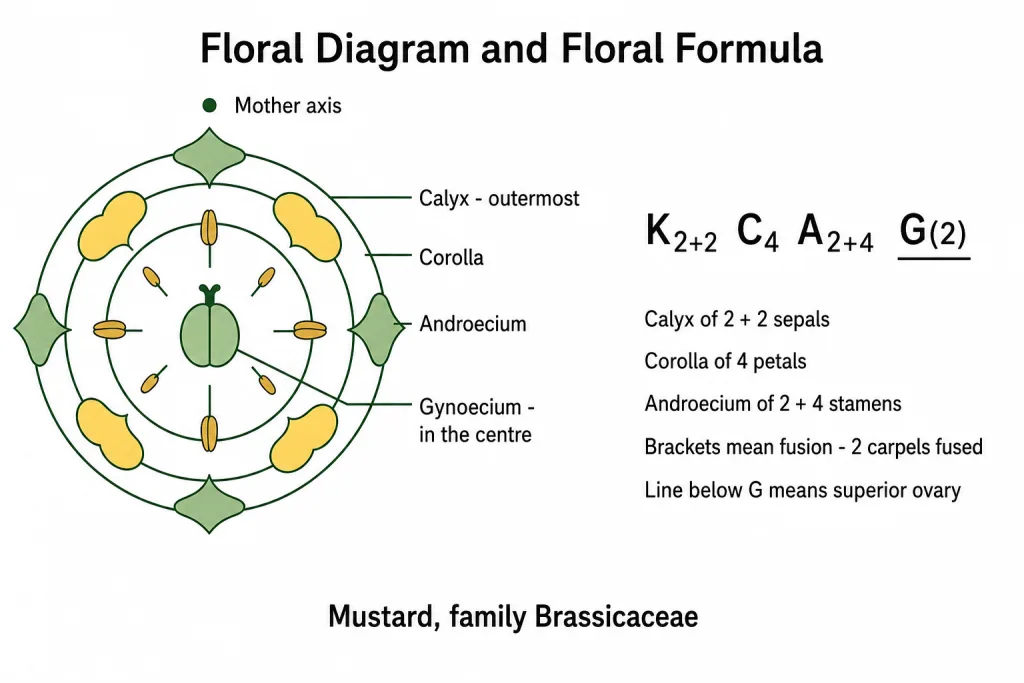
| Floral diagram | Floral formula | |
|---|---|---|
| What it shows | Number of parts, their arrangement, and their relation to one another | The same information written as symbols and numbers |
| Outermost element | Calyx | Written first, after the symmetry and sex signs |
| Centre | Gynoecium | Written last |
| Mother axis | A dot at the top | - |
| Fusion | Drawn as joined parts | Brackets |
| Adhesion | Drawn as connecting lines | A line above the symbols |
Quick Recap
- Describe in order: habit, then vegetative characters (root, stem, leaves), then floral characters (inflorescence, flower parts), then the floral diagram and floral formula.
- Br bracteate, K calyx, C corolla, P perianth, A androecium, G gynoecium.
- Line under G - superior ovary. Line over G - inferior ovary.
- Brackets - fusion. Line above symbols - adhesion.
- Floral diagram: dot at the top for the mother axis; whorls drawn calyx outermost, gynoecium in the centre.
- Mustard: actinomorphic, bisexual, K2+2 C4 A2+4 G(2), ovary superior. Mustard is ebracteate, so no Br is written.
Solved Examples
Question 1
Q. In what order is a flowering plant described?
Answer. Habit first, then the vegetative characters - roots, stem and leaves - then the floral characters, meaning inflorescence and flower parts. The floral diagram and floral formula come last.
Question 2
Q. What does the description have to be like?
Answer. Brief, in simple and scientific language, and presented in a proper sequence.
Question 3
Q. What do Br, K, C, P, A and G stand for?
Answer. Br - bracteate. K - calyx. C - corolla. P - perianth. A - androecium. G - gynoecium.
Question 4
Q. How is a superior ovary shown in a floral formula, and how is an inferior one shown?
Answer. A line drawn below the G means the ovary is superior; a line drawn above the G means it is inferior.
Question 5
Q. How are fusion and adhesion shown in a floral formula?
Answer. Fusion is shown by enclosing the figure within brackets, so G(2) is two fused carpels. Adhesion is shown by a line drawn above the symbols of the floral parts, so a line joining C and A means the stamens are stuck to the petals.
Question 6
Q. What information does a floral diagram give?
Answer. The number of parts of a flower, their arrangement, and the relation they have with one another.
Question 7
Q. How is the mother axis marked on a floral diagram?
Answer. By a dot on the top of the diagram, showing the position of the mother axis with respect to the flower.
Question 8
Q. In which order are the whorls drawn in a floral diagram?
Answer. In successive whorls, with the calyx outermost and the gynoecium in the centre, and corolla and androecium in between.
Question 9
Q. Read the formula K2+2 C4 A2+4 G(2) and say what it tells you.
Answer. Calyx of 2 + 2 sepals, so the four sepals sit in two sets of two. Corolla of four petals. Androecium of 2 + 4 stamens, again in two sets, of two and four. Gynoecium of two carpels which are fused, because the 2 is in brackets. With a line under the G it also tells you the ovary is superior. This is the mustard plant.
Question 10
Q. In a floral formula the letters C and A are joined by a line above them. What does that mean, and what is the one-word term?
Answer. It means adhesion between the corolla and the androecium - the stamens are attached to the petals. The one-word term is epipetalous.
Question 11
Q. A formula reads A5 while another reads A(5). What is the difference?
Answer. A5 means five stamens that are free from each other. A(5) means the five stamens are fused, because brackets always mean fusion.