
The Fruit
The fruit is a characteristic feature of the flowering plants. It is a mature or ripened ovary, developed after fertilisation.
If a fruit is formed without fertilisation of the ovary, it is called a parthenocarpic fruit.
Generally the fruit consists of a wall or pericarp and seeds. The pericarp may be dry or fleshy. When the pericarp is thick and fleshy, it is differentiated into the outer epicarp, the middle mesocarp and the inner endocarp.
The drupe. In mango and coconut the fruit is known as a drupe. Both develop from monocarpellary superior ovaries and are one seeded.
- In mango the pericarp is well differentiated into an outer thin epicarp, a middle fleshy edible mesocarp and an inner stony hard endocarp.
- In coconut, which is also a drupe, the mesocarp is fibrous.
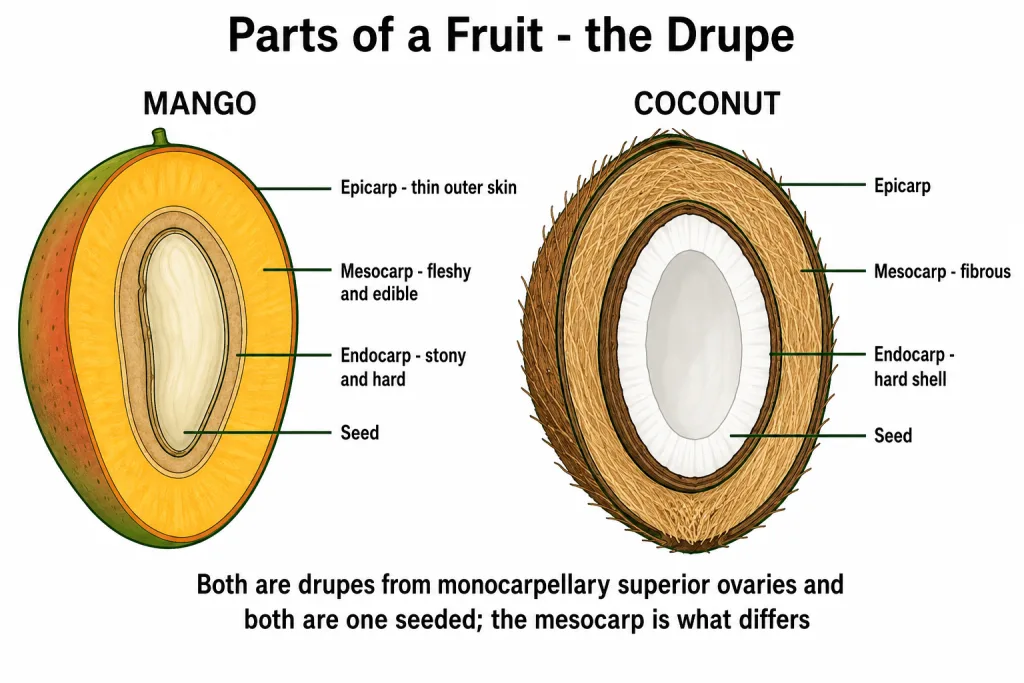
| Mango | Coconut | |
|---|---|---|
| Fruit type | Drupe | Drupe |
| Epicarp | Thin, the outer skin | Outer layer |
| Mesocarp | Fleshy and edible | Fibrous |
| Endocarp | Stony hard | Hard shell |
| Ovary | Monocarpellary, superior | Monocarpellary, superior |
| Seeds | One | One |
[NEET Important] The two drupes are asked as a contrast, and the difference is one word: the mango mesocarp is fleshy and edible, the coconut mesocarp is fibrous. Also keep the definition tight - a fruit is a ripened ovary, and one formed without fertilisation is parthenocarpic.
The Seed - Structure of a Dicotyledonous Seed
The ovules after fertilisation develop into seeds. A seed is made up of a seed coat and an embryo, and the embryo is made up of a radicle, an embryonal axis and one or two cotyledons - one as in wheat and maize, two as in gram and pea.
The dicot seed, layer by layer:
- The outermost covering is the seed coat, which has two layers - the outer testa and the inner tegmen.
- The hilum is a scar on the seed coat through which the developing seed was attached to the fruit.
- Above the hilum is a small pore called the micropyle.
- Within the seed coat is the embryo, consisting of an embryonal axis and two cotyledons. The cotyledons are often fleshy and full of reserve food materials.
- At the two ends of the embryonal axis are the radicle and the plumule.
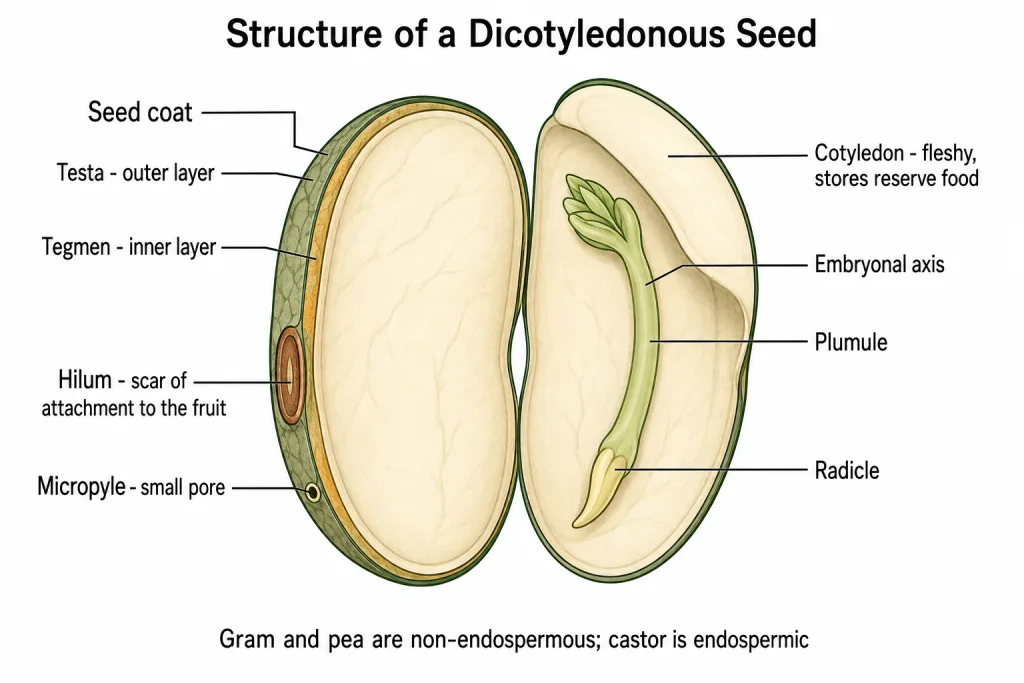
Endospermic and non-endospermous seeds. In some seeds such as castor, the endosperm formed as a result of double fertilisation is a food storing tissue, and such seeds are called endospermic. In plants such as bean, gram and pea the endosperm is not present in mature seeds, and such seeds are called non-endospermous.
[NEET Important] Three one-word answers live in this block: testa (outer seed coat), tegmen (inner seed coat) and hilum (the scar of attachment), with the micropyle as the small pore above the hilum. And the endosperm pair is fixed: castor is endospermic, bean, gram and pea are non-endospermous.
Structure of a Monocotyledonous Seed
Generally, monocotyledonous seeds are endospermic, but some, as in orchids, are non-endospermic.
In the seeds of cereals such as maize:
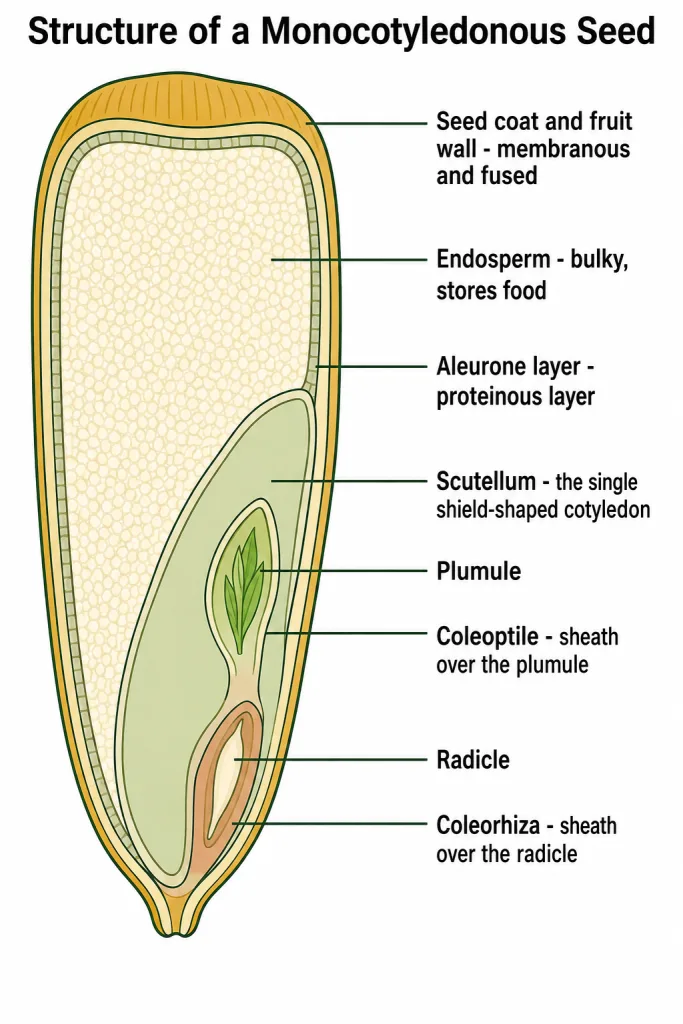
- The seed coat is membranous and generally fused with the fruit wall.
- The endosperm is bulky and stores food.
- The outer covering of the endosperm separates the embryo by a proteinous layer called the aleurone layer.
- The embryo is small and situated in a groove at one end of the endosperm.
- It consists of one large and shield-shaped cotyledon known as the scutellum, and a short axis with a plumule and a radicle.
- The plumule and radicle are enclosed in sheaths, which are called coleoptile and coleorhiza respectively.
| Feature | Dicot seed (gram, pea) | Monocot seed (maize) |
|---|---|---|
| Cotyledons | Two, often fleshy with reserve food | One, large and shield-shaped, the scutellum |
| Seed coat | Testa and tegmen | Membranous, generally fused with the fruit wall |
| Endosperm | Absent in gram and pea; present in castor | Bulky, stores food |
| Special layer | - | Aleurone layer, a proteinous layer |
| Plumule sheath | Absent | Coleoptile |
| Radicle sheath | Absent | Coleorhiza |
| Scar and pore | Hilum and micropyle | - |
[NEET Important] Coleoptile covers the plumule, coleorhiza covers the radicle - the trap is simply swapping them, and the way to hold it is that coleorhiza and radicle both point downward to the root. The aleurone layer is proteinous and it is what separates the embryo from the endosperm. And note the exception the chapter gives you for free: orchid seeds are non-endospermic, unlike most monocots.
Quick Recap
Fruit
- A mature or ripened ovary, developed after fertilisation; a characteristic feature of flowering plants.
- Parthenocarpic - formed without fertilisation of the ovary.
- Pericarp may be dry or fleshy; when thick and fleshy it splits into epicarp, mesocarp and endocarp.
- Drupe - mango and coconut; from monocarpellary superior ovaries, one seeded.
- Mango - thin epicarp, fleshy edible mesocarp, stony hard endocarp. Coconut - fibrous mesocarp.
Dicot seed
- Seed coat = testa (outer) + tegmen (inner).
- Hilum - scar of attachment to the fruit. Micropyle - small pore above the hilum.
- Embryo = embryonal axis + two cotyledons, often fleshy with reserve food; radicle and plumule at the two ends.
- Endospermic - castor. Non-endospermous - bean, gram, pea.
Monocot seed
- Generally endospermic; orchids are non-endospermic.
- Maize: membranous seed coat fused with the fruit wall, bulky endosperm, proteinous aleurone layer separating the embryo.
- Embryo small, in a groove at one end: one shield-shaped cotyledon, the scutellum, plus a short axis.
- Coleoptile sheathes the plumule; coleorhiza sheathes the radicle.
Solved Examples
Question 1
Q. What is a fruit?
Answer. A mature or ripened ovary, formed after fertilisation. It is a characteristic feature of the flowering plants.
Question 2
Q. What is a parthenocarpic fruit?
Answer. A fruit that has formed without fertilisation of the ovary.
Question 3
Q. Name the three layers of a thick fleshy pericarp, from outside in.
Answer. Epicarp, mesocarp and endocarp.
Question 4
Q. Which two fruits are named as drupes, and what do their ovaries have in common?
Answer. Mango and coconut. Both develop from monocarpellary superior ovaries and both are one seeded.
Question 5
Q. How does the mesocarp of mango differ from that of coconut?
Answer. In mango the mesocarp is fleshy and edible; in coconut it is fibrous. That one word is the whole difference between the two drupes.
Question 6
Q. Name the two layers of a dicot seed coat.
Answer. The outer testa and the inner tegmen.
Question 7
Q. What are the hilum and the micropyle?
Answer. The hilum is a scar on the seed coat marking where the developing seed was attached to the fruit. The micropyle is a small pore just above the hilum.
Question 8
Q. What makes a seed endospermic, and which seeds are non-endospermous?
Answer. A seed is endospermic when the endosperm formed by double fertilisation stays on as a food storing tissue - castor is the example. In bean, gram and pea the endosperm is not present in the mature seed, so those are non-endospermous.
Question 9
Q. Draw and label the parts of a gram seed.
Answer. Label these, working from the outside in: the seed coat, with its outer testa and inner tegmen; the hilum, the scar of attachment, and the micropyle as a small pore just above it; then inside, the two cotyledons, fleshy and full of reserve food; and the embryonal axis carrying the radicle at one end and the plumule at the other. Gram is non-endospermous, so do not draw an endosperm. This is one of the chapter-end exercises.
Question 10
Q. Draw and label a vertical section of a maize seed.
Answer. Label these: the seed coat, membranous and fused with the fruit wall; the bulky endosperm; the aleurone layer, a proteinous layer separating the endosperm from the embryo; and the embryo sitting in a groove at one end, made of the scutellum, which is the single large shield-shaped cotyledon, a short axis, the plumule covered by the coleoptile, and the radicle covered by the coleorhiza. This is one of the chapter-end exercises.
Question 11
Q. What is the scutellum?
Answer. The single large, shield-shaped cotyledon of a monocot seed such as maize.
Question 12
Q. What are the coleoptile and the coleorhiza?
Answer. They are the two sheaths of a monocot embryo. The coleoptile encloses the plumule and the coleorhiza encloses the radicle.
Question 13
Q. What is the aleurone layer and what does it separate?
Answer. A proteinous layer forming the outer covering of the endosperm. It separates the endosperm from the embryo.
Question 14
Q. A seed has one shield-shaped cotyledon, a bulky food store and two protective sheaths at the ends of a short axis. Which class is the plant, and what is the exception the chapter names?
Answer. It is a monocotyledon - maize fits exactly. Monocot seeds are generally endospermic, and the exception given is the orchids, whose seeds are non-endospermic.
Question 15
Q. A single fruit has a thin skin, a thick juicy middle layer and a stone at its centre. Name the fruit type, the three layers and one plant that fits.
Answer. It is a drupe. The layers are the thin epicarp, the fleshy edible mesocarp and the stony hard endocarp. Mango fits.