
Calyx
The calyx is the outermost whorl of the flower and its members are called sepals.
- Generally, sepals are green, leaf like and protect the flower in the bud stage.
- The calyx may be gamosepalous, meaning the sepals are united, or polysepalous, meaning the sepals are free.
Corolla
Corolla is composed of petals.
- Petals are usually brightly coloured to attract insects for pollination.
- Like the calyx, the corolla may be gamopetalous (petals united) or polypetalous (petals free).
- The shape and colour of the corolla vary greatly between plants. A corolla may be tubular, bell-shaped, funnel-shaped or wheel-shaped.
[NEET Important] For sepals and petals the prefix carries the meaning: gamo- means united, poly- means free. (Careful: in the stamen terms poly- means many, not free - polyadelphous stamens are united into more than two bundles.) So gamosepalous = united sepals, polysepalous = free sepals, gamopetalous = united petals, polypetalous = free petals. Learn the prefix once and you have four terms.
Aestivation
Aestivation is the mode of arrangement of sepals or petals in the floral bud with respect to the other members of the same whorl.
Read that definition carefully - it is about one whorl arranged against itself, inside the bud, not about how whorls relate to each other.
The main types are valvate, twisted, imbricate and vexillary.
Valvate. The sepals or petals in a whorl just touch one another at the margin, without overlapping, as in Calotropis.
Twisted. One margin of the appendage overlaps that of the next one, and so on, as in china rose, lady's finger and cotton.
Imbricate. The margins of sepals or petals overlap one another, but not in any particular direction, as in Cassia and gulmohur.
Vexillary or papilionaceous. In pea and bean flowers there are five petals: the largest, the standard, overlaps the two lateral petals, the wings, which in turn overlap the two smallest anterior petals, the keel.
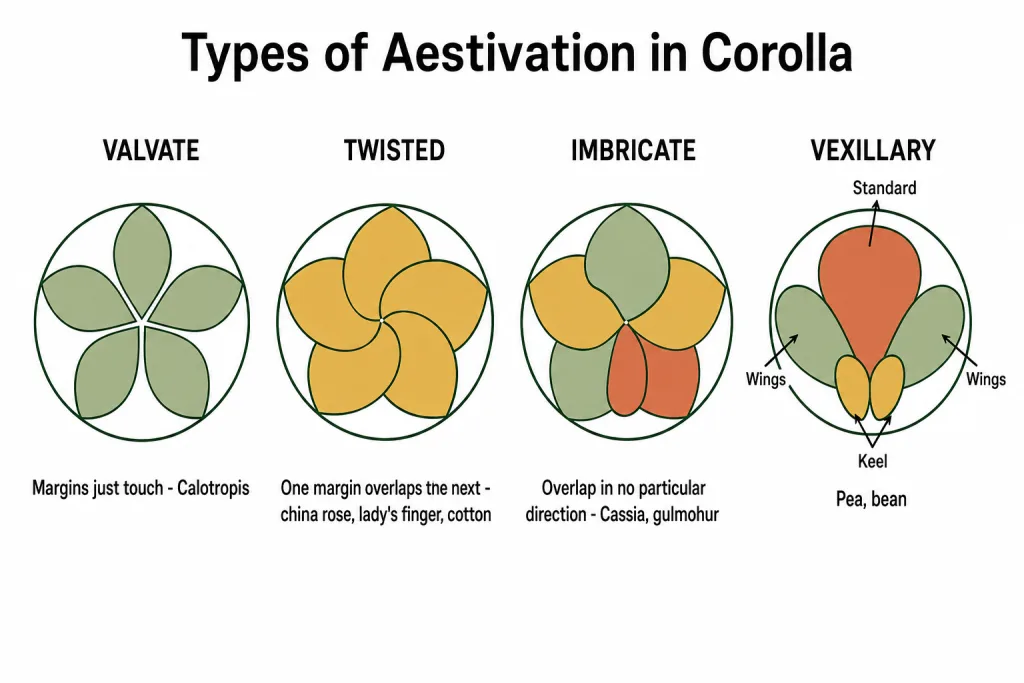
| Type | Arrangement in the bud | Examples |
|---|---|---|
| Valvate | Margins just touch, no overlap | Calotropis |
| Twisted | One margin overlaps the next, in one direction throughout | China rose, lady's finger, cotton |
| Imbricate | Margins overlap but in no particular direction | Cassia, gulmohur |
| Vexillary | Standard over wings over keel, in a five-petalled flower | Pea, bean |
The three petal names of a vexillary corolla, in order of size: standard (largest, one), wings (two lateral), keel (two smallest, anterior).
[NEET Important] Twisted and imbricate are the pair that gets confused, and one word separates them: direction. Twisted overlaps in a regular direction; imbricate overlaps in no particular direction. Vexillary questions almost always want the three petal names rather than the definition.
Quick Recap
Calyx - outermost whorl; members are sepals; generally green, leaf like, and they protect the flower in the bud stage.
- Gamosepalous - sepals united. Polysepalous - sepals free.
Corolla - composed of petals; usually brightly coloured to attract insects for pollination.
- Gamopetalous - petals united. Polypetalous - petals free.
- Shapes: tubular, bell-shaped, funnel-shaped, wheel-shaped.
Aestivation - mode of arrangement of sepals or petals in the floral bud with respect to the other members of the same whorl.
- Valvate - just touch, no overlap; Calotropis.
- Twisted - one margin overlaps the next; china rose, lady's finger, cotton.
- Imbricate - overlap in no particular direction; Cassia, gulmohur.
- Vexillary / papilionaceous - standard, wings, keel; pea, bean.
Solved Examples
Question 1
Q. What is the calyx made of, and what does it do?
Answer. It is the outermost whorl, made of sepals. They are generally green and leaf like, and they protect the flower in the bud stage.
Question 2
Q. What is the difference between gamosepalous and polysepalous?
Answer. Gamosepalous means the sepals are united; polysepalous means they are free.
Question 3
Q. Why are petals usually brightly coloured?
Answer. To attract insects for pollination.
Question 4
Q. Name the four shapes a corolla may take.
Answer. Tubular, bell-shaped, funnel-shaped and wheel-shaped.
Question 5
Q. Define aestivation.
Answer. The mode of arrangement of sepals or petals in the floral bud with respect to the other members of the same whorl. This is one of the chapter-end exercises.
Question 6
Q. Name the main types of aestivation.
Answer. Valvate, twisted, imbricate and vexillary.
Question 7
Q. What is valvate aestivation and where is it seen?
Answer. The sepals or petals just touch one another at the margin, without overlapping. Calotropis is the example.
Question 8
Q. How do you tell twisted aestivation from imbricate?
Answer. By the direction of overlap. In twisted, one margin overlaps the next one and so on, so the overlap runs the same way all round - china rose, lady's finger and cotton. In imbricate, the margins overlap but not in any particular direction - Cassia and gulmohur. Same overlapping, different regularity.
Question 9
Q. Describe vexillary aestivation.
Answer. It belongs to pea and bean flowers, which have five petals. The largest petal, the standard, overlaps the two lateral petals called the wings, and the wings in turn overlap the two smallest anterior petals, the keel. It is also called papilionaceous.
Question 10
Q. Name the three sets of petals in a vexillary corolla, largest first.
Answer. The standard, then the two wings, then the two keel petals.
Question 11
Q. A flower bud is opened and its five petals are found to overlap, each one covering the edge of the next in the same direction all the way round. Name the aestivation and give an example.
Answer. Twisted. The regular, one-way overlap is the giveaway. China rose is the example.
Question 12
Q. A flower has sepals joined into a cup and petals joined into a tube. Describe its calyx and corolla in technical terms.
Answer. The calyx is gamosepalous and the corolla is gamopetalous. Both prefixes are gamo-, meaning united.