
The Stem
The stem is the ascending part of the axis, bearing branches, leaves, flowers and fruits. It develops from the plumule of the embryo of a germinating seed.
What it carries:
- Nodes and internodes. The region where leaves are born is a node; the portion between two nodes is an internode.
- Buds, which may be terminal or axillary.
- It is generally green when young and later often becomes woody and dark brown.
What it does:
- The main function is spreading out branches bearing leaves, flowers and fruits.
- It conducts water, minerals and photosynthates.
- In some plants it also performs storage of food, support, protection and vegetative propagation.
[NEET Important] Two origins, learnt as a pair: the stem comes from the plumule, the root from the radicle. To that add two more separators: a stem bears multicellular hairs where root hairs are unicellular, and a stem is positively phototropic where a root is not. Those three - nodes and internodes, multicellular hairs, positive phototropism - are the cleanest way to tell a stem from a root in a "how would you distinguish" answer.
The Leaf
The leaf is a lateral, generally flattened outgrowth of the stem. It develops exogenously at the node and bears a bud in its axil, and that axillary bud later develops into a branch. Leaves originate from shoot apical meristems and are arranged in an acropetal order. They are the most important vegetative organs for photosynthesis.
A typical leaf has three main parts: leaf base, petiole and lamina.
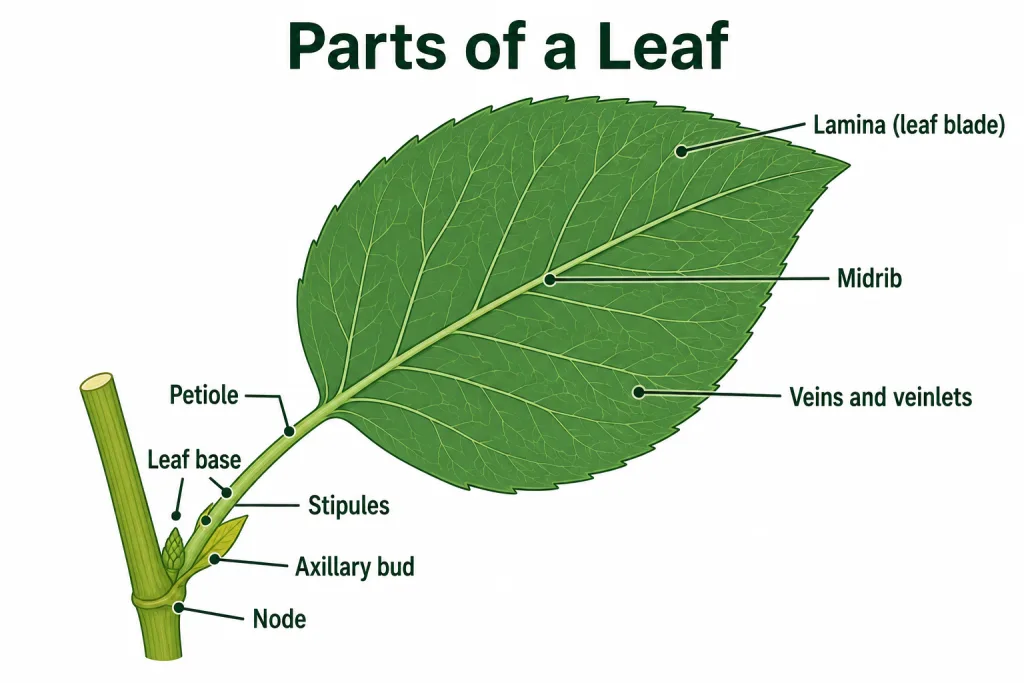
Leaf base. The leaf is attached to the stem by the leaf base, and it may bear two lateral small leaf-like structures called stipules. Two special forms are asked directly:
- In monocotyledons the leaf base expands into a sheath covering the stem partially or wholly.
- In some leguminous plants the leaf base becomes swollen, and this is called the pulvinus.
Petiole. The petiole helps hold the blade to light. Long, thin, flexible petioles allow leaf blades to flutter in wind, which cools the leaf and brings fresh air to the leaf surface.
Lamina. The lamina or leaf blade is the green expanded part of the leaf with veins and veinlets. There is usually a middle prominent vein known as the midrib. Veins provide rigidity to the leaf blade and act as channels of transport for water, minerals and food materials. The shape, margin, apex, surface and extent of incision of the lamina vary from leaf to leaf.
[NEET Important] Three one-word answers come out of this block over and over: pulvinus (the swollen leaf base of some leguminous plants), stipules (the two small leaf-like structures on the leaf base) and midrib (the middle prominent vein). Learn the flutter explanation too - "cools the leaf and brings fresh air to the leaf surface" is the wording a marker looks for.
Stem Against Root, Side by Side
| Feature | Stem | Root |
|---|---|---|
| Develops from | Plumule of the embryo | Radicle of the embryo |
| Direction | Ascending part of the axis | Grows down into the soil |
| Nodes and internodes | Present | Absent |
| Bears | Branches, leaves, flowers and fruits, buds | Root hairs, lateral roots |
| Colour when young | Generally green | Not green |
| Main job | Spreading out branches; conducting water, minerals and photosynthates | Absorption and anchorage |
Quick Recap
Stem
- Ascending axis, from the plumule; bears branches, leaves, flowers, fruits.
- Nodes and internodes; terminal and axillary buds.
- Green when young, often woody and dark brown later.
- Conducts water, minerals and photosynthates; some stems do storage, support, protection, vegetative propagation.
Leaf
- Lateral, generally flattened, borne at the node, with a bud in its axil.
- From shoot apical meristems, in acropetal order; the main organ of photosynthesis.
- Three parts: leaf base, petiole, lamina.
- Stipules on the leaf base; sheathing leaf base in monocots; pulvinus in some legumes.
- Petiole holds the blade to light and lets it flutter, cooling the leaf and bringing fresh air to its surface.
- Lamina - green, expanded, with veins, veinlets and a midrib; veins give rigidity and carry water, minerals and food.
Solved Examples
Question 1
Q. What is the stem, and what does it grow from?
Answer. The ascending part of the axis, carrying branches, leaves, flowers and fruits. It grows from the plumule of the embryo of a germinating seed.
Question 2
Q. What are the two kinds of bud a stem bears?
Answer. Terminal buds and axillary buds.
Question 3
Q. Give the other functions of the stem, apart from bearing branches.
Answer. It conducts water, minerals and photosynthates, and in some plants it also handles storage of food, support, protection and vegetative propagation.
Question 4
Q. Name the three main parts of a typical leaf.
Answer. Leaf base, petiole and lamina.
Question 5
Q. What are stipules and where do they sit?
Answer. Two lateral small leaf-like structures carried on the leaf base.
Question 6
Q. What is a pulvinus, and which plants have one?
Answer. A swollen leaf base. You find it in some leguminous plants.
Question 7
Q. How is the leaf base different in monocotyledons?
Answer. It expands into a sheath that covers the stem partially or wholly.
Question 8
Q. Why does a long, thin, flexible petiole help the plant?
Answer. It holds the blade to the light, and it lets the blade flutter in the wind. The fluttering cools the leaf and brings fresh air to the leaf surface.
Question 9
Q. What is the midrib?
Answer. The middle prominent vein running through the lamina.
Question 10
Q. What do the veins of a leaf do?
Answer. Two jobs. They give rigidity to the leaf blade, and they act as channels of transport for water, minerals and food materials.
Question 11
Q. Where does a leaf develop, and what sits in its axil?
Answer. At the node. A bud sits in its axil, and that axillary bud later becomes a branch.
Question 12
Q. Leaves are said to be arranged in acropetal order. What does that mean, and where do they come from?
Answer. They arise from the shoot apical meristems, and acropetal means the younger leaves are nearer the apex - the oldest at the bottom, the newest at the growing tip.
Question 13
Q. You are handed a piece of a plant axis and asked whether it is stem or root. What do you check?
Answer. Look for nodes and internodes - a stem has them, a root does not. A stem also bears leaves, flowers, fruits and buds and is generally green when young. If you can trace its origin, the stem came from the plumule and the root from the radicle.
Question 14
Q. Which parts of the lamina vary from one leaf to another?
Answer. Its shape, margin, apex, surface and extent of incision. That variation is exactly what the next section uses to sort leaves into types.