
The Chapter in One Read
Plants, unlike animals, have no special systems for breathing or gaseous exchange. Stomata and lenticels allow gaseous exchange by diffusion, and almost all living cells in a plant have their surfaces exposed to air - which is why no lung, gill or tracheal system is needed. That is the whole of the first section, and the rest of the chapter is about what happens once the is inside.
The breaking of the C-C bonds of complex organic molecules by oxidation, leading to the release of a lot of energy, is called cellular respiration. The energy is not released in one go. Complete combustion of glucose would give the same end products but hand out most of the energy as heat, and heat is useless to a cell:
So the cell oxidises glucose not in one step but in several small steps, each just large enough that the energy released can be coupled to ATP synthesis. Glucose is the favoured substrate for respiration, and fats and proteins can also be broken down to yield energy.
The initial stage of cellular respiration takes place in the cytoplasm. Each glucose molecule is broken through a series of enzyme catalysed reactions into two molecules of pyruvic acid - glycolysis, the EMP pathway of Embden, Meyerhof and Parnas, present in all living organisms and, in anaerobic organisms, the only process in respiration. Its arithmetic is small and heavily examined: 4 ATP made, 2 spent, a net gain of 2, along with 2 .
The fate of the pyruvate depends on the availability of oxygen and the organism. Under anaerobic conditions either lactic acid fermentation or alcohol fermentation occurs, and fermentation takes place under anaerobic conditions in many prokaryotes, unicellular eukaryotes and in germinating seeds. Both routes exist for one reason - to reoxidise back to so that glycolysis can keep running. It is a poor bargain: less than seven per cent of the energy in glucose is released, the products are hazardous, and yeast poisons itself to death at about 13 per cent alcohol.
In eukaryotic organisms aerobic respiration occurs in the presence of oxygen. Pyruvic acid is transported into the mitochondria where it is converted into acetyl CoA with the release of - the link reaction, catalysed by pyruvic dehydrogenase in the matrix. Acetyl CoA then enters the tricarboxylic acid pathway, or Krebs' cycle, operating in the matrix of the mitochondria, where it condenses with oxaloacetic acid and water to give citric acid and, over two decarboxylations and a run of oxidations, is stripped back to oxaloacetic acid again. and are generated in the Krebs' cycle, along with one GTP per turn by substrate level phosphorylation.
The energy in these molecules, as well as that in the synthesised during glycolysis, is used to synthesise ATP. This is accomplished through a system of electron carriers called the electron transport system (ETS), located on the inner membrane of the mitochondria. The electrons, as they move through the system, release enough energy that is trapped to synthesise ATP - oxidative phosphorylation, so named because it is the energy of oxidation-reduction, and not light energy as in the chloroplast, that builds the proton gradient. In this process is the ultimate acceptor of electrons and it gets reduced to water. The machinery is the chemiosmosis of the previous chapter with the addresses changed: protons accumulate in the intermembrane space rather than the thylakoid lumen, and the components are and rather than and . Add the stages up on four assumptions and there can be a net gain of 38 ATP molecules per glucose.
Finally, two ideas that stop the chapter being just a ledger. The respiratory pathway is an amphibolic pathway, as it involves both anabolism and catabolism - the very compounds that enter when a substrate is respired are the ones withdrawn when that substrate is synthesised. And the respiratory quotient depends upon the type of respiratory substance used during respiration - 1 for carbohydrates, about 0.9 for proteins and 0.7 for a fat like tripalmitin.
Master Quick Recap
Gas exchange in plants
- Plants require for respiration to occur and they also give out .
- Plants, unlike animals, have no specialised organs for gaseous exchange - they have stomata and lenticels for this purpose.
- Reason one: each plant part takes care of its own gas-exchange needs, and there is very little transport of gases from one plant part to another.
- Reason two: plants do not present great demands for gas exchange, and roots, stems and leaves respire at rates far lower than animals do. Only during photosynthesis are large volumes of gases exchanged, and each leaf is well adapted to take care of its own needs; when cells photosynthesise, availability of is not a problem, since is released within the cell.
- Reason three: the distance that gases must diffuse even in large, bulky plants is not great, since each living cell is located quite close to the surface of the plant.
- In stems the living cells are organised in thin layers inside and beneath the bark, and have openings called lenticels; the cells in the interior are dead and provide only mechanical support.
- Loose packing of parenchyma cells in leaves, stems and roots provides an interconnected network of air spaces.
Respiration, combustion and substrates
- The breaking of the C-C bonds of complex compounds through oxidation within cells, leading to release of a considerable amount of energy, is respiration; the compounds oxidised are the respiratory substrates.
- Usually carbohydrates are oxidised to release energy, but proteins, fats and even organic acids can be used as respiratory substances in some plants, under certain conditions.
- Complete combustion of glucose gives and and yields energy, most of which is given out as heat - and heat is useless to a cell.
- The cell catabolises glucose so that not all the liberated energy goes out as heat, by oxidising it not in one step but in several small steps, enabling some steps to be just large enough that the energy released can be coupled to ATP synthesis.
- ATP acts as the energy currency of the cell.
- The first cells on this planet lived in an atmosphere that lacked oxygen. Some organisms are facultative anaerobes; in others the requirement for anaerobic condition is obligate.
- All living organisms retain the enzymatic machinery to partially oxidise glucose without the help of oxygen - the breakdown of glucose to pyruvic acid, called glycolysis.
Glycolysis
- From the Greek glycos, sugar, and lysis, splitting. The scheme was given by Gustav Embden, Otto Meyerhof and J. Parnas - the EMP pathway.
- In anaerobic organisms it is the only process in respiration. It occurs in the cytoplasm of the cell. It is present in all living organisms.
- Glucose undergoes partial oxidation to form two molecules of pyruvic acid.
- In plants the glucose is derived from sucrose, the end product of photosynthesis, or from storage carbohydrates; invertase converts sucrose into glucose and fructose, and these two monosaccharides readily enter the glycolytic pathway.
- A chain of ten reactions, under the control of different enzymes, produces pyruvate from glucose.
- Glucose and fructose are phosphorylated to give glucose-6-phosphate by hexokinase, which isomerises to fructose-6-phosphate; subsequent steps of metabolism of glucose and fructose are the same.
- Fructose 1,6-bisphosphate is split into dihydroxyacetone phosphate and 3-phosphoglyceraldehyde (PGAL) - from here everything happens twice.
- One step forms from - PGAL to 1,3-bisphosphoglycerate (BPGA) - when two redox-equivalents are removed, in the form of two hydrogen atoms, and transferred to .
- ATP is utilised at two steps - glucose to glucose-6-phosphate, and fructose-6-phosphate to fructose 1,6-bisphosphate.
- ATP is synthesised at two steps - BPGA to 3-phosphoglyceric acid, and PEP to pyruvic acid.
- Per glucose: 2 ATP used, 4 ATP made, net 2 ATP, 2 and 2 pyruvic acid.
- Three fates of pyruvic acid - lactic acid fermentation, alcoholic fermentation and aerobic respiration.
Fermentation
- In fermentation, say by yeast, the incomplete oxidation of glucose is achieved under anaerobic conditions by sets of reactions where pyruvic acid is converted to and ethanol.
- The enzymes pyruvic acid decarboxylase and alcohol dehydrogenase catalyse these reactions:
- Other organisms like some bacteria produce lactic acid from pyruvic acid, and in animal cells also, like muscles during exercise, when oxygen is inadequate for cellular respiration pyruvic acid is reduced to lactic acid by lactate dehydrogenase:
- The reducing agent is , which is reoxidised to in both the processes.
- Only the alcoholic route releases ; lactic acid fermentation releases none.
- In both, not much energy is released - less than seven per cent of the energy in glucose, and not all of it is trapped as high energy bonds of ATP.
- The processes are hazardous - either acid or alcohol is produced.
- Net ATP per glucose fermented is 2, since four are synthesised during glycolysis and two are utilised; the fermentation steps themselves make none.
- Yeasts poison themselves to death when the concentration of alcohol reaches about 13 per cent, so the maximum concentration in naturally fermented beverages is about 13 per cent, and beverages of greater alcohol content are obtained by distillation.
Aerobic respiration and the link reaction
- Aerobic respiration is the process that leads to a complete oxidation of organic substances in the presence of oxygen, and releases , water and a large amount of energy present in the substrate. It is most common in higher organisms.
- In eukaryotes these steps take place within the mitochondria and require .
- Pyruvate, the final product of glycolysis, is transported from the cytoplasm into the mitochondria.
- Crucial event one: the complete oxidation of pyruvate by the stepwise removal of all the hydrogen atoms, leaving three molecules of - in the matrix of the mitochondria.
- Crucial event two: the passing on of the electrons removed as part of the hydrogen atoms to molecular with simultaneous synthesis of ATP - on the inner membrane of the mitochondria.
- In the matrix pyruvate undergoes oxidative decarboxylation by a complex set of reactions catalysed by pyruvic dehydrogenase, which requires the participation of several coenzymes, including and Coenzyme A, with as cofactor:
- Carbon count - pyruvate 3C, one carbon out as , acetyl CoA 2C.
- Two molecules of NADH are produced from the metabolism of two molecules of pyruvic acid, produced from one glucose molecule during glycolysis. The link reaction yields no ATP.
- Do not confuse pyruvic dehydrogenase, in the mitochondrial matrix, with pyruvic acid decarboxylase, in the cytoplasm of a fermenting yeast.
The tricarboxylic acid cycle
- The TCA cycle starts with the condensation of the acetyl group with oxaloacetic acid (OAA) and water to yield citric acid, catalysed by citrate synthase, with a molecule of CoA released.
- Citrate is then isomerised to isocitrate.
- Two successive steps of decarboxylation follow, leading to the formation of -ketoglutaric acid and then succinyl-CoA.
- In the remaining steps of the citric acid cycle, succinyl-CoA is oxidised to OAA, allowing the cycle to continue.
- Carbon counts - acetyl CoA 2C, OAA 4C, citric acid 6C, -ketoglutaric acid 5C, succinic acid 4C, malic acid 4C.
- During the conversion of succinyl-CoA to succinic acid a molecule of GTP is synthesised. This is a substrate level phosphorylation. In a coupled reaction GTP is converted to GDP with the simultaneous synthesis of ATP from ADP.
- There are three points in the cycle where is reduced to and one point where is reduced to .
- Yield per turn: 3 , 1 , 1 GTP and 2 .
- The cycle requires the continued replenishment of oxaloacetic acid, the first member of the cycle, and the regeneration of and from NADH and respectively.
- The summary equation for this phase, in the mitochondrial matrix:
- That equation is written per pyruvic acid and bundles the link reaction in with the cycle, which is why it shows 4 and 3 rather than the 3 and 2 of the cycle alone.
- By the end of the TCA cycle, eight molecules of and two of have been synthesised besides just two molecules of ATP in the TCA cycle.
The electron transport system
- The following steps release and utilise the energy stored in and , by oxidising them through the ETS, with the electrons passed on to , resulting in the formation of .
- The metabolic pathway through which the electron passes from one carrier to another is called the electron transport system (ETS), and it is present in the inner mitochondrial membrane.
- Complex I, NADH dehydrogenase - electrons from NADH produced in the mitochondrial matrix during the citric acid cycle are oxidised by it, and the electrons are then transferred to ubiquinone located within the inner membrane.
- Complex II - ubiquinone also receives reducing equivalents via , which is generated during the oxidation of succinate in the citric acid cycle.
- Complex III, the cytochrome complex - the reduced ubiquinone (ubiquinol) is oxidised with the transfer of electrons to cytochrome c.
- Cytochrome c is a small protein attached to the outer surface of the inner membrane, and acts as a mobile carrier for transfer of electrons between complex III and complex IV. It is not a complex itself.
- Complex IV - the cytochrome c oxidase complex, containing cytochromes a and , and two copper centres.
- Complex V, ATP synthase - the electrons passing via complex I to complex IV are coupled to it for the production of ATP from ADP and inorganic phosphate.
- The number of ATP molecules synthesised depends on the nature of the electron donor. Oxidation of one molecule of NADH gives rise to 3 molecules of ATP; oxidation of one molecule of produces 2 molecules of ATP.
- yields less because it enters at complex II and bypasses complex I.
- The role of oxygen is limited to the terminal stage of the process, yet its presence is vital, since it drives the whole process by removing hydrogen from the system. Oxygen acts as the final hydrogen acceptor, and is the ultimate acceptor of electrons, getting reduced to water.
- Unlike photophosphorylation, where light energy is utilised for the production of the proton gradient, in respiration it is the energy of oxidation-reduction that is utilised - hence the name oxidative phosphorylation.
ATP synthase and chemiosmosis
- The energy released during the electron transport system is utilised in synthesising ATP with the help of ATP synthase (complex V).
- This complex consists of two major components, and .
- The headpiece is a peripheral membrane protein complex and contains the site for synthesis of ATP from ADP and inorganic phosphate.
- is an integral membrane protein complex that forms the channel through which protons cross the inner membrane.
- The passage of protons through the channel is coupled to the catalytic site of the component for the production of ATP.
- For each ATP produced, pass through from the intermembrane space to the matrix down the electrochemical proton gradient.
- In respiration protons accumulate in the intermembrane space of the mitochondrion; in photosynthesis they accumulate in the thylakoid lumen.
- Respiration has and ; photosynthesis has and - the same architecture under different names.
The respiratory balance sheet
- It is possible to make calculations of the net gain of ATP for every glucose molecule oxidised, but in reality this can remain only a theoretical exercise.
- Assumption 1: there is a sequential, orderly pathway functioning, with one substrate forming the next and with glycolysis, TCA cycle and ETS pathway following one after another.
- Assumption 2: the NADH synthesised in glycolysis is transferred into the mitochondria and undergoes oxidative phosphorylation.
- Assumption 3: none of the intermediates in the pathway are utilised to synthesise any other compound.
- Assumption 4: only glucose is being respired - no other alternative substrates are entering the pathway at any of the intermediary stages.
- The assumptions are not really valid in a living system: all pathways work simultaneously and do not take place one after another; substrates enter the pathways and are withdrawn from them as and when necessary; ATP is utilised as and when needed; enzymatic rates are controlled by multiple means.
- Yet it is useful to do this exercise, to appreciate the beauty and efficiency of the living system in extraction and storing energy.
- Hence, there can be a net gain of 38 ATP molecules during aerobic respiration of one molecule of glucose.
- Fermentation accounts for only a partial breakdown of glucose, whereas in aerobic respiration it is completely degraded to and .
- In fermentation there is a net gain of only two molecules of ATP for each molecule of glucose degraded to pyruvic acid, whereas many more molecules of ATP are generated under aerobic conditions.
- NADH is oxidised to rather slowly in fermentation, however the reaction is very vigorous in the case of aerobic respiration.
The amphibolic pathway
- Glucose is the favoured substrate for respiration, and all carbohydrates are usually first converted into glucose before they are used for respiration.
- Fats and proteins are broken down to yield energy too, but they do not enter the respiratory pathway at the first step.
- Fats would need to be broken down into glycerol and fatty acids first.
- Fatty acids, if respired, would first be degraded to acetyl CoA and enter the pathway there.
- Glycerol would enter the pathway after being converted to PGAL.
- Proteins would be degraded by proteases, and the individual amino acids, after deamination, depending on their structure, would enter the pathway at some stage within the Krebs' cycle, or even as pyruvate or acetyl CoA.
- It is these very compounds that would be withdrawn from the respiratory pathway for the synthesis of the said substrates - acetyl CoA is withdrawn when the organism needs to synthesise fatty acids, so the respiratory pathway comes into the picture both during breakdown and synthesis of fatty acids; during breakdown and synthesis of protein too, respiratory intermediates form the link.
- Breaking down processes within the living organism is catabolism; synthesis is anabolism.
- Because the respiratory pathway is involved in both anabolism and catabolism, it would be better to consider it an amphibolic pathway rather than a catabolic one.
The respiratory quotient
- The ratio of the volume of evolved to the volume of consumed in respiration is called the respiratory quotient (RQ) or respiratory ratio, and it has no unit:
- The respiratory quotient depends upon the type of respiratory substrate used during respiration.
- When carbohydrates are used as substrate and are completely oxidised, the RQ will be 1, because equal amounts of and are evolved and consumed respectively:
- When fats are used in respiration, the RQ is less than 1. For tripalmitin:
- When proteins are respiratory substrates the ratio would be about 0.9.
- In living organisms, respiratory substrates are often more than one; pure proteins or fats are never used as respiratory substrates.
The Whole Pathway, End to End
Read the table across, one row at a time. Glucose enters at the top left in the cytoplasm and leaves as , and ATP at the bottom right, inside the mitochondrion. Every row is one stage, and the Where column is the column most marks are lost in.
| Stage | Where | Inputs | Outputs |
|---|---|---|---|
| Glycolysis | The cytoplasm of the cell - in all living organisms, and in anaerobic organisms the only process in respiration | Glucose, 2 ATP invested, 2 , inorganic phosphate; enzymes including hexokinase, and invertase upstream to release glucose from sucrose | 2 pyruvic acid, 4 ATP made and so a net 2, 2 at the PGAL to BPGA step |
| Link reaction, running twice | The matrix of the mitochondria, after pyruvate is transported in from the cytoplasm | Pyruvic acid (3C), Coenzyme A, ; enzyme pyruvic dehydrogenase, cofactor | Acetyl CoA (2C), 1 , 1 per pyruvate - so 2, 2 and 2 per glucose, and no ATP at all |
| TCA cycle, turning twice | The matrix of the mitochondria | Acetyl CoA (2C), oxaloacetic acid (4C), water, 3 and 1 per turn; first enzyme citrate synthase | 2 , 3 , 1 and 1 GTP by substrate level phosphorylation, per turn; OAA regenerated |
| Electron transport system | The inner mitochondrial membrane - complex I NADH dehydrogenase, complex II the entry, complex III the cytochrome complex, cytochrome c as mobile carrier on the outer surface of the inner membrane, complex IV cytochrome c oxidase | 10 and 2 , and as the final hydrogen acceptor | , regenerated and , and a proton gradient, with protons driven into the intermembrane space |
| Oxidative phosphorylation | ATP synthase, complex V, of the inner mitochondrial membrane - the integral channel, the peripheral catalytic headpiece | The proton gradient, with returning through from the intermembrane space to the matrix per ATP, plus ADP and inorganic phosphate | 34 ATP - 3 per and 2 per , the gradient built by the energy of oxidation-reduction, not by light |
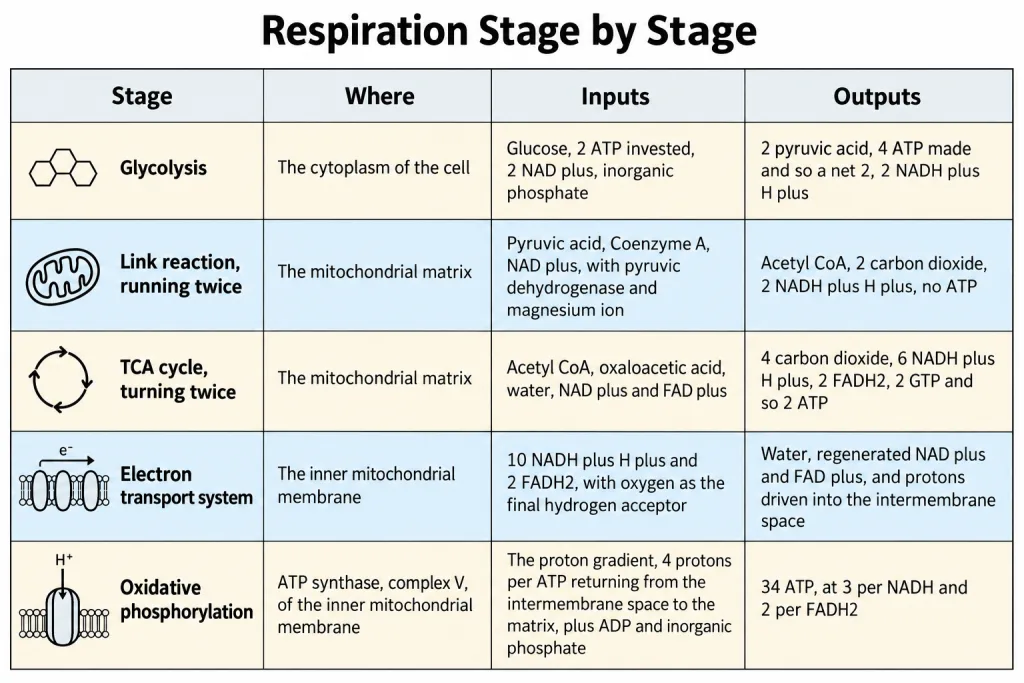
Now the ledger. Build the 38 rather than memorising it - the two halves are what each stage produced and what each reduced coenzyme is worth.
| Stage, per one glucose | Where | ATP at the substrate level | ATP after conversion | ||
|---|---|---|---|---|---|
| Glycolysis | Cytoplasm | 2 net, that is 4 made minus 2 spent | 2 | 0 | 2 plus (2 x 3) = 8 |
| Link reaction, twice | Matrix | 0 | 2 | 0 | (2 x 3) = 6 |
| TCA cycle, twice | Matrix | 2, from succinyl-CoA to succinic acid, via GTP | 6 | 2 | 2 plus (6 x 3) plus (2 x 2) = 24 |
| Totals | 4 | 10 | 2 | 38 |
Read the split before you leave the table. Only 4 of the 38 come from substrate level phosphorylation - 2 net in glycolysis and 2 in the TCA cycle - while the other 34 come from oxidative phosphorylation, which is 30 from the ten at 3 each and 4 from the two at 2 each. That is why the electron transport system carries so much of the chapter.
The Eight Comparisons Worth Memorising
- Respiration against combustion - combustion is a single uncontrolled step in which most of the energy is given out as heat; respiration oxidises the same glucose in several small enzyme-controlled steps, some of them just large enough that the released energy can be coupled to ATP synthesis. The end products are the same, and ; what differs is that respiration traps the energy as ATP instead of losing it as heat. That is also the answer to the significance of the step-wise release of energy.
- Glycolysis against the Krebs' cycle - glycolysis is in the cytoplasm, present in all living organisms, needs no oxygen, is linear, not cyclic, takes glucose to two pyruvic acid by partial oxidation, and gives a net 2 ATP and 2 per glucose, with no released; the Krebs' cycle is in the mitochondrial matrix, works only when oxygen is available, is cyclic, with oxaloacetic acid regenerated, takes the 2C acetyl group to , and gives per turn 3 , 1 , 1 GTP and 2 . No carbon dioxide leaves during glycolysis at all - that row alone answers several questions.
- Aerobic against anaerobic respiration - aerobic respiration requires , completely oxidises the substrate to and , runs glycolysis, the link reaction, the TCA cycle and the ETS, is located in the cytoplasm and then the mitochondria, and yields a possible net 38 ATP per glucose; anaerobic respiration needs no , oxidises the substrate incompletely to ethanol and or to lactic acid, runs only glycolysis plus the fermentation steps, is entirely in the cytoplasm, and yields a net 2 ATP per glucose. Aerobic respiration is most common in higher organisms.
- Glycolysis against fermentation - glycolysis is the ten-reaction pathway that takes glucose to two pyruvic acid, and it is common to both routes; fermentation is what a cell does to that pyruvic acid when there is no oxygen. Glycolysis makes the ATP - a net 2 - and makes ; fermentation makes no ATP whatever and spends the . The purpose of the fermentation steps is to reoxidise to so that glycolysis can keep running, and that is the only reason the cell makes its own acid or alcohol.
- Alcoholic against lactic acid fermentation - alcoholic fermentation is carried out by yeast, uses pyruvic acid decarboxylase and alcohol dehydrogenase, goes through acetaldehyde, gives ethanol and , and releases carbon dioxide; lactic acid fermentation is carried out by some bacteria and by animal muscle when oxygen is inadequate during exercise, uses lactate dehydrogenase, gives lactic acid only, and releases no carbon dioxide, because the 3C pyruvate simply becomes 3C lactate. Both use as the reducing agent and recover .
- Substrate level against oxidative phosphorylation - substrate level phosphorylation makes the high energy bond directly in a chemical reaction on a substrate molecule, needs no membrane, no gradient and no oxygen, and happens at BPGA to 3-phosphoglyceric acid and PEP to pyruvic acid in glycolysis, and at succinyl-CoA to succinic acid in the TCA cycle, giving 4 ATP per glucose; oxidative phosphorylation makes ATP through ATP synthase as protons collapse back down a gradient across the inner mitochondrial membrane, requires the ETS and , and gives 34 ATP per glucose. The GTP of the TCA cycle is substrate level, not oxidative - that is the standard trap.
- Oxidative phosphorylation against photophosphorylation - the chapter 11 contrast, and the most heavily examined comparison in either chapter. The organelle is the mitochondrion against the chloroplast; the membrane is the inner mitochondrial membrane against the thylakoid membrane; protons accumulate in the intermembrane space against the thylakoid lumen; they return to the matrix against the stroma; the channel is against and the catalytic headpiece is against ; the terminal electron acceptor is , reduced to water, against ; and above all the gradient is built by the energy of oxidation-reduction against light energy. What is identical is the mechanism - a membrane, a proton gradient, a channel and a catalytic headpiece; build a gradient with whatever energy you have, then let it collapse through ATP synthase.
- Catabolic against amphibolic - a catabolic pathway only breaks molecules down and releases energy; an amphibolic pathway does both, because its intermediates are drawn on for synthesis as well. Respiration was traditionally considered catabolic, but fatty acids are broken down to acetyl CoA to enter the pathway, and acetyl CoA is withdrawn from the pathway when fatty acids are to be synthesised, and during breakdown and synthesis of protein too, respiratory intermediates form the link. Since the pathway is involved in both anabolism and catabolism, it is better considered amphibolic. Amphi means both - the distractors pair the word with needing oxygen or occurring in the mitochondria, and neither has anything to do with it.
Writing the Chapter-End Exercises Well
Class 11 has no board paper, but the twelve chapter-end exercises are the best test of this chapter that exists. Between them they cover three sets of differences, two schematic diagrams, the main steps of aerobic respiration, the ETS, the assumptions, the amphibolic argument, RQ and oxidative phosphorylation - which is very nearly the whole chapter. Marks are lost here cheaply, by naming a molecule and never saying which compartment it sits in or how much it yields.
What a schematic of glycolysis must carry as labels. One exercise asks for the schematic representation of glycolysis, and a diagram without labels earns almost nothing. Draw it as a vertical chain of ten steps and put these labels on it, in this order: glucose at the top; the arrow to glucose-6-phosphate marked with hexokinase and with ATP spent; the isomerisation to fructose-6-phosphate; the arrow to fructose 1,6-bisphosphate marked with the second ATP spent; the split into dihydroxyacetone phosphate and 3-phosphoglyceraldehyde (PGAL); a note that everything below this line happens twice; the arrow from PGAL to 1,3-bisphosphoglycerate (BPGA) marked with going to and with inorganic phosphate joining; the arrow from BPGA to 3-phosphoglyceric acid marked with ATP made; the run down to PEP; and the arrow from PEP to pyruvic acid marked with the second ATP made. Finish outside the diagram with the totals - 2 ATP used, 4 made, net 2, 2 , 2 pyruvic acid - and with the site, the cytoplasm. A student who marks the two ATP-spending arrows and the two ATP-making arrows has already earned most of the marks.
What a Krebs' cycle diagram must carry. The exercise asks for the schematic representation of an overall view of Krebs' cycle, so draw a closed loop, not a line. Enter at the top with acetyl CoA (2C) joining oxaloacetic acid (4C) and water and mark the arrow citrate synthase, CoA released. Then go round the loop labelling citric acid (6C), isocitrate, -ketoglutaric acid (5C) with leaving on that arrow, succinyl-CoA (4C) with the second leaving, succinic acid (4C) with GTP made and marked substrate level phosphorylation, and malic acid (4C) returning to oxaloacetic acid. Mark three arrows with to and one arrow with to , and write matrix of the mitochondria beside the loop. The three things that get missed are the water in the first step, the carbon count under each intermediate and the label on the GTP arrow.
Laying out the 38-ATP derivation so the marker can follow it. Never write the number alone. Set it out as two short tables in a fixed order. The first table lists stage, site, substrate-level ATP, , for glycolysis (cytoplasm, 2 net, 2, 0), the link reaction running twice (matrix, 0, 2, 0) and the TCA cycle turning twice (matrix, 2, 6, 2), and closes with the totals 4, 10 and 2. The second table converts them: 4 ATP at the substrate level, 10 at 3 each giving 30, 2 at 2 each giving 4, a net gain of 38 per molecule of glucose. Then add one closing sentence - there can be a net gain of 38 ATP, and only on the four assumptions, because in a living system all pathways work simultaneously and do not take place one after another. Writing "38" with no working is worth almost nothing; writing the two tables is worth all of it. When a separate exercise asks for the assumptions, give four separate bullets, since marks are given per point, and do not forget the second one - the NADH synthesised in glycolysis is transferred into the mitochondria and undergoes oxidative phosphorylation.
The habit that every one of the twelve rewards. Name the stage, then the compartment, then the yield, in that order. "What are the main steps in aerobic respiration and where does it take place?" is answered as glycolysis in the cytoplasm giving a net 2 ATP and 2 ; the link reaction in the matrix giving acetyl CoA, and 2 ; the TCA cycle in the matrix giving 6 , 2 , 2 ATP and 4 ; and the ETS with oxidative phosphorylation on the inner mitochondrial membrane giving 34 ATP and water. "Explain ETS" is answered as a system of electron carriers on the inner mitochondrial membrane - complex I, complex II, complex III, cytochrome c as a mobile carrier on the outer surface of the inner membrane, complex IV and complex V - through which electrons from and pass to , forming water, with 3 ATP per NADH and 2 per . "What is oxidative phosphorylation?" is answered as the synthesis of ATP from ADP and inorganic phosphate using the energy of oxidation-reduction released as electrons pass along the ETS, carried out by ATP synthase, complex V - and unlike photophosphorylation, where light energy produces the gradient. "Define RQ. What is its value for fats?" is answered as the ratio of the volume of evolved to the volume of consumed, with no unit, and 0.7 for a fat such as tripalmitin, since 102 come out for 145 taken in. And "discuss the respiratory pathway is an amphibolic pathway" is marked on the argument, not the word - give the fatty acid example in full, acetyl CoA in during breakdown and acetyl CoA out during synthesis, then say protein behaves the same way through respiratory intermediates.
NEET Strategy
What the paper asks. Respiration in Plants is a high-yield, low-effort chapter, because almost every question is a number, a location, an enzyme name or a two-way comparison. Nothing has to be derived, and the only arithmetic is multiplying reduced coenzymes by 3 and 2. That makes it a chapter where speed comes from certainty, and the minutes saved here are minutes kept for the chapters that genuinely need working out.
The marking is +4 and -1. On a pure-recall question, a coin flip between two options loses marks on average. If both the number and the compartment have genuinely gone, leave it and bank the time.
Budget. Aim for 25 to 30 seconds per question in this chapter. If a question is still open at forty seconds, staring at it will not fix it - mark it and move on.
The four shapes, in the order they are easiest to attempt.
- Give the number. Fastest of all if the ladder is in your head - net 2 and gross 4 from glycolysis; 1 and 1 per pyruvate in the link reaction; 3 , 1 , 1 GTP and 2 per turn; 8 and 2 by the end of the TCA cycle, 10 and 2 for the balance sheet; 3 ATP per NADH and 2 per ; 4 protons per ATP; 4 substrate-level and 34 oxidative, total 38; less than seven per cent and about 13 per cent; RQ 1.0, about 0.9 and 0.7. Answer in five seconds or move.
- Name the enzyme, the intermediate or the complex. The clue is given, so there is nothing to work out. Sucrose to glucose and fructose - invertase. Glucose to glucose-6-phosphate - hexokinase. Pyruvic acid to acetyl CoA - pyruvic dehydrogenase. Pyruvic acid to acetaldehyde - pyruvic acid decarboxylase. Pyruvic acid to lactic acid - lactate dehydrogenase. Acetyl CoA plus OAA to citric acid - citrate synthase. Mobile carrier between complex III and IV - cytochrome c.
- Say which compartment. Read until one clue fixes the place and stop reading. "Ten reactions, all living organisms" is the cytoplasm; "oxidative decarboxylation" and "citrate synthase" are the matrix; "complexes I to V" is the inner mitochondrial membrane; "protons accumulate" is the intermembrane space.
- Compare two stages, or spot the incorrect statement. Leave these for last. A "which is NOT" or "which is INCORRECT" question forces you to check all four options and costs two to three times what the others cost.
Read the direction word before you read the options. NOT, INCORRECT and respectively are the three words that turn a fact you know into a mark you lose. Underline them as you read the stem. In a respectively question, match the first item first - with a pair like 3 and 2 for NADH and that usually eliminates two options in a single step.
One habit that fits this chapter in particular. Before choosing a number, ask per what? - per pyruvate, per turn of the cycle, or per glucose. The wrong option in this chapter is almost never invented; it is a true number quoted against the wrong unit: the gross 4 offered as the net 2, the 3 of one turn offered as the 6 of two turns, the 8 by the end of the TCA cycle offered as the 10 of the balance sheet, the 1 of the link reaction offered per glucose instead of per pyruvate.
The Mistakes That Cost the Most Marks
- Writing 4 ATP as the yield of glycolysis. Four ATP are synthesised and two are utilised, so the net gain is 2 per glucose. ATP is spent at glucose to glucose-6-phosphate and at fructose-6-phosphate to fructose 1,6-bisphosphate, and made at BPGA to 3-phosphoglyceric acid and at PEP to pyruvic acid, each of the last two happening twice. Read whether the stem says net or synthesised.
- Moving glycolysis into the mitochondrion. Glycolysis occurs in the cytoplasm of the cell, is present in all living organisms, and in anaerobic organisms it is the only process in respiration. The TCA cycle is in the matrix and needs oxygen to keep going; no is released during glycolysis at all.
- Counting the link reaction as part of glycolysis or of the Krebs' cycle. It is neither - it is the oxidative decarboxylation of pyruvic acid by pyruvic dehydrogenase in the mitochondrial matrix, needing , Coenzyme A and , and it releases exactly one per pyruvate and makes no ATP. And do not confuse pyruvic dehydrogenase with pyruvic acid decarboxylase, which works in the cytoplasm of a fermenting yeast and makes acetaldehyde.
- Saying the TCA cycle makes ATP directly. During the conversion of succinyl-CoA to succinic acid a molecule of GTP is synthesised, and this is a substrate level phosphorylation; in a coupled reaction GTP is converted to GDP with the simultaneous synthesis of ATP from ADP. The label the examiner wants is substrate level phosphorylation, and the distractor is always oxidative phosphorylation.
- Mixing up the per-turn and the per-glucose coenzyme counts. Three and one per turn. Two turns give 6 and 2; add the 2 from the two link reactions for 8 and 2 by the end of the TCA cycle; add the 2 from glycolysis for 10 and 2 in the balance sheet. If the stem says in the TCA cycle the NADH answer is 6, if it says so far it is 8, and if it says available to the ETS it is 10.
- Giving three ATP, or forgetting why it gets two. Oxidation of one molecule of NADH gives rise to 3 molecules of ATP; oxidation of one molecule of produces 2 molecules of ATP, and the reason is that enters the chain at complex II and so bypasses complex I - a shorter run, less energy released along the way.
- Getting the ETS components or their order wrong. Complex I is NADH dehydrogenase; complex II is the entry point from succinate oxidation; complex III is the cytochrome complex; complex IV is the cytochrome c oxidase complex with cytochromes a and and two copper centres; complex V is ATP synthase. Cytochrome c is not a complex - it is a small protein attached to the outer surface of the inner membrane, acting as a mobile carrier between complex III and complex IV. The distractor swaps the copper centres for iron or magnesium.
- Dismissing oxygen because it acts only at the end. The role of oxygen is limited to the terminal stage of the process, and yet its presence is vital, since it drives the whole process by removing hydrogen from the system. Oxygen acts as the final hydrogen acceptor and is the ultimate acceptor of electrons, getting reduced to water. Take it away and the carriers stay reduced, and are never regenerated, and everything upstream halts.
- Swapping and , or the proton address. is an integral membrane protein complex forming the channel through which protons cross the inner membrane; the headpiece is a peripheral membrane protein complex containing the site for synthesis of ATP from ADP and inorganic phosphate - remember integral and peripheral. For each ATP produced, pass through from the intermembrane space to the matrix, down the electrochemical proton gradient. And keep the chapter 11 contrast straight: protons gather in the intermembrane space here and in the thylakoid lumen there; and here, and there; the energy of oxidation-reduction here, light energy there. The matrix and the stroma are where the protons return to, not where they gather.
- Treating 38 as a fact, and swapping the amphibolic entry points. There can be a net gain of 38 ATP, on four assumptions that are not really valid in a living system, because all pathways work simultaneously and do not take place one after another. Never write that the assumptions hold. While you are there, keep the entry points the right way round - the fatty acid goes in as acetyl CoA and the glycerol as PGAL, never the other way round - and remember that amino acids must be deaminated first, and that the respiratory pathway is amphibolic because it is involved in both anabolism and catabolism, not because it needs oxygen or sits in the mitochondria.
A Short Revision Plan
First pass - one hour. Read the chapter sections straight through without stopping to memorise. You are building the map: gas exchange and why respiration is not combustion, then glycolysis, then fermentation, then the link reaction, the TCA cycle, the electron transport system, ATP synthase and chemiosmosis, the balance sheet, the amphibolic pathway and the respiratory quotient. Do not stop to learn numbers on this pass - just notice that the road runs cytoplasm, matrix, matrix, inner membrane, that glucose is taken apart in small steps so the energy can be trapped as ATP, and that every stage has an address inside the cell.
Second pass - one hour and fifteen minutes. Work the Solved Examples in each section, writing the answers out rather than reading them, then check your wording against the answer given and mark only the words you missed. The marking-scheme keywords are in bold in every answer for exactly that purpose. Pay particular attention to the items on the gross and net ATP of glycolysis, the enzymes of the two fermentations, the coenzymes and cofactor of the link reaction, the GTP step and its label, the position of cytochrome c, and the four assumptions.
Third pass - forty-five minutes. Learn the five-row pathway table and the balance sheet table in this section, and the eight comparisons above. Then say the chain out loud in one run: glucose in the cytoplasm, two ATP spent, the six-carbon sugar split in two, reduced at PGAL to BPGA, two ATP made at BPGA to PGA and two more at PEP to pyruvate, a net 2 ATP and 2 and 2 pyruvic acid; pyruvate into the matrix, pyruvic dehydrogenase with Coenzyme A, and , one out and acetyl CoA left; acetyl CoA onto oxaloacetic acid with water by citrate synthase, citric acid to isocitrate to -ketoglutaric acid to succinyl-CoA with two leaving, GTP at succinyl-CoA to succinic acid, back round to oxaloacetic acid, three and one per turn; then the inner membrane, complex I to ubiquinone, complex II to ubiquinone, complex III to cytochrome c, cytochrome c to complex IV, complex IV to oxygen giving water; protons pushed into the intermembrane space, four of them back through per ATP made on . Then the numbers: 4 and 2 and net 2; 1 per pyruvate; 3, 1, 1 and 2 per turn; 8 and 2 then 10 and 2; 3 and 2 per coenzyme; 4 protons; 4 plus 34 giving 38; less than seven per cent and about 13 per cent; 1.0, about 0.9 and 0.7, and 102 over 145.
Fourth pass - one hour. Sit the 45 NEET-Pattern Practice Questions under time - 45 minutes, nothing looked up - then go back only to the rows of the tables your wrong answers came from. Redo the same questions three days later; the second attempt is what tells you whether the compartments and the numbers stuck.
The night before. Read the five-row pathway table once, then the balance sheet table, then the eight comparisons, then the ten mistakes. Nothing else, and no new material. If you have time for only one thing, read down the Where column of the pathway table and say aloud which compartment each stage happens in and what it yields. This chapter rewards a clean recent pass far more than a long one.