
Glucose Is the Favoured Substrate
Glucose is the favoured substrate for respiration. Everything you have learnt so far in this chapter - glycolysis, the link reaction, Krebs' cycle, the ETS - was traced starting from a glucose molecule, and that is not an accident of teaching. It is what the plant cell actually prefers.
All carbohydrates are usually first converted into glucose before they are used for respiration. A starch grain in a storage organ, or the sucrose arriving through the phloem, is not fed into the pathway as it stands. It is brought to glucose first, and only then respired.
Other substrates can also be respired. Fats and proteins are broken down to yield energy too. But here is the sentence that the question paper is built on: they do not enter the respiratory pathway at the first step.
That single line is the whole of this section in miniature. The respiratory pathway is not one door with one queue. It is a long road with several entry points, and which entry point a molecule uses depends on what that molecule is.
[NEET Important] The stem is almost always "the favoured substrate for respiration is" and the answer is glucose, with sucrose, starch and fatty acids offered as distractors. The second favourite stem is "other substrates enter the respiratory pathway" - and the key is not at the first step. Do not tick an option saying fats or proteins cannot be respired; they can be, just not from the beginning of the road.
Where Each Substrate Enters
Different substrates enter the respiratory pathway at different points, and this table is exactly how the question is asked - substrate on the left, entry point on the right.
| Substrate | Broken down first into | Enters the respiratory pathway |
|---|---|---|
| Fats | Glycerol and fatty acids | Not as fat - each half enters at its own point |
| Fatty acids | Acetyl CoA | As acetyl CoA, that is after glycolysis and after the link reaction |
| Glycerol | PGAL | As PGAL, which is a glycolysis intermediate |
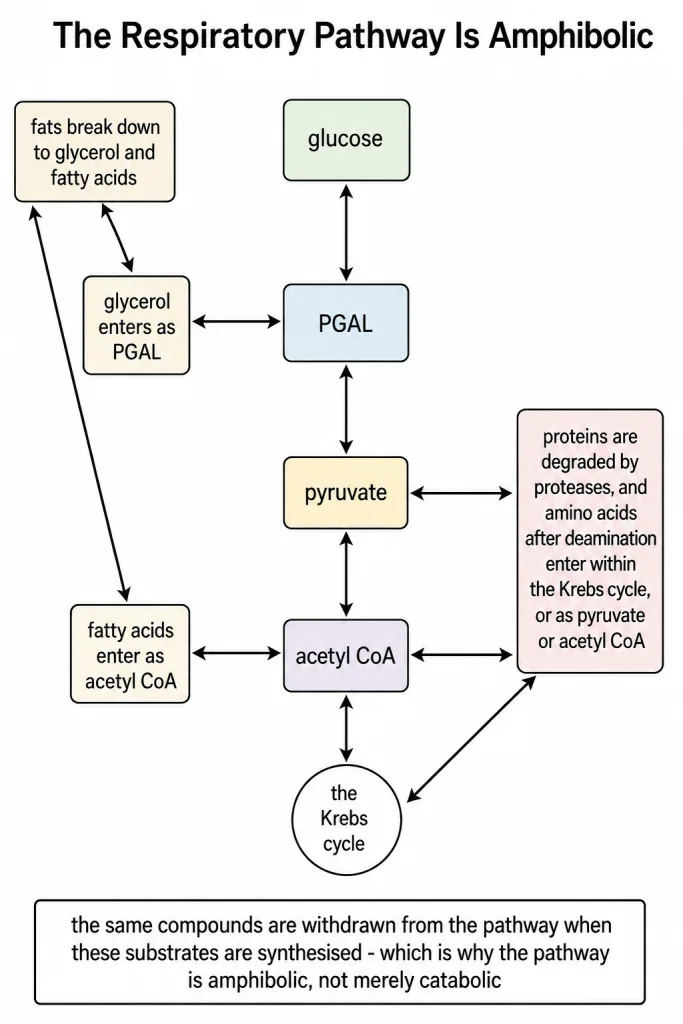
| Proteins | Amino acids, released by proteases, then deaminated | At some stage within the Krebs' cycle, or even as pyruvate or acetyl CoA |
Read the table one row at a time.
Fats would need to be broken down into glycerol and fatty acids first. A fat molecule has no single entry point - it is split into two chemically very different pieces, and the two pieces go their separate ways.
If fatty acids were to be respired they would first be degraded to acetyl CoA and enter the pathway there. Acetyl CoA is the 2C molecule that condenses with oxaloacetic acid to start the Krebs' cycle, so a respired fatty acid skips the whole of glycolysis.
Glycerol would enter the pathway after being converted to PGAL. PGAL, that is 3-phosphoglyceraldehyde, sits in the middle of glycolysis, so glycerol joins the road much earlier than a fatty acid does.
The proteins would be degraded by proteases, and the individual amino acids, after deamination, depending on their structure, would enter the pathway at some stage within the Krebs' cycle, or even as pyruvate or acetyl CoA. There is no one entry point for protein, because there is no one amino acid - the carbon skeleton left after the amino group is removed decides where that particular amino acid fits.
[NEET Important] Learn the four entry points as four pairs: fats to glycerol and fatty acids, fatty acids to acetyl CoA, glycerol to PGAL, amino acids after deamination into the Krebs' cycle or as pyruvate or acetyl CoA. The examiner's trap is to swap glycerol and fatty acid - glycerol goes to PGAL, the fatty acid goes to acetyl CoA, never the other way round. The second trap is forgetting deamination; an amino acid cannot enter the pathway carrying its amino group.
Is Respiration Only a Breaking-Down Process?
Since respiration involves breakdown of substrates, the respiratory process has traditionally been considered a catabolic process, and the respiratory pathway a catabolic pathway. That is the received view, and on the face of it the evidence for it is strong - glucose goes in, and come out, and big molecules become small ones.
But is this understanding correct? The chapter puts the question in exactly those words, and then answers it by looking again at the entry points you just tabulated.
Here is the argument, step by step.
Step one. You have just seen at which points different substrates enter the respiratory pathway if they are to be respired and used to derive energy.
Step two. What is important to recognise is that it is these very compounds that would be withdrawn from the respiratory pathway for the synthesis of the said substrates. The same molecule that is the entrance when the substrate is being pulled apart is the exit when the substrate is being put together.
Step three - the fatty acid case. Fatty acids would be broken down to acetyl CoA before entering the respiratory pathway when a fatty acid is being used as a substrate. But when the organism needs to synthesise fatty acids, acetyl CoA would be withdrawn from the respiratory pathway for it. Hence the respiratory pathway comes into the picture both during breakdown and synthesis of fatty acids. Acetyl CoA is a two-way door.
Step four - the protein case. Similarly, during breakdown and synthesis of protein too, respiratory intermediates form the link. The Krebs' cycle acids that accept a deaminated amino acid on the way in are the same acids that are withdrawn to build an amino acid on the way out.
[NEET Important] This is a discuss-type chapter-end question, and it is marked on the argument, not on the word. Write the fatty acid example in full - acetyl CoA in during breakdown, acetyl CoA out during synthesis - and then say that protein behaves the same way through respiratory intermediates. A student who only writes "the pathway does both" without an example loses most of the marks.
Catabolism, Anabolism, and Why the Pathway Is Amphibolic
Two definitions finish the argument, and both are one line each.
- Breaking down processes within the living organism is catabolism.
- Synthesis is anabolism.
Because the respiratory pathway is involved in both anabolism and catabolism, it would hence be better to consider the respiratory pathway as an amphibolic pathway rather than as a catabolic one.
| Catabolic pathway | Anabolic pathway | Amphibolic pathway | |
|---|---|---|---|
| What it does | Breaks molecules down | Builds molecules up | Does both |
| Energy | Releases energy | Consumes energy | Both, depending on the direction |
| Example from this chapter | Glucose oxidised to and | Acetyl CoA used to build fatty acids | The respiratory pathway itself |
The word is worth unpacking. Amphi means both - the pathway faces both ways at once. The intermediates of glycolysis and the Krebs' cycle are not just waste stations on a demolition route; they are the common pool from which the cell draws carbon skeletons when it needs to build.
This is why the figure for this section is drawn as a hub with arrows going in and out, and not as an arrow pointing one way. Respiration mediated breakdown of different organic molecules to and is only half of what the diagram shows.
[NEET Important] The one-mark version is "the respiratory pathway is amphibolic because it is involved in both anabolism and catabolism". Keep the three words apart: catabolism is breaking down, anabolism is synthesis, amphibolic is both. The classic distractor pairs amphibolic with "requires oxygen" or "occurs in the mitochondria" - neither has anything to do with the term.
Quick Recap
- Glucose is the favoured substrate for respiration.
- All carbohydrates are usually first converted into glucose before they are used for respiration.
- Other substrates can also be respired, but they do not enter the respiratory pathway at the first step.
- Fats would need to be broken down into glycerol and fatty acids first.
- Fatty acids, if respired, are first degraded to acetyl CoA and enter the pathway there.
- Glycerol enters the pathway after being converted to PGAL.
- Proteins are degraded by proteases, and the individual amino acids, after deamination, depending on their structure, enter the pathway at some stage within the Krebs' cycle, or even as pyruvate or acetyl CoA.
- Because respiration involves breakdown of substrates, the respiratory process has traditionally been considered a catabolic process and the pathway a catabolic pathway.
- The very compounds that enter the pathway when a substrate is respired are the compounds withdrawn from the pathway for the synthesis of that substrate.
- Fatty acids are broken down to acetyl CoA before entering the pathway; when the organism needs to synthesise fatty acids, acetyl CoA is withdrawn from the pathway for it.
- Hence the respiratory pathway comes into the picture both during breakdown and synthesis of fatty acids.
- During breakdown and synthesis of protein too, respiratory intermediates form the link.
- Catabolism is the breaking down of processes within the living organism; anabolism is synthesis.
- Because the respiratory pathway is involved in both anabolism and catabolism, it is better considered an amphibolic pathway rather than a catabolic one.
Solved Examples
Question 1
Q. Which substrate is favoured for respiration, and what happens to the other carbohydrates?
Answer. Glucose is the favoured substrate for respiration. All carbohydrates are usually first converted into glucose before they are used for respiration, so starch and sucrose are brought to glucose and only then respired.
Question 2
Q. Can substrates other than glucose be respired? If so, at what point do they join the pathway?
Answer. Yes, other substrates can also be respired, but they do not enter the respiratory pathway at the first step. Each substrate has its own entry point further along the pathway, decided by what it is broken down into first.
Question 3
Q. What must happen to a fat before it can be respired?
Answer. Fats would need to be broken down into glycerol and fatty acids first. A fat does not enter the pathway as a whole molecule - it is split into two pieces that then enter at two different points.
Question 4
Q. If fatty acids are respired, what are they degraded to, and where do they enter the respiratory pathway?
Answer. They would first be degraded to acetyl CoA and enter the pathway there. Acetyl CoA is the 2C molecule that condenses with oxaloacetic acid to begin the Krebs' cycle, so a respired fatty acid bypasses the whole of glycolysis.
Question 5
Q. Where does glycerol enter the respiratory pathway?
Answer. Glycerol would enter the pathway after being converted to PGAL, that is 3-phosphoglyceraldehyde. PGAL is an intermediate of glycolysis, so glycerol joins the pathway earlier than a fatty acid does.
Question 6
Q. How do proteins enter the respiratory pathway?
Answer. The proteins would be degraded by proteases. The individual amino acids, after deamination, depending on their structure, would enter the pathway at some stage within the Krebs' cycle, or even as pyruvate or acetyl CoA. There is no single entry point, because the carbon skeleton left behind after the amino group is removed differs from one amino acid to the next.
Question 7
Q. What are respiratory substrates? Name the most common respiratory substrate. This is one of the chapter-end exercises.
Answer. Respiratory substrates are the organic compounds that are oxidised during respiration to release energy. They are the fuel of the cell - the molecules whose C-C bonds are broken by oxidation so that the energy locked in them can be trapped as ATP.
The most common respiratory substrate is glucose. Glucose is the favoured substrate for respiration, and all carbohydrates are usually first converted into glucose before they are used for respiration.
The alternatives, and where each one joins the pathway:
| Respiratory substrate | What happens to it | Entry point |
|---|---|---|
| Carbohydrates | Converted to glucose | At the first step, glycolysis |
| Fats | Broken into glycerol and fatty acids | The two halves enter separately |
| Fatty acids | Degraded to acetyl CoA | As acetyl CoA |
| Glycerol | Converted to PGAL | Within glycolysis |
| Proteins | Degraded by proteases to amino acids, then deaminated | Within the Krebs' cycle, or as pyruvate or acetyl CoA |
The one line to remember: fats and proteins can also be broken down to yield energy, but only glucose enters at the first step.
Question 8
Q. Why has respiration traditionally been considered a catabolic process?
Answer. Because respiration involves breakdown of substrates. Large organic molecules are taken apart into and with the release of energy, and breaking down processes within the living organism is catabolism.
Question 9
Q. Define catabolism and anabolism.
Answer. Breaking down processes within the living organism is catabolism. Synthesis is anabolism. Catabolism releases energy; anabolism consumes it.
Question 10
Q. Discuss: the respiratory pathway is an amphibolic pathway. This is one of the chapter-end exercises.
Answer. The claim is that the respiratory pathway is not a one-way demolition route but a two-way road, used both for breaking substrates down and for building them up. Here is the argument in the order it should be written.
1. The traditional view. Since respiration involves breakdown of substrates, the respiratory process has traditionally been considered a catabolic process, and the respiratory pathway a catabolic pathway.
2. The entry points. Different substrates enter the respiratory pathway at different points if they are to be respired and used to derive energy. Fats are broken down into glycerol and fatty acids; fatty acids are degraded to acetyl CoA and enter there; glycerol enters after being converted to PGAL; proteins are degraded by proteases and the amino acids, after deamination, enter at some stage within the Krebs' cycle, or even as pyruvate or acetyl CoA.
3. The key recognition. It is these very compounds that would be withdrawn from the respiratory pathway for the synthesis of the said substrates. The molecule that is the way in during breakdown is the way out during synthesis.
4. The fatty acid example. Fatty acids would be broken down to acetyl CoA before entering the respiratory pathway when a fatty acid is used as a substrate. But when the organism needs to synthesise fatty acids, acetyl CoA would be withdrawn from the respiratory pathway for it. Hence the respiratory pathway comes into the picture both during breakdown and synthesis of fatty acids.
5. The protein example. Similarly, during breakdown and synthesis of protein too, respiratory intermediates form the link. The same Krebs' cycle acids that receive deaminated amino acids on the way in are withdrawn to build amino acids on the way out.
6. The definitions. Breaking down processes within the living organism is catabolism, and synthesis is anabolism.
7. The conclusion. Because the respiratory pathway is involved in both anabolism and catabolism, it would hence be better to consider the respiratory pathway as an amphibolic pathway rather than as a catabolic one.
Question 11
Q. Give one compound that acts as a link between the breakdown and the synthesis of fats.
Answer. Acetyl CoA. When a fatty acid is respired, it is degraded to acetyl CoA, which enters the respiratory pathway. When the organism needs to synthesise fatty acids, acetyl CoA is withdrawn from the respiratory pathway for that purpose. The same molecule, two directions.
Question 12
Q. What is deamination, and why must it happen before an amino acid is respired?
Answer. Deamination is the removal of the amino group from an amino acid. It must happen first because the respiratory pathway handles carbon skeletons, not nitrogen-containing groups. Once the amino group is off, the carbon skeleton that remains decides where that amino acid enters - at some stage within the Krebs' cycle, or as pyruvate or acetyl CoA.
Question 13
Q. What does the word amphibolic mean here, and why is it a better description than catabolic?
Answer. An amphibolic pathway is one that serves both breakdown and synthesis. Catabolic would describe only the breaking down, but the respiratory pathway also supplies the intermediates that are withdrawn to build fats and proteins. Since it is involved in both anabolism and catabolism, amphibolic is the more accurate word.
Question 14
Q. A plant cell is actively storing oil in its seeds. Which part of the respiratory pathway is it drawing on, and does this contradict calling respiration a breakdown process?
Answer. It is drawing acetyl CoA out of the respiratory pathway, because acetyl CoA is the compound from which fatty acids are built. It does not contradict anything - it is exactly the reason the pathway is called amphibolic. The same pathway that would degrade a fatty acid to acetyl CoA is now running the traffic the other way, and because it is involved in both anabolism and catabolism, it is best described as an amphibolic pathway rather than a catabolic one.