
What the Respiratory Quotient Measures
As you know, during aerobic respiration is consumed and is released. Two gases move in opposite directions across the same cell, and the amounts of the two are not always equal. That inequality is useful, and it is what this section measures.
The ratio of the volume of evolved to the volume of consumed in respiration is called the respiratory quotient (RQ) or respiratory ratio.
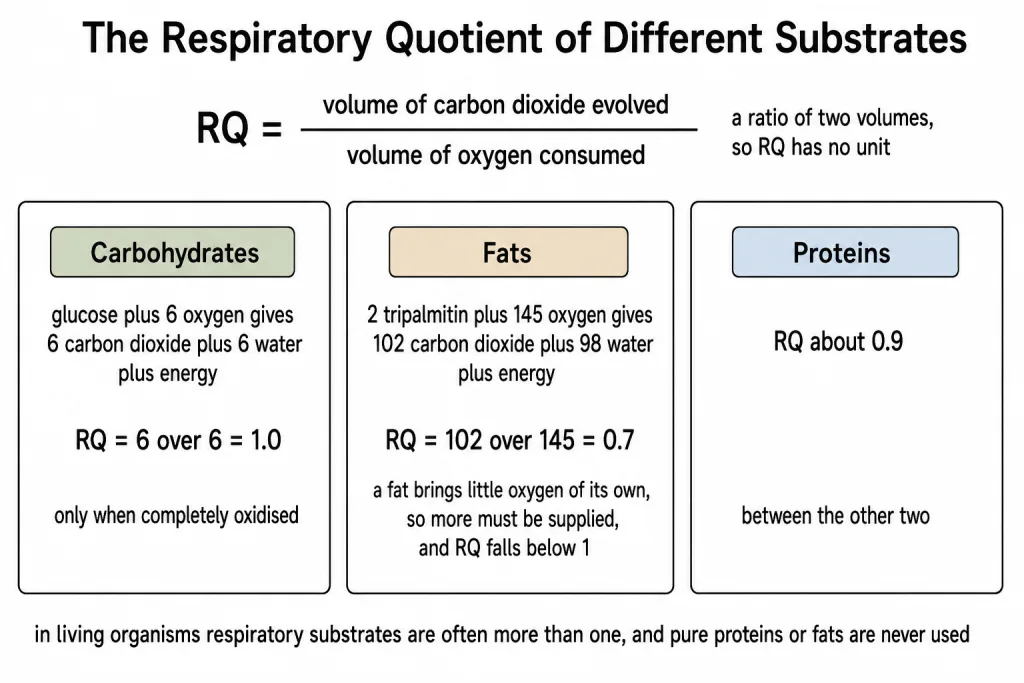
Note what sits where. Carbon dioxide evolved is on top; oxygen consumed is at the bottom. RQ is a pure ratio of two volumes, so it has no unit.
The respiratory quotient depends upon the type of respiratory substrate used during respiration. That is the whole reason the measurement is worth making - an RQ value is a clue to what the tissue is burning.
[NEET Important] Two things get asked and both are one line. The definition - volume of evolved divided by volume of consumed - and what RQ depends on, which is the type of respiratory substrate. The commonest trap is inverting the ratio; if you write oxygen on top you will report 1.43 for a fat instead of 0.7.
Carbohydrates Give an RQ of 1
When carbohydrates are used as substrate and are completely oxidised, the RQ will be 1, and the reason is arithmetic, not biology: equal amounts of and are evolved and consumed respectively.
Work it from the equation for the complete oxidation of glucose:
Six molecules of go in and six molecules of come out. Substituting into the definition:
Two conditions are hiding in that sentence and both matter. The substrate must be a carbohydrate, and it must be completely oxidised. If the oxidation is not complete, the tidy 1.0 does not follow.
[NEET Important] The examiner will give you a balanced equation and ask for the RQ - all you do is put the coefficient over the coefficient. For glucose that is 6 over 6, which is 1.0. Remember the qualifier completely oxidised; an option that says a carbohydrate always gives 1.0 whatever the conditions is written to be wrong.
Fats Give Less Than 1, Proteins About 0.9
When fats are used in respiration, the RQ is less than 1. The chapter works this out for tripalmitin, and the arithmetic is worth doing rather than memorising.
Two molecules of tripalmitin need 145 molecules of and give out only 102 molecules of . More oxygen goes in than carbon dioxide comes out, so the fraction must be less than one:
Compare the two formulas and the difference explains itself. Glucose is - six carbons carrying six oxygens of their own. Tripalmitin is - fifty-one carbons carrying only six oxygens. A fat brings far less oxygen of its own to the reaction, so far more has to be supplied from outside, and the denominator of the RQ grows.
When proteins are respiratory substrates the ratio would be about 0.9 - between the two.
| Respiratory substrate | RQ value |
|---|---|
| Carbohydrates, completely oxidised | 1.0 |
| Proteins | About 0.9 |
| Fats, for example tripalmitin | 0.7, that is less than 1 |
One caution before you use any of this on a real plant. What is important to recognise is that in living organisms, respiratory substrates are often more than one; pure proteins or fats are never used as respiratory substrates. A measured RQ from an actual tissue is therefore a mixture, and you should expect a value somewhere between the clean textbook numbers, not exactly 1.0 or exactly 0.7.
[NEET Important] Learn the ladder 1.0, about 0.9, 0.7 with carbohydrate, protein, fat against it, and learn 145 and 102 as a pair for tripalmitin. The most frequently missed line in the whole section is the last one: pure proteins or fats are never used as respiratory substrates, and in living organisms respiratory substrates are often more than one.
Quick Recap
- During aerobic respiration is consumed and is released.
- The ratio of the volume of evolved to the volume of consumed in respiration is called the respiratory quotient (RQ) or respiratory ratio.
- The formula: evolved on top, consumed below; RQ has no unit.
- The respiratory quotient depends upon the type of respiratory substrate used during respiration.
- Carbohydrates, when used as substrate and completely oxidised, give an RQ of 1, because equal amounts of and are evolved and consumed respectively.
- For glucose: plus energy, so RQ is 6 over 6, that is 1.0.
- When fats are used in respiration, the RQ is less than 1.
- For tripalmitin: 2 molecules plus 145 give 102 plus 98 plus energy, so RQ is 102 over 145, that is 0.7.
- When proteins are respiratory substrates the ratio would be about 0.9.
- In living organisms, respiratory substrates are often more than one.
- Pure proteins or fats are never used as respiratory substrates, so a real measured RQ is a mixed value, not a clean 1.0 or 0.7.
Solved Examples
Question 1
Q. Define RQ. What is its value for fats? This is one of the chapter-end exercises.
Answer. RQ, the respiratory quotient or respiratory ratio, is the ratio of the volume of evolved to the volume of consumed in respiration.
For fats the RQ is less than 1. Worked for tripalmitin, the value is 0.7:
Why it comes out below one: 145 molecules of oxygen are consumed but only 102 molecules of carbon dioxide are released, so the numerator is smaller than the denominator.
Question 2
Q. What does the respiratory quotient depend upon?
Answer. The respiratory quotient depends upon the type of respiratory substrate used during respiration. A carbohydrate, a protein and a fat each give a different value, which is why an RQ reading is a clue to what the tissue is respiring.
Question 3
Q. What is the RQ of a carbohydrate, and why?
Answer. When carbohydrates are used as substrate and are completely oxidised, the RQ will be 1, because equal amounts of and are evolved and consumed respectively.
Question 4
Q. Work out the RQ for the complete oxidation of glucose.
Answer. Write the balanced equation first:
Then put the carbon dioxide coefficient over the oxygen coefficient:
Six in, six out, so the RQ is 1.0.
Question 5
Q. Show the calculation of RQ when tripalmitin is used as the respiratory substrate.
Answer. The equation for tripalmitin is:
Two molecules of tripalmitin consume 145 molecules of oxygen and release 102 molecules of carbon dioxide. Substituting:
Question 6
Q. Why is the RQ of a fat lower than the RQ of a carbohydrate?
Answer. Because a fat needs far more oxygen from outside for every carbon dioxide it releases. Compare the two formulas: glucose is , six carbons already carrying six oxygens, while tripalmitin is , fifty-one carbons carrying only six oxygens. A fat brings almost no oxygen of its own, so the oxygen consumed in the denominator is large - 145 against 102 for tripalmitin - and the ratio falls below one.
Question 7
Q. What is the RQ when proteins are the respiratory substrate?
Answer. When proteins are respiratory substrates the ratio would be about 0.9. That places protein between carbohydrate at 1.0 and fat at 0.7.
Question 8
Q. Arrange carbohydrate, protein and fat in decreasing order of their RQ values.
Answer. Carbohydrate, then protein, then fat.
| Substrate | RQ |
|---|---|
| Carbohydrate, completely oxidised | 1.0 |
| Protein | About 0.9 |
| Fat | 0.7 |
Question 9
Q. Why is a measured RQ in a living plant rarely exactly 1.0 or exactly 0.7?
Answer. Because in living organisms, respiratory substrates are often more than one. Pure proteins or fats are never used as respiratory substrates, so the tissue is burning a mixture and the measured value falls somewhere between the clean values for the separate substrates.
Question 10
Q. Does RQ have a unit? Explain.
Answer. No. RQ is a ratio of one volume to another volume - the volume of evolved over the volume of consumed. The units cancel, so the answer is a plain number.
Question 11
Q. A germinating seed shows an RQ of about 0.7. What is it most likely respiring, and what would an RQ close to 1.0 have told you?
Answer. A value near 0.7 points to a fat, because when fats are used in respiration the RQ is less than 1, and for tripalmitin it works out to 0.7. A value close to 1.0 would have pointed to a carbohydrate being completely oxidised, since then equal amounts of and are evolved and consumed. Say "most likely", not "certainly" - respiratory substrates in living organisms are often more than one.
Question 12
Q. Which two gas volumes are compared in the respiratory quotient, and which one is the numerator?
Answer. The volume of evolved and the volume of consumed during respiration. Carbon dioxide evolved is the numerator; oxygen consumed is the denominator. Writing them the other way round inverts every value - a fat would then read about 1.43 instead of 0.7.