
Round the Cycle, Step by Step
The TCA cycle starts with the condensation of the acetyl group with oxaloacetic acid (OAA) and water to yield citric acid. The reaction is catalysed by the enzyme citrate synthase and a molecule of CoA is released.
Citrate is then isomerised to isocitrate.
It is followed by two successive steps of decarboxylation, leading to the formation of -ketoglutaric acid and then succinyl-CoA.
In the remaining steps of the citric acid cycle, succinyl-CoA is oxidised to OAA, allowing the cycle to continue.
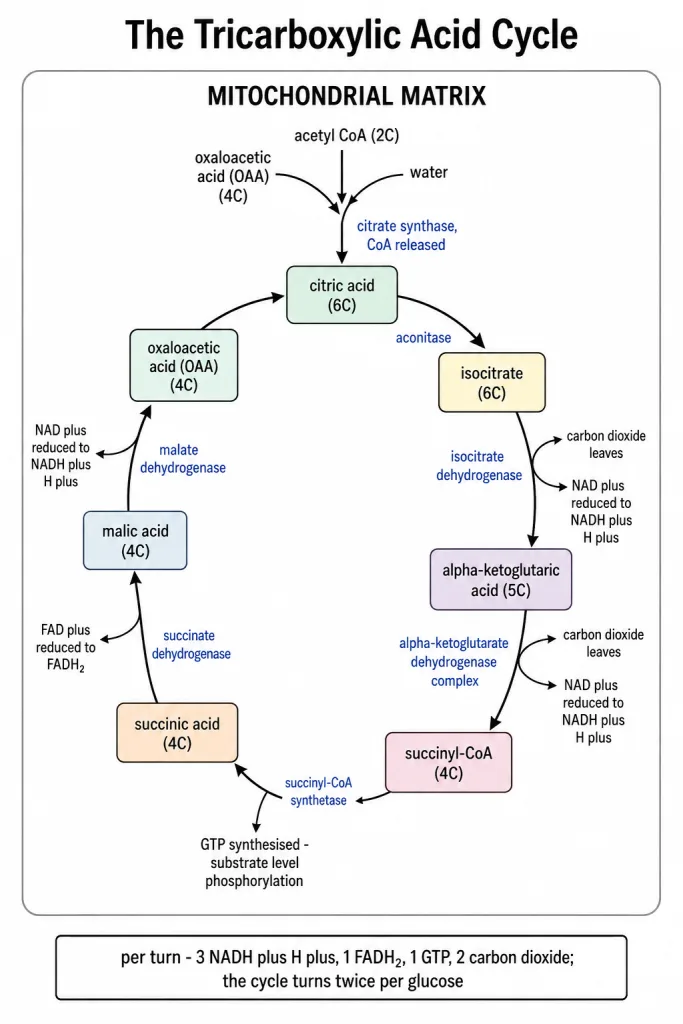
Follow the carbons and the cycle stops being a list of names. A 2C acetyl group joins a 4C acceptor to make a 6C acid; two carbons then leave as , taking it back down to 4C; and those four carbons are rebuilt into the acceptor so the whole thing can start again.
| Intermediate | Carbons | What happens at or after it |
|---|---|---|
| Oxaloacetic acid (OAA) | 4C | Condenses with the 2C acetyl group and water; citrate synthase; CoA released |
| Citric acid | 6C | Isomerised to isocitrate |
| -ketoglutaric acid | 5C | Formed by the first decarboxylation; leaves |
| Succinyl-CoA | 4C | Formed by the second decarboxylation; leaves |
| Succinic acid | 4C | Formed from succinyl-CoA with a GTP made |
| Malic acid | 4C | Oxidised in the last step to regenerate OAA |
Notice that the cycle is a true cycle. OAA goes in at the top and comes out at the bottom, so one molecule of it can process acetyl group after acetyl group.
[NEET Important] The enzyme name citrate synthase and the fact that water is a reactant in the very first step are both asked, and both are easy to skip. So is the release of CoA at that first step - the Coenzyme A is not consumed, it hands over its acetyl group and goes back for another pyruvate. The standard distractor for the first product is isocitrate; citric acid comes first, and is then isomerised.
What One Turn Yields
During the conversion of succinyl-CoA to succinic acid a molecule of GTP is synthesised. This is a substrate level phosphorylation. In a coupled reaction GTP is converted to GDP with the simultaneous synthesis of ATP from ADP.
Also there are three points in the cycle where is reduced to and one point where is reduced to .
| Yield per turn of the cycle | Number |
|---|---|
| 3 | |
| 1 | |
| GTP, and hence ATP | 1 |
| 2 |
Substrate level phosphorylation is worth pausing on. The ATP here is made directly, in a chemical reaction on a substrate molecule, not by a proton gradient across a membrane. In oxidative phosphorylation, which comes later in the chapter, it is the energy of oxidation-reduction that builds a proton gradient, and protons accumulate in the intermembrane space of the mitochondrion. Compare photosynthesis, where it is light energy that creates the gradient and the protons accumulate in the thylakoid lumen. The ATP synthase is the same machine in both, called and in the mitochondrion and and in the chloroplast. The GTP-forming step of the TCA cycle needs none of that machinery.
Keeping the cycle turning. The continued oxidation of acetyl CoA via the TCA cycle requires the continued replenishment of oxaloacetic acid, the first member of the cycle. In addition it also requires regeneration of and from NADH and respectively.
Both requirements are the reason the cycle stops the moment oxygen runs out. Nothing in the cycle itself uses , but without oxygen there is nowhere to unload the reduced coenzymes, so and are never handed back and the cycle grinds to a halt.
The summary equation for this phase of respiration, which takes place in the mitochondrial matrix, is:
Read the coefficients carefully. This equation is written per pyruvic acid, not per glucose, and it bundles the link reaction in with the cycle - which is why it shows 4 and 3 , rather than the 3 and 2 of the cycle alone.
[NEET Important] Three reduced, one reduced, one GTP per turn of the cycle - that ladder is asked in every form. The named step, succinyl-CoA to succinic acid, is asked for by itself, and so is the label substrate level phosphorylation, whose distractor is always oxidative phosphorylation.
Where the Chapter Stands Now
We have till now seen that glucose has been broken down to release , and that eight molecules of and two of have been synthesised inside the mitochondrion, besides just two molecules of ATP in the TCA cycle.
That is the running tally to memorise, and it is worth seeing where each figure comes from:
| Stage, per one glucose | ATP | ||
|---|---|---|---|
| Glycolysis, in the cytoplasm | 2 | 0 | 2 net |
| Link reaction, running twice | 2 | 0 | 0 |
| TCA cycle, turning twice | 6 | 2 | 2 |
| Made inside the mitochondrion - link reaction + TCA only | 8 | 2 | just 2 |
| Running total from one glucose, glycolysis included | 10 | 2 | 4 |
Why the eight is not the column added up. The eight counts only what happens inside the mitochondrion - two from the link reaction and six from the cycle. Glycolysis runs in the cytoplasm, so its two sit outside that figure. Count them in and one glucose has produced ten - and ten is the number the next section actually cashes in.
Now the honest question. Neither has come into the picture nor the promised large number of ATP has yet been synthesised. Also, what is the role of the and that is synthesised?
The answer is that the energy is not lost - it is stored in a different currency. Counting glycolysis as well, one glucose has loaded ten and two - twelve loaded carriers - and cashing them in is exactly what the next section is about. That is where finally appears, and where the large number of ATP is made.
[NEET Important] Eight , two , two ATP in the TCA cycle is the exact wording of the source and the exact wording of the question. The trap is the eight: the cycle itself makes only six, and the other two come from the link reaction. If the stem says "in the TCA cycle", the NADH answer is 6; if it says "so far" or "in total", it is 8.
Quick Recap
- The TCA cycle starts with the condensation of the acetyl group with oxaloacetic acid (OAA) and water to yield citric acid.
- The reaction is catalysed by the enzyme citrate synthase and a molecule of CoA is released.
- Citrate is then isomerised to isocitrate.
- Two successive steps of decarboxylation follow, leading to the formation of -ketoglutaric acid and then succinyl-CoA.
- In the remaining steps succinyl-CoA is oxidised to OAA, allowing the cycle to continue.
- Carbon counts: OAA 4C, citric acid 6C, -ketoglutaric acid 5C, succinic acid 4C, malic acid 4C, with acetyl CoA entering as 2C.
- During the conversion of succinyl-CoA to succinic acid a molecule of GTP is synthesised. This is a substrate level phosphorylation.
- In a coupled reaction GTP is converted to GDP with the simultaneous synthesis of ATP from ADP.
- There are three points in the cycle where is reduced to and one point where is reduced to .
- The continued oxidation of acetyl CoA via the TCA cycle requires the continued replenishment of oxaloacetic acid, the first member of the cycle.
- It also requires regeneration of and from NADH and respectively.
- The summary equation for this phase, in the mitochondrial matrix:
- Glucose has now been broken down to release , and eight molecules of and two of have been synthesised besides just two molecules of ATP in the TCA cycle.
- So far neither has come into the picture nor the large number of ATP been synthesised.
Solved Examples
Question 1
Q. How does the TCA cycle start?
Answer. With the condensation of the acetyl group with oxaloacetic acid (OAA) and water to yield citric acid. Note that water is one of the reactants - it is easy to miss.
Question 2
Q. Which enzyme catalyses the first step, and what is released?
Answer. The reaction is catalysed by the enzyme citrate synthase, and a molecule of CoA is released. Coenzyme A is not used up - it delivers the acetyl group and is freed to collect another.
Question 3
Q. What happens to citrate next?
Answer. Citrate is then isomerised to isocitrate. No carbon is gained or lost - the same six carbons are simply rearranged.
Question 4
Q. What do the two successive steps of decarboxylation produce?
Answer. They lead to the formation of -ketoglutaric acid and then succinyl-CoA. A molecule of leaves at each of the two steps, taking the 6C citric acid down to 5C and then to 4C.
Question 5
Q. What happens in the remaining steps of the cycle?
Answer. Succinyl-CoA is oxidised to OAA, allowing the cycle to continue. Regenerating the OAA is what makes it a cycle rather than a chain.
Question 6
Q. At which step is GTP synthesised, and what kind of phosphorylation is it?
Answer. During the conversion of succinyl-CoA to succinic acid a molecule of GTP is synthesised. This is a substrate level phosphorylation - the phosphate is transferred directly in a chemical reaction on a substrate, not through a proton gradient across a membrane.
Question 7
Q. How does the GTP become ATP?
Answer. In a coupled reaction GTP is converted to GDP with the simultaneous synthesis of ATP from ADP. So one turn of the cycle is counted as one ATP.
Question 8
Q. How many points in the cycle reduce NAD plus, and how many reduce FAD plus?
Answer. There are three points in the cycle where is reduced to and one point where is reduced to .
Question 9
Q. What must be continually supplied for the TCA cycle to keep running?
Answer. Two things. The continued oxidation of acetyl CoA via the TCA cycle requires the continued replenishment of oxaloacetic acid, the first member of the cycle. In addition it also requires regeneration of and from NADH and respectively.
Question 10
Q. Write the summary equation for this phase of respiration and say where it happens.
Answer. It takes place in the mitochondrial matrix.
The equation is written per molecule of pyruvic acid, and it includes the link reaction along with the cycle, which is why it shows 3 and 4 .
Question 11
Q. Give the carbon count of each named intermediate of the cycle.
Answer. Acetyl CoA 2C entering, then:
| Intermediate | Carbons |
|---|---|
| Oxaloacetic acid (OAA) | 4C |
| Citric acid | 6C |
| -ketoglutaric acid | 5C |
| Succinic acid | 4C |
| Malic acid | 4C |
The arithmetic checks out: 4C plus 2C gives 6C, then two decarboxylations take away 1C each, giving 5C and then 4C, and the last four-carbon intermediates rebuild the 4C OAA.
Question 12
Q. Give the schematic representation of an overall view of Krebs' cycle. This is one of the chapter-end exercises.
Answer. Draw a ring, with acetyl CoA entering it from outside at the top and the same acceptor regenerated at the end. A full-marks diagram carries all of the following labels.
The entry. Pyruvate (3C) stands above the ring. An arrow leads down from it, and and CoA go in while and come out, giving acetyl coenzyme A (2C). This is the link reaction, drawn outside the ring.
The ring itself, going clockwise, with every carbon count written in:
- Oxaloacetic acid (OAA), 4C - acetyl CoA and water condense with it, citrate synthase catalyses, CoA is released, and the product is
- Citric acid, 6C - isomerised to isocitrate; then an arrow carrying in, and out leads to
- -ketoglutaric acid, 5C - then an arrow carrying in, and out leads on to succinyl-CoA, and from there an arrow carrying GDP in and GTP out leads to
- Succinic acid, 4C - then an arrow carrying in and out leads to
- Malic acid, 4C - then an arrow carrying in and out closes the ring back at OAA.
The seven marks the examiner looks for:
- The ring shape, with OAA both consumed and regenerated.
- Acetyl CoA (2C) entering, and CoA released at the citrate synthase step.
- Every intermediate labelled with its carbon count - OAA 4C, citric acid 6C, -ketoglutaric acid 5C, succinic acid 4C, malic acid 4C.
- Three points where is reduced to , marked on the arrows.
- One point where is reduced to , at succinic acid.
- Two decarboxylation points where leaves the ring, on the way to -ketoglutaric acid and on the way to succinyl-CoA.
- The GTP-forming step, on the conversion of succinyl-CoA to succinic acid, labelled substrate level phosphorylation.
Write the per-turn tally beside the diagram: 3 , 1 , 1 GTP and hence 1 ATP, and 2 . Label the whole figure "mitochondrial matrix".
Question 13
Q. Where does the chapter stand at the end of the TCA cycle?
Answer. Glucose has been broken down to release , and eight molecules of and two of have been synthesised besides just two molecules of ATP in the TCA cycle. So far neither has come into the picture nor the large number of ATP been synthesised - the energy is sitting in the reduced coenzymes, waiting to be cashed in.
Question 14
Q. The cycle uses no oxygen anywhere. Why then does it stop when oxygen runs out?
Answer. Because of the regeneration requirement. The cycle requires regeneration of and from NADH and respectively, and oxygen is what makes that regeneration possible. With no oxygen the reduced coenzymes have nowhere to unload, no or comes back, and the three NAD-reducing steps and the one FAD-reducing step have nothing left to work with.
Question 15
Q. Why is the number of NADH so often got wrong at this point in the chapter?
Answer. Because two different totals are both correct, for two different questions. The TCA cycle itself makes 3 per turn, so 6 per glucose, since the cycle turns twice. The link reaction adds 2 more, giving 8 in all. If the question says "in the TCA cycle", answer 6; if it says "so far" or "in total", answer 8.