
Why the Balance Sheet Is Only a Theoretical Exercise
It is possible to make calculations of the net gain of ATP for every glucose molecule oxidised; but in reality this can remain only a theoretical exercise.
These calculations can be made only on certain assumptions, and there are four of them. They are a chapter-end exercise, so learn them as a set of four.
- There is a sequential, orderly pathway functioning, with one substrate forming the next and with glycolysis, TCA cycle and ETS pathway following one after another.
- The NADH synthesised in glycolysis is transferred into the mitochondria and undergoes oxidative phosphorylation.
- None of the intermediates in the pathway are utilised to synthesise any other compound.
- Only glucose is being respired - no other alternative substrates are entering the pathway at any of the intermediary stages.
Notice what each assumption is protecting. The first one lets us add the stages up as if they were steps in a queue. The second one lets us count the two glycolytic NADH at the full mitochondrial rate. The third one stops anything leaking out of the pathway to be built into something else. The fourth one stops anything leaking in.
[NEET Important] All four are asked as a list, and marks are given per point, so write four separate bullets, not a paragraph. The one students forget is the second - the NADH synthesised in glycolysis is transferred into the mitochondria and undergoes oxidative phosphorylation. Without it, the glycolytic NADH could not be counted the same way as the mitochondrial NADH, and the total would not come out at 38.
Why the Assumptions Do Not Hold, and Why We Still Do It
But this kind of assumption is not really valid in a living system. The chapter gives four reasons, one against each assumption:
- All pathways work simultaneously and do not take place one after another.
- Substrates enter the pathways and are withdrawn from them as and when necessary.
- ATP is utilised as and when needed.
- Enzymatic rates are controlled by multiple means.
A living cell is not a production line running one machine at a time. Glycolysis, the TCA cycle and the ETS are all going at once, and the intermediates are constantly being pulled out to build amino acids, fats and other molecules - which is the whole point of calling respiration an amphibolic pathway.
So why bother? Yet, it is useful to do this exercise, to appreciate the beauty and efficiency of the living system in extraction and storing energy.
Hence, there can be a net gain of 38 ATP molecules during aerobic respiration of one molecule of glucose.
[NEET Important] Read the wording of the conclusion carefully - there CAN BE a net gain of 38 ATP, not "there is". The examiner sets questions on why the number is theoretical, and the answer is the four reasons above, of which all pathways work simultaneously and do not take place one after another is the one most often quoted. Never write that the assumptions are valid.
Where the 38 Comes From
Do not memorise 38 blindly. Build it from the facts already established in this chapter, and it will never leave you.
Step one - collect what each stage produced, per molecule of glucose.
| Stage | Where it happens | Substrate-level ATP | ||
|---|---|---|---|---|
| Glycolysis | Cytoplasm | 2 (net; 4 made, 2 spent) | 2 | 0 |
| Pyruvic acid to acetyl CoA, happening twice | Mitochondrial matrix | 0 | 2 | 0 |
| TCA cycle, turning twice | Mitochondrial matrix | 2 | 6 | 2 |
| Totals | 4 | 10 | 2 |
Check the middle rows against the earlier sections. One glucose gives two pyruvic acid, so the link reaction and the TCA cycle each happen twice. Each turn of the TCA cycle has three points where is reduced to and one point where is reduced to , and one GTP, and so one ATP, is made at the substrate level when succinyl-CoA becomes succinic acid. Two turns therefore give 6 NADH, 2 and 2 ATP.
Step two - convert the reduced coenzymes into ATP using the rates from the electron transport system.
| Source of ATP | Number | ATP each | ATP obtained |
|---|---|---|---|
| Substrate-level phosphorylation | 4 | - | 4 |
| oxidised through the ETS | 10 | 3 | 30 |
| oxidised through the ETS | 2 | 2 | 4 |
| Net gain per molecule of glucose | 38 |
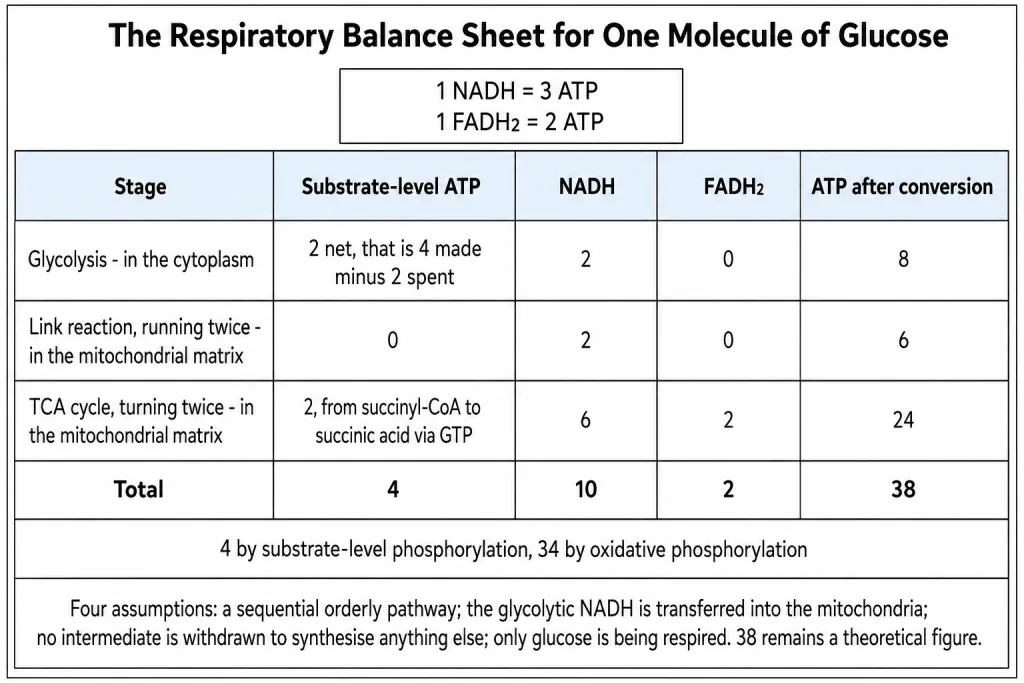
Read the split. Only 4 of the 38 come from substrate-level phosphorylation - 2 in glycolysis and 2 in the TCA cycle. The other 34 come from oxidative phosphorylation, which is why the electron transport system matters so much and why the chapter spends so long on it.
Where the 4 substrate-level ATP were made, exactly: BPGA to 3-phosphoglyceric acid and PEP to pyruvic acid, each happening twice in glycolysis - that is the gross 4, of which 2 are spent at the start, leaving a net 2; then succinyl-CoA to succinic acid, happening twice in the TCA cycle, for 2 more.
[NEET Important] Numerical questions almost always give you a count of coenzymes and ask for the ATP, so keep 10 NADH and 2 at your fingertips along with 3 and 2 as the conversion rates. The commonest distractor is 36, which appears if the glycolytic NADH is not counted at the full rate - remember that assumption two is exactly what allows us to count it at 3 ATP each and arrive at 38. The other trap asks for the ATP from substrate-level phosphorylation only, where the answer is 4, not 38.
Fermentation Compared with Aerobic Respiration
Now let us compare fermentation and aerobic respiration. The chapter gives three points, and all three are asked.
- Fermentation accounts for only a partial breakdown of glucose, whereas in aerobic respiration it is completely degraded to and .
- In fermentation there is a net gain of only two molecules of ATP for each molecule of glucose degraded to pyruvic acid, whereas many more molecules of ATP are generated under aerobic conditions.
- NADH is oxidised to rather slowly in fermentation, however the reaction is very vigorous in the case of aerobic respiration.
| Fermentation | Aerobic respiration | |
|---|---|---|
| Breakdown of glucose | Only partial | Completely degraded to and |
| Net ATP per glucose | Only two | Many more - a net gain of 38 |
| Oxidation of NADH to | Rather slow | Very vigorous |
Put the numbers next to each other and the contrast is stark. Fermentation gets 2 ATP; aerobic respiration gets 38 from the same molecule of glucose. The reason is exactly the one the first point gives - fermentation stops at pyruvic acid or its products and never touches the energy still locked in those carbon skeletons, while aerobic respiration takes the glucose all the way down to and .
[NEET Important] Give all three points when the comparison is asked - students routinely give the first two and lose the mark on the third. The third point is worth remembering in its own words: NADH is oxidised to rather slowly in fermentation, while the reaction is very vigorous in aerobic respiration.
Quick Recap
- It is possible to calculate the net gain of ATP for every glucose molecule oxidised, but in reality this can remain only a theoretical exercise.
- Assumption 1: there is a sequential, orderly pathway functioning, with one substrate forming the next and with glycolysis, TCA cycle and ETS pathway following one after another.
- Assumption 2: the NADH synthesised in glycolysis is transferred into the mitochondria and undergoes oxidative phosphorylation.
- Assumption 3: none of the intermediates in the pathway are utilised to synthesise any other compound.
- Assumption 4: only glucose is being respired - no other alternative substrates are entering the pathway at any of the intermediary stages.
- The assumptions are not really valid in a living system. All pathways work simultaneously and do not take place one after another; substrates enter the pathways and are withdrawn as and when necessary; ATP is utilised as and when needed; enzymatic rates are controlled by multiple means.
- Yet it is useful to do the exercise, to appreciate the beauty and efficiency of the living system in extraction and storing energy.
- There can be a net gain of 38 ATP molecules during aerobic respiration of one molecule of glucose.
- Per glucose the stages yield: glycolysis, net 2 ATP and 2 ; the two link reactions, 2 ; the two turns of the TCA cycle, 2 ATP, 6 and 2 .
- Totals: 4 ATP by substrate-level phosphorylation, 10 and 2 .
- Converting at 3 ATP per NADH and 2 ATP per : 30 plus 4 from oxidative phosphorylation, plus 4 at the substrate level, giving 38.
- Fermentation accounts for only a partial breakdown of glucose, whereas in aerobic respiration it is completely degraded to and .
- In fermentation there is a net gain of only two molecules of ATP for each molecule of glucose degraded to pyruvic acid, whereas many more are generated under aerobic conditions.
- NADH is oxidised to rather slowly in fermentation, while the reaction is very vigorous in aerobic respiration.
Solved Examples
Question 1
Q. Why is the respiratory balance sheet called a theoretical exercise?
Answer. Because the calculations can be made only on certain assumptions, and those assumptions are not really valid in a living system. It is possible to make calculations of the net gain of ATP for every glucose molecule oxidised, but in reality this can remain only a theoretical exercise.
Question 2
Q. What are the assumptions made during the calculation of net gain of ATP? This is one of the chapter-end exercises.
Answer. The calculations can be made only on four assumptions.
- There is a sequential, orderly pathway functioning, with one substrate forming the next, and with glycolysis, TCA cycle and ETS pathway following one after another.
- The NADH synthesised in glycolysis is transferred into the mitochondria and undergoes oxidative phosphorylation.
- None of the intermediates in the pathway are utilised to synthesise any other compound.
- Only glucose is being respired - no other alternative substrates are entering the pathway at any of the intermediary stages.
Why the answer must also say that these are not valid. In a living system all pathways work simultaneously and do not take place one after another; substrates enter the pathways and are withdrawn from them as and when necessary; ATP is utilised as and when needed; and enzymatic rates are controlled by multiple means.
Finish with the point of the exercise. It is still useful to do it, to appreciate the beauty and efficiency of the living system in extraction and storing energy, and on these assumptions there can be a net gain of 38 ATP molecules during aerobic respiration of one molecule of glucose.
Question 3
Q. Give the four reasons why the assumptions are not valid in a living system.
Answer. All pathways work simultaneously and do not take place one after another. Substrates enter the pathways and are withdrawn from them as and when necessary. ATP is utilised as and when needed. Enzymatic rates are controlled by multiple means.
Question 4
Q. If the assumptions are not valid, why do the calculation at all?
Answer. Because it is useful to do this exercise, to appreciate the beauty and efficiency of the living system in extraction and storing energy. The number shows how much of the energy in a glucose molecule a cell manages to trap in a usable form, even though the real cell never runs the pathways in the tidy order the calculation assumes.
Question 5
Q. What is the net gain of ATP during the aerobic respiration of one molecule of glucose?
Answer. There can be a net gain of 38 ATP molecules during aerobic respiration of one molecule of glucose.
Question 6
Q. How many and are available per glucose, and where does each come from?
Answer. Ten and two .
- 2 from glycolysis, in the cytoplasm.
- 2 from the conversion of pyruvic acid to acetyl CoA, which happens twice, once for each pyruvate.
- 6 and 2 from the TCA cycle, which turns twice, each turn giving three points where is reduced and one where is reduced.
Question 7
Q. Work out the 38 ATP from first principles.
Answer. Collect the products first, then convert them.
| Stage | Substrate-level ATP | ||
|---|---|---|---|
| Glycolysis | 2 net | 2 | 0 |
| Pyruvic acid to acetyl CoA, twice | 0 | 2 | 0 |
| TCA cycle, two turns | 2 | 6 | 2 |
| Total | 4 | 10 | 2 |
Now use the conversion rates from the electron transport system. Oxidation of one NADH gives 3 ATP; oxidation of one gives 2 ATP.
- 10 NADH x 3 = 30 ATP
- 2 x 2 = 4 ATP
- Substrate-level phosphorylation = 4 ATP
30 + 4 + 4 = a net gain of 38 ATP per molecule of glucose.
Question 8
Q. How much of the 38 ATP comes from substrate-level phosphorylation, and how much from oxidative phosphorylation?
Answer. Only 4 come from substrate-level phosphorylation - a net 2 in glycolysis and 2 in the TCA cycle. The remaining 34 come from oxidative phosphorylation, that is 30 from the ten and 4 from the two .
Question 9
Q. Which assumption is the total of 38 most sensitive to?
Answer. The second one - that the NADH synthesised in glycolysis is transferred into the mitochondria and undergoes oxidative phosphorylation. It is what lets the two glycolytic NADH be counted at 3 ATP each, along with the mitochondrial ones. Drop that assumption and those two NADH can no longer be counted the same way, and the total falls below 38.
Question 10
Q. Compare fermentation and aerobic respiration.
Answer. The chapter makes three comparisons.
- Fermentation accounts for only a partial breakdown of glucose, whereas in aerobic respiration it is completely degraded to and .
- In fermentation there is a net gain of only two molecules of ATP for each molecule of glucose degraded to pyruvic acid, whereas many more molecules of ATP are generated under aerobic conditions.
- NADH is oxidised to rather slowly in fermentation, however the reaction is very vigorous in the case of aerobic respiration.
| Fermentation | Aerobic respiration | |
|---|---|---|
| Breakdown of glucose | Partial | Complete, to and |
| Net ATP per glucose | Two | Many more - 38 |
| Oxidation of NADH | Rather slow | Very vigorous |
Question 11
Q. Why does fermentation yield only two ATP per glucose?
Answer. Because fermentation accounts for only a partial breakdown of glucose. The pathway stops at pyruvic acid and its products, so most of the energy is still locked in those carbon skeletons. The only ATP made is the net two from glycolysis, and there is no electron transport system to cash in the reduced coenzymes.
Question 12
Q. How does the oxidation of NADH differ in fermentation and in aerobic respiration?
Answer. NADH is oxidised to rather slowly in fermentation, however the reaction is very vigorous in the case of aerobic respiration.
Question 13
Q. In which process is glucose completely degraded, and to what?
Answer. In aerobic respiration, where it is completely degraded to and . Fermentation accounts for only a partial breakdown of glucose.