
Getting the Pyruvate In
For aerobic respiration to take place within the mitochondria, the final product of glycolysis, pyruvate, is transported from the cytoplasm into the mitochondria.
That transport is the hinge of the whole chapter. Glycolysis finished in the cytoplasm and left its pyruvate there; everything from here on happens inside an organelle.
The crucial events in aerobic respiration are three, and they are asked as a set:
- The complete oxidation of pyruvate by the stepwise removal of all the hydrogen atoms, leaving three molecules of .
- The passing on of the electrons removed as part of the hydrogen atoms to molecular with simultaneous synthesis of ATP.
- What is interesting to note is that the first process takes place in the matrix of the mitochondria while the second process is located on the inner membrane of the mitochondria.
| Event | Where it happens |
|---|---|
| Complete oxidation of pyruvate, all hydrogen atoms removed stepwise, leaving 3 | Matrix of the mitochondria |
| Electrons passed on to molecular , with simultaneous synthesis of ATP | Inner membrane of the mitochondria |
Read the first event carefully. Three molecules of per pyruvate - and pyruvate has exactly three carbons, so every one of them leaves as . That is what the word complete means here.
And notice what oxygen does not do. never touches the pyruvate. It waits at the very end of the second process to collect the electrons.
[NEET Important] The two-part split of location is the most-asked single fact of this section: oxidation in the matrix, electron transfer and ATP synthesis on the inner membrane. The distractor is outer membrane or intermembrane space. Learn also that three come from one pyruvate, not from one glucose - one glucose gives two pyruvates and therefore six .
The Link Reaction
Pyruvate, which is formed by the glycolytic catabolism of carbohydrates in the cytosol, after it enters the mitochondrial matrix undergoes oxidative decarboxylation by a complex set of reactions catalysed by pyruvic dehydrogenase.
The reactions catalysed by pyruvic dehydrogenase require the participation of several coenzymes, including and Coenzyme A.
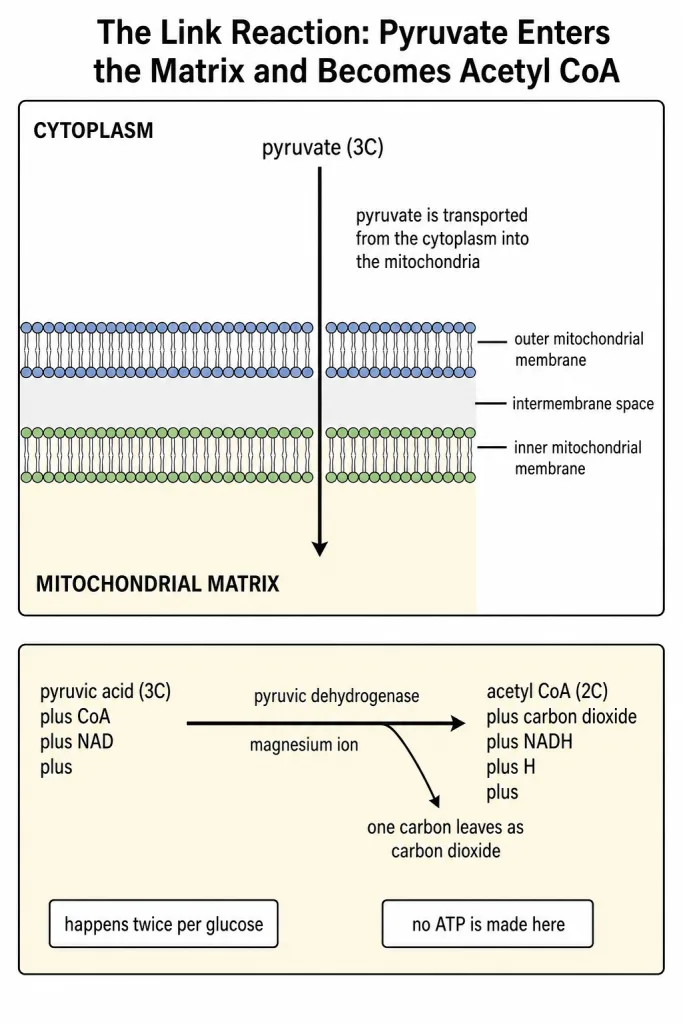
Take the name apart and the reaction explains itself. Oxidative - hydrogen is removed and handed to , which becomes . Decarboxylation - a carboxyl carbon is removed and leaves as . is the cofactor, and Coenzyme A picks up the two-carbon fragment that is left.
During this process, two molecules of NADH are produced from the metabolism of two molecules of pyruvic acid, produced from one glucose molecule during glycolysis.
The acetyl CoA then enters a cyclic pathway, the tricarboxylic acid cycle, more commonly called Krebs' cycle after the scientist Hans Krebs who first elucidated it.
[NEET Important] Do not confuse pyruvic dehydrogenase with pyruvic acid decarboxylase from the fermentation section - they are different enzymes doing different jobs in different places. Pyruvic dehydrogenase works in the mitochondrial matrix and makes acetyl CoA; pyruvic acid decarboxylase works in the cytoplasm of a fermenting yeast and makes acetaldehyde. The cofactor and the coenzymes and Coenzyme A are each asked directly.
The Carbon Bookkeeping, Done Twice
The link reaction is short, but the accounting matters more than the chemistry, because every later number in the chapter is built on it.
Per pyruvate:
| Carbons | |
|---|---|
| Pyruvate in | 3C |
| out | 1C |
| Acetyl CoA out | 2C |
One carbon leaves as at this step, and the remaining two-carbon acetyl group is carried on by Coenzyme A.
And all of it happens twice per glucose, because glycolysis produced two pyruvic acid molecules from one glucose:
| Per one glucose | Amount |
|---|---|
| Pyruvate entering the matrix | 2 |
| released in the link reaction | 2 |
| Acetyl CoA formed | 2 |
| formed | 2 |
| ATP formed | 0 |
So the link reaction makes no ATP whatever. Its entire yield is two and two molecules of acetyl CoA, and the acetyl CoA is what the next section spends.
Where the six carbons of glucose stand now. Two have left as in the link reaction. Four remain, as two acetyl groups of 2C each, and the tricarboxylic acid cycle exists to strip those four away as well.
[NEET Important] The phrase "two molecules of NADH are produced from the metabolism of two molecules of pyruvic acid" is a trap set for careless reading. It is 1 per pyruvate and 2 per glucose - the options will offer 1, 2, 3 and 4, and the answer depends entirely on whether the question says per pyruvate or per glucose.
Quick Recap
- For aerobic respiration to take place within the mitochondria, the final product of glycolysis, pyruvate, is transported from the cytoplasm into the mitochondria.
- Crucial event one: the complete oxidation of pyruvate by the stepwise removal of all the hydrogen atoms, leaving three molecules of .
- Crucial event two: the passing on of the electrons removed as part of the hydrogen atoms to molecular with simultaneous synthesis of ATP.
- The first process takes place in the matrix of the mitochondria; the second is located on the inner membrane of the mitochondria.
- Pyruvate is formed by the glycolytic catabolism of carbohydrates in the cytosol.
- After entering the mitochondrial matrix it undergoes oxidative decarboxylation by a complex set of reactions catalysed by pyruvic dehydrogenase.
- These reactions require the participation of several coenzymes, including and Coenzyme A, with as cofactor.
- The equation:
- Carbon count: pyruvate 3C, one carbon out as , acetyl CoA 2C.
- Two molecules of NADH are produced from the metabolism of two molecules of pyruvic acid, which came from one glucose molecule during glycolysis.
- The link reaction happens twice per glucose and yields no ATP.
- The acetyl CoA then enters a cyclic pathway, the tricarboxylic acid cycle, more commonly called Krebs' cycle after the scientist Hans Krebs who first elucidated it.
Solved Examples
Question 1
Q. What has to be moved before aerobic respiration can begin, and from where to where?
Answer. Pyruvate, the final product of glycolysis, is transported from the cytoplasm into the mitochondria. For aerobic respiration to take place within the mitochondria that transport must happen first.
Question 2
Q. State the crucial events in aerobic respiration.
Answer. There are two, plus a note on where each happens.
- The complete oxidation of pyruvate by the stepwise removal of all the hydrogen atoms, leaving three molecules of .
- The passing on of the electrons removed as part of the hydrogen atoms to molecular with simultaneous synthesis of ATP.
The first process takes place in the matrix of the mitochondria while the second process is located on the inner membrane of the mitochondria.
Question 3
Q. How many molecules of carbon dioxide are left by the complete oxidation of one pyruvate, and why that number?
Answer. Three. Pyruvate has three carbons, and complete oxidation means every one of them ends up as . Per glucose the figure is six, because glycolysis gives two pyruvates.
Question 4
Q. What happens to pyruvate as soon as it enters the mitochondrial matrix?
Answer. It undergoes oxidative decarboxylation by a complex set of reactions catalysed by pyruvic dehydrogenase. Hydrogen is removed and passed to , and one carbon is removed and leaves as .
Question 5
Q. Which coenzymes does pyruvic dehydrogenase require, and what is the cofactor?
Answer. The reactions catalysed by pyruvic dehydrogenase require the participation of several coenzymes, including and Coenzyme A. The cofactor shown with the reaction is .
Question 6
Q. Write the equation of the link reaction.
Answer.
Enzyme: pyruvic dehydrogenase. Cofactor: . Site: the mitochondrial matrix.
Question 7
Q. How many molecules of NADH are produced in the link reaction, and from what?
Answer. Two molecules of NADH are produced from the metabolism of two molecules of pyruvic acid, and those two pyruvic acid molecules were produced from one glucose molecule during glycolysis. So it is one per pyruvate, two per glucose.
Question 8
Q. Give the carbon bookkeeping of the link reaction.
Answer. Pyruvate is 3C. One carbon is removed and leaves as . Acetyl CoA is 2C.
Since one glucose gives two pyruvates, all of this happens twice, so per glucose: 2 released, 2 acetyl CoA formed, 2 formed and no ATP at all. Of the six carbons of glucose, two are now gone and four remain as two 2C acetyl groups.
Question 9
Q. What happens to the acetyl CoA, and who is the pathway named after?
Answer. The acetyl CoA then enters a cyclic pathway, the tricarboxylic acid cycle, more commonly called Krebs' cycle - after the scientist Hans Krebs, who first elucidated it.
Question 10
Q. What are the main steps in aerobic respiration? Where does it take place? This is one of the chapter-end exercises.
Answer. Aerobic respiration has four main steps, and they are spread across two compartments of the cell.
Step 1 - Glycolysis. Glucose undergoes partial oxidation to form two molecules of pyruvic acid, through a chain of ten reactions. It takes place in the cytoplasm, and it does not need oxygen. Net yield: 2 ATP and 2 per glucose.
Step 2 - The link reaction, or oxidative decarboxylation of pyruvate. Pyruvate is transported from the cytoplasm into the mitochondria, and in the mitochondrial matrix it undergoes oxidative decarboxylation catalysed by pyruvic dehydrogenase to give acetyl CoA, and . It takes place in the matrix of the mitochondria.
Step 3 - The tricarboxylic acid cycle, or Krebs' cycle. Acetyl CoA condenses with oxaloacetic acid and the cycle strips the remaining carbons away as , reducing at three points and at one, and making one GTP, and hence one ATP, per turn. It takes place in the matrix of the mitochondria.
Step 4 - The electron transport system and oxidative phosphorylation. The electrons removed as part of the hydrogen atoms are passed on to molecular with simultaneous synthesis of ATP, and water is formed. It is located on the inner membrane of the mitochondria.
| Step | Where | Oxygen needed |
|---|---|---|
| Glycolysis | Cytoplasm | No |
| Link reaction | Matrix of the mitochondria | No, but it only runs when the cycle is turning |
| Krebs' cycle | Matrix of the mitochondria | No directly, but it stops without oxygen |
| ETS and oxidative phosphorylation | Inner membrane of the mitochondria | Yes |
The one-line answer to "where": it begins in the cytoplasm and finishes in the mitochondrion - the oxidation in the matrix, the electron transfer and ATP synthesis on the inner membrane.
Worth setting beside chapter 11. In oxidative phosphorylation the proton gradient is created by the energy of oxidation-reduction, and protons accumulate in the intermembrane space of the mitochondrion; in photophosphorylation it is light energy that creates the gradient, and protons accumulate in the thylakoid lumen. The ATP synthase is the same machine with different names - and in the mitochondrion, and in the chloroplast.
Question 11
Q. Where does oxygen actually enter aerobic respiration?
Answer. Only at the very end. never reacts with pyruvate. It receives the electrons removed as part of the hydrogen atoms, and that happens on the inner membrane of the mitochondria, with simultaneous synthesis of ATP.
Question 12
Q. Why is the link reaction called an oxidative decarboxylation?
Answer. Because both things happen at once. Oxidative - hydrogen is removed from pyruvate and transferred to , giving . Decarboxylation - a carboxyl carbon is removed and released as . What is left is a two-carbon acetyl group, picked up by Coenzyme A.
Question 13
Q. How many times does the link reaction run for each glucose molecule, and how do you know?
Answer. Twice. Glycolysis produces two molecules of pyruvic acid from one glucose molecule, and each of them is metabolised separately. That is exactly why two molecules of NADH are produced from the metabolism of two molecules of pyruvic acid.
Question 14
Q. Give the two compartments of the mitochondrion named in this section and the process each carries out.
Answer. The matrix carries out the complete oxidation of pyruvate by the stepwise removal of all the hydrogen atoms, leaving three molecules of . The inner membrane carries out the passing on of the electrons to molecular with simultaneous synthesis of ATP.