
Fermentation: Glucose Broken Down Without Oxygen
In fermentation, say by yeast, the incomplete oxidation of glucose is achieved under anaerobic conditions by sets of reactions where pyruvic acid is converted to and ethanol.
Two words in that sentence carry the marks. Incomplete - the glucose is not taken all the way to and . Anaerobic - there is no anywhere in the process.
The enzymes pyruvic acid decarboxylase and alcohol dehydrogenase catalyse these reactions.
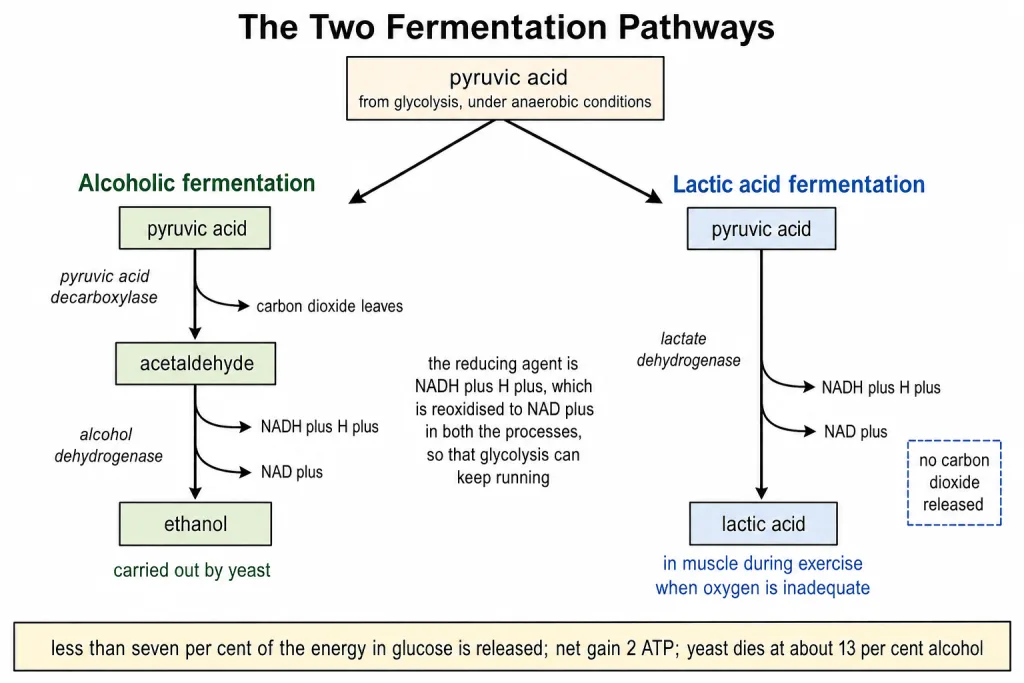
The other route. Other organisms like some bacteria produce lactic acid from pyruvic acid. In animal cells also, like muscles during exercise, when oxygen is inadequate for cellular respiration pyruvic acid is reduced to lactic acid by lactate dehydrogenase.
What both routes share. The reducing agent is , which is reoxidised to in both the processes. That is the whole point of the exercise. Glycolysis needs a supply of at the PGAL step, and without oxygen there is no other way to get it back, so the cell dumps the hydrogen onto pyruvic acid and carries on splitting sugar.
| Alcoholic fermentation | Lactic acid fermentation | |
|---|---|---|
| Carried out by | Yeast | Some bacteria, and animal muscle during exercise |
| Enzymes | Pyruvic acid decarboxylase and alcohol dehydrogenase | Lactate dehydrogenase |
| End products | Ethanol and | Lactic acid only |
| released | Yes | No |
| Reducing agent | ||
| Coenzyme recovered |
[NEET Important] The enzyme names are the favourite question. Pyruvic acid decarboxylase and alcohol dehydrogenase for ethanol; lactate dehydrogenase for lactic acid - and the standard distractor is to swap alcohol dehydrogenase with lactate dehydrogenase. Remember also that only the alcoholic route releases ; lactic acid fermentation releases none, because the three-carbon pyruvate simply becomes three-carbon lactate.
Why Fermentation Is a Poor Bargain
In both lactic acid and alcohol fermentation not much energy is released. Less than seven per cent of the energy in glucose is released, and not all of it is trapped as high energy bonds of ATP.
Also, the processes are hazardous - either acid or alcohol is produced. The cell is making its own poison just to keep glycolysis running.
The ATP account. Nothing is added to the glycolytic tally by fermentation itself. Four ATP are synthesised during glycolysis and two are utilised, so:
| Per glucose fermented | |
|---|---|
| ATP synthesised in glycolysis | 4 |
| ATP utilised in glycolysis | 2 |
| Net ATP | 2 |
| ATP made by the fermentation steps themselves | 0 |
| Energy of glucose released | less than seven per cent |
So the net ATP synthesised when one molecule of glucose is fermented to alcohol or lactic acid is two.
The yeast's own limit. Yeasts poison themselves to death when the concentration of alcohol reaches about 13 per cent. Two things follow from that single fact, and both are asked:
- The maximum concentration of alcohol in naturally fermented beverages is therefore about 13 per cent - the yeast cannot survive to make any more.
- Alcoholic beverages of alcohol content greater than this concentration are obtained by distillation.
[NEET Important] Three numbers, and they are the whole section: less than seven per cent of the energy released, net 2 ATP per glucose, about 13 per cent alcohol before the yeast dies. The trap on the ATP question is 4 - that is the gross figure from glycolysis, and the two ATP invested at the start must still be deducted.
The Way Out: Complete Oxidation
What then is the process by which organisms can carry out complete oxidation of glucose and extract the energy stored to synthesise a larger number of ATP molecules needed for cellular metabolism?
In eukaryotes these steps take place within the mitochondria and this requires .
Aerobic respiration is the process that leads to a complete oxidation of organic substances in the presence of oxygen, and releases , water and a large amount of energy present in the substrate. This type of respiration is most common in higher organisms.
Set the two side by side and the contrast is complete:
| Fermentation | Aerobic respiration | |
|---|---|---|
| Oxidation of glucose | Incomplete | Complete |
| Oxygen | Not required - anaerobic | Required |
| Site in a eukaryote | Cytoplasm | Within the mitochondria |
| End products | Ethanol and , or lactic acid | and water |
| Energy of glucose released | less than seven per cent | A large amount |
| ATP per glucose | 2 | A much larger number |
| Common in | Yeast, some bacteria, muscle short of oxygen | Higher organisms |
[NEET Important] Learn the textbook definition word for word, because it is often the question stem: aerobic respiration leads to a complete oxidation of organic substances in the presence of oxygen and releases , water and a large amount of energy present in the substrate. The distractor is a definition that stops at "releases energy" without the words complete oxidation or in the presence of oxygen.
Quick Recap
- In fermentation, say by yeast, the incomplete oxidation of glucose is achieved under anaerobic conditions.
- Sets of reactions convert pyruvic acid to and ethanol.
- The enzymes pyruvic acid decarboxylase and alcohol dehydrogenase catalyse these reactions.
- Other organisms like some bacteria produce lactic acid from pyruvic acid.
- In animal cells also, like muscles during exercise, when oxygen is inadequate for cellular respiration, pyruvic acid is reduced to lactic acid by lactate dehydrogenase.
- The reducing agent is , which is reoxidised to in both the processes.
- In both lactic acid and alcohol fermentation not much energy is released - less than seven per cent of the energy in glucose is released, and not all of it is trapped as high energy bonds of ATP.
- The processes are hazardous - either acid or alcohol is produced.
- Net ATP per glucose fermented is 2 - 4 synthesised in glycolysis minus 2 utilised.
- Yeasts poison themselves to death when the concentration of alcohol reaches about 13 per cent, so naturally fermented beverages cannot exceed about that concentration, and stronger drinks are obtained by distillation.
- Complete oxidation of glucose yields a larger number of ATP molecules; in eukaryotes these steps take place within the mitochondria and require .
- Aerobic respiration is the process that leads to a complete oxidation of organic substances in the presence of oxygen, and releases , water and a large amount of energy present in the substrate.
- This type of respiration is most common in higher organisms.
Solved Examples
Question 1
Q. What is fermentation, and what does yeast turn pyruvic acid into?
Answer. In fermentation, say by yeast, the incomplete oxidation of glucose is achieved under anaerobic conditions by sets of reactions in which pyruvic acid is converted to and ethanol. The two words to keep are incomplete and anaerobic.
Question 2
Q. Name the two enzymes that catalyse alcoholic fermentation.
Answer. Pyruvic acid decarboxylase and alcohol dehydrogenase.
Question 3
Q. What do some bacteria make from pyruvic acid instead?
Answer. Lactic acid. Other organisms like some bacteria produce lactic acid from pyruvic acid.
Question 4
Q. What happens in a muscle cell during hard exercise, and which enzyme is responsible?
Answer. In animal cells also, like muscles during exercise, when oxygen is inadequate for cellular respiration, pyruvic acid is reduced to lactic acid. The enzyme is lactate dehydrogenase.
Question 5
Q. What is the reducing agent in both fermentation pathways, and what happens to it?
Answer. The reducing agent is , and it is reoxidised to in both the processes. That recovered is what lets glycolysis keep running in the absence of oxygen.
Question 6
Q. How much of the energy in glucose is released by fermentation?
Answer. Less than seven per cent, and not all of even that is trapped as high energy bonds of ATP. In both lactic acid and alcohol fermentation not much energy is released.
Question 7
Q. Why are the fermentation processes described as hazardous?
Answer. Because either acid or alcohol is produced. The cell accumulates its own end product, and that product is toxic to it.
Question 8
Q. Calculate how many ATP are synthesised, and deduct the number utilised during glycolysis, to give the net ATP when one molecule of glucose is fermented to alcohol or lactic acid.
Answer. Four ATP are synthesised during glycolysis, because the two ATP-yielding steps each happen twice. Two ATP are utilised, in the conversion of glucose to glucose 6-phosphate and in the conversion of fructose 6-phosphate to fructose 1,6-bisphosphate.
4 synthesised minus 2 utilised gives a net of 2 ATP per glucose.
The fermentation steps themselves add no ATP at all - they exist only to reoxidise back to .
Question 9
Q. Yeasts poison themselves to death when the concentration of alcohol reaches about 13 per cent. What then is the maximum concentration of alcohol in naturally fermented beverages, and how are stronger drinks obtained?
Answer. About 13 per cent. The yeast dies before it can raise the concentration any further, so a naturally fermented beverage cannot go much above that figure.
Alcoholic beverages of alcohol content greater than this concentration are obtained by distillation - the alcohol is boiled off and collected, which concentrates it well beyond what the living yeast could tolerate.
Question 10
Q. Distinguish between aerobic respiration and fermentation. This is one of the chapter-end exercises.
Answer. Both begin with glycolysis, and both start from pyruvic acid. What differs is whether oxygen is present, and therefore how far the glucose is broken down.
In fermentation the oxidation of glucose is incomplete. It happens under anaerobic conditions, in the cytoplasm, and pyruvic acid is converted either to and ethanol or to lactic acid. Less than seven per cent of the energy in glucose is released, the net gain is only 2 ATP, and the process is hazardous because either acid or alcohol is produced.
In aerobic respiration the oxidation is complete. It requires , and in eukaryotes it takes place within the mitochondria. Organic substances are completely oxidised in the presence of oxygen, releasing , water and a large amount of energy present in the substrate, which is trapped as a much larger number of ATP molecules.
| Fermentation | Aerobic respiration | |
|---|---|---|
| Oxygen | Not required | Required |
| Oxidation of glucose | Incomplete | Complete |
| Site in a eukaryote | Cytoplasm | Within the mitochondria |
| End products | Ethanol and , or lactic acid | and water |
| Energy released | Less than seven per cent of that in glucose | A large amount |
| Net ATP per glucose | 2 | A much larger number |
| Hazard | Acid or alcohol accumulates | End products are harmless |
| Common in | Yeast, some bacteria, muscle short of oxygen | Higher organisms |
Question 11
Q. Distinguish between glycolysis and fermentation. This is one of the chapter-end exercises.
Answer. They are consecutive, not alternative. Glycolysis comes first and fermentation is what an anaerobic cell does with the pyruvic acid that glycolysis leaves behind.
Glycolysis is the breakdown of glucose to pyruvic acid. It is a chain of ten reactions in the cytoplasm, present in all living organisms, in which glucose undergoes partial oxidation to form two molecules of pyruvic acid. It makes 4 ATP and uses 2, for a net of 2, and produces 2 .
Fermentation begins where glycolysis ends. It converts pyruvic acid to and ethanol, or to lactic acid, under anaerobic conditions. It synthesises no ATP of its own; its job is to reoxidise to so that glycolysis can continue.
| Glycolysis | Fermentation | |
|---|---|---|
| Starting material | Glucose | Pyruvic acid |
| End product | Two molecules of pyruvic acid | Ethanol and , or lactic acid |
| Occurs in | All living organisms | Yeast, some bacteria, muscle short of oxygen |
| Oxygen | Not required, but happens in aerobes too | Only under anaerobic conditions |
| Number of steps | Ten | One or two |
| ATP made | 4 made, 2 used, net 2 | None of its own |
| Role of | Reduced to | Regenerated from |
Question 12
Q. Distinguish between aerobic respiration and anaerobic respiration. This is one of the chapter-end exercises.
Answer. The single difference that produces all the others is oxygen.
Anaerobic respiration goes on without . Glucose is only partially oxidised, glycolysis in the cytoplasm is the whole of it, and the pyruvic acid is then converted to ethanol and or to lactic acid. Less than seven per cent of the energy in glucose is released, the net gain is 2 ATP, and the end products are hazardous, being either an acid or an alcohol. In anaerobic organisms glycolysis is the only process in respiration.
Aerobic respiration requires . It leads to a complete oxidation of organic substances in the presence of oxygen, and releases , water and a large amount of energy present in the substrate. In eukaryotes these steps take place within the mitochondria, and this type of respiration is most common in higher organisms.
| Aerobic respiration | Anaerobic respiration | |
|---|---|---|
| Oxygen | Required | Not required |
| Oxidation of glucose | Complete | Partial or incomplete |
| Site in a eukaryote | Cytoplasm, then within the mitochondria | Cytoplasm only |
| End products | and water | Ethanol and , or lactic acid |
| Energy yield | A large amount | Less than seven per cent of that in glucose |
| Net ATP per glucose | A much larger number | 2 |
| Nature of end products | Harmless | Hazardous - an acid or an alcohol |
| Found in | Higher organisms | Yeast, some bacteria, muscle short of oxygen |
Question 13
Q. Define aerobic respiration, and say where it happens in a eukaryote.
Answer. Aerobic respiration is the process that leads to a complete oxidation of organic substances in the presence of oxygen, and releases , water and a large amount of energy present in the substrate. In eukaryotes these steps take place within the mitochondria and this requires . This type of respiration is most common in higher organisms.
Question 14
Q. Why does an anaerobic cell bother to convert pyruvic acid to alcohol or lactic acid at all, if it gains no ATP by doing so?
Answer. To get its back. Glycolysis reduces to at the PGAL to BPGA step, and the cell has only a small fixed pool of the coenzyme. With no oxygen there is no other way to reoxidise it, so the cell unloads the hydrogen onto pyruvic acid. The reducing agent is reoxidised to in both the processes, and glycolysis can then keep turning out its 2 net ATP.
Question 15
Q. Which fermentation releases carbon dioxide, and why does the other one not?
Answer. Only alcoholic fermentation releases , at the step catalysed by pyruvic acid decarboxylase, whose very name says it removes a carboxyl group. Lactic acid fermentation releases none, because the three-carbon pyruvic acid is simply reduced to three-carbon lactic acid - no carbon is lost.