
Chemiosmosis, Now in the Mitochondrion
You have already studied about the mechanism of membrane-linked ATP synthesis as explained by the chemiosmotic hypothesis in the earlier chapter. The same idea now returns, in a different organelle.
The energy released during the electron transport system is utilised in synthesising ATP with the help of ATP synthase (complex V).
The chain of events is short and worth memorising as a sequence. Electrons pass along the carriers of the inner mitochondrial membrane. The energy released as they do so is used to move protons across that membrane, so that they accumulate in the intermembrane space. A proton gradient is built. The protons then flow back into the matrix through ATP synthase, and that flow is what makes the ATP.
So the gradient is not the product. It is the collapse of the gradient that does the work - exactly as in the chloroplast.
This complex consists of two major components, and .
[NEET Important] The examiner tests whether you know that chemiosmosis is one mechanism used twice, in two organelles. Say the energy released during the ETS is used to synthesise ATP with the help of ATP synthase, complex V, and then name and as its two major components. Do not say the proton gradient itself is the energy store the cell spends - the ATP is.
The Two Components of ATP Synthase
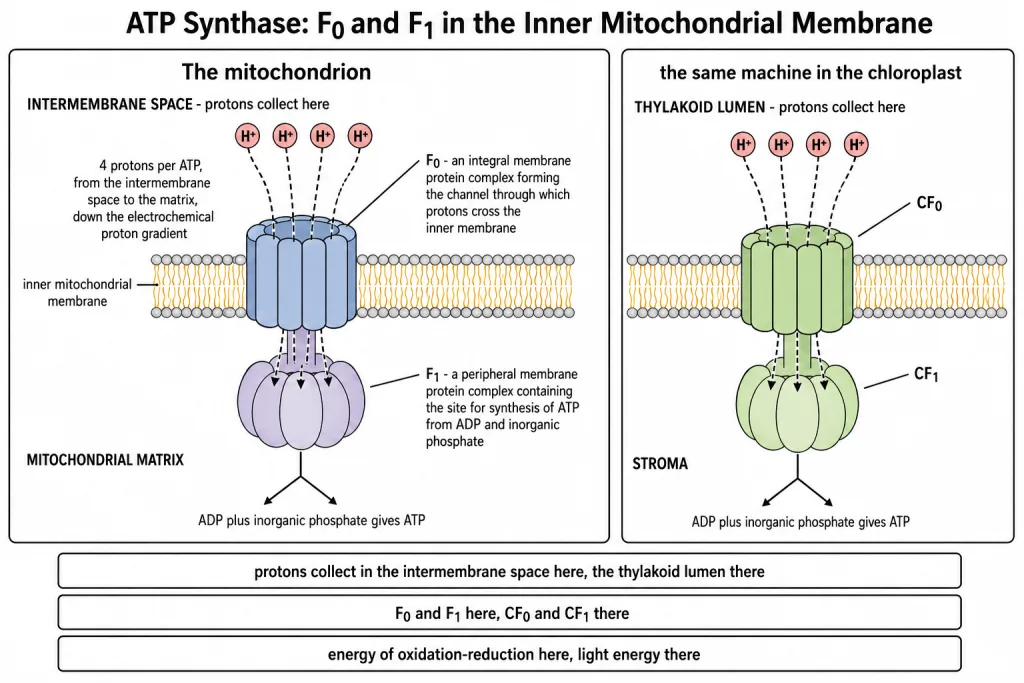
The headpiece is a peripheral membrane protein complex and contains the site for synthesis of ATP from ADP and inorganic phosphate.
is an integral membrane protein complex that forms the channel through which protons cross the inner membrane.
The passage of protons through the channel is coupled to the catalytic site of the component for the production of ATP.
| Type of protein complex | Peripheral membrane protein complex | Integral membrane protein complex |
| Position | A headpiece sitting on the membrane, projecting into the matrix | Embedded within the inner membrane |
| What it does | Contains the site for the synthesis of ATP from ADP and inorganic phosphate | Forms the channel through which protons cross the inner membrane |
Now the number. For each ATP produced, pass through from the intermembrane space to the matrix down the electrochemical proton gradient.
Read that sentence slowly, because three separate facts are packed into it:
- The count is four protons per ATP.
- The direction is from the intermembrane space into the matrix - into the interior of the mitochondrion, not out of it.
- The movement is down the electrochemical proton gradient - the cell spends nothing to move them; it is the gradient, already built by the ETS, that is being spent.
[NEET Important] is the channel in the membrane; is the headpiece that makes the ATP. The two are swapped in options constantly, and the giveaways are the words integral for and peripheral for . The other favourite is the proton count: 4 protons per ATP, from the intermembrane space to the matrix, down the gradient. Watch for options that reverse the direction or make the movement active transport.
The Chapter 11 Contrast: One Machine, Two Addresses
This is the comparison the two chapters are built to be tested on. Learn it as a table, not as a feeling that the two are "similar".
| Photosynthesis (Chapter 11) | Respiration (this chapter) | |
|---|---|---|
| Organelle | The chloroplast | The mitochondrion |
| Membrane across which the gradient forms | The thylakoid membrane | The inner mitochondrial membrane |
| Where protons accumulate | In the thylakoid lumen, that is towards the inside of the membrane | In the intermembrane space of the mitochondrion |
| Where protons flow back to | The stroma | The matrix |
| The channel component | ||
| The catalytic headpiece | ||
| Energy that builds the gradient | Light energy | The energy of oxidation-reduction |
| Name of the process | Photophosphorylation | Oxidative phosphorylation |
Three things to say out loud when you revise.
First, the addresses. In photosynthesis protons accumulate in the thylakoid lumen. In respiration they accumulate in the intermembrane space of the mitochondrion. The trap option offers you the stroma for photosynthesis and the matrix for respiration - those are where the protons go back to, not where they gather.
Second, the names. Photosynthesis has and ; respiration has and . Same architecture, different names - the C simply stands for the chloroplast version.
Third, the energy source. In photophosphorylation it is light energy that creates the proton gradient; in oxidative phosphorylation it is the energy of oxidation-reduction. That difference is the definition of oxidative phosphorylation, and it is the reason the word "oxidative" is in the name.
What is identical in both. The architecture does not change at all: a membrane, a proton gradient across it, a channel component through which the protons return, and a catalytic headpiece on the far side that synthesises the ATP. Chemiosmosis is one idea, used twice. Build a gradient with whatever energy you have, then let it collapse through ATP synthase.
[NEET Important] This block is a favourite for assertion-reason and match-the-column questions. Lumen goes with photosynthesis; intermembrane space goes with respiration. and go with the chloroplast; and go with the mitochondrion. Light goes with photophosphorylation; oxidation-reduction goes with oxidative phosphorylation. And whenever a question asks what the two have in common, the answer is the mechanism - a proton gradient across a membrane whose breakdown drives ATP synthase.
Quick Recap
- The mechanism of membrane-linked ATP synthesis is explained by the chemiosmotic hypothesis, studied in the earlier chapter.
- The energy released during the electron transport system is utilised in synthesising ATP with the help of ATP synthase (complex V).
- ATP synthase consists of two major components, and .
- The headpiece is a peripheral membrane protein complex and contains the site for synthesis of ATP from ADP and inorganic phosphate.
- is an integral membrane protein complex that forms the channel through which protons cross the inner membrane.
- The passage of protons through the channel is coupled to the catalytic site of the component for the production of ATP.
- For each ATP produced, pass through from the intermembrane space to the matrix down the electrochemical proton gradient.
- The movement is down the gradient, so the cell spends nothing to drive it.
- In respiration protons accumulate in the intermembrane space of the mitochondrion; in photosynthesis they accumulate in the thylakoid lumen.
- Respiration has and ; photosynthesis has and - the same architecture under different names.
- In oxidative phosphorylation the gradient is built by the energy of oxidation-reduction; in photophosphorylation it is built by light energy.
- What is common to both: a membrane, a proton gradient, a channel component and a catalytic headpiece - build a gradient, then let it collapse through ATP synthase.
Solved Examples
Question 1
Q. Which hypothesis explains the mechanism of membrane-linked ATP synthesis?
Answer. The chemiosmotic hypothesis, which you studied in the earlier chapter for the chloroplast. It says ATP synthesis is linked to the development of a proton gradient across a membrane.
Question 2
Q. What is complex V, and where does the energy it uses come from?
Answer. Complex V is ATP synthase. The energy released during the electron transport system is utilised in synthesising ATP with the help of ATP synthase.
Question 3
Q. Name the two major components of mitochondrial ATP synthase.
Answer. and .
Question 4
Q. What kind of protein complex is , and what does it contain?
Answer. The headpiece is a peripheral membrane protein complex. It contains the site for synthesis of ATP from ADP and inorganic phosphate.
Question 5
Q. What is , and what does it form?
Answer. is an integral membrane protein complex. It forms the channel through which protons cross the inner membrane.
Question 6
Q. How is the passage of protons linked to the making of ATP?
Answer. The passage of protons through the channel is coupled to the catalytic site of the component for the production of ATP. In other words, the protons move through , and that movement drives the catalytic site in .
Question 7
Q. How many protons pass through for each ATP produced, and in which direction?
Answer. For each ATP produced, pass through from the intermembrane space to the matrix, down the electrochemical proton gradient.
Question 8
Q. Why does the cell not have to spend energy to move those protons?
Answer. Because they move down the electrochemical proton gradient. The gradient was already built by the electron transport system, using the energy of oxidation-reduction. The protons are simply running back downhill, and that flow is what is harnessed to make the ATP.
Question 9
Q. Where do protons accumulate in respiration, and where in photosynthesis?
Answer. In respiration, protons accumulate in the intermembrane space of the mitochondrion. In photosynthesis, they accumulate in the thylakoid lumen. The matrix and the stroma are where the protons flow back to, not where they gather.
Question 10
Q. Compare and of the mitochondrion with and of the chloroplast.
Answer. They are the same architecture under different names - the C marks the chloroplast version.
| Chloroplast | Mitochondrion | |
|---|---|---|
| The channel | , embedded in the thylakoid membrane | , an integral protein complex of the inner membrane |
| The catalytic headpiece | , on the stroma side | , a peripheral protein complex facing the matrix |
| Protons flow | From the lumen to the stroma | From the intermembrane space to the matrix |
In both cases the protons pass through the channel component, and the headpiece is where ATP is synthesised from ADP and inorganic phosphate.
Question 11
Q. What creates the proton gradient in photophosphorylation, and what creates it in oxidative phosphorylation?
Answer. In photophosphorylation it is light energy that is utilised for the production of the proton gradient required for phosphorylation. In respiration it is the energy of oxidation-reduction that is utilised for the same process. It is for this reason that the respiratory process is called oxidative phosphorylation.
Question 12
Q. List what chemiosmosis needs, and say where each part is found in a mitochondrion.
Answer. A membrane - the inner mitochondrial membrane. A way of pumping protons - the complexes of the electron transport system, driven by the oxidation of and . A proton gradient - protons accumulated in the intermembrane space. ATP synthase - complex V, with as the channel in the membrane and as the headpiece facing the matrix.
The same four things are needed in the chloroplast, with the thylakoid membrane, the photosystems, the lumen and with filling the same four roles.
Question 13
Q. A student writes that ATP synthase uses ATP to pump protons into the matrix. What is wrong with this?
Answer. It has the machine running backwards. ATP synthase does not spend ATP - it makes ATP. The protons move from the intermembrane space to the matrix down the electrochemical proton gradient, which means they are moving on their own, from high concentration to low. The energy of that downhill flow is coupled to the catalytic site of the component, and that is what produces ATP from ADP and inorganic phosphate. The pumping was done earlier, by the electron transport system.