
Do Plants Breathe?
The answer is not quite so direct. Yes, plants require for respiration to occur and they also give out , so plants have systems in place that ensure the availability of .
But plants, unlike animals, have no specialised organs for gaseous exchange. They have stomata and lenticels for this purpose, and that is all.
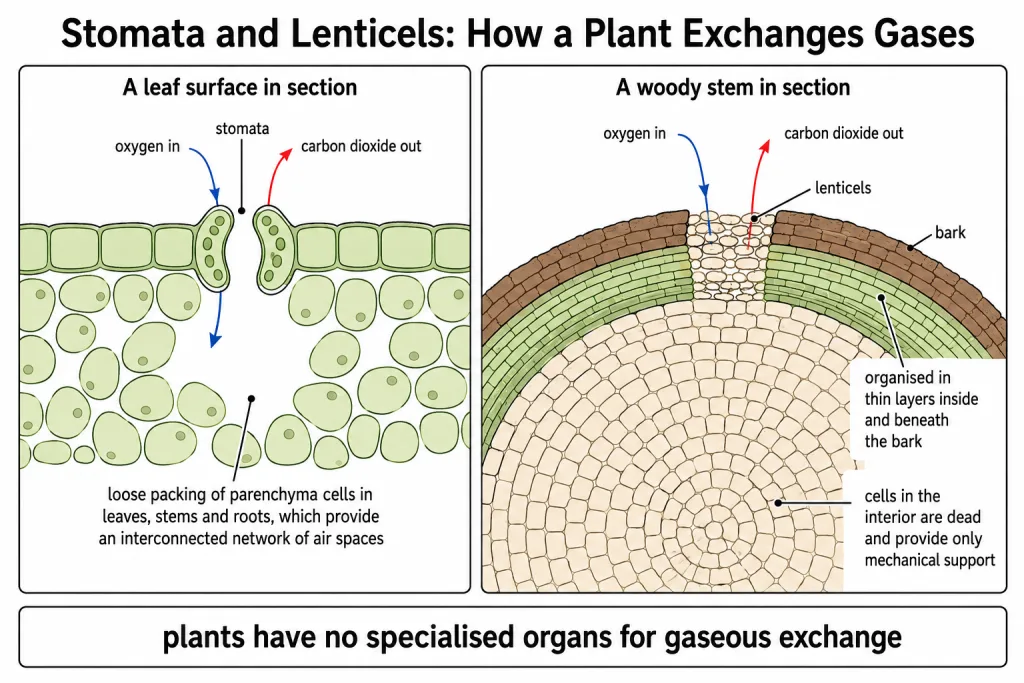
There are three reasons why plants can get along without respiratory organs, and the chapter gives them in order.
First, each plant part takes care of its own gas-exchange needs. There is very little transport of gases from one plant part to another.
Second, plants do not present great demands for gas exchange. Roots, stems and leaves respire at rates far lower than animals do. Only during photosynthesis are large volumes of gases exchanged, and each leaf is well adapted to take care of its own needs during these periods. When cells photosynthesise, availability of is not a problem in these cells, since is released within the cell.
Third, the distance that gases must diffuse even in large, bulky plants is not great. Each living cell in a plant is located quite close to the surface of the plant. In stems, the living cells are organised in thin layers inside and beneath the bark, and they also have openings called lenticels; the cells in the interior are dead and provide only mechanical support. Thus most cells of a plant have at least a part of their surface in contact with air, which is also facilitated by the loose packing of parenchyma cells in leaves, stems and roots, which provide an interconnected network of air spaces.
[NEET Important] The three reasons are asked as a set, so learn them as own needs, low demand, short distance. Note the detail that makes the second one work: during photosynthesis is released inside the very cells that need it. And do not write that plants have no gas exchange - they have no specialised organs, which is a different claim.
Why Respiration Is Not Combustion
The complete combustion of glucose, which produces and as end products, yields energy most of which is given out as heat:
Heat is useless to a cell. If this energy is to be useful, the cell should be able to utilise it to synthesise other molecules that it requires.
The strategy the plant cell uses is to catabolise the glucose molecule in such a way that not all the liberated energy goes out as heat. The key is to oxidise glucose not in one step but in several small steps, enabling some steps to be just large enough that the energy released can be coupled to ATP synthesis. How this is done is, essentially, the story of respiration.
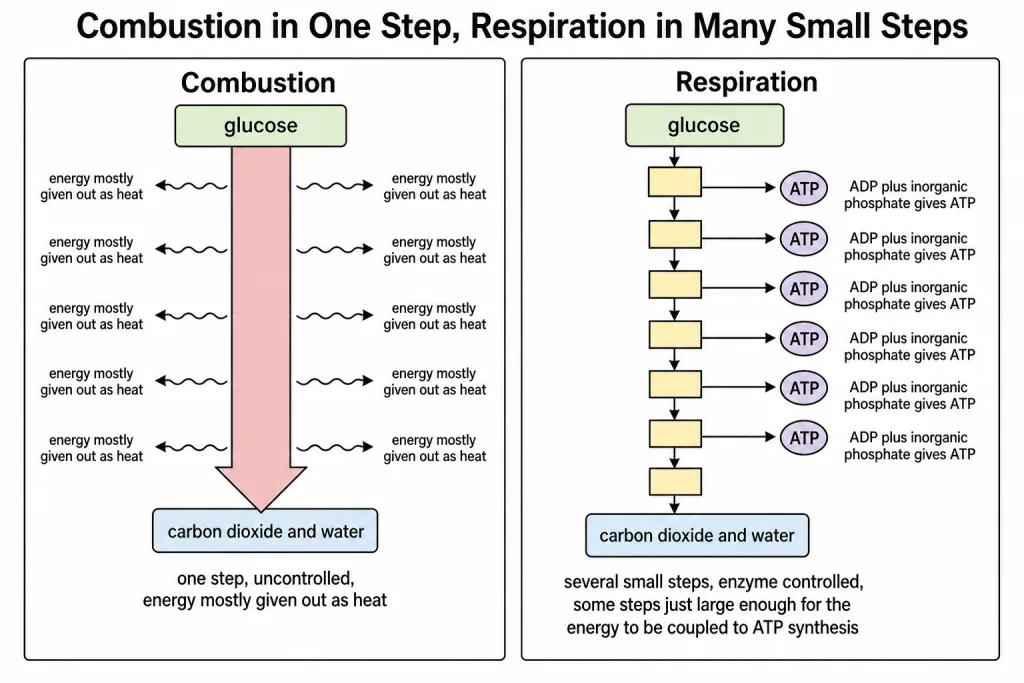
| Combustion | Respiration | |
|---|---|---|
| Steps | One step | Several small steps |
| Energy | Most given out as heat | Coupled to ATP synthesis at some steps |
| Control | Uncontrolled | Enzyme controlled |
| End products | and | , and energy as ATP |
[NEET Important] This block answers two questions at once. "Differentiate respiration from combustion" is a chapter-end exercise, and "what is the significance of the step-wise release of energy" is another. Both come down to the same sentence: the energy is released in packets small enough to be trapped as ATP instead of lost as heat.
Life Without Oxygen
During the process of respiration, oxygen is utilised, and carbon dioxide, water and energy are released as products. The combustion reaction requires oxygen. But some cells live where oxygen may or may not be available.
There are sufficient reasons to believe that the first cells on this planet lived in an atmosphere that lacked oxygen. Even among present-day living organisms we know of several that are adapted to anaerobic conditions.
- Some of these organisms are facultative anaerobes - they can manage either way.
- In others the requirement for anaerobic condition is obligate - they must have no oxygen.
In any case, all living organisms retain the enzymatic machinery to partially oxidise glucose without the help of oxygen. This breakdown of glucose to pyruvic acid is called glycolysis.
[NEET Important] The sentence to carry forward is "all living organisms retain the enzymatic machinery to partially oxidise glucose without the help of oxygen". It is why glycolysis is universal and happens in the cytoplasm of every cell, aerobic or not - which is the first fact of the next section.
Quick Recap
- Plants require for respiration and give out .
- Plants have no specialised organs for gaseous exchange - only stomata and lenticels.
- Three reasons they manage without respiratory organs: each plant part takes care of its own gas-exchange needs, with very little transport of gases between parts; plants do not present great demands, and roots, stems and leaves respire at rates far lower than animals; and the distance gases must diffuse is not great, since each living cell is quite close to the surface.
- Only during photosynthesis are large volumes of gases exchanged, and then is released within the cell.
- In stems the living cells lie in thin layers inside and beneath the bark, with lenticels as openings; the interior cells are dead and give only mechanical support.
- Loose packing of parenchyma cells provides an interconnected network of air spaces.
- Complete combustion of glucose gives and energy, most of which is given out as heat.
- The cell oxidises glucose in several small steps, not one, so that some steps are just large enough for the released energy to be coupled to ATP synthesis.
- The first cells lived in an atmosphere lacking oxygen. Facultative anaerobes can manage either way; in obligate ones the anaerobic requirement is absolute.
- All living organisms retain the enzymatic machinery to partially oxidise glucose without oxygen - the breakdown of glucose to pyruvic acid, called glycolysis.
Solved Examples
Question 1
Q. Do plants breathe, and what do they use for gaseous exchange?
Answer. Plants require for respiration and give out , so in that sense yes. But plants, unlike animals, have no specialised organs for gaseous exchange - they have stomata and lenticels for this purpose.
Question 2
Q. Give the three reasons why plants can get along without respiratory organs.
Answer. First, each plant part takes care of its own gas-exchange needs, and there is very little transport of gases from one plant part to another. Second, plants do not present great demands for gas exchange - roots, stems and leaves respire at rates far lower than animals do. Third, the distance that gases must diffuse even in large, bulky plants is not great, since each living cell is located quite close to the surface of the plant.
Question 3
Q. When are large volumes of gases exchanged in a plant, and why is oxygen not a problem then?
Answer. Only during photosynthesis. Each leaf is well adapted to take care of its own needs during these periods, and when cells photosynthesise, availability of is not a problem in these cells since is released within the cell.
Question 4
Q. How do the living cells of a thick woody stem get their oxygen?
Answer. In stems the living cells are organised in thin layers inside and beneath the bark, and they have openings called lenticels. The cells in the interior are dead and provide only mechanical support, so they need nothing.
Question 5
Q. What structural feature of plant tissue helps gases reach the cells?
Answer. The loose packing of parenchyma cells in leaves, stems and roots, which provides an interconnected network of air spaces. Because of it, most cells of a plant have at least a part of their surface in contact with air.
Question 6
Q. Differentiate between respiration and combustion. This is one of the chapter-end exercises.
Answer. Both oxidise glucose to and and release energy, and the overall equation is the same. What differs is how the energy comes out.
Combustion happens in one step. It is uncontrolled, and the energy yielded is mostly given out as heat, which a cell cannot use to build anything.
Respiration oxidises glucose in several small steps, each controlled by an enzyme. The steps are sized so that the energy released at some of them can be coupled to ATP synthesis, and the cell stores the energy in ATP instead of losing it as heat.
| Combustion | Respiration | |
|---|---|---|
| Number of steps | One | Several small steps |
| Control | Uncontrolled | Controlled by enzymes |
| Energy | Mostly lost as heat | Trapped as ATP at some steps |
| Where | Anywhere, needs high temperature | In the cell, at body temperature |
| Products | , , heat | , , ATP |
Question 7
Q. What is the significance of the step-wise release of energy in respiration? This is one of the chapter-end exercises.
Answer. Because energy released all at once cannot be captured.
If glucose were oxidised in a single step, as in combustion, most of the liberated energy would go out as heat, and the cell has no way of using heat to synthesise the molecules it requires. A single large burst would also damage the cell.
So the cell catabolises glucose in such a way that not all the liberated energy goes out as heat. It oxidises glucose not in one step but in several small steps, and some of those steps are just large enough that the energy released can be coupled to ATP synthesis.
Three things follow from this, and a full-marks answer names all three. Energy is trapped in a usable form, as ATP, which the cell can spend wherever it needs it. The release is controlled, because each step has its own enzyme and can be regulated. And the intermediates become available - the compounds formed along the way can be withdrawn for building other molecules, which is what makes the pathway amphibolic.
Question 8
Q. Why can a cell not use the heat released by combustion?
Answer. Because to be useful the energy must be in a form the cell can spend on synthesis. Heat cannot be coupled to the making of a molecule. The cell's answer is to trap the energy in ATP, which it can then use to synthesise the other molecules it requires.
Question 9
Q. What is a facultative anaerobe, and how does it differ from an obligate one?
Answer. A facultative anaerobe can live with or without oxygen. In an obligate one, the requirement for anaerobic condition is absolute - it must have no oxygen.
Question 10
Q. What do all living organisms retain, whether or not they use oxygen?
Answer. The enzymatic machinery to partially oxidise glucose without the help of oxygen. This breakdown of glucose to pyruvic acid is called glycolysis.
Question 11
Q. Write the equation for the complete combustion of glucose.
Answer. Most of that energy is given out as heat.
Question 12
Q. Why is it significant that the first cells on this planet lived in an atmosphere lacking oxygen?
Answer. Because it explains why glycolysis is universal. Those cells had to extract energy from glucose without oxygen, and all living organisms have retained that machinery ever since - which is why glycolysis occurs in the cytoplasm of every living organism, aerobic or anaerobic.