
Same Syllabus. A Different Exam.
The Important Questions and Answers section worked this chapter the way a written paper does - trace the pathway, explain the mechanism, derive the balance sheet. NEET does not ask you to derive anything. It names one enzyme, one compartment or one number, gives four options, and you have about half a minute.
The marking is +4 for a correct answer and -1 for a wrong one. In a written answer, getting the Krebs cycle roughly right still earns most of the marks. Here, 4 ATP where the answer is 2 ATP is worth -1, which is five marks behind the person who skipped it.
Respiration is the most arithmetic-heavy chapter in Class 11 Biology, and that is good news: the numbers do not change, and there are only about twenty of them. Learn the numbers and the compartments and most of the chapter answers itself.
The Four Shapes This Chapter Is Asked In
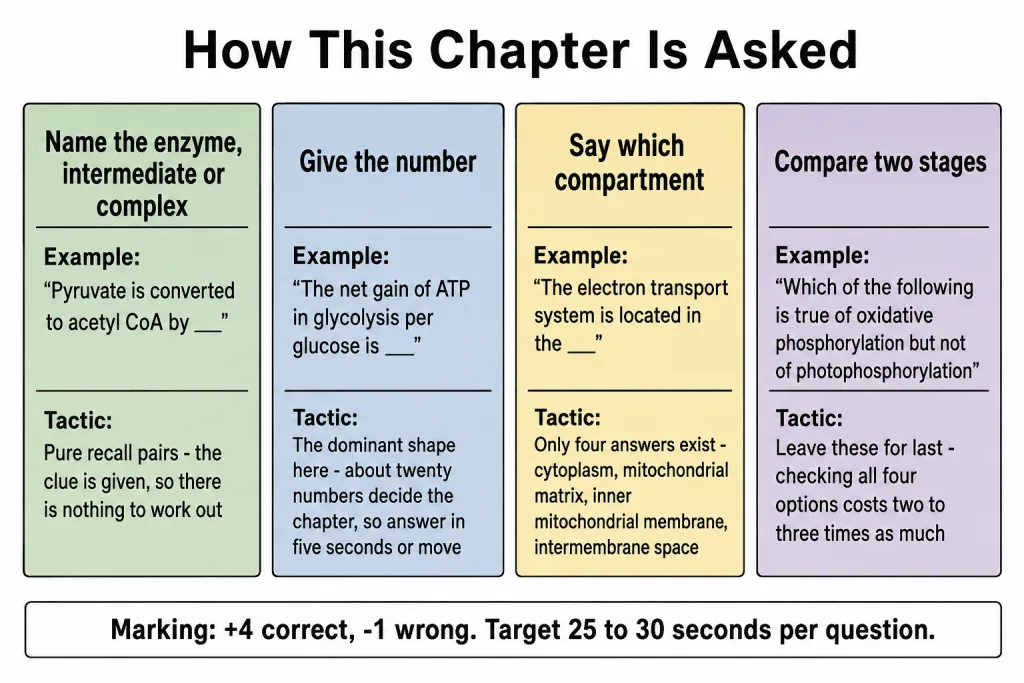
Shape 1 - Name the enzyme, intermediate or complex. "Pyruvate is converted to acetyl CoA by _." Pure recall pairs, and this chapter has a lot of them.
Shape 2 - Give the number. "The net gain of ATP in glycolysis per glucose is _." This is the dominant shape here and the reason the chapter is worth over-preparing. Every number is listed below in one block.
Shape 3 - Which compartment. "The electron transport system is located in the _." There are only four possible answers - cytoplasm, mitochondrial matrix, inner mitochondrial membrane, intermembrane space - and every structure in the chapter lives in exactly one of them.
Shape 4 - Compare two stages. Glycolysis against the Krebs cycle, fermentation against aerobic respiration, and above all oxidative phosphorylation against photophosphorylation, which pulls in the previous chapter.
One Thing, One Compartment
Almost every Shape 1 and Shape 3 question is answered by one row of this table.
| The thing | Where it is, and what it does |
|---|---|
| Glycolysis | Cytoplasm; all living organisms; partial oxidation of glucose |
| Invertase | Splits sucrose into glucose and fructose |
| Hexokinase | Glucose to glucose-6-phosphate |
| PGAL to BPGA | The one step making in glycolysis |
| BPGA to PGA, and PEP to pyruvate | The two ATP-making steps of glycolysis |
| Pyruvic acid decarboxylase, alcohol dehydrogenase | Alcoholic fermentation |
| Lactate dehydrogenase | Lactic acid fermentation, including muscle during exercise |
| Pyruvic dehydrogenase | The link reaction, in the matrix |
| Citrate synthase | Acetyl CoA + OAA + water to citric acid |
| TCA cycle | Mitochondrial matrix |
| Succinyl-CoA to succinic acid | The GTP step; substrate level phosphorylation |
| ETS | Inner mitochondrial membrane |
| Complex I | NADH dehydrogenase |
| Complex II | Feeds in, from succinate oxidation |
| Ubiquinone | Within the inner membrane; takes from both I and II |
| Complex III | Cytochrome bc1 complex |
| Cytochrome c | Small protein on the OUTER surface of the INNER membrane; mobile carrier between III and IV |
| Complex IV | Cytochrome c oxidase; cytochromes a and a3, two copper centres |
| Complex V | ATP synthase |
| Integral; the proton channel | |
| Peripheral headpiece; the site of ATP synthesis | |
| Protons accumulate in | The intermembrane space |
| Oxygen | Acts only at the terminal stage, as the final hydrogen acceptor |
The rule that saves the most marks here: when a question names a structure, ask which of the four compartments. Cytoplasm means glycolysis and nothing else. Matrix means the link reaction and the TCA cycle. Inner membrane means the ETS and ATP synthase. Intermembrane space means the protons. No structure in this chapter belongs to two.
The Numbers, and the Negatives
Every number in the chapter
Glycolysis, per glucose: 10 reactions - 2 ATP used - 4 ATP made - net 2 ATP - 2 - 2 pyruvic acid.
Link reaction, per glucose: happens twice - 2 - 2 NADH - no ATP.
TCA cycle, per turn: 3 - 1 - 1 GTP, and so 1 ATP - 2 . Per glucose, double all of it.
The running total the source gives: after glycolysis, the link reaction and the TCA cycle, 8 and 2 have been made besides just 2 ATP in the TCA cycle.
ETS conversion: 1 NADH gives 3 ATP - 1 gives 2 ATP.
ATP synthase: 4 protons per ATP, moving from the intermembrane space to the matrix.
Net gain: 38 ATP per glucose, aerobically. Fermentation gives only 2.
Fermentation: less than 7 per cent of the energy in glucose is released - yeast dies at about 13 per cent alcohol.
RQ: carbohydrates 1.0 - fats about 0.7 (tripalmitin, 102 over 145) - proteins about 0.9.
Why is worth less than NADH. enters at complex II, downstream of complex I, so it drives fewer proton-pumping steps - hence 2 ATP instead of 3. That reasoning is itself a question.
The lists the "which is NOT" questions come from
- The three fates of pyruvate: lactic acid fermentation, alcoholic fermentation, aerobic respiration.
- The four assumptions behind 38 ATP: a sequential orderly pathway; the glycolytic NADH is transferred into the mitochondria; no intermediate is withdrawn to synthesise anything else; only glucose is being respired.
- The five ETS complexes: I NADH dehydrogenase, II the entry, III cytochrome bc1, IV cytochrome c oxidase, V ATP synthase.
- The four amphibolic entry points: fats to glycerol and fatty acids; fatty acids to acetyl CoA; glycerol to PGAL; proteins by proteases, amino acids after deamination into the Krebs cycle, or as pyruvate or acetyl CoA.
- Three reasons plants need no respiratory organs: each part meets its own needs; demand is low; the diffusion distance is short.
The pairs that get swapped
- Gross 4 ATP against net 2 ATP in glycolysis.
- Glycolysis is cytoplasmic and universal; the TCA cycle is in the matrix and aerobic.
- The TCA cycle makes GTP by substrate level phosphorylation, not ATP directly.
- 3 NADH and 1 per turn, but 8 NADH and 2 per glucose once the link reaction and the doubling are counted.
- Cytochrome c sits on the OUTER surface of the INNER membrane - two words, both needed.
- is the channel; is the catalytic headpiece.
- Protons accumulate in the INTERMEMBRANE SPACE here, but in the THYLAKOID LUMEN in photosynthesis. Same for and here against and there, and the energy of oxidation-reduction here against light energy there.
- RQ 1.0 for carbohydrates, 0.7 for fats, 0.9 for proteins - and fats are the one below 1.
Solved Examples at NEET Pace
Each item names the shortcut it uses, because the shortcut is the thing worth carrying into the exam hall.
Question 1
Q. The net gain of ATP in glycolysis per molecule of glucose is (a) 2 (b) 4 (c) 8 (d) 38
Answer. (a) 2. Shortcut - the question always asks net; the gross is the distractor. Four ATP are synthesised, because the two ATP-yielding steps each happen twice after the six-carbon molecule splits. Two are spent at the start - once on glucose to glucose-6-phosphate and once on fructose-6-phosphate to fructose 1,6-bisphosphate - so the net gain is 2.
Question 2
Q. The electron transport system is located in the (a) cytoplasm (b) mitochondrial matrix (c) inner mitochondrial membrane (d) intermembrane space
Answer. (c) inner mitochondrial membrane. Shortcut - four compartments, and every structure in this chapter has exactly one address. Glycolysis is cytoplasmic. The link reaction and the TCA cycle are in the matrix. The ETS and ATP synthase are on the inner membrane. The protons collect in the intermembrane space. Learn the four and every "where" question is a lookup.
Question 3
Q. During one turn of the TCA cycle, the number of and produced is (a) 3 and 1 (b) 4 and 1 (c) 3 and 2 (d) 6 and 2
Answer. (a) 3 and 1. Shortcut - read whether the stem says "per turn" or "per glucose". There are three points in the cycle where is reduced and one point where is reduced. Per glucose the cycle turns twice, giving 6 NADH and 2 from the cycle alone - and 8 NADH in total once glycolysis and the link reaction are added. Option (d) is the per-glucose figure offered under a per-turn stem.
Question 4
Q. Oxidation of one molecule of through the ETS yields (a) 1 ATP (b) 2 ATP (c) 3 ATP (d) 4 ATP
Answer. (b) 2 ATP. Shortcut - NADH gives 3, gives 2, and there is a reason. enters the chain at complex II, which is downstream of complex I, so it drives fewer proton-pumping steps. That reasoning is worth knowing because it is sometimes the question rather than the number.
Question 5
Q. In the mitochondrion, protons accumulate in the (a) matrix (b) intermembrane space (c) thylakoid lumen (d) cytoplasm
Answer. (b) intermembrane space. Shortcut - photosynthesis fills the lumen, respiration fills the intermembrane space. Option (c) is the chloroplast answer, placed here because the two chapters teach chemiosmosis as a parallel and the compartment is exactly what gets swapped. For each ATP produced, 4 protons pass through from the intermembrane space to the matrix, down the electrochemical proton gradient.
Question 6
Q. Cytochrome c is (a) an integral protein of the inner membrane (b) a small protein on the outer surface of the inner membrane, acting as a mobile carrier (c) part of complex IV (d) located in the matrix
Answer. (b) a small protein on the outer surface of the inner membrane, acting as a mobile carrier. Shortcut - two adjectives, both examinable: outer surface, inner membrane. It acts as a mobile carrier for transfer of electrons between complex III and complex IV. It is not part of either complex, which is what makes option (c) tempting.
Question 7
Q. In the TCA cycle, GTP is synthesised during the conversion of (a) citrate to isocitrate (b) alpha-ketoglutaric acid to succinyl-CoA (c) succinyl-CoA to succinic acid (d) malic acid to OAA
Answer. (c) succinyl-CoA to succinic acid. Shortcut - one GTP, one step, and it is a substrate level phosphorylation. In a coupled reaction GTP is converted to GDP with the simultaneous synthesis of ATP from ADP. Note the wording carefully: the cycle makes GTP directly and ATP only through that coupling - a question that says "the TCA cycle directly synthesises ATP" is testing exactly this.
Question 8
Q. Which of the following is NOT an assumption made in calculating the net gain of 38 ATP? (a) a sequential, orderly pathway functions (b) the NADH from glycolysis is transferred into the mitochondria (c) intermediates are withdrawn to synthesise other compounds (d) only glucose is being respired
Answer. (c) intermediates are withdrawn to synthesise other compounds. Shortcut - the assumptions are all statements that the pathway behaves tidily; the odd one out is the untidy reality. The actual assumption is the opposite - that none of the intermediates in the pathway are utilised to synthesise any other compound. In a real cell substrates enter the pathways and are withdrawn as and when necessary, which is one of the reasons 38 remains a theoretical figure.
Question 9
Q. The respiratory quotient of fats is about (a) 0.7 (b) 0.9 (c) 1.0 (d) 1.4
Answer. (a) 0.7. Shortcut - three values, and fats are the one below 1. Carbohydrates give 1.0, because equal amounts of and are evolved and consumed. Fats give less than 1 - for tripalmitin, Proteins give about 0.9.
Question 10
Q. In alcoholic fermentation, the enzymes involved are (a) lactate dehydrogenase and hexokinase (b) pyruvic acid decarboxylase and alcohol dehydrogenase (c) invertase and citrate synthase (d) pyruvic dehydrogenase and enolase
Answer. (b) pyruvic acid decarboxylase and alcohol dehydrogenase. Shortcut - alcohol has two enzymes, lactic acid has one. Lactic acid fermentation uses lactate dehydrogenase alone, and it is what happens in muscle during exercise when oxygen is inadequate. In both, the reducing agent is , which is reoxidised to - which is the actual point of fermentation.
Question 11
Q. The respiratory pathway is best described as (a) catabolic (b) anabolic (c) amphibolic (d) neither catabolic nor anabolic
Answer. (c) amphibolic. Shortcut - the same compound that enters for breakdown is withdrawn for synthesis. Fatty acids are broken down to acetyl CoA before entering the respiratory pathway, but when the organism needs to synthesise fatty acids, acetyl CoA is withdrawn from the respiratory pathway for it. Breaking down is catabolism, synthesis is anabolism, and because the pathway is involved in both it is amphibolic rather than catabolic.
Question 12
Q. Which statement correctly contrasts oxidative phosphorylation with photophosphorylation? (a) both use light energy to build the proton gradient (b) oxidative phosphorylation uses the energy of oxidation-reduction, photophosphorylation uses light energy (c) both accumulate protons in the thylakoid lumen (d) oxidative phosphorylation needs no proton gradient
Answer. (b) oxidative phosphorylation uses the energy of oxidation-reduction, photophosphorylation uses light energy. Shortcut - the two chapters share a mechanism and differ in three named ways. Unlike photophosphorylation, where it is the light energy that is utilised for the production of the proton gradient, in respiration it is the energy of oxidation-reduction utilised for the same process - which is why the process is called oxidative phosphorylation. The other two differences are where the protons collect - intermembrane space here, thylakoid lumen there - and the names of the ATP synthase parts, and here against and there.
A Drill Before You Move On
Decide each one before you read the verdict. Aim for 25 to 30 seconds per question.
Mark yourself honestly. A wrong answer here is worth -1 in the hall, so treat "I think it is B" as a skip, not an answer, and go back to the numbers block for that row.