
What the Electron Transport System Is For
Look at where the chapter stands. Glucose has been completely broken down, has been released, and eight molecules of and two of have been synthesised - and yet only four molecules of ATP have been made, two in glycolysis and two in the TCA cycle. Oxygen has not appeared anywhere so far.
The following steps in the respiratory process are to release and utilise the energy stored in and .
This is accomplished when they are oxidised through the electron transport system and the electrons are passed on to , resulting in the formation of .
The metabolic pathway through which the electron passes from one carrier to another is called the electron transport system (ETS), and it is present in the inner mitochondrial membrane.
Think of it this way. Glycolysis and the citric acid cycle collected the hydrogen and parked it on and . The ETS is where that hydrogen is finally handed to oxygen, and the energy of that handover is what pays for the large number of ATP promised at the start of the chapter.
[NEET Important] Three phrases are lifted straight into options. The ETS is in the inner mitochondrial membrane - not the outer membrane, not the matrix, not the cytoplasm. The electrons end up on and the product is - the was released earlier, in the link reaction and the TCA cycle, not here. And the ETS oxidises and , which means it regenerates the and the earlier stages need to keep running.
The Five Complexes, One Step at a Time
Follow the electron. The ETS is a run of carriers set in the inner mitochondrial membrane, and the chapter names five complexes. Learn them in order, because the order is what gets asked.
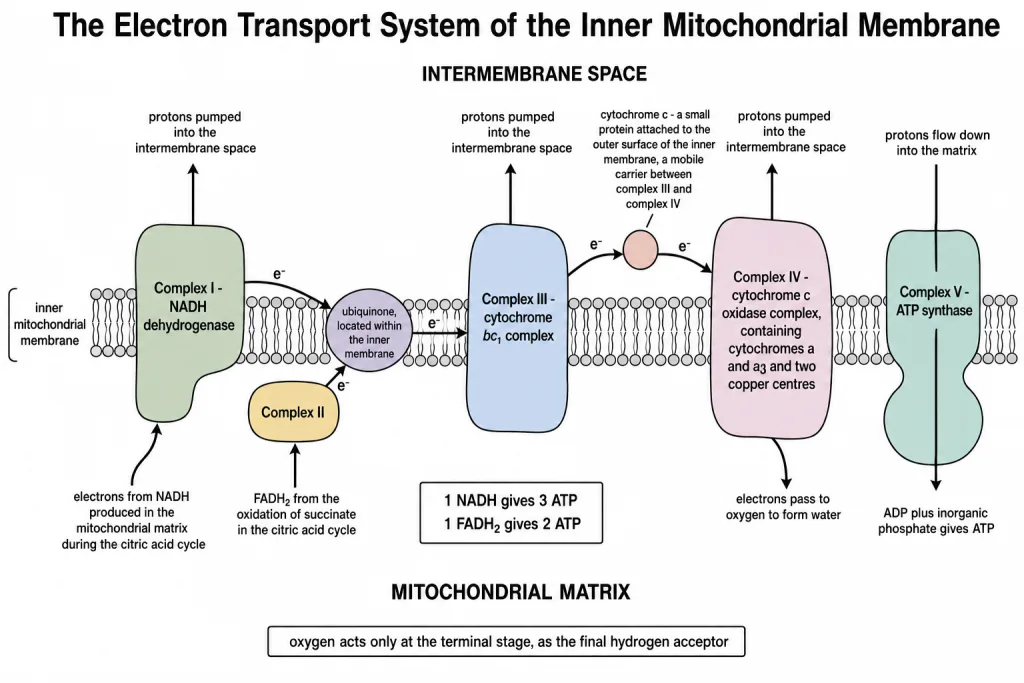
Complex I - NADH dehydrogenase. Electrons from NADH produced in the mitochondrial matrix during the citric acid cycle are oxidised by an NADH dehydrogenase (complex I), and the electrons are then transferred to ubiquinone located within the inner membrane.
Complex II - the entry point for . Ubiquinone also receives reducing equivalents via (complex II), which is generated during the oxidation of succinate in the citric acid cycle. Notice that this route skips complex I altogether - it feeds in one stop later.
Complex III - the cytochrome complex. The reduced ubiquinone (ubiquinol) is then oxidised with the transfer of electrons to cytochrome c via the cytochrome complex (complex III).
Cytochrome c - the mobile link. Cytochrome c is a small protein attached to the outer surface of the inner membrane, and it acts as a mobile carrier for transfer of electrons between complex III and complex IV. It is not a complex itself - it is the shuttle between two of them.
Complex IV - cytochrome c oxidase. Complex IV refers to the cytochrome c oxidase complex, containing cytochromes a and , and two copper centres. This is where the electrons finally reach oxygen.
Complex V - ATP synthase. When the electrons pass from one carrier to another via complex I to complex IV in the electron transport chain, they are coupled to ATP synthase (complex V) for the production of ATP from ADP and inorganic phosphate.
| Complex | Name | What it does |
|---|---|---|
| I | NADH dehydrogenase | Oxidises NADH from the matrix and passes the electrons to ubiquinone |
| II | The entry point | Passes reducing equivalents from , made in succinate oxidation, to ubiquinone |
| III | Cytochrome complex | Oxidises ubiquinol and transfers the electrons to cytochrome c |
| IV | Cytochrome c oxidase complex | Contains cytochromes a and and two copper centres; passes electrons to oxygen |
| V | ATP synthase | Coupled to the electron flow; makes ATP from ADP and inorganic phosphate |
Ubiquinone is the meeting point. Both complex I and complex II hand their electrons to it, which is exactly why ends up worth less ATP than - it joins the chain further down.
[NEET Important] Two details are asked more than any other. Cytochrome c is a small protein attached to the OUTER SURFACE OF THE INNER MEMBRANE and is a mobile carrier between complex III and IV - the trap option puts it between I and II, or calls it complex III. And complex IV is the cytochrome c oxidase complex with cytochromes a and and two copper centres - the distractor swaps the copper for iron or magnesium. Also keep the numbering straight: the cytochrome complex is III, cytochrome c oxidase is IV, ATP synthase is V.
The Yield: What Each Reduced Coenzyme Is Worth
The number of ATP molecules synthesised depends on the nature of the electron donor.
- Oxidation of one molecule of NADH gives rise to 3 molecules of ATP.
- Oxidation of one molecule of produces 2 molecules of ATP.
| Electron donor | Enters the chain at | ATP produced |
|---|---|---|
| One | Complex I | 3 |
| One | Complex II | 2 |
Why the difference? Because enters at complex II and so bypasses complex I. It travels a shorter stretch of the chain, so less energy is released along its path, so fewer ATP are made.
These two numbers are the conversion rates for the whole chapter. Every ATP total you will meet later - including the net gain of 38 ATP per glucose - is built by multiplying the reduced coenzymes by 3 and 2.
[NEET Important] 3 ATP per NADH and 2 ATP per is the single most-used pair of numbers in this chapter. The examiner tests it by giving you a count of reduced coenzymes and asking for the ATP, so practise the multiplication both ways. And be ready for the reason: yields less because it enters at complex II and skips complex I.
The Role of Oxygen, and Why It Is Called Oxidative Phosphorylation
Although the aerobic process of respiration takes place only in the presence of oxygen, the role of oxygen is limited to the terminal stage of the process.
That sounds like a small job. It is not. The presence of oxygen is vital, since it drives the whole process by removing hydrogen from the system. Oxygen acts as the final hydrogen acceptor.
Take oxygen away and the chain backs up. The carriers stay reduced, and are never regenerated, and glycolysis and the TCA cycle, which need those oxidised coenzymes, come to a halt. Oxygen only appears at the last step, but nothing upstream can run without it.
Now the name. Unlike photophosphorylation, where it is the light energy that is utilised for the production of the proton gradient required for phosphorylation, in respiration it is the energy of oxidation-reduction that is utilised for the same process. It is for this reason that the process is called oxidative phosphorylation.
Set the two side by side - the chapter on photosynthesis and this one are examined against each other.
| Photophosphorylation (Chapter 11) | Oxidative phosphorylation (this chapter) | |
|---|---|---|
| What creates the proton gradient | Light energy | The energy of oxidation-reduction |
| Where it happens | The thylakoid membrane of the chloroplast | The inner mitochondrial membrane |
| Where protons gather | The thylakoid lumen | The intermembrane space of the mitochondrion |
| Terminal electron acceptor | , which becomes | |
| The machine that makes the ATP | ATP synthase, with and | ATP synthase, complex V, with and |
The mechanism is the same in both; only the energy source and the address change. That is the whole point of the comparison, and it is why the word "oxidative" is doing all the work in the name - it tells you where the energy for phosphorylation came from.
[NEET Important] "What is oxidative phosphorylation?" is a chapter-end exercise, and the marking scheme wants the contrast. Say the synthesis of ATP from ADP and inorganic phosphate, using the energy of oxidation-reduction released as electrons pass along the ETS, carried out by ATP synthase, complex V, and then name the contrast with photophosphorylation, where light energy does the same job. On the role of oxygen, the trap option says oxygen is unimportant because it acts only at the end. The correct line is that its role is limited to the terminal stage, yet its presence is vital, since it drives the whole process by removing hydrogen from the system, acting as the final hydrogen acceptor.
Quick Recap
- The steps after the TCA cycle exist to release and utilise the energy stored in and .
- This is done by oxidising them through the electron transport system, with the electrons passed on to , resulting in the formation of .
- The metabolic pathway through which the electron passes from one carrier to another is called the electron transport system (ETS).
- The ETS is present in the inner mitochondrial membrane.
- Complex I: electrons from NADH produced in the mitochondrial matrix during the citric acid cycle are oxidised by an NADH dehydrogenase, and the electrons are transferred to ubiquinone located within the inner membrane.
- Complex II: ubiquinone also receives reducing equivalents via , generated during the oxidation of succinate in the citric acid cycle.
- Complex III: the reduced ubiquinone (ubiquinol) is oxidised with the transfer of electrons to cytochrome c via the cytochrome complex.
- Cytochrome c is a small protein attached to the outer surface of the inner membrane and acts as a mobile carrier for transfer of electrons between complex III and IV.
- Complex IV is the cytochrome c oxidase complex, containing cytochromes a and , and two copper centres.
- Complex V: when the electrons pass from one carrier to another via complex I to IV, they are coupled to ATP synthase for the production of ATP from ADP and inorganic phosphate.
- The number of ATP molecules synthesised depends on the nature of the electron donor.
- Oxidation of one molecule of NADH gives rise to 3 molecules of ATP; oxidation of one molecule of produces 2 molecules of ATP.
- yields less because it enters at complex II and bypasses complex I.
- The aerobic process takes place only in the presence of oxygen, but the role of oxygen is limited to the terminal stage.
- The presence of oxygen is vital, since it drives the whole process by removing hydrogen from the system. Oxygen acts as the final hydrogen acceptor.
- Unlike photophosphorylation, where light energy is utilised to produce the proton gradient required for phosphorylation, in respiration it is the energy of oxidation-reduction that is utilised - which is why the process is called oxidative phosphorylation.
Solved Examples
Question 1
Q. What is the purpose of the respiratory steps that follow the citric acid cycle?
Answer. To release and utilise the energy stored in and . Up to that point the cell has collected a great deal of reducing power but only four molecules of ATP. The energy is now released by oxidising those coenzymes through the electron transport system.
Question 2
Q. Where is the electron transport system located?
Answer. In the inner mitochondrial membrane. Not the outer membrane, and not the matrix - the matrix is where the citric acid cycle runs.
Question 3
Q. Explain ETS. This is one of the chapter-end exercises.
Answer. ETS stands for the electron transport system. It is the metabolic pathway through which an electron passes from one carrier to another, and it is present in the inner mitochondrial membrane.
What it is for. The energy released during glycolysis and the citric acid cycle is stored in and . The ETS oxidises these coenzymes and passes the electrons on to , resulting in the formation of .
The path the electron takes, complex by complex:
- Electrons from NADH produced in the mitochondrial matrix during the citric acid cycle are oxidised by an NADH dehydrogenase (complex I), and the electrons are transferred to ubiquinone located within the inner membrane.
- Ubiquinone also receives reducing equivalents via (complex II), generated during the oxidation of succinate in the citric acid cycle.
- The reduced ubiquinone (ubiquinol) is oxidised with the transfer of electrons to cytochrome c via the cytochrome complex (complex III).
- Cytochrome c is a small protein attached to the outer surface of the inner membrane and acts as a mobile carrier for transfer of electrons between complex III and IV.
- Complex IV is the cytochrome c oxidase complex, containing cytochromes a and , and two copper centres.
- When the electrons pass from one carrier to another via complex I to IV, they are coupled to ATP synthase (complex V) for the production of ATP from ADP and inorganic phosphate.
What it yields. The number of ATP molecules synthesised depends on the nature of the electron donor. Oxidation of one molecule of NADH gives rise to 3 molecules of ATP, while that of one molecule of produces 2 molecules of ATP.
The role of oxygen. Oxygen acts as the final hydrogen acceptor. Its role is limited to the terminal stage, but its presence is vital, since it drives the whole process by removing hydrogen from the system.
Question 4
Q. Which enzyme oxidises the NADH produced in the mitochondrial matrix, and where do those electrons go next?
Answer. An NADH dehydrogenase, which is complex I. The electrons are then transferred to ubiquinone, located within the inner membrane.
Question 5
Q. How does feed into the electron transport system?
Answer. Through complex II. Ubiquinone receives reducing equivalents via , and that is generated during the oxidation of succinate in the citric acid cycle.
Question 6
Q. What is ubiquinol, and what happens to it?
Answer. Ubiquinol is reduced ubiquinone - ubiquinone after it has picked up electrons from complex I or complex II. It is then oxidised with the transfer of electrons to cytochrome c via the cytochrome complex, which is complex III.
Question 7
Q. Describe cytochrome c and state its role in the ETS.
Answer. Cytochrome c is a small protein attached to the outer surface of the inner membrane. It acts as a mobile carrier for the transfer of electrons between complex III and complex IV. It is not one of the complexes - it is the shuttle that links two of them.
Question 8
Q. What is complex IV, and what does it contain?
Answer. Complex IV is the cytochrome c oxidase complex. It contains cytochromes a and , and two copper centres.
Question 9
Q. Name the five complexes of the electron transport system in order.
Answer. Complex I - NADH dehydrogenase. Complex II - the entry point through which passes reducing equivalents to ubiquinone. Complex III - the cytochrome complex. Complex IV - the cytochrome c oxidase complex. Complex V - ATP synthase.
Question 10
Q. What is complex V, and what does it do?
Answer. Complex V is ATP synthase. When the electrons pass from one carrier to another via complex I to IV in the electron transport chain, they are coupled to ATP synthase for the production of ATP from ADP and inorganic phosphate.
Question 11
Q. How many ATP are produced by the oxidation of one NADH and of one , and why do the two differ?
Answer. The number of ATP molecules synthesised depends on the nature of the electron donor. Oxidation of one molecule of NADH gives rise to 3 molecules of ATP, while that of one molecule of produces 2 molecules of ATP.
They differ because they join the chain at different points. NADH is oxidised at complex I, so its electrons travel the full length of the chain. enters at complex II, so it bypasses complex I, less energy is released along its shorter path, and fewer ATP are made.
Question 12
Q. What is oxidative phosphorylation? This is one of the chapter-end exercises.
Answer. Oxidative phosphorylation is the synthesis of ATP from ADP and inorganic phosphate using the energy released when and are oxidised through the electron transport system.
How it works. As the electrons pass from one carrier to another via complex I to IV in the inner mitochondrial membrane, they are coupled to ATP synthase (complex V) for the production of ATP from ADP and inorganic phosphate. The energy released along the chain is used to build a proton gradient, and the collapse of that gradient through ATP synthase drives the phosphorylation.
Why it carries that name. Unlike photophosphorylation, where it is the light energy that is utilised for the production of the proton gradient required for phosphorylation, in respiration it is the energy of oxidation-reduction that is utilised for the same process. It is for this reason that the process is called oxidative phosphorylation.
Two facts to add for full marks. The number of ATP produced depends on the electron donor - 3 ATP per NADH and 2 ATP per . And oxygen acts as the final hydrogen acceptor, which is what keeps the whole process running.
Question 13
Q. Is the role of oxygen in respiration a small one? Explain.
Answer. Its role is small in position but not in importance.
Although the aerobic process of respiration takes place only in the presence of oxygen, the role of oxygen is limited to the terminal stage of the process. Yet the presence of oxygen is vital, since it drives the whole process by removing hydrogen from the system. Oxygen acts as the final hydrogen acceptor.
If oxygen is not there, the carriers of the ETS stay reduced, and are not regenerated, and the earlier stages that need them stop as well.
Question 14
Q. How does oxidative phosphorylation differ from photophosphorylation?
Answer. The mechanism is the same; the energy source and the address differ.
| Photophosphorylation | Oxidative phosphorylation | |
|---|---|---|
| Energy that makes the proton gradient | Light energy | The energy of oxidation-reduction |
| Organelle and membrane | The chloroplast, across the thylakoid membrane | The mitochondrion, across the inner membrane |
| Where protons accumulate | In the thylakoid lumen | In the intermembrane space |
| Final electron acceptor | , forming | |
| ATP synthase parts | and | and , together complex V |
In both, a proton gradient is built across a membrane and its collapse through ATP synthase makes the ATP.