
What Glycolysis Is, and Where
The term glycolysis has originated from the Greek words glycos for sugar and lysis for splitting.
The scheme of glycolysis was given by Gustav Embden, Otto Meyerhof and J. Parnas, and is often referred to as the EMP pathway.
Three facts about its place in the cell settle most questions:
- In anaerobic organisms, it is the only process in respiration.
- Glycolysis occurs in the cytoplasm of the cell.
- It is present in all living organisms.
In this process, glucose undergoes partial oxidation to form two molecules of pyruvic acid.
Where the glucose comes from in a plant. In plants this glucose is derived from sucrose, which is the end product of photosynthesis, or from storage carbohydrates. Sucrose is converted into glucose and fructose by the enzyme invertase, and these two monosaccharides readily enter the glycolytic pathway.
[NEET Important] Four attributes of glycolysis are asked directly and should be memorised as one line: cytoplasm, all living organisms, partial oxidation, two pyruvic acid. The word partial is doing real work - glucose is not fully oxidised here, which is why there is a whole chapter after this section.
The Ten Reactions
In glycolysis, a chain of ten reactions, under the control of different enzymes, takes place to produce pyruvate from glucose.
The opening moves. Glucose and fructose are phosphorylated to give rise to glucose-6-phosphate by the activity of the enzyme hexokinase. This phosphorylated form of glucose then isomerises to produce fructose-6-phosphate. Subsequent steps of metabolism of glucose and fructose are the same.
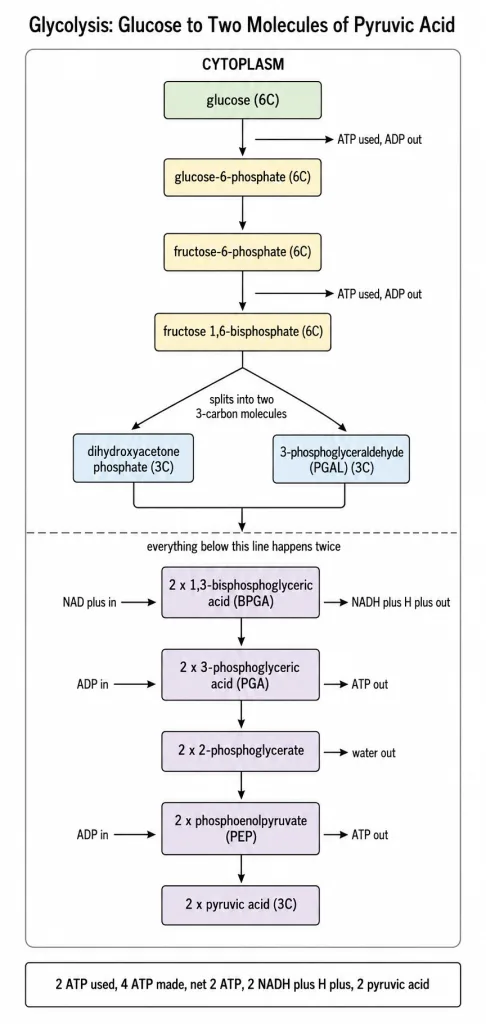
The split. The fructose 1,6-bisphosphate is split into dihydroxyacetone phosphate and 3-phosphoglyceraldehyde (PGAL). From here on everything happens twice, because one six-carbon molecule has become two three-carbon molecules.
The oxidation step. There is one step where is formed from : when 3-phosphoglyceraldehyde (PGAL) is converted to 1,3-bisphosphoglycerate (BPGA). Two redox-equivalents are removed, in the form of two hydrogen atoms, from PGAL and transferred to a molecule of . PGAL is oxidised and, with inorganic phosphate, gets converted into BPGA.
The two energy-yielding steps. The conversion of BPGA to 3-phosphoglyceric acid (PGA) is an energy yielding process, and this energy is trapped by the formation of ATP. Another ATP is synthesised during the conversion of PEP to pyruvic acid.
[NEET Important] Learn the pathway by its four marked events, not by its ten steps. ATP is spent twice, is made at one step, and ATP is made at two steps - each of those last three happening twice over, because the molecule has split in half.
The ATP Account
ATP is utilised at two steps:
- First, in the conversion of glucose into glucose 6-phosphate.
- Second, in the conversion of fructose 6-phosphate to fructose 1,6-bisphosphate.
ATP is synthesised at two steps, and because the six-carbon molecule has already split into two three-carbon molecules, each of these happens twice:
- In the conversion of BPGA to 3-phosphoglyceric acid.
- In the conversion of PEP to pyruvic acid.
| Per glucose | |
|---|---|
| ATP used | 2 |
| ATP made | 4, that is 2 steps happening twice |
| Net ATP | 2 |
| made | 2, that is 1 step happening twice |
| Pyruvic acid made | 2 |
Pyruvic acid is then the key product of glycolysis.
What happens to it depends on the cellular need. There are three major ways in which different cells handle pyruvic acid produced by glycolysis:
- Lactic acid fermentation
- Alcoholic fermentation
- Aerobic respiration
Fermentation takes place under anaerobic conditions in many prokaryotes and unicellular eukaryotes. For the complete oxidation of glucose to and , however, organisms adopt Krebs' cycle, which is also called aerobic respiration. This requires supply.
[NEET Important] Gross 4 ATP, net 2 ATP is the single most-asked number in this section, and the distractor is always 4. The reason the two differ is the 2 ATP invested at the start - a cell has to spend ATP to make ATP. Note also that the two are not yet cashed in; what they are worth depends entirely on whether oxygen turns up.
Quick Recap
- Glycolysis - from Greek glycos, sugar, and lysis, splitting.
- Scheme given by Gustav Embden, Otto Meyerhof and J. Parnas - the EMP pathway.
- In anaerobic organisms it is the only process in respiration.
- Occurs in the cytoplasm; present in all living organisms.
- Glucose undergoes partial oxidation to form two molecules of pyruvic acid.
- In plants the glucose comes from sucrose, the end product of photosynthesis, or from storage carbohydrates; invertase converts sucrose into glucose and fructose, which readily enter the pathway.
- A chain of ten reactions under the control of different enzymes.
- Hexokinase phosphorylates glucose to glucose-6-phosphate, which isomerises to fructose-6-phosphate.
- Fructose 1,6-bisphosphate splits into dihydroxyacetone phosphate and 3-phosphoglyceraldehyde (PGAL).
- is formed from at one step - PGAL to 1,3-bisphosphoglycerate (BPGA) - when two redox-equivalents are removed as two hydrogen atoms.
- ATP is utilised at two steps - glucose to glucose-6-phosphate, and fructose-6-phosphate to fructose 1,6-bisphosphate.
- ATP is synthesised at two steps - BPGA to PGA, and PEP to pyruvic acid.
- Per glucose: 2 ATP used, 4 made, net 2 ATP, plus 2 and 2 pyruvic acid.
- Three fates of pyruvate: lactic acid fermentation, alcoholic fermentation, aerobic respiration.
- Fermentation happens under anaerobic conditions in many prokaryotes and unicellular eukaryotes; complete oxidation needs Krebs' cycle and an supply.
Solved Examples
Question 1
Q. What does the word glycolysis mean, and what is the pathway also called?
Answer. From the Greek glycos for sugar and lysis for splitting. It is often referred to as the EMP pathway, after Gustav Embden, Otto Meyerhof and J. Parnas, who gave the scheme.
Question 2
Q. Where does glycolysis occur, and in which organisms?
Answer. In the cytoplasm of the cell, and it is present in all living organisms. In anaerobic organisms it is the only process in respiration.
Question 3
Q. What does glycolysis do to glucose?
Answer. Glucose undergoes partial oxidation to form two molecules of pyruvic acid. Note the word partial - the glucose is not fully broken down here.
Question 4
Q. In a plant, where does the glucose for glycolysis come from?
Answer. From sucrose, which is the end product of photosynthesis, or from storage carbohydrates. Sucrose is converted into glucose and fructose by the enzyme invertase, and both readily enter the glycolytic pathway.
Question 5
Q. Which enzyme phosphorylates glucose, and to what?
Answer. Hexokinase, which converts glucose to glucose-6-phosphate. That then isomerises to fructose-6-phosphate.
Question 6
Q. What is fructose 1,6-bisphosphate split into?
Answer. Dihydroxyacetone phosphate and 3-phosphoglyceraldehyde (PGAL).
Question 7
Q. At which step of glycolysis is formed, and how?
Answer. When 3-phosphoglyceraldehyde (PGAL) is converted to 1,3-bisphosphoglycerate (BPGA). Two redox-equivalents are removed, as two hydrogen atoms, from PGAL and transferred to a molecule of ; PGAL is oxidised and, with inorganic phosphate, becomes BPGA.
Question 8
Q. Name the two steps at which ATP is utilised in glycolysis.
Answer. The conversion of glucose into glucose 6-phosphate, and the conversion of fructose 6-phosphate to fructose 1,6-bisphosphate.
Question 9
Q. Name the two steps at which ATP is synthesised in glycolysis.
Answer. The conversion of BPGA to 3-phosphoglyceric acid (PGA), and the conversion of PEP to pyruvic acid.
Question 10
Q. How many ATP molecules are directly synthesised in glycolysis from one glucose molecule, and what is the net gain?
Answer. Four are synthesised, because the two ATP-yielding steps each happen twice - the six-carbon molecule has already split into two three-carbon molecules. Two are used up at the start, so the net gain is 2 ATP per glucose.
Question 11
Q. Give the schematic representation of glycolysis. This is one of the chapter-end exercises.
Answer. Draw it as a single vertical chain from glucose down to pyruvic acid, marking every point where ATP or enters or leaves.
The chain, with the carbon count at each stage:
Glucose (6C) - ATP used, ADP out - glucose-6-phosphate (6C) - fructose-6-phosphate (6C) - ATP used, ADP out - fructose 1,6-bisphosphate (6C) - splits into two 3-carbon molecules: dihydroxyacetone phosphate and 3-phosphoglyceraldehyde (PGAL) - in, out - 2 x 1,3-bisphosphoglyceric acid (BPGA) - ADP in, ATP out - 2 x 3-phosphoglyceric acid (PGA) - 2 x 2-phosphoglycerate - water out - 2 x phosphoenolpyruvate (PEP) - ADP in, ATP out - 2 x pyruvic acid (3C).
Four things your diagram must show to earn full marks:
- ATP used at two steps, both before the split.
- The split of the 6-carbon fructose 1,6-bisphosphate into two 3-carbon molecules - after this, write everything as "2 x".
- formed at one step, PGAL to BPGA.
- ATP formed at two steps, BPGA to PGA and PEP to pyruvic acid.
Write the tally underneath: 2 ATP used, 4 ATP made, net 2 ATP, 2 , 2 pyruvic acid.
Question 12
Q. What are the three fates of pyruvic acid, and what decides which one happens?
Answer. Lactic acid fermentation, alcoholic fermentation and aerobic respiration. Which one happens depends on the cellular need - chiefly whether oxygen is available.
Question 13
Q. Why does everything after the split step in glycolysis happen twice?
Answer. Because fructose 1,6-bisphosphate, a six-carbon molecule, is split into two three-carbon molecules. Each of them then goes through the remaining steps separately, so every later product, every ATP made and every made is doubled.
Question 14
Q. Distinguish between glycolysis and the Krebs cycle. This is one of the chapter-end exercises.
Answer. They are consecutive stages of the same breakdown, but almost everything about them differs.
| Glycolysis | Krebs' cycle | |
|---|---|---|
| Location | Cytoplasm | Matrix of the mitochondria |
| Oxygen | Not required | Requires an supply |
| Shape of the pathway | A linear chain of ten reactions | A cycle - the acceptor is regenerated |
| Starting material | Glucose, 6 carbons | Acetyl CoA, 2 carbons |
| End product | Two molecules of pyruvic acid | , with OAA regenerated |
| released | None | Released |
| Oxidation of glucose | Partial | Completes the oxidation |
| Occurs in | All living organisms | Aerobic organisms |
| Reduced coenzymes | 2 | at three points and at one |
The one-line version: glycolysis splits a sugar in the cytoplasm without oxygen and gets very little out of it; the Krebs cycle finishes the job in the mitochondrial matrix and needs oxygen to keep going.