
Three Axes, Three Planes, Eight Octants
Locating a point in a plane takes two numbers; locating a fan-tip in a room takes three — the distances from two adjacent walls and from the floor. That is the whole idea of 3D coordinates.
Take three mutually perpendicular planes meeting at a point . They intersect along three mutually perpendicular lines , , — the -, - and -axes — forming the rectangular coordinate system with origin .
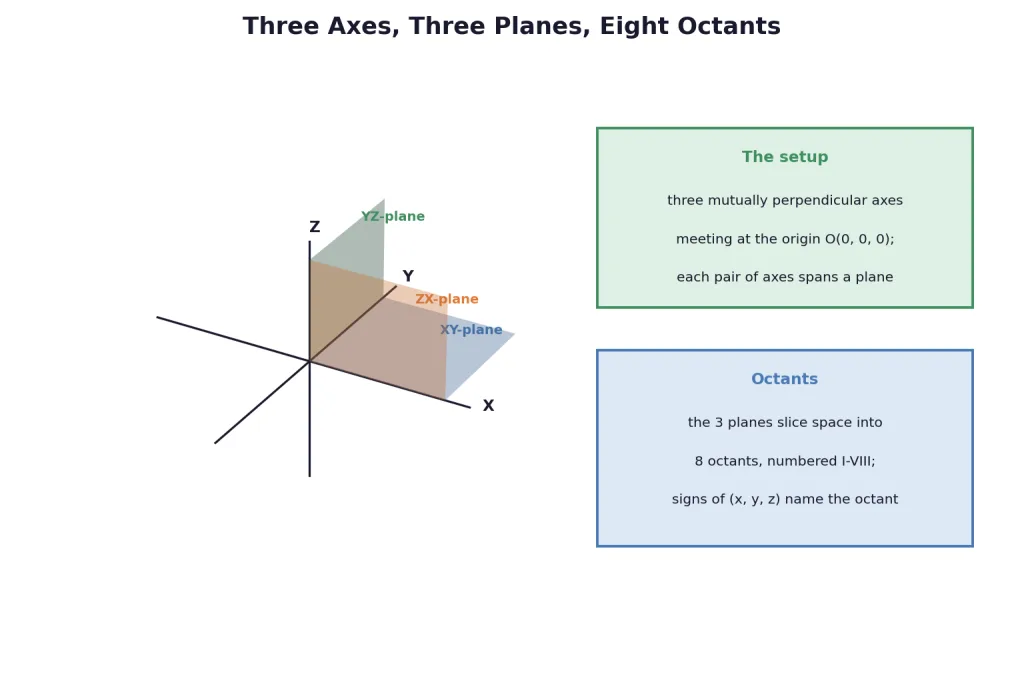
Key Point (Coordinate planes): each pair of axes spans a plane — the -plane, -plane and -plane. With the -plane horizontal, distances up along are positive, down are negative; similarly each axis carries its positive and negative direction.
The three planes slice space into eight octants, numbered I through VIII. Signs identify them:
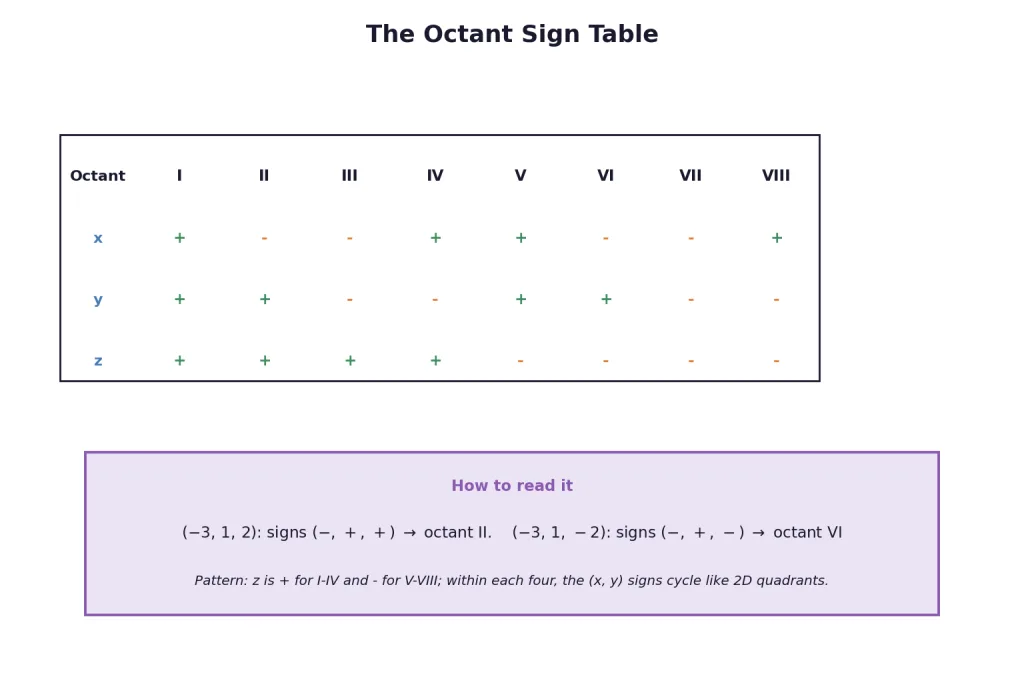
Reading the table: has signs — octant II; has signs — octant VI. The pattern: octants I-IV have and cycle through the four 2D-quadrant sign patterns of ; octants V-VIII repeat them with .
Coordinates of a Point in Space
Key Point (The triplet): given in space, drop a perpendicular to the -plane, then a perpendicular to the -axis. With , , , the point is . Equivalently, , , are the perpendicular distances of from the -, - and -planes respectively.
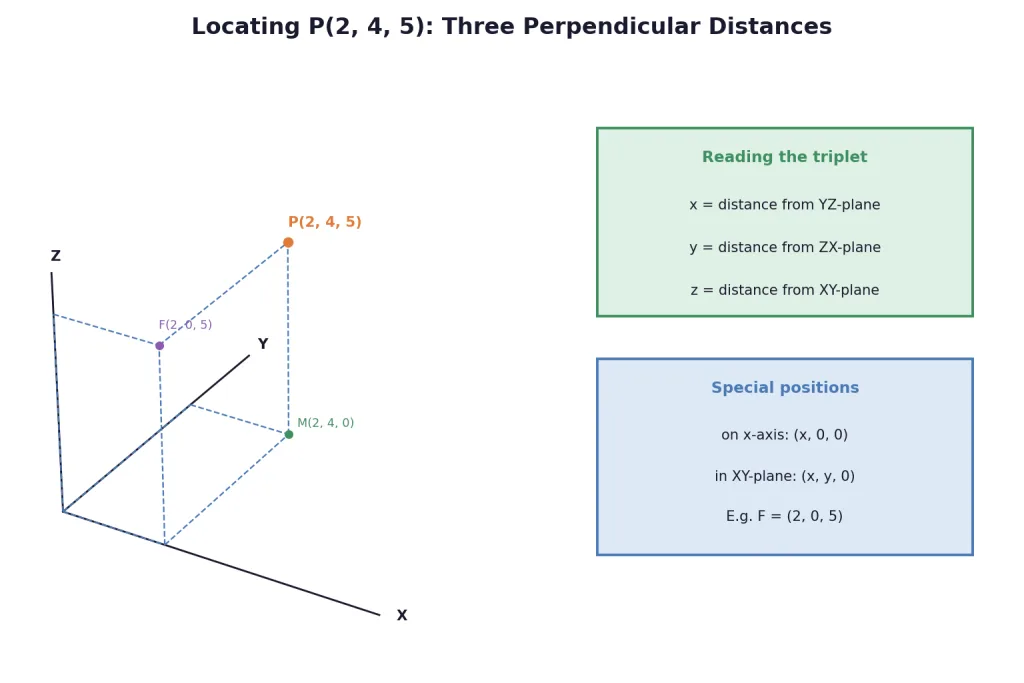
This sets up a one-to-one correspondence between points of space and ordered triplets : every point gets exactly one triplet, and every triplet locates exactly one point (fix on the -axis, walk to in the -plane, rise to ).
Special positions worth memorising:
The origin is . A point on the -axis looks like ; on the -axis ; on the -axis . A point in the -plane looks like ; in the -plane ; in the -plane .
Worked check: if and is the foot of the perpendicular from to the -plane, then the -distance collapses to zero: .
[Board Tip] "A point is in the -plane — what is its -coordinate?". Answer in one word: zero. Lying in a coordinate plane kills exactly the coordinate measured away from that plane — no computation needed.
Solved Examples
Example 1: Collapsing one coordinate
is . Find the coordinates of , the foot of the perpendicular from to the -plane.
Solution:
Step 1 — Identify what reaching the plane changes. The -plane is the set ; the perpendicular from travels purely in the -direction, so only the -coordinate changes.
Step 2 — Set it to zero. .
Takeaway: Dropping a perpendicular to a coordinate plane zeroes exactly one coordinate — the one measured away from that plane.
Example 2: Naming octants
Find the octants in which and lie.
Solution:
Step 1 — Read the signs. has sign pattern ; has .
Step 2 — Look up the octant table. is octant II; is octant VI.
Takeaway: Octants I-IV have and cycle the 2D quadrant signs of ; V-VIII repeat them with — the same point with negated jumps by exactly four.
Example 3: Points on an axis, points in a plane
(i) A point lies on the -axis: what are its - and -coordinates? (ii) A point lies in the -plane: what is its -coordinate?
Solution:
Step 1 — (i) An axis point. The -axis is the intersection of the - and -planes, so distances from both are zero: AND — the point is .
Step 2 — (ii) A plane point. Lying in the -plane means zero distance from it, and that distance is : , form .
Takeaway: Membership of an axis kills two coordinates; membership of a coordinate plane kills one.
Example 4: An octant drill
Name the octants of , , , , , , , .
Solution:
Step 1 — Sort by the sign of . With : , , , land in octants I-IV; with : the other four land in V-VIII.
Step 2 — Use the quadrant within each half. : → I. : → IV. : → II. : → III.
Step 3 — Repeat below the -plane. : → V. : → VI. : → VII. : → VIII.
Takeaway: Decide first, then read the pair like a 2D quadrant — the table becomes automatic.
Example 5: Fill in the blanks
(i) The -axis and -axis taken together determine a plane known as . (ii) The coordinates of points in the -plane are of the form . (iii) Coordinate planes divide the space into __ octants.
Solution:
Step 1 — (i). Two intersecting lines span exactly one plane: the -plane.
Step 2 — (ii). Height above that plane is , and in the plane : form .
Step 3 — (iii). Each coordinate independently positive or negative: eight octants.
Takeaway: All three blanks are one fact seen three ways — the coordinate planes carve space by signs.
Example 6: Signs to octant, octant to signs
(i) A point has , , : which octant? (ii) Write a sample point in octant VII.
Solution:
Step 1 — (i) Signs to octant. : third quadrant pattern in with — octant III.
Step 2 — (ii) Octant to signs. Octant VII is the partner of III: signs , e.g. .
Takeaway: The table works in both directions — memorise the four upper octants and negate for the lower four.
Example 7: Feet of perpendiculars to all three planes
For , write the feet of the perpendiculars from to the -, - and -planes, and the distances to each plane.
Solution:
Step 1 — Zero one coordinate per plane. Foot on (): ; on (): ; on (): .
Step 2 — Distances are the dropped coordinates. From : ; from : ; from : .
Step 3 — Check one. From to : ✓.
Takeaway: ARE the three plane-distances — that is the geometric meaning of the coordinates.
Example 8: Reflections in the coordinate planes
Write the image of in (i) the -plane, (ii) the -plane, (iii) the origin.
Solution:
Step 1 — (i) Mirror in . The mirror flips the coordinate perpendicular to it: gives .
Step 2 — (ii) Mirror in . gives .
Step 3 — (iii) Point reflection in . All three flip: .
Takeaway: Plane mirrors flip ONE sign; the origin flips all three; an axis reflection (compose two planes) flips two.