
The Section Formula
The rationalised syllabus keeps only the distance formula, but JEE (and Class 12 vectors) assume you also carry the section formula. Everything in this section is one formula and its disguises.
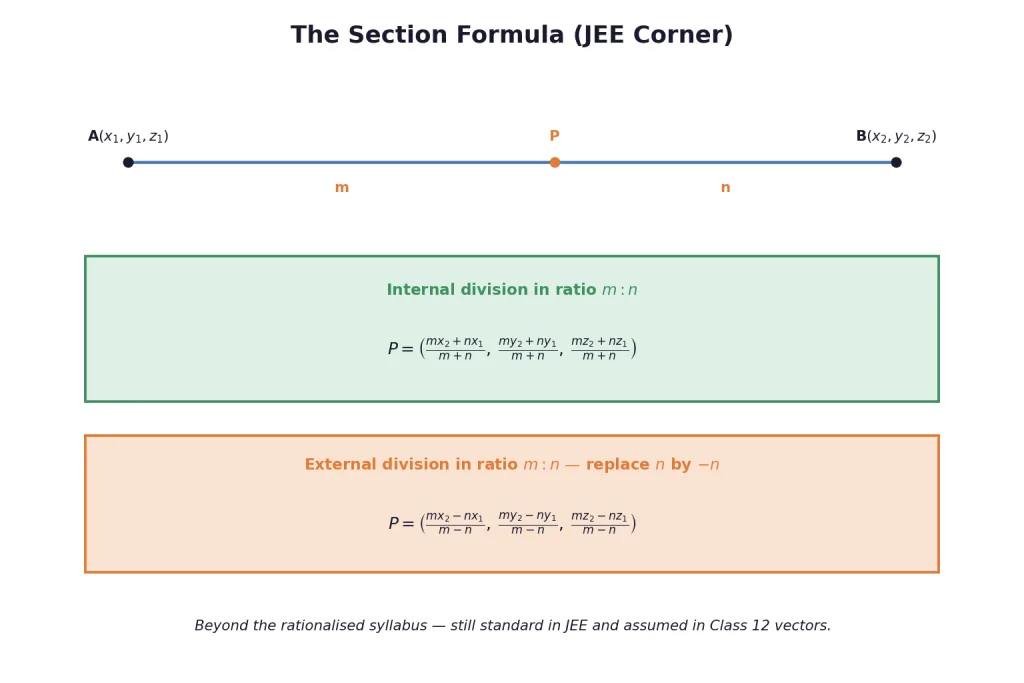
Key Point (Internal division): the point dividing in ratio internally, with and , is
Key Point (External division): replace by :
The disguises — all the same pattern:
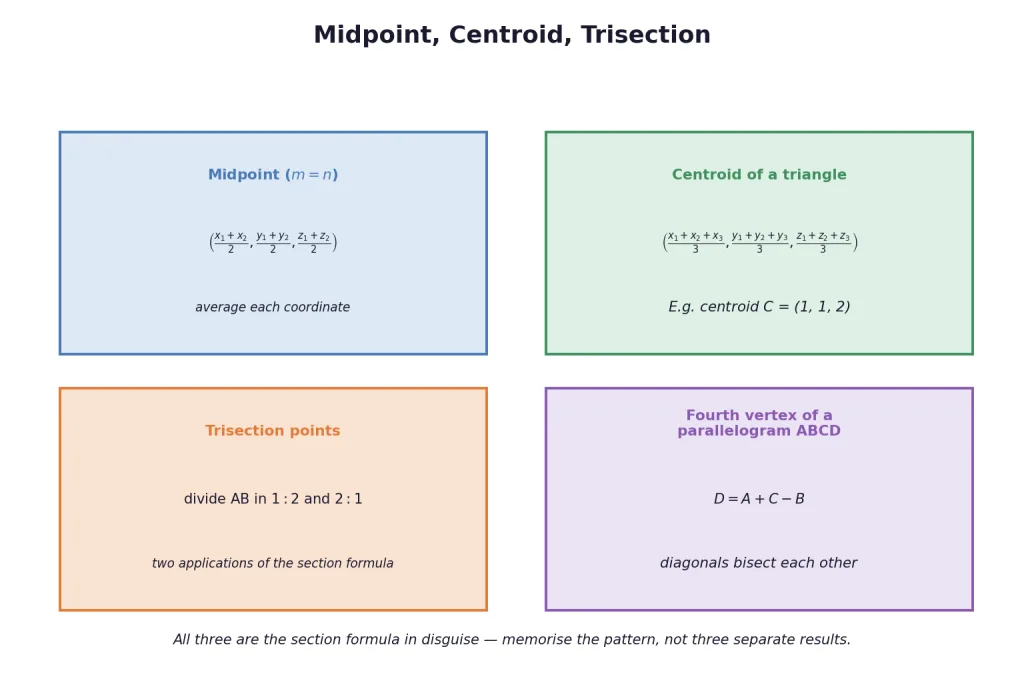
The midpoint is : average each coordinate. Trisection points divide in and . The centroid of a triangle averages all three vertices, , and divides each median from the vertex. The fourth vertex of parallelogram comes from the diagonals bisecting each other: .
Collinearity via ratios: three points are collinear exactly when one of them divides the segment joining the other two in some real ratio — often faster than three distance computations.
Plane-Division Ratios, Distances from Axes, and Spheres
1. In what ratio does a coordinate plane cut a segment? The -plane is : set the -coordinate of the section point to zero and solve for .
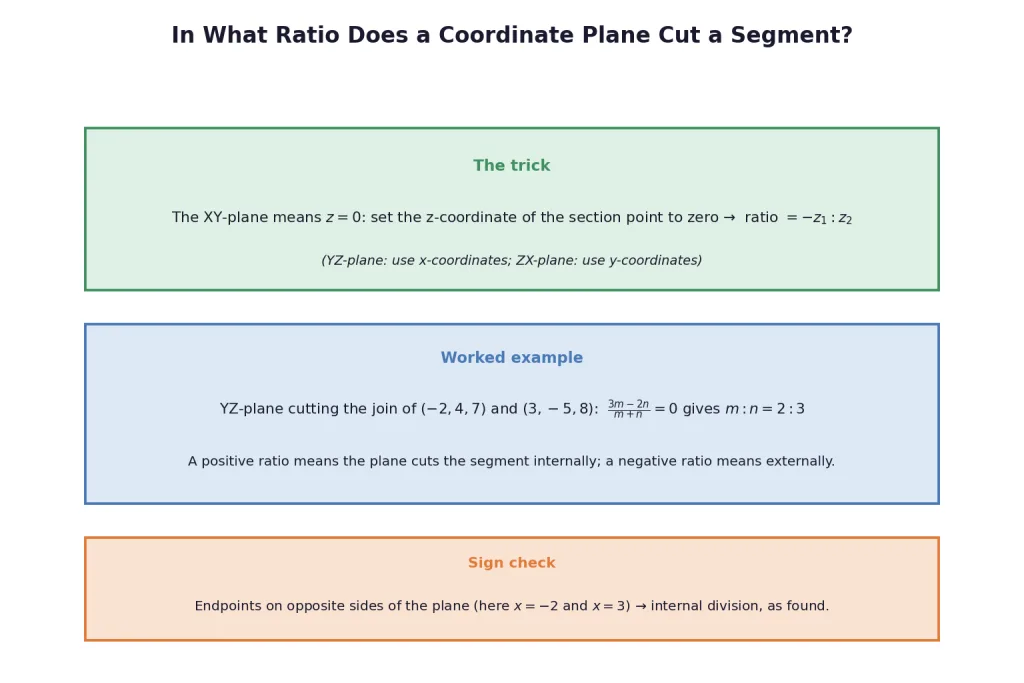
A positive ratio means the plane cuts the segment internally (the endpoints lie on opposite sides); a negative ratio means externally. The -plane uses -coordinates and the -plane uses -coordinates in the same way.
2. Distance of a point from the coordinate axes (not the planes!): the distance of from the -axis is — collapse the coordinate that runs along the axis and keep the other two. From the -axis: ; from the -axis: .
3. Spheres by completing squares. Just as is a circle, the 3D analogue
is a sphere with centre and radius . Completing three squares reads off both.
[JEE Tip] Keep "distance from a plane" and "distance from an axis" separate: from the -plane it is (one coordinate), from the -axis it is (two coordinates). Mixing them is the classic one-mark giveaway in 3D screening questions.
JEE-Style Solved Examples
Example 1: Internal division
Find the point dividing the join of and in the ratio internally.
Solution:
Step 1 — Set the weights. Ratio : weight by and by , denominator .
Step 2 — Apply per coordinate. ; ; .
Step 3 — Sanity check. The ratio is less than 1, so should sit nearer — and is indeed closer to than to ✓.
Takeaway: multiplies the FAR point , the NEAR point — swapping them is the single most common section-formula error.
Example 2: External division
Find the point dividing the same in the ratio externally.
Solution:
Step 1 — Replace by . Denominator .
Step 2 — Apply. ; ; .
Step 3 — Interpret. lies OUTSIDE segment , beyond (since , the external point falls on 's side).
Takeaway: External division with lands beyond the first point; with , beyond the second — predict the side before computing.
Example 3: Trisection points
Find the points of trisection of the segment joining and .
Solution:
Step 1 — First trisection point (ratio ). .
Step 2 — Second trisection point (ratio ). .
Step 3 — Check the spacing. The -coordinates run — equal jumps of ✓.
Takeaway: Trisection = the ratios and ; checking one coordinate for equal steps validates both points at once.
Example 4: Ratio cut by the -plane
In what ratio does the -plane divide the segment joining and ?
Solution:
Step 1 — The -plane is . Set the section point's -coordinate to zero: .
Step 2 — Solve. : — ratio .
Step 3 — Internal or external? The endpoints' -coordinates and have opposite signs, so the segment genuinely crosses the plane: internal.
Takeaway: Only the coordinate perpendicular to the plane matters — the other four numbers are decoys.
Example 5: Ratio cut by the -plane
In what ratio does the -plane divide the segment joining and ?
Solution:
Step 1 — The -plane is . .
Step 2 — Solve. : ratio .
Step 3 — Classify. runs from to — a sign change, so the cut is internal.
Takeaway: The shortcut gives directly; a positive result means internal.
Example 6: Collinearity by the section idea
Show that , , are collinear, and state the ratio in which divides .
Solution:
Step 1 — Test whether is a section point of . Midpoint of : .
Step 2 — Compare. That is exactly : all three coordinates agree at the ratio .
Step 3 — Conclude. divides in ratio (it is the midpoint) — one point of the segment lying on the line through the others: collinear. ∎
Takeaway: "Some point divides the other two in a REAL ratio" is a complete collinearity test — one consistent ratio across all three coordinates.
Example 7: Centroid from a vertex and the opposite midpoint
In , and the midpoint of is . Find the centroid.
Solution:
Step 1 — Use the property. The centroid divides median in ratio from the vertex .
Step 2 — Section formula on and . .
Step 3 — Compute. .
Takeaway: You never need and separately — the median's endpoints carry all the centroid information.
Example 8: Distances from the three axes
Find the distances of from the -, - and -axes.
Solution:
Step 1 — Drop the along-axis coordinate. From the -axis, only and matter: .
Step 2 — Repeat. From the -axis: ; from the -axis: .
Step 3 — Cross-check with the identity. ✓.
Takeaway: Axis distance keeps the OTHER two coordinates; plane distance keeps one. The sum-of-squares identity is a free error detector.
Example 9: Reading a sphere's centre and radius
Find the centre and radius of .
Solution:
Step 1 — Complete three squares. .
Step 2 — Collect. Right side .
Step 3 — Read off. Centre , radius .
Takeaway: Same drill as the circle with one more square — halve each linear coefficient, flip the sign, add the three squares to the constant.
Example 10: The ratio in which a point divides a segment
lies on the join of and . Find the ratio .
Solution:
Step 1 — Difference vectors. ; .
Step 2 — Compare. : the two steps are parallel and the second is twice as long.
Step 3 — Conclude. , and the proportionality confirms really lies on segment . ∎
Takeaway: Ratios read directly from difference vectors — no formula rearrangement needed when the point is already known.
Example 11: A section point with an unknown
The point divides the join of and internally. Find the ratio and then , .
Solution:
Step 1 — Use the known coordinate. : cross-multiplying, .
Step 2 — Solve for the ratio. : .
Step 3 — Feed the ratio back. ; .
Takeaway: One known coordinate pins the ratio; the ratio then generates every other coordinate — a two-stage template worth memorising.
Example 12: Sphere through the origin
A sphere has centre and passes through the origin. Find its equation in expanded form.
Solution:
Step 1 — Radius. Centre to origin: .
Step 2 — Standard form. .
Step 3 — Expand. , i.e. .
Takeaway: A sphere through the origin has NO constant term — substitute and the equation must reduce to .