
Solved Examples — the Full Chapter Workout
Thirty worked problems: octant drills, distances, triangle and quadrilateral classification, centroid and locus problems. Attempt each before reading the solution.
Example 1: Parallelogram, not rectangle
Show that , , , form a parallelogram that is not a rectangle.
Solution:
Step 1 — Squared sides in cyclic order. ; ; ; .
Step 2 — Parallelogram test. and : opposite sides equal — parallelogram.
Step 3 — Rectangle test via diagonals. ; . : not a rectangle. ∎
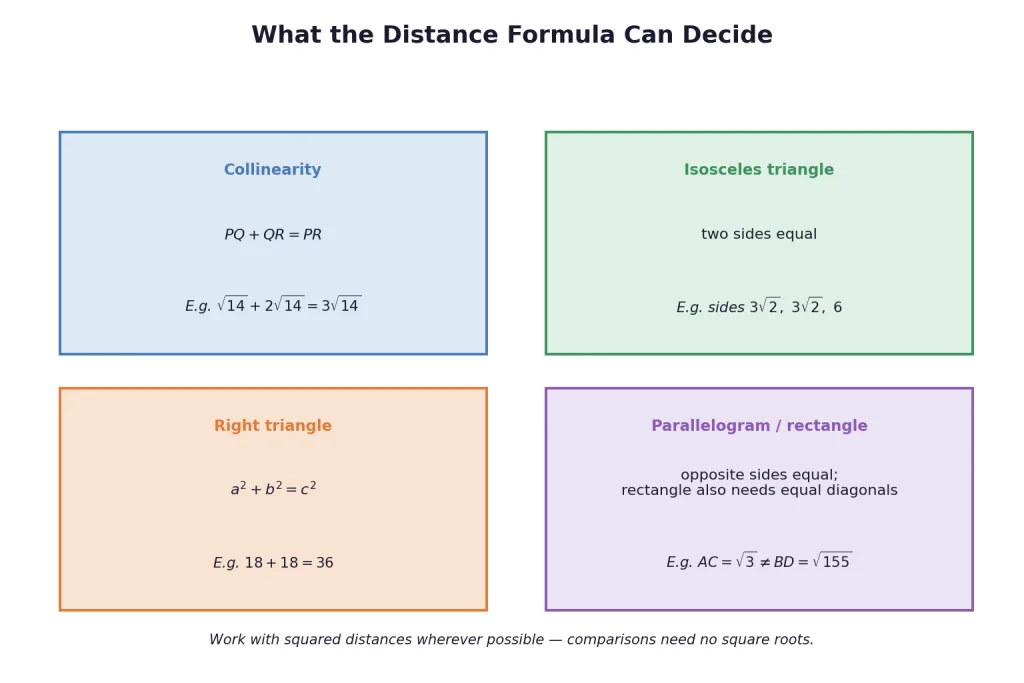
Takeaway: Equal opposite sides buy the parallelogram; the rectangle upgrade costs one more check — equal diagonals — and here it fails spectacularly.
Example 2: Diagonal-midpoint check of the same quadrilateral
Verify Example 1's conclusion using midpoints of the diagonals.
Solution:
Step 1 — Midpoint of . .
Step 2 — Midpoint of . .
Step 3 — Conclude. The diagonals bisect each other — parallelogram, in one line. ∎
Takeaway: The midpoint test is faster than four side lengths; keep both tools and pick by the arithmetic on offer.
Example 3: An equidistant plane
Find the set of points equidistant from and .
Solution:
Step 1 — Square the condition. : .
Step 2 — Expand; the squares cancel. .
Step 3 — Collect. — the perpendicular-bisector plane of .
Takeaway: Equidistance from two points is always a plane in 3D — squaring kills every quadratic term, guaranteed.
Example 4: Recovering a vertex from the centroid
The centroid of is ; and . Find .
Solution:
Step 1 — Set up one equation per coordinate. With : , , .
Step 2 — Solve each. gives ; gives ; gives .
Step 3 — Write and check. ; averaging all three vertices indeed returns ✓.
Takeaway: Centroid problems are three independent 1D problems — never solve them as a system.
Example 5: The fourth vertex
Three vertices of parallelogram are , , . Find .
Solution:
Step 1 — Use the diagonal property. In parallelogram the diagonals and share a midpoint, so coordinate-wise.
Step 2 — Compute. .
Step 3 — Check. Midpoint of : ; midpoint of : ✓.
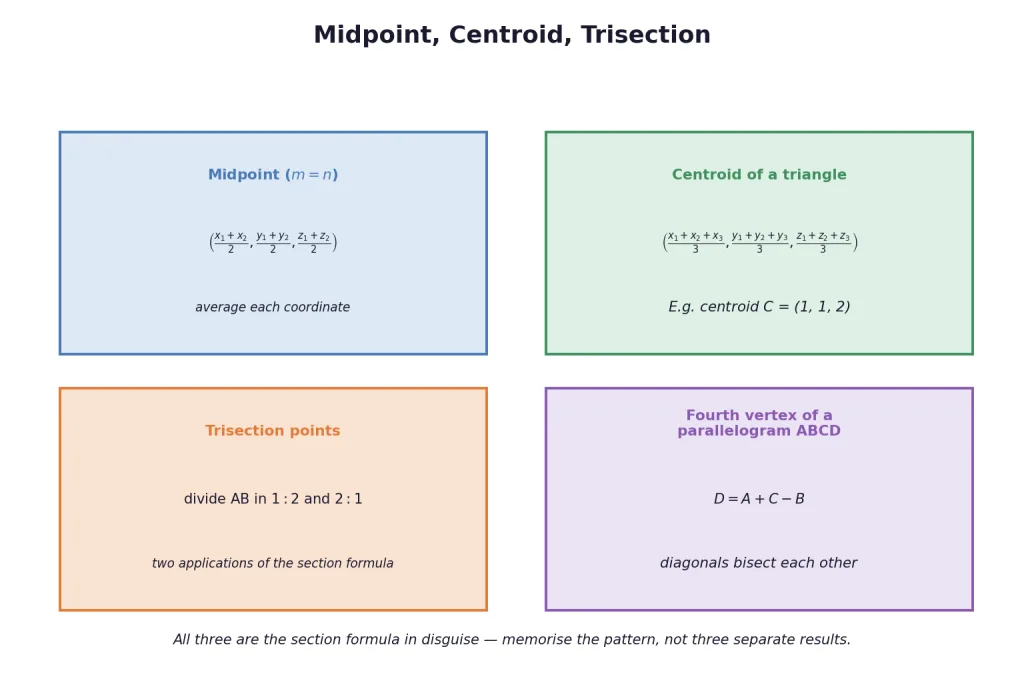
Takeaway: is the one-line fourth-vertex formula — but match the LABELS: it pairs the vertices adjacent to across the diagonal.
Example 6: Median lengths
Find the lengths of the medians of the triangle , , .
Solution:
Step 1 — Midpoints of the sides. : ; : ; : .
Step 2 — Median from each vertex to the opposite midpoint. From : ; from : ; from : .
Step 3 — Sanity check the symmetry. and play symmetric roles (swap ), so their medians must match — and they do, both 7 ✓.
Takeaway: A median is just a distance to a midpoint — two formulas chained; symmetry predicts equal answers before computing.
Example 7: Centroid at the origin
The origin is the centroid of with , , . Find , , .
Solution:
Step 1 — -average. gives : .
Step 2 — -average. gives : .
Step 3 — -average. gives : .
Takeaway: "Centroid at the origin" means each coordinate-list sums to zero — three separate little equations, one unknown each.
Example 8: A locus
With and , find the set of points with .
Solution:
Step 1 — Write both squared distances. .
Step 2 — Expand and merge. Quadratics double up; linear terms: ; constants: .
Step 3 — Write the locus. — a sphere-type equation.
Takeaway: Sums of SQUARED distances keep their quadratic terms — expect a sphere, not a plane.
Example 9: An octant drill with fresh numbers
Name the octants of , , and .
Solution:
Step 1 — Sort by . : and (octants I-IV); : and (octants V-VIII).
Step 2 — Read the quadrant. : → IV. : → II.
Step 3 — Repeat below. : → VII. : → V.
Takeaway: first, then the 2D quadrant — the octant table reads itself.
Example 10: Diagonals of a cube and a box
Find (i) the diagonal of a cube of side with one vertex at the origin and edges along the axes; (ii) the diagonal of a box with edges 3, 4, 12.
Solution:
Step 1 — (i) Opposite corners. From to : .
Step 2 — (ii) The box. .
Step 3 — Note the pattern. is a Pythagorean quadruple — the 3D cousin of .
Takeaway: A box diagonal IS the distance formula — the formula's own derivation picture, run backwards.
Example 11: A point on the -axis equidistant from two points
Find the point on the -axis equidistant from and .
Solution:
Step 1 — Parametrise the axis. The point is ; set the squared distances equal: .
Step 2 — Expand and cancel . gives : .
Step 3 — Conclude and check. The point is the origin ; both distances are ✓ — and it satisfies the bisector plane of these two points.
Takeaway: Restricting a locus to an axis turns a plane condition into a single linear equation — one unknown, because the axis has one degree of freedom.
Example 12: A point on the -axis equidistant from two points
Find the point on the -axis equidistant from and .
Solution:
Step 1 — Parametrise. For : .
Step 2 — Expand. , i.e. .
Step 3 — Solve and check. : — the point is , and both distances equal ✓.
Takeaway: Always verify with the actual distances — the check costs two lines and catches every sign slip.
Example 13: A point on the -axis equidistant from two points
Find the point on the -axis equidistant from and .
Solution:
Step 1 — Parametrise. For : .
Step 2 — Cancel the equal constants. , so .
Step 3 — Solve. : — the point is .
Takeaway: When the fixed constants match on both sides (), the equation collapses to comparing two squares — spot it and skip a line of algebra.
Example 14: A 3-4-5 triangle on the axes
Find the perimeter of the triangle with vertices , , .
Solution:
Step 1 — Two sides along the axes. Origin to : 3; origin to : 4.
Step 2 — The hypotenuse. to : .
Step 3 — Sum. Perimeter .
Takeaway: Points with a shared zero coordinate live in one coordinate plane — the problem is secretly 2D.
Example 15: An equilateral triangle in space
Show that , , form an equilateral triangle.
Solution:
Step 1 — Squared sides. ; ; .
Step 2 — Conclude. All sides : equilateral. ∎
Step 3 — See why before computing. The vertices are cyclic permutations of — the same three squared differences reappear in every side, just reordered.
Takeaway: Cyclic-permutation vertices always give equilateral triangles — symmetry does the arithmetic.
Example 16: A collinearity check
Are , , collinear?
Solution:
Step 1 — Three distances. ; ; .
Step 2 — Test the sum. .
Step 3 — Conclude. Collinear — and since , is the midpoint of . ∎
Takeaway: Equal steps with matching differences per coordinate is uniform motion along a line — the distance check just certifies it.
Example 17: Right and isosceles at once
Classify the triangle , , .
Solution:
Step 1 — Squared sides. ; ; .
Step 2 — Isosceles test. ✓.
Step 3 — Right-angle test. : right angle at (the vertex between the equal sides).
Takeaway: is the signature of the isosceles right triangle — half a square cut along its diagonal.
Example 18: A locus with a ratio condition
A point moves so that where is the origin and . Find the locus.
Solution:
Step 1 — Square the ratio condition. : .
Step 2 — Expand. .
Step 3 — Collect. — a sphere (an Apollonius sphere: the 3D analogue of the Apollonius circle).
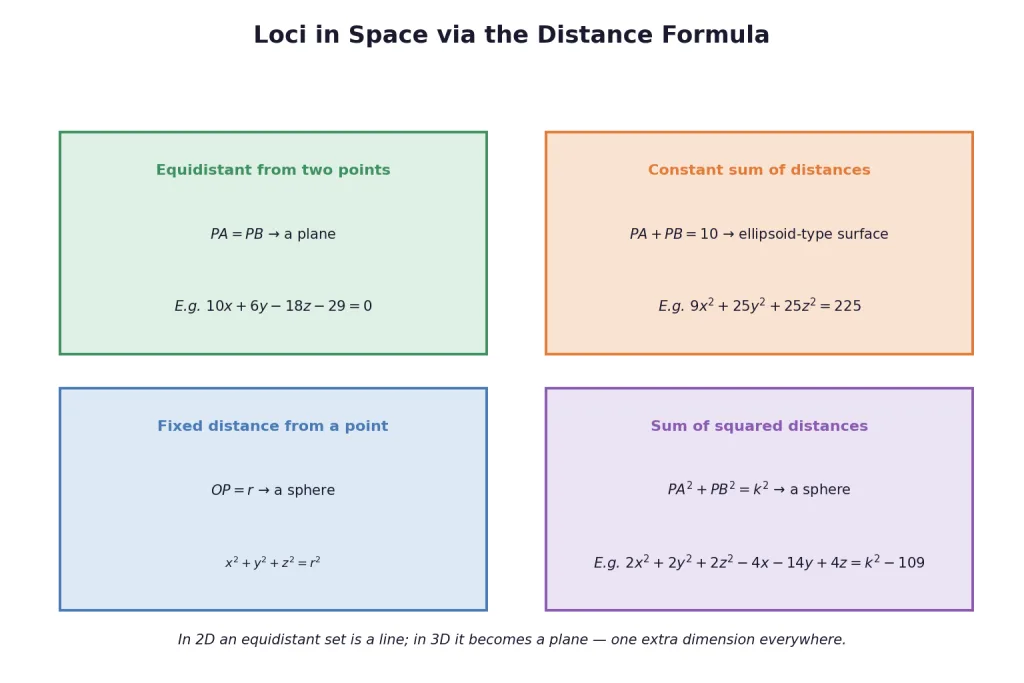
Takeaway: A distance RATIO other than 1 gives a sphere; ratio exactly 1 gives the bisector plane — the boundary case.
Example 19: On the sphere or not?
The set of points at distance 5 from the origin is . Which of and lies on it?
Solution:
Step 1 — Test . ✓ — on the sphere.
Step 2 — Test . — inside the sphere (distance ).
Takeaway: Substitute and compare with : equal — on; less — inside; greater — outside. Same trichotomy as the circle, one coordinate up.
Example 20: Distances of a point from the three planes and the origin
For , find the distances from the three coordinate planes and from the origin.
Solution:
Step 1 — Plane distances are absolute coordinates. From : ; from : ; from : .
Step 2 — Origin distance. .
Step 3 — Connect them. — the origin distance bundles the three plane distances by Pythagoras.
Takeaway: again — recognising quadruples turns arithmetic into recall.
Example 21: Solving for a coordinate from a distance
Find so that the distance between and is 5.
Solution:
Step 1 — Only differs. The distance collapses to .
Step 2 — Solve. : or .
Step 3 — Interpret. Two answers, one on each side of — a distance condition rarely has a unique solution.
Takeaway: Keep the absolute value until the last step; dropping it silently loses the second solution.
Example 22: Distance plus midpoint
For and , find and the midpoint of .
Solution:
Step 1 — Distance. .
Step 2 — Midpoint. Average each coordinate: .
Step 3 — Check. The midpoint's distance to each end should be : from : ✓.
Takeaway: Midpoint = coordinate averages — the case of the section formula.
Example 23: Equidistant from all three planes
A point in octant I is at distance 2 from each coordinate plane. Find it, and its distance from the origin.
Solution:
Step 1 — Translate. , all positive in octant I: .
Step 2 — Origin distance. .
Step 3 — Generalise. Any cube-corner point is from the origin — the cube-diagonal ratio.
Takeaway: "Distance from a coordinate plane" is always one absolute coordinate — no formula needed, just the right one.
Example 24: A degenerate "triangle"
Show that , and do not form a triangle.
Solution:
Step 1 — Distances. to : ; to : ; to : .
Step 2 — Sum test. : equality — the points are collinear, with the midpoint of . ∎
Step 3 — Confirm by averaging. Midpoint of and : ✓.
Takeaway: "Show they do NOT form a triangle" = show the triangle inequality degenerates to equality.
Example 25: Verifying a parallelogram by midpoints
Check by diagonal midpoints that , , , form a parallelogram.
Solution:
Step 1 — Midpoint of . .
Step 2 — Midpoint of . .
Step 3 — Conclude. Same point: the diagonals bisect each other — parallelogram. ∎
Takeaway: This re-proves Section 2's side-length verification in a third of the work — midpoints beat distances when both are available.
Example 26: Checking all pairings for a right angle
Why is the triangle , , not right-angled?
Solution:
Step 1 — Squared sides. , , .
Step 2 — Only one candidate hypotenuse. The right angle would have to face the LARGEST side, so the only possible identity is .
Step 3 — Test it. : no right angle. ∎
Takeaway: You never need to test all three pairings — only the largest square can be the hypotenuse's.
Example 27: Distance from the origin — ordering points
Order , , , by distance from the origin.
Solution:
Step 1 — Squared distances. ; ; ; .
Step 2 — Order. , , tie at distance 3; is farthest at .
Step 3 — Picture it. , , all lie on the sphere of radius 3; sits outside it.
Takeaway: Squared distances order points exactly as distances do — compare squares, root only if the answer demands it.
Example 28: A sphere through a given point
A sphere has centre and passes through . Find and the equation.
Solution:
Step 1 — Radius from centre to the point. .
Step 2 — Write the equation. .
Step 3 — Check. Substituting : ✓.
Takeaway: Centre plus one point determines a sphere the same way it determines a circle — one squared-distance computation.
Example 29: Centroid drill
Find the centroid of the triangle , , .
Solution:
Step 1 — Sum each coordinate. : ; : ; : .
Step 2 — Divide by 3. Centroid .
Takeaway: Centroid = coordinate averages; in 3D that is three small averages, nothing more.
Example 30: A distance identity
Show that for any point , the squared distances from the three axes sum to twice the squared distance from the origin.
Solution:
Step 1 — Distance from each axis. From the -axis: (the two coordinates NOT along the axis); similarly and .
Step 2 — Sum the squares. .
Step 3 — Conclude. . ∎ Each coordinate appears in exactly two of the three axis-distances — hence the factor 2.
Takeaway: Axis distance uses the OTHER two coordinates; plane distance uses just one — keep the two notions apart and identities like this become counting arguments.