
Continuity — Drawing Without Lifting the Pen
Informally, a function is continuous at a point if its graph can be drawn through that point without lifting the pen. Two piecewise examples show how this can fail: a function that jumps from value to value across , and a function that equals everywhere except for a lone value at . In both cases the pen must lift.
Definition. Let be a point in the domain of . Then is continuous at if
Unpacked, three things must hold and agree: the left hand limit, the right hand limit, and the value . If any is missing or they disagree, is discontinuous at , and is a point of discontinuity.
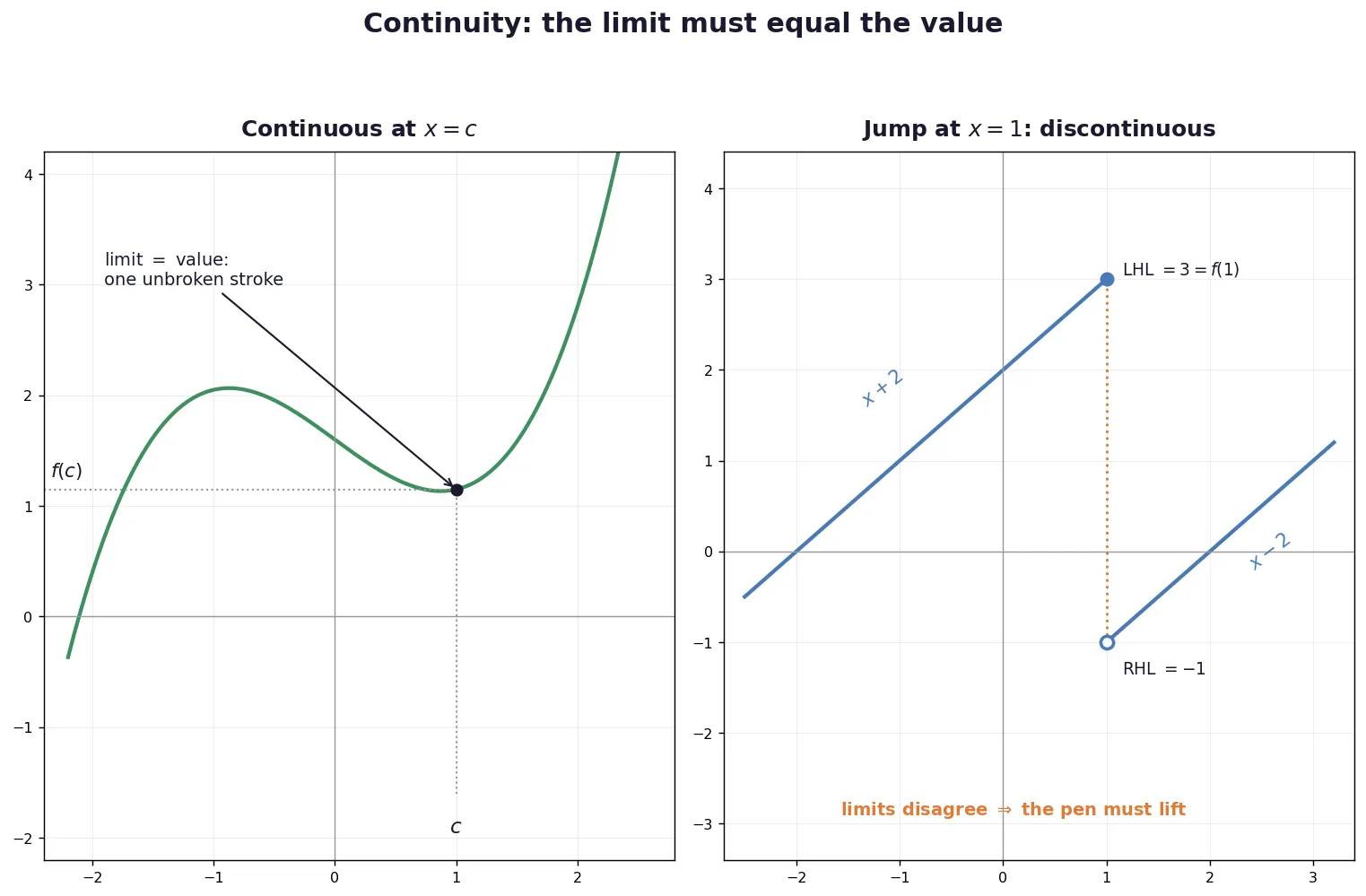
A function is continuous (with no point named) if it is continuous at every point of its domain. Subtle but exam-relevant: is a continuous function — is not in its domain, so there is no domain point where continuity fails.
The case-analysis routine for piecewise functions
For check three cases: away from the joint on each side, each piece is a polynomial (continuous); at the joint : LHL , RHL . They disagree, so is the only point of discontinuity. Every piecewise problem in Exercise territory is this routine — the only work is at the joints.
Algebra of continuous functions
If and are continuous at , then so are , , , and (wherever ). Combined with two seed facts — constants and the identity are continuous — this yields whole families at once:
- Every polynomial is continuous (sums of products of with constants).
- Every rational function is continuous on its domain (quotient rule of the algebra).
- and are continuous everywhere; hence is continuous except where , i.e. at odd multiples of .
- is continuous everywhere — including the corner at (both one-sided limits are ; a corner bends the graph but never breaks it).
- Composites: if and are continuous, so is — so , and friends are continuous with no computation.
One famous troublemaker: the greatest integer function is discontinuous at every integer — at each integer the left hand limit sits one step below the value.
Solved Examples
Example 1 — A first check from the definition
Check the continuity of at .
Step 1 — the limit: .
Step 2 — the value: .
Answer: limit value, so is continuous at .
Example 2 — A two-piece function with a jump
Find all points of discontinuity of .
Step 1 — away from the joint: each piece is a polynomial, continuous on its open piece.
Step 2 — at : LHL ; RHL .
Answer: the one-sided limits disagree, so is the only point of discontinuity.
Example 3 — Three pieces, two joints
Find all points of discontinuity of .
Step 1 — joint : LHL ; RHL ; value . All agree — continuous here.
Step 2 — joint : LHL ; RHL . Disagree.
Answer: discontinuous only at . Always check every joint — one may pass while another fails.
Example 4 — A lone bad value
Discuss the continuity of at .
Step 1 — one-sided limits: LHL , RHL — already unequal, so no value of could rescue continuity.
Answer: discontinuous at (and continuous everywhere else). Redefining a single value can only fix a discontinuity when the two one-sided limits already agree.
Example 5 — Why every polynomial is continuous
Show that every polynomial function is continuous.
Step 1 — seed facts: constant functions and the identity are continuous (each limit is immediate from the definition).
Step 2 — build up with the algebra: is a repeated product of continuous functions, a product with a constant, and a polynomial a finite sum of these.
Answer: by the algebra of continuous functions, every polynomial is continuous at every real number. ∎ The identical argument makes every rational function continuous on its domain.
Example 6 — The greatest integer function
Find all points of discontinuity of , the greatest integer less than or equal to .
Step 1 — away from integers: on any interval between consecutive integers, is constant — continuous.
Step 2 — at an integer : LHL (values just below round down to ), while RHL .
Answer: is discontinuous at every integer and continuous everywhere else — an infinite family of jump points from one innocent-looking definition.