
Chapter 5 at a Glance
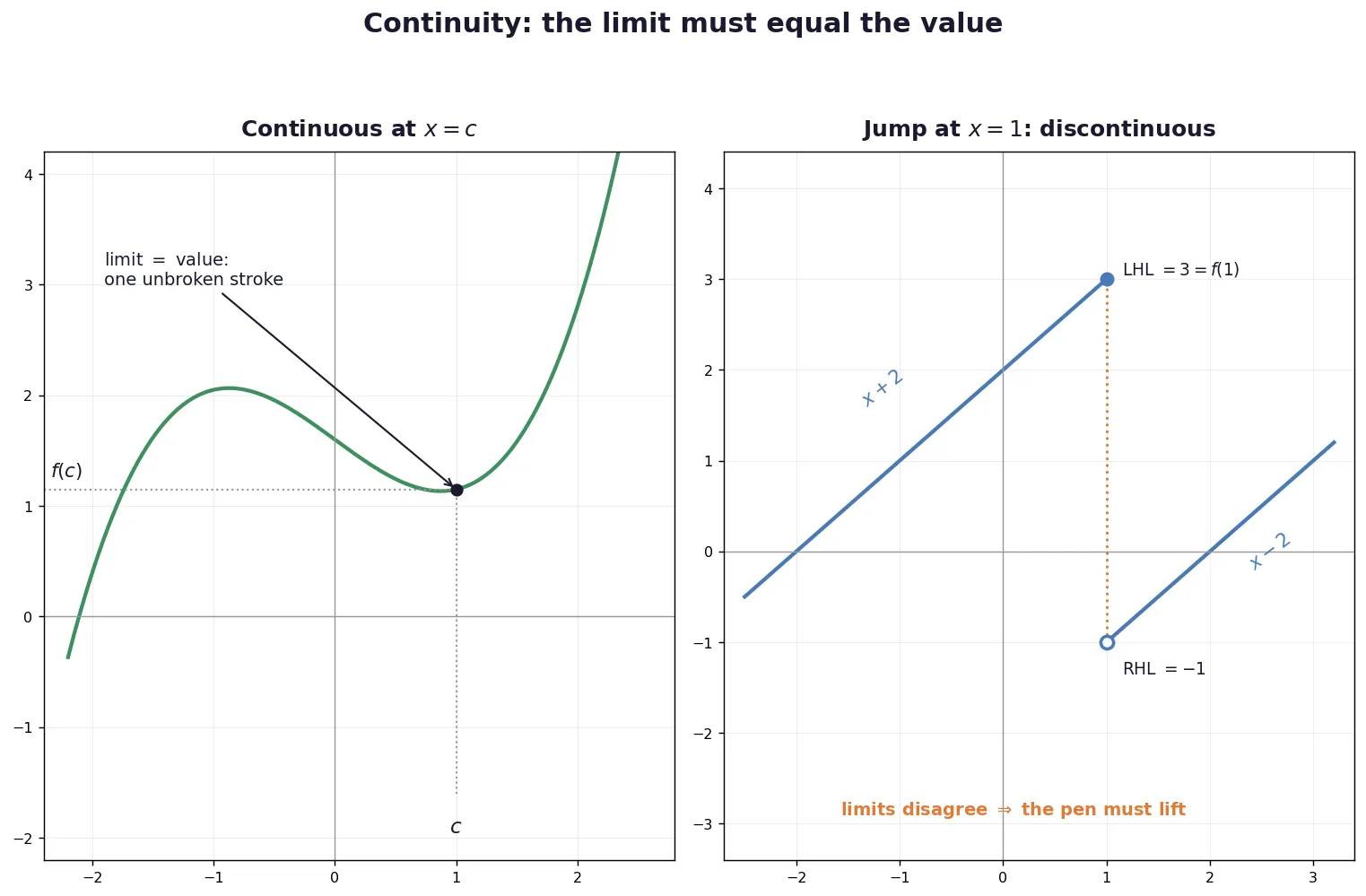
Continuity
is continuous at a domain point when — left limit, right limit and value all present and equal. Sums, differences, products and quotients (denominator nonzero) of continuous functions stay continuous, and so do composites; polynomials, rational functions, , and are continuous throughout their domains, while jumps at every integer.
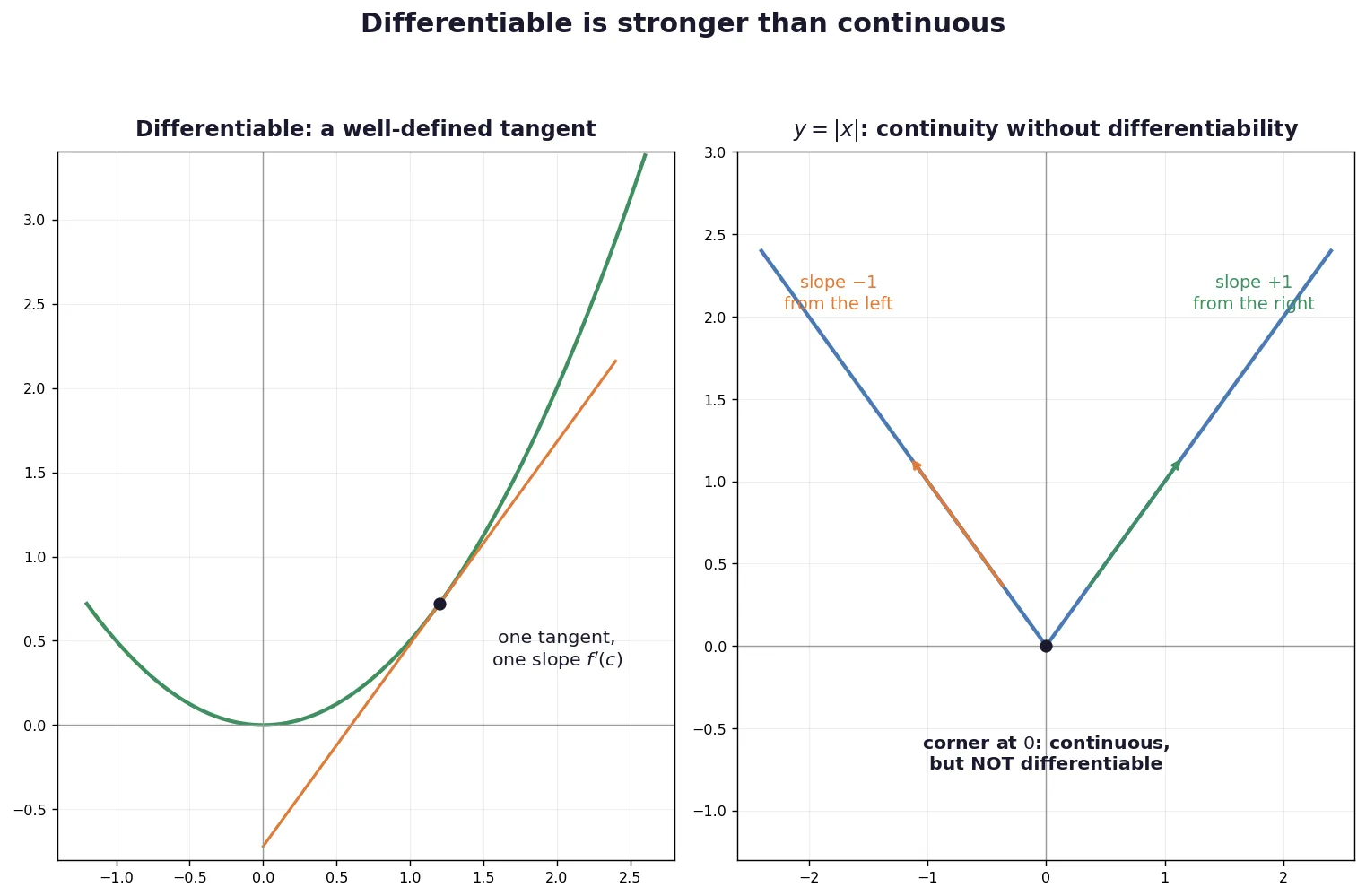
Differentiability
, when the limit exists. Every differentiable function is continuous; the converse fails — has a corner at (LHD , RHD ).
The derivative table
The techniques
Chain rule: — one factor per layer. Implicit: differentiate the relation; every triggers a . Logarithmic: for (both positive where needed), first. Parametric: (with ). Second order: differentiate again; for relation proofs, clear radicals/denominators after the first round, then differentiate the cleaned equation.
Mistake checklist
- Forgetting the inner derivative — , never just .
- Continuity at joints only — piecewise functions can misbehave only at their joints; test each joint's LHL, RHL and value separately.
- Differentiable needs continuous first — and is the standing example that continuity alone is not enough.
- is not — variable-to-variable powers demand logarithmic differentiation; keep the classification straight (: power rule; : ).
- Parametric fractions the right way up — , and the second derivative is not .
- Simplify inverse-trig arguments first — the substitution dictionary (, , ) turns page-long quotient rules into one-liners.
- — the superscript counts repetitions, not powers.
The 15 questions below are a fast pass over the whole chapter at recall level. Each explanation names the section to revisit if it feels shaky.