Chapter 2 at a Glance

The branch table (the chapter's backbone)

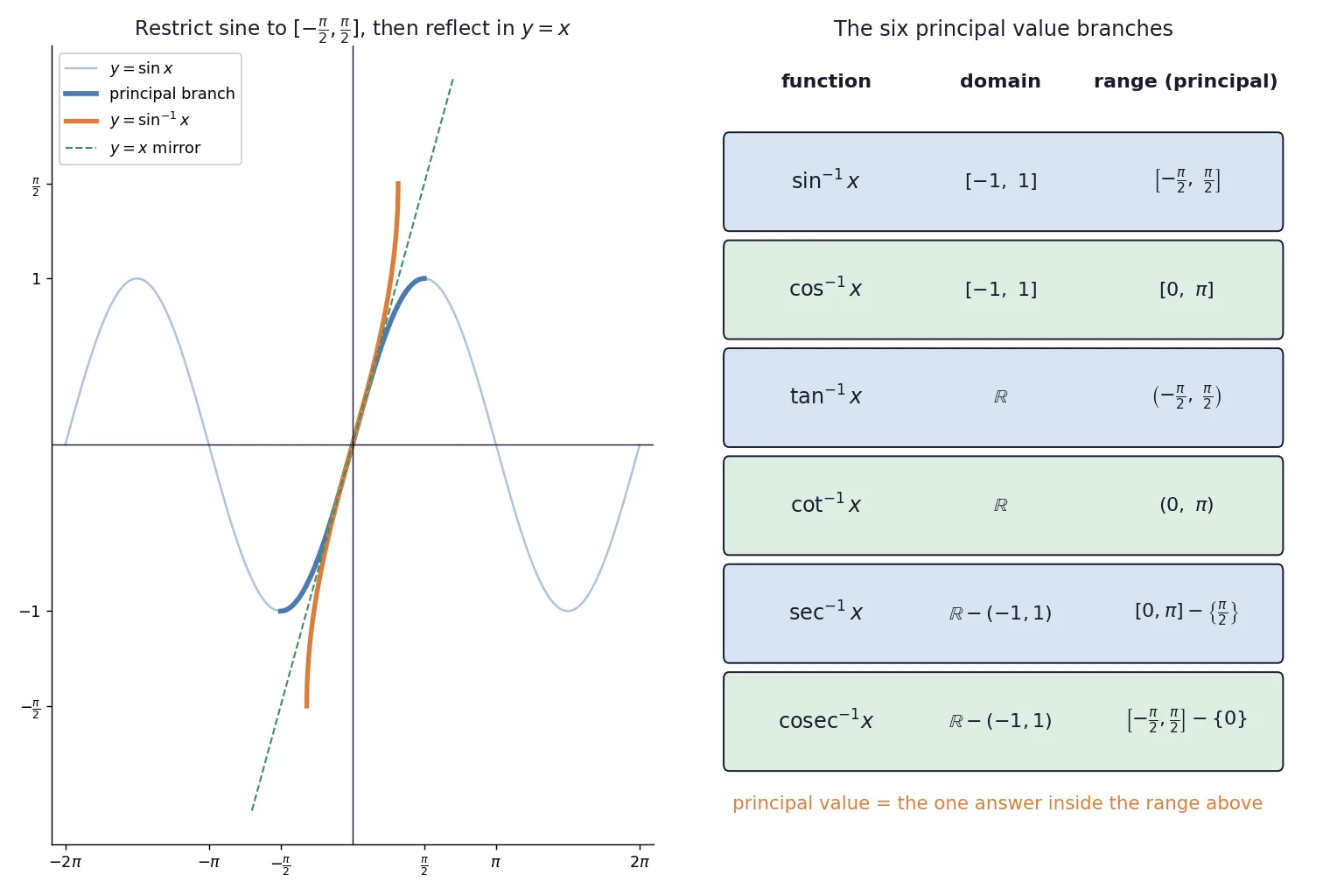
Sine restricted and reflected to arcsine, with table of six principal branches

Function Domain Range (principal branch)
sin⁡−1x\sin^{-1} x [−1,1][-1, 1] [−π2,π2]\left[-\frac{\pi}{2}, \frac{\pi}{2}\right]
cos⁡−1x\cos^{-1} x [−1,1][-1, 1] [0,π][0, \pi]
tan⁡−1x\tan^{-1} x R\mathbb{R} (−π2,π2)\left(-\frac{\pi}{2}, \frac{\pi}{2}\right)
cot⁡−1x\cot^{-1} x R\mathbb{R} (0,π)(0, \pi)
sec⁡−1x\sec^{-1} x R−(−1,1)\mathbb{R} - (-1, 1) [0,π]−{π2}[0, \pi] - \left\{\frac{\pi}{2}\right\}
cosec−1 x\mathrm{cosec}^{-1}\, x R−(−1,1)\mathbb{R} - (-1, 1) [−π2,π2]−{0}\left[-\frac{\pi}{2}, \frac{\pi}{2}\right] - \{0\}

Negative inputs: odd trio (sin⁡−1,tan⁡−1,cosec−1\sin^{-1}, \tan^{-1}, \mathrm{cosec}^{-1}) flips the sign; the [0,π][0, \pi] family (cos⁡−1,cot⁡−1,sec⁡−1\cos^{-1}, \cot^{-1}, \sec^{-1}) reflects to π−(reference)\pi - (\text{reference}). And sin⁡−1x\sin^{-1}x is never 1sin⁡x\frac{1}{\sin x} — that is (sin⁡x)−1(\sin x)^{-1}.

The cancellation laws

sin⁡(sin⁡−1x)=x on [−1,1] (always safe)sin⁡−1(sin⁡x)=x only on [−π2,π2]\sin(\sin^{-1}x) = x \ \text{on } [-1, 1] \ (\text{always safe}) \qquad \sin^{-1}(\sin x) = x \ \text{only on } \left[-\frac{\pi}{2}, \frac{\pi}{2}\right]

Outside the branch, wrap first: sin⁡(π−x)=sin⁡x\sin(\pi - x) = \sin x,  cos⁡(2π−x)=cos⁡x\ \cos(2\pi - x) = \cos x,  tan⁡(x±π)=tan⁡x\ \tan(x \pm \pi) = \tan x — then cancel.

The substitution dictionary

1−x2→x=sin⁡θ1+x2→x=tan⁡θx2−1→x=sec⁡θa2−x2→x=asin⁡θ\sqrt{1 - x^2} \to x = \sin\theta \qquad \sqrt{1 + x^2} \to x = \tan\theta \qquad \sqrt{x^2 - 1} \to x = \sec\theta \qquad \sqrt{a^2 - x^2} \to x = a\sin\theta 1±cos⁡x→half anglescos⁡x±sin⁡x→tan⁡(π4±x) forms1 \pm \cos x \to \text{half angles} \qquad \cos x \pm \sin x \to \tan\left(\tfrac{\pi}{4} \pm x\right) \text{ forms}

Key memorised reductions: tan⁡−1cos⁡x1−sin⁡x=π4+x2\tan^{-1}\frac{\cos x}{1 - \sin x} = \frac{\pi}{4} + \frac{x}{2};  cot⁡−11x2−1=sec⁡−1x\ \cot^{-1}\frac{1}{\sqrt{x^2 - 1}} = \sec^{-1}x;  3sin⁡−1x=sin⁡−1(3x−4x3)\ 3\sin^{-1}x = \sin^{-1}(3x - 4x^3) on [−12,12]\left[-\frac{1}{2}, \frac{1}{2}\right];  3cos⁡−1x=cos⁡−1(4x3−3x)\ 3\cos^{-1}x = \cos^{-1}(4x^3 - 3x) on [12,1]\left[\frac{1}{2}, 1\right].

The JEE identity card

sin⁡−1x+cos⁡−1x=π2tan⁡−1x+cot⁡−1x=π2sec⁡−1x+cosec−1x=π2\sin^{-1}x + \cos^{-1}x = \frac{\pi}{2} \qquad \tan^{-1}x + \cot^{-1}x = \frac{\pi}{2} \qquad \sec^{-1}x + \mathrm{cosec}^{-1}x = \frac{\pi}{2} tan⁡−1x+tan⁡−1y=tan⁡−1x+y1−xy (xy<1);add π when x,y>0, xy>1\tan^{-1}x + \tan^{-1}y = \tan^{-1}\frac{x + y}{1 - xy} \ (xy < 1); \quad \text{add } \pi \text{ when } x, y > 0, \ xy > 1 2tan⁡−1x=sin⁡−12x1+x2=cos⁡−11−x21+x2=tan⁡−12x1−x2 (windows: ∣x∣≤1, x≥0, ∣x∣<1)2\tan^{-1}x = \sin^{-1}\frac{2x}{1 + x^2} = \cos^{-1}\frac{1 - x^2}{1 + x^2} = \tan^{-1}\frac{2x}{1 - x^2} \ (\text{windows: } \vert x \vert \leq 1, \ x \geq 0, \ \vert x \vert < 1)

Sum conditions: tan⁡−1x+tan⁡−1y+tan⁡−1z=π2⇒xy+yz+zx=1\tan^{-1}x + \tan^{-1}y + \tan^{-1}z = \frac{\pi}{2} \Rightarrow xy + yz + zx = 1; sum =π⇒x+y+z=xyz= \pi \Rightarrow x + y + z = xyz.

The mistake checklist (read before every exam)

Blind cancellation — sin⁡−1(sin⁡x)=x\sin^{-1}(\sin x) = x only inside the branch; wrap first otherwise.

Sign-flipping the [0,π][0, \pi] family — cos⁡−1,cot⁡−1,sec⁡−1\cos^{-1}, \cot^{-1}, \sec^{-1} of negatives go to the second quadrant, never negative.

f−1f^{-1} vs reciprocal — sin⁡−1x≠1sin⁡x\sin^{-1}x \neq \frac{1}{\sin x}.

Domain slips — sin⁡−1(2)\sin^{-1}(2) and sec⁡−1(12)\sec^{-1}\left(\frac{1}{2}\right) do not exist; solve the inequality for composite arguments like sin⁡−1(3x−1)\sin^{-1}(3x - 1).

The π\pi-correction — tan⁡−1x+tan⁡−1y\tan^{-1}x + \tan^{-1}y with x,y>0x, y > 0, xy>1xy > 1 needs +π+\pi.

Trio windows — sin⁡−12x1+x2=2tan⁡−1x\sin^{-1}\frac{2x}{1+x^2} = 2\tan^{-1}x fails for ∣x∣>1\vert x \vert > 1 (becomes π−2tan⁡−1x\pi - 2\tan^{-1}x for x>1x > 1).

Extraneous roots — after clearing inverse functions from an equation, substitute every root back; typically one dies.