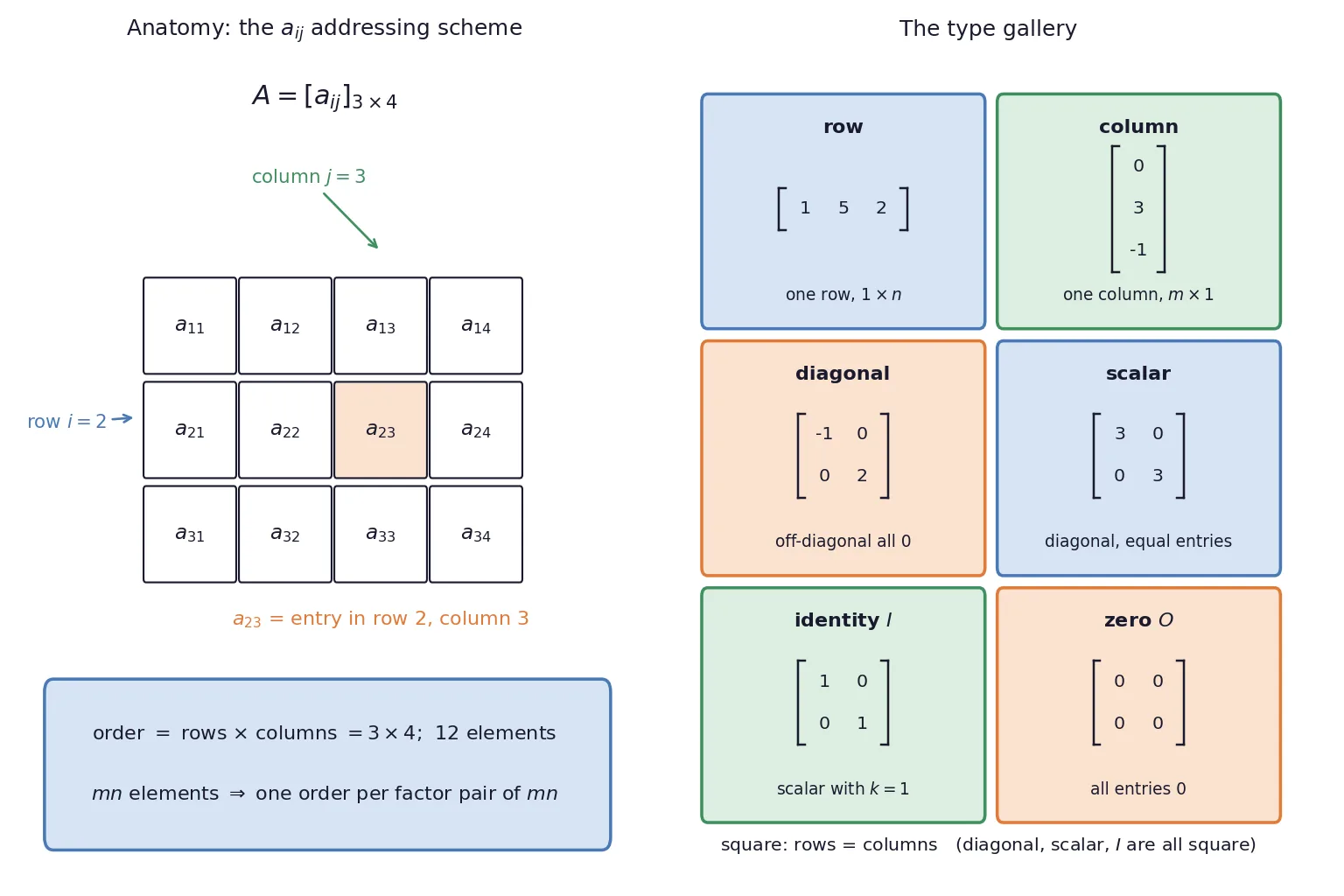
1. What is a Matrix?

A matrix is a rectangular arrangement (an array) of numbers or functions, organized into rows and columns. Think of it like a spreadsheet, a seating chart, or a grid. The numbers or functions inside the grid are called the elements or entries.

  • Notation: Matrices are typically named with capital letters (e.g., A, B, C).
  • Rows vs. Columns: Rows are the horizontal lines of elements. Columns are the vertical lines of elements.
  • Order of a Matrix: A matrix with 'm' rows and 'n' columns has an order of m x n (read as 'm by n'). The number of rows always comes first.

Example: A=[210349]A = \begin{bmatrix} 2 & -1 & 0 \\ 3 & 4 & 9 \end{bmatrix} This matrix has 2 rows and 3 columns, so its order is 2 x 3.

Element Notation: The element in the i-th row and j-th column is denoted by aija_{ij}.

A=[a11a12a1na21a22a2nam1am2amn]m×nA = \begin{bmatrix} a_{11} & a_{12} & \dots & a_{1n} \\ a_{21} & a_{22} & \dots & a_{2n} \\ \vdots & \vdots & \ddots & \vdots \\ a_{m1} & a_{m2} & \dots & a_{mn} \end{bmatrix}_{m \times n}

In our example matrix A above:

  • a11=2a_{11} = 2 (1st row, 1st column)
  • a13=0a_{13} = 0 (1st row, 3rd column)
  • a21=3a_{21} = 3 (2nd row, 1st column)

2. Types of Matrices

  1. Row Matrix: A matrix that has only one row. Its order is 1 x n.

    • Example: A=[1592]1×4A = \begin{bmatrix} 1 & 5 & 9 & -2 \end{bmatrix}_{1 \times 4}
  2. Column Matrix: A matrix that has only one column. Its order is m x 1.

    • Example: B=[246]3×1B = \begin{bmatrix} 2 \\ 4 \\ 6 \end{bmatrix}_{3 \times 1}
  3. Square Matrix: A matrix where the number of rows equals the number of columns (m = n). A matrix of order 'n x n' is called a square matrix of order n.

    • Example: C=[1234]2×2C = \begin{bmatrix} 1 & 2 \\ 3 & 4 \end{bmatrix}_{2 \times 2}
    • Principal Diagonal: In a square matrix, the elements a11,a22,a33,...a_{11}, a_{22}, a_{33}, ... (where the row and column index are the same) form the principal diagonal. In matrix C, the principal diagonal elements are 1 and 4.
  4. Diagonal Matrix: A square matrix where all non-diagonal elements are zero. The diagonal elements can be zero or non-zero.

    • Example: D=[500020001]D = \begin{bmatrix} 5 & 0 & 0 \\ 0 & -2 & 0 \\ 0 & 0 & 1 \end{bmatrix}
  5. Scalar Matrix: A special type of diagonal matrix where all the diagonal elements are equal.

    • Example: E=[700070007]E = \begin{bmatrix} 7 & 0 & 0 \\ 0 & 7 & 0 \\ 0 & 0 & 7 \end{bmatrix}
  6. Identity Matrix (or Unit Matrix): A special type of scalar matrix where all the diagonal elements are 1. It is denoted by InI_n (or just II) and is the matrix equivalent of the number 1.

    • Example (I3I_3, the identity matrix of order 3): I3=[100010001]I_3 = \begin{bmatrix} 1 & 0 & 0 \\ 0 & 1 & 0 \\ 0 & 0 & 1 \end{bmatrix}
  7. Zero Matrix (or Null Matrix): A matrix (of any order) in which all elements are zero. It is denoted by O and is the matrix equivalent of the number 0.

    • Example (2x3 Zero Matrix): O=[000000]O = \begin{bmatrix} 0 & 0 & 0 \\ 0 & 0 & 0 \end{bmatrix}

3. Equality of Matrices

Two matrices, A and B, are equal if and only if they meet two conditions:

  1. They are of the same order (same number of rows and columns).
  2. Each corresponding element is equal (i.e., aij=bija_{ij} = b_{ij} for all i and j).

Example 1: Equal If A=[x25y]A = \begin{bmatrix} x & 2 \\ 5 & y \end{bmatrix} and B=[1259]B = \begin{bmatrix} 1 & 2 \\ 5 & 9 \end{bmatrix}, then A=BA=B only if x=1x=1 and y=9y=9.

Example 2: Not Equal

  • C=[1234]C = \begin{bmatrix} 1 & 2 \\ 3 & 4 \end{bmatrix} and D=[1324]D = \begin{bmatrix} 1 & 3 \\ 2 & 4 \end{bmatrix} are not equal because their corresponding elements c12d12c_{12} \ne d_{12}.
  • E=[1234]E = \begin{bmatrix} 1 & 2 \\ 3 & 4 \end{bmatrix} and F=[120340]F = \begin{bmatrix} 1 & 2 & 0 \\ 3 & 4 & 0 \end{bmatrix} are not equal because they have different orders (2x2 vs 2x3).

Example 1: Constructing a Matrix

Question: Construct a 2 x 2 matrix A=[aij]A = [a_{ij}] whose elements are given by aij=i+ja_{ij} = i + j.

Explanation:

  1. Understand the Order: A 2 x 2 matrix has 2 rows and 2 columns. The general form is [a11a12a21a22]\begin{bmatrix} a_{11} & a_{12} \\ a_{21} & a_{22} \end{bmatrix}
  2. Use the Formula: We find the value of each element using the given rule aij=i+ja_{ij} = i + j (where 'i' is the row number and 'j' is the column number).
    • a11a_{11} (i=1, j=1): 1+1=21+1=2
    • a12a_{12} (i=1, j=2): 1+2=31+2=3
    • a21a_{21} (i=2, j=1): 2+1=32+1=3
    • a22a_{22} (i=2, j=2): 2+2=42+2=4
  3. Construct the Matrix: Place the calculated values into their corresponding positions.

Answer: A=[2334]A = \begin{bmatrix} 2 & 3 \\ 3 & 4 \end{bmatrix}.

Example 2: Constructing a Matrix with a Condition

Question: Construct a 3 x 2 matrix whose elements are given by aij=12i3ja_{ij} = \frac{1}{2}|i-3j|.

Explanation:

  1. Understand the Order: A 3 x 2 matrix has 3 rows and 2 columns. We need to find 6 elements.
  2. Use the Formula: Apply the rule aij=12i3ja_{ij} = \frac{1}{2}|i-3j| for each position.
    • a11a_{11} (i=1, j=1): 1213(1)=122=12(2)=1\frac{1}{2}|1-3(1)| = \frac{1}{2}|-2| = \frac{1}{2}(2) = 1
    • a12a_{12} (i=1, j=2): 1213(2)=125=12(5)=5/2\frac{1}{2}|1-3(2)| = \frac{1}{2}|-5| = \frac{1}{2}(5) = 5/2
    • a21a_{21} (i=2, j=1): 1223(1)=121=12(1)=1/2\frac{1}{2}|2-3(1)| = \frac{1}{2}|-1| = \frac{1}{2}(1) = 1/2
    • a22a_{22} (i=2, j=2): 1223(2)=124=12(4)=2\frac{1}{2}|2-3(2)| = \frac{1}{2}|-4| = \frac{1}{2}(4) = 2
    • a31a_{31} (i=3, j=1): 1233(1)=120=0\frac{1}{2}|3-3(1)| = \frac{1}{2}|0| = 0
    • a32a_{32} (i=3, j=2): 1233(2)=123=12(3)=3/2\frac{1}{2}|3-3(2)| = \frac{1}{2}|-3| = \frac{1}{2}(3) = 3/2
  3. Construct the Matrix:

Answer: [15/21/2203/2]\begin{bmatrix} 1 & 5/2 \\ 1/2 & 2 \\ 0 & 3/2 \end{bmatrix}.

Example 3: Identifying Order and Elements

Question: If a matrix has 8 elements, what are the possible orders it can have?

Explanation:

  1. Understand the Concept: The order of a matrix is (number of rows) x (number of columns). The total number of elements is found by multiplying the number of rows by the number of columns.

  2. Problem: We are given that the total number of elements is 8. We need to find all pairs of natural numbers (m,nm, n) such that m×n=8m \times n = 8.

  3. Find the Factor Pairs: The pairs of factors for 8 are:

    • 1×81 \times 8
    • 8×18 \times 1
    • 2×42 \times 4
    • 4×24 \times 2

Answer: The possible orders are 1 x 8 (a row matrix), 8 x 1 (a column matrix), 2 x 4, and 4 x 2.

Example 4: Solving for Variables using Equality

Question: Find the values of x, y, and z from the following equation: [x+y25+zxy]=[6258].\begin{bmatrix} x+y & 2 \\ 5+z & xy \end{bmatrix} = \begin{bmatrix} 6 & 2 \\ 5 & 8 \end{bmatrix}.

Explanation:

  1. Use the Definition of Equality: For two matrices to be equal, their corresponding elements must be equal.

  2. Set up Equations: By comparing the elements in each position, we get a system of equations:

    • (Row 1, Col 1): x+y=6(1)x+y=6 \quad \cdots(1)
    • (Row 1, Col 2): 2=22=2 (This is true and gives no new information.)
    • (Row 2, Col 1): 5+z=5(2)5+z=5 \quad \cdots(2)
    • (Row 2, Col 2): xy=8(3)xy=8 \quad \cdots(3)
  3. Solve the System:

    • From (2): 5+z=5    z=05+z=5 \implies z=0.
    • From (1): y=6xy=6-x.
    • Substitute this expression for yy into equation (3): x(6x)=8x(6-x)=8.
    • 6xx2=8    x26x+8=06x-x^2=8 \implies x^2-6x+8=0.
    • Factor the quadratic: (x2)(x4)=0(x-2)(x-4)=0. This gives two possibilities for x.
    • Case 1: If x=2x=2, then y=62=4y=6-2=4.
    • Case 2: If x=4x=4, then y=64=2y=6-4=2.

Answer: There are two possible solutions: x=2, y=4, z=0 or x=4, y=2, z=0.

Example 5: Identifying Matrix Types

Question: Classify the following matrix: A=[500050005].A = \begin{bmatrix} 5 & 0 & 0 \\ 0 & 5 & 0 \\ 0 & 0 & 5 \end{bmatrix}.

Explanation:

  1. Check if Square: The matrix has 3 rows and 3 columns, so it is a square matrix.

  2. Check for Diagonal: All non-diagonal elements are zero. So, it is a diagonal matrix.

  3. Check for Scalar: All the principal diagonal elements are equal (they are all 5). So, it is a scalar matrix.

  4. Check for Identity: The diagonal elements are not 1, so it is not an identity matrix.

Answer: The most specific classification is a scalar matrix. (It is also a diagonal matrix and a square matrix by definition, but 'scalar' is the most descriptive term).

Example 6: Finding Diagonal Elements

Question: In the matrix A=[123456789]A = \begin{bmatrix} 1 & 2 & 3 \\ 4 & 5 & 6 \\ 7 & 8 & 9 \end{bmatrix}, what are the principal diagonal elements?

Explanation: The principal diagonal (or main diagonal) of a square matrix consists of the elements from the top-left corner to the bottom-right corner. These are the elements where the row index is equal to the column index (i.e., aiia_{ii}).

  • a11=1a_{11} = 1
  • a22=5a_{22} = 5
  • a33=9a_{33} = 9

Answer: The principal diagonal elements are 1, 5, and 9.

Example 7: Number of Possible Matrices

Question: Find the number of all possible matrices of order 3 x 3 with each entry 0 or 1.

Explanation:

  1. Count the Elements: A 3 x 3 matrix has 3×3=93 \times 3 = 9 total elements (positions).

  2. Count the Choices: Each element can be filled in one of two ways: either with a 0 or a 1.

  3. Apply the Multiplication Principle: Since each of the 9 elements has 2 independent choices, the total number of different matrices is: 2×2×2×2×2×2×2×2×2=292 \times 2 \times 2 \times 2 \times 2 \times 2 \times 2 \times 2 \times 2 = 2^9

Answer: 29=5122^9 = 512.

Example 8: Solving for Variables (Advanced)

Question: Find the values of a, b, c, and d from the equation: [2a+ba2b5cd4c+3d]=[431124].\begin{bmatrix} 2a+b & a-2b \\ 5c-d & 4c+3d \end{bmatrix} = \begin{bmatrix} 4 & -3 \\ 11 & 24 \end{bmatrix}.

Explanation: By the equality of matrices, we can set up two independent systems of linear equations.

System 1 (for a and b):

1) 2a+b=42a+b=4

2) a2b=3a-2b=-3

  • From (1), b=42ab = 4-2a.
  • Substitute this into (2): a2(42a)=3a - 2(4-2a) = -3     a8+4a=3\implies a - 8 + 4a = -3     5a=5\implies 5a = 5     a=1\implies a=1
  • Now find b: b=42(1)=2b = 4-2(1) = 2
  • Solution for (a,b) is (1, 2).

System 2 (for c and d):

3) 5cd=115c-d=11

4) 4c+3d=244c+3d=24

  • From (3), d=5c11d = 5c-11.

  • Substitute this into (4): 4c+3(5c11)=244c + 3(5c-11) = 24     4c+15c33=24\implies 4c + 15c - 33 = 24     19c=57\implies 19c = 57     c=3\implies c=3

  • Now find d: d=5(3)11=1511=4d = 5(3)-11 = 15-11 = 4.

  • Solution for (c,d) is (3, 4).

Answer: a=1, b=2, c=3, d=4.

Example 9: Identifying an Identity Matrix

Question: Is the matrix A=[100100]A = \begin{bmatrix} 1 & 0 \\ 0 & 1 \\ 0 & 0 \end{bmatrix} an identity matrix?

Explanation: By definition, an identity matrix must be a square matrix (number of rows = number of columns). The given matrix A has 3 rows and 2 columns, so its order is 3 x 2. Since it is not a square matrix, it cannot be an identity matrix.

Answer: No, because an identity matrix must be a square matrix.

Example 10: Zero Matrix Properties

Question: If [x100y+2]=O\begin{bmatrix} x-1 & 0 \\ 0 & y+2 \end{bmatrix} = O, where O is the 2x2 zero matrix, find x and y.

Explanation:

  1. Define the Zero Matrix: The 2x2 zero matrix, O, is [0000]\begin{bmatrix} 0 & 0 \\ 0 & 0 \end{bmatrix}.
  2. Set up the Equation: [x100y+2]=[0000]\begin{bmatrix} x-1 & 0 \\ 0 & y+2 \end{bmatrix} = \begin{bmatrix} 0 & 0 \\ 0 & 0 \end{bmatrix}
  3. Use Equality of Matrices: We equate the corresponding elements.
    • (Row 1, Col 1): x1=0    x=1x-1 = 0 \implies x=1.
    • (Row 2, Col 2): y+2=0    y=2y+2 = 0 \implies y=-2.

Answer: The solution is x=1, y=-2.