1. Transpose of a Matrix

The transpose of a matrix A, denoted by ATA^T or AA', is the matrix you get by flipping the original matrix over its main diagonal. This operation effectively interchanges the rows and columns. The first row becomes the first column, the second row becomes the second column, and so on.

  • Rule: If A=[aij]A = [a_{ij}] is an m x n matrix, then its transpose ATA^T will be an n x m matrix where the element at the i-th row and j-th column is the original ajia_{ji}.
  • Example: If A=[123456]A = \begin{bmatrix} 1 & 2 & 3 \\ 4 & 5 & 6 \end{bmatrix} (a 2x3 matrix), then its transpose ATA^T is found by making the first row (1, 2, 3) the first column, and the second row (4, 5, 6) the second column: AT=[142536](a 3x2 matrix)A^T = \begin{bmatrix} 1 & 4 \\ 2 & 5 \\ 3 & 6 \end{bmatrix} \quad (\text{a 3x2 matrix})

Properties of Transpose:

For any matrices A and B of suitable orders:

  1. (AT)T=A(A^T)^T = A
    • (Explanation: If you flip the matrix, and then flip it back, you get the original matrix.)
  2. (kA)T=kAT(kA)^T = kA^T (where k is any constant)
    • (Explanation: You can either scale the matrix first and then flip it, or flip it first and then scale it. The result is the same.)
  3. (A+B)T=AT+BT(A+B)^T = A^T + B^T
    • (Explanation: You can either add two matrices and then flip the result, or flip both matrices first and then add them. The result is the same.)
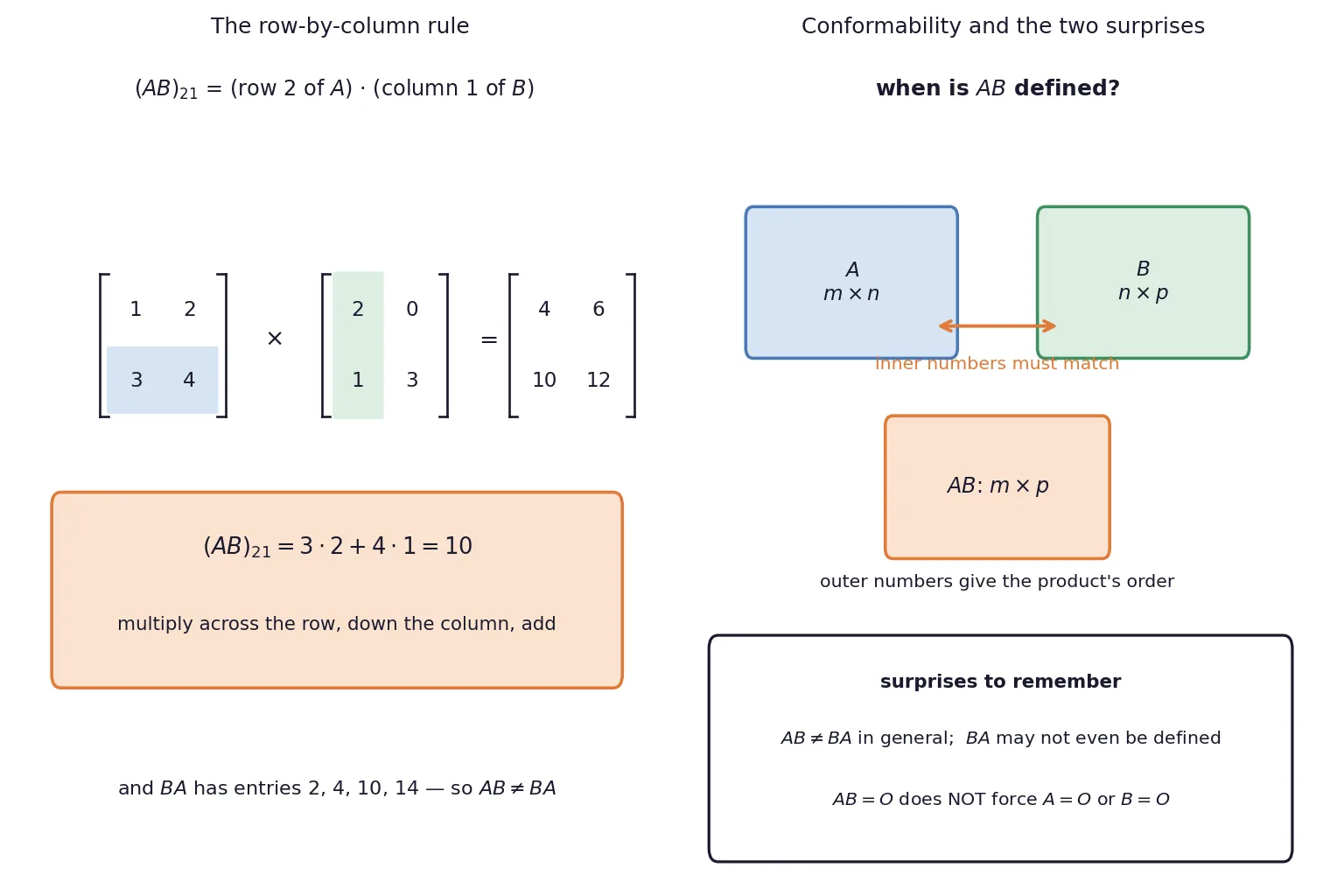
  4. (AB)T=BTAT(AB)^T = B^T A^T (Reversal Law)
    • (Explanation: This is the most important property. Like taking off socks and shoes, the order of the operation is reversed when transposed. The transpose of a product is the product of the transposes in the reverse order.)

2. Symmetric Matrix

A square matrix A is called symmetric if it is its own transpose, meaning it is perfectly symmetrical across its main diagonal.

AT=AA^T = A

  • Condition: This means that the element in row 'i', column 'j' must be equal to the element in row 'j', column 'i' (i.e., aij=ajia_{ij} = a_{ji} for all i, j).
  • Example: In the matrix below, notice how a12=a21=7a_{12}=a_{21}=7 and a13=a31=3a_{13}=a_{31}=3. A=[173725356]andAT=[173725356]A = \begin{bmatrix} 1 & 7 & 3 \\ 7 & 2 & 5 \\ 3 & 5 & 6 \end{bmatrix} \quad \text{and} \quad A^T = \begin{bmatrix} 1 & 7 & 3 \\ 7 & 2 & 5 \\ 3 & 5 & 6 \end{bmatrix} Since A=ATA = A^T, this matrix is symmetric.

3. Skew-Symmetric Matrix

A square matrix A is called skew-symmetric if its transpose is equal to its negative. It is a negative mirror image of itself across the diagonal.

AT=AA^T = -A

  • Condition: This means that aij=ajia_{ij} = -a_{ji} for all i, j.
  • Property: This condition has a special consequence for the principal diagonal elements. For any diagonal element aiia_{ii} (like a11a_{11} or a22a_{22}), the condition is aii=aiia_{ii} = -a_{ii}. This implies 2aii=02a_{ii}=0, so aii=0a_{ii}=0. All principal diagonal elements of a skew-symmetric matrix must be zero.
  • Example: Notice the diagonal is all zeros, and a12=1a_{12}=1 while a21=1a_{21}=-1. A=[012103230]andAT=[012103230]A = \begin{bmatrix} 0 & 1 & -2 \\ -1 & 0 & 3 \\ 2 & -3 & 0 \end{bmatrix} \quad \text{and} \quad A^T = \begin{bmatrix} 0 & -1 & 2 \\ 1 & 0 & -3 \\ -2 & 3 & 0 \end{bmatrix} You can see that AT=AA^T = -A, so this matrix is skew-symmetric.

4. Key Theorems

  • Theorem 1: For any square matrix A, the matrix A+ATA+A^T is always symmetric, and the matrix AATA-A^T is always skew-symmetric.

    • (Proof for A+ATA+A^T: Let's transpose it. (A+AT)T=AT+(AT)T=AT+A=A+AT(A+A^T)^T = A^T + (A^T)^T = A^T + A = A+A^T Since its transpose is equal to itself, it is symmetric.)
    • (Proof for AATA-A^T: Let's transpose it. (AAT)T=AT(AT)T=ATA=(AAT)(A-A^T)^T = A^T - (A^T)^T = A^T - A = -(A-A^T) Since its transpose is equal to its negative, it is skew-symmetric.)
  • Theorem 2: Any square matrix A can be expressed as the sum of a symmetric and a skew-symmetric matrix. This is a clever algebraic trick. We can write any matrix A as: A=12(A+A)=12(A+AT+AAT)A = \frac{1}{2}(A+A) = \frac{1}{2}(A + A^T + A - A^T) Rearranging this gives:

A=12(A+AT)Symmetric Part+12(AAT)Skew-Symmetric PartA = \underbrace{\frac{1}{2}(A+A^T)}_{\text{Symmetric Part}} + \underbrace{\frac{1}{2}(A-A^T)}_{\text{Skew-Symmetric Part}}

This formula is very useful as it allows us to decompose any square matrix into these two special types of matrices.

Example 1: Finding the Transpose

Question: Find the transpose of the matrix A=[3571]A = \begin{bmatrix} 3 & 5 \\ 7 & -1 \end{bmatrix}.

Explanation:

  1. Understand Transpose: The transpose of a matrix, ATA^T, is found by interchanging its rows and columns.
  2. Identify Rows: The first row of A is [3 5]. The second row of A is [7 -1].
  3. Create Columns: The first row of A becomes the first column of ATA^T. The second row of A becomes the second column of ATA^T.
  4. Construct the Transpose: AT=[3751]A^T = \begin{bmatrix} 3 & 7 \\ 5 & -1 \end{bmatrix}

Answer: AT=[3751]A^T = \begin{bmatrix} 3 & 7 \\ 5 & -1 \end{bmatrix}.

Example 2: Verifying (A+B)T=AT+BT(A+B)^T = A^T+B^T

Question: If A=[1201]A = \begin{bmatrix} 1 & 2 \\ 0 & 1 \end{bmatrix} and B=[3410]B = \begin{bmatrix} 3 & 4 \\ 1 & 0 \end{bmatrix}, verify that (A+B)T=AT+BT(A+B)^T = A^T+B^T.

Explanation: 1. Calculate the Left-Hand Side (LHS):

  • First, find A+BA+B: A+B=[1+32+40+11+0]=[4611]A+B = \begin{bmatrix} 1+3 & 2+4 \\ 0+1 & 1+0 \end{bmatrix} = \begin{bmatrix} 4 & 6 \\ 1 & 1 \end{bmatrix}
  • Now, find the transpose of the result: (A+B)T=[4161](A+B)^T = \begin{bmatrix} 4 & 1 \\ 6 & 1 \end{bmatrix}

2. Calculate the Right-Hand Side (RHS):

  • First, find ATA^T and BTB^T: AT=[1021]A^T = \begin{bmatrix} 1 & 0 \\ 2 & 1 \end{bmatrix} and BT=[3140]B^T = \begin{bmatrix} 3 & 1 \\ 4 & 0 \end{bmatrix}
  • Now, add the transposes: AT+BT=[1+30+12+41+0]=[4161]A^T+B^T = \begin{bmatrix} 1+3 & 0+1 \\ 2+4 & 1+0 \end{bmatrix} = \begin{bmatrix} 4 & 1 \\ 6 & 1 \end{bmatrix}

3. Conclusion:

  • Since LHS = [4161]\begin{bmatrix} 4 & 1 \\ 6 & 1 \end{bmatrix} and RHS = [4161]\begin{bmatrix} 4 & 1 \\ 6 & 1 \end{bmatrix}, the property is verified.

Answer: LHS = RHS = [4161]\begin{bmatrix} 4 & 1 \\ 6 & 1 \end{bmatrix}.

Example 3: Verifying (AB)T=BTAT(AB)^T = B^TA^T (Reversal Law)

Question: If A=[143]A = \begin{bmatrix} 1 \\ -4 \\ 3 \end{bmatrix} and B=[121]B = \begin{bmatrix} -1 & 2 & 1 \end{bmatrix}, verify the reversal law for transpose.

Explanation: 1. Calculate the Left-Hand Side (LHS):

  • First, find the product ABAB. A is (3x1) and B is (1x3), so ABAB will be (3x3). AB=[143][121]AB = \begin{bmatrix} 1 \\ -4 \\ 3 \end{bmatrix} \begin{bmatrix} -1 & 2 & 1 \end{bmatrix} =[1(1)1(2)1(1)4(1)4(2)4(1)3(1)3(2)3(1)]= \begin{bmatrix} 1(-1) & 1(2) & 1(1) \\ -4(-1) & -4(2) & -4(1) \\ 3(-1) & 3(2) & 3(1) \end{bmatrix} =[121484363]= \begin{bmatrix} -1 & 2 & 1 \\ 4 & -8 & -4 \\ -3 & 6 & 3 \end{bmatrix}
  • Now, find the transpose of ABAB: (AB)T=[143286143](AB)^T = \begin{bmatrix} -1 & 4 & -3 \\ 2 & -8 & 6 \\ 1 & -4 & 3 \end{bmatrix}

2. Calculate the Right-Hand Side (RHS):

  • First, find BTB^T and ATA^T: BT=[121]B^T = \begin{bmatrix} -1 \\ 2 \\ 1 \end{bmatrix} (a 3x1 matrix).

    AT=[143]A^T = \begin{bmatrix} 1 & -4 & 3 \end{bmatrix} (a 1x3 matrix).

  • Now, find the product BTATB^TA^T: (3x1) ×\times (1x3) \to (3x3). BTAT=[121][143]B^TA^T = \begin{bmatrix} -1 \\ 2 \\ 1 \end{bmatrix} \begin{bmatrix} 1 & -4 & 3 \end{bmatrix} =[1(1)1(4)1(3)2(1)2(4)2(3)1(1)1(4)1(3)]= \begin{bmatrix} -1(1) & -1(-4) & -1(3) \\ 2(1) & 2(-4) & 2(3) \\ 1(1) & 1(-4) & 1(3) \end{bmatrix} =[143286143]= \begin{bmatrix} -1 & 4 & -3 \\ 2 & -8 & 6 \\ 1 & -4 & 3 \end{bmatrix}

3. Conclusion:

  • Since LHS = RHS, the reversal law (AB)T=BTAT(AB)^T = B^TA^T is verified.

Answer: LHS = RHS = [143286143]\begin{bmatrix} -1 & 4 & -3 \\ 2 & -8 & 6 \\ 1 & -4 & 3 \end{bmatrix}.

Example 4: Identifying Symmetric and Skew-Symmetric Matrices

Question: Determine if the matrix A=[115121513]A = \begin{bmatrix} 1 & -1 & 5 \\ -1 & 2 & 1 \\ 5 & 1 & 3 \end{bmatrix} is symmetric or skew-symmetric.

Explanation:

  1. Find the Transpose (ATA^T): We interchange rows and columns.

    • Row 1 [1 -1 5] becomes Column 1.
    • Row 2 [-1 2 1] becomes Column 2.
    • Row 3 [5 1 3] becomes Column 3. AT=[115121513]A^T = \begin{bmatrix} 1 & -1 & 5 \\ -1 & 2 & 1 \\ 5 & 1 & 3 \end{bmatrix}
  2. Compare ATA^T with AA:

    We check if AT=AA^T = A. By direct comparison, ATA^T is identical to AA.

Answer: Since AT=AA^T = A, the matrix is symmetric.

Example 5: Identifying a Skew-Symmetric Matrix

Question: Show that the matrix A=[011101110]A = \begin{bmatrix} 0 & 1 & -1 \\ -1 & 0 & 1 \\ 1 & -1 & 0 \end{bmatrix} is skew-symmetric.

Explanation:

  1. Find the Transpose (ATA^T): AT=[011101110]A^T = \begin{bmatrix} 0 & -1 & 1 \\ 1 & 0 & -1 \\ -1 & 1 & 0 \end{bmatrix}

  2. Find the Negative of A (A-A): A=1×[011101110]=[011101110]-A = -1 \times \begin{bmatrix} 0 & 1 & -1 \\ -1 & 0 & 1 \\ 1 & -1 & 0 \end{bmatrix} = \begin{bmatrix} 0 & -1 & 1 \\ 1 & 0 & -1 \\ -1 & 1 & 0 \end{bmatrix}

  3. Compare ATA^T with A-A:

    We observe that ATA^T is identical to A-A.

Answer: Since AT=AA^T = -A, the matrix is skew-symmetric.

Example 6: Using Properties of Symmetric/Skew-Symmetric Matrices

Question: If A is a symmetric matrix, show that BTABB^TAB is also symmetric.

Explanation:

  1. State the Goal: We need to prove that the matrix P=BTABP = B^TAB is symmetric. This means we must show that PT=PP^T = P.

  2. State the Given: We are given that A is symmetric, which means AT=AA^T = A.

  3. Take the Transpose: Let's find the transpose of PP using the Reversal Law, (XY)T=YTXT(XY)^T = Y^TX^T We will group BTAB^TA as one matrix and BB as the other. PT=((BTA)B)T=BT(BTA)TP^T = ( (B^T A) B )^T = B^T (B^T A)^T

  4. Apply Reversal Law Again: Now we apply the reversal law to the term (BTA)T(B^T A)^T. PT=BT(AT(BT)T)P^T = B^T (A^T (B^T)^T)

  5. Simplify: We know that (BT)T=B(B^T)^T = B. So, PT=BTATBP^T = B^T A^T B

  6. Use the Given: We were given that A is symmetric, so AT=AA^T = A. We substitute this into our expression: PT=BTABP^T = B^T A B.

  7. Conclusion: We have shown that PT=BTABP^T = B^T A B, which is equal to the original matrix PP. Since PT=PP^T = P, the matrix BTABB^TAB is symmetric.

Answer: Proven.

Example 7: Expressing a Matrix as a Sum

Question: Express the matrix A=[224134123]A = \begin{bmatrix} 2 & -2 & -4 \\ -1 & 3 & 4 \\ 1 & -2 & -3 \end{bmatrix} as the sum of a symmetric (P) and a skew-symmetric (Q) matrix.

Explanation: We use the formulas P=12(A+AT)P = \frac{1}{2}(A+A^T) and Q=12(AAT)Q = \frac{1}{2}(A-A^T)

  1. Find ATA^T: AT=[211232443]A^T = \begin{bmatrix} 2 & -1 & 1 \\ -2 & 3 & -2 \\ -4 & 4 & -3 \end{bmatrix}

  2. Find the Symmetric Part (P): A+AT=[2+2214+1123+342142+433]A+A^T = \begin{bmatrix} 2+2 & -2-1 & -4+1 \\ -1-2 & 3+3 & 4-2 \\ 1-4 & -2+4 & -3-3 \end{bmatrix} =[433362326]= \begin{bmatrix} 4 & -3 & -3 \\ -3 & 6 & 2 \\ -3 & 2 & -6 \end{bmatrix} P=12(A+AT)=[23/23/23/2313/213]P = \frac{1}{2}(A+A^T) = \begin{bmatrix} 2 & -3/2 & -3/2 \\ -3/2 & 3 & 1 \\ -3/2 & 1 & -3 \end{bmatrix}

  3. Find the Skew-Symmetric Part (Q): AAT=[222(1)411(2)334(2)1(4)243(3)]A-A^T = \begin{bmatrix} 2-2 & -2-(-1) & -4-1 \\ -1-(-2) & 3-3 & 4-(-2) \\ 1-(-4) & -2-4 & -3-(-3) \end{bmatrix} =[015106560]= \begin{bmatrix} 0 & -1 & -5 \\ 1 & 0 & 6 \\ 5 & -6 & 0 \end{bmatrix} Q=12(AAT)=[01/25/21/2035/230]Q = \frac{1}{2}(A-A^T) = \begin{bmatrix} 0 & -1/2 & -5/2 \\ 1/2 & 0 & 3 \\ 5/2 & -3 & 0 \end{bmatrix}

Answer: A=P+QA = P+Q, where P=[23/23/23/2313/213]P = \begin{bmatrix} 2 & -3/2 & -3/2 \\ -3/2 & 3 & 1 \\ -3/2 & 1 & -3 \end{bmatrix} and Q=[01/25/21/2035/230]Q = \begin{bmatrix} 0 & -1/2 & -5/2 \\ 1/2 & 0 & 3 \\ 5/2 & -3 & 0 \end{bmatrix}

Example 8: Solving for Variables

Question: If the matrix A=[0a32b1c10]A = \begin{bmatrix} 0 & a & 3 \\ 2 & b & -1 \\ c & 1 & 0 \end{bmatrix} is a skew-symmetric matrix, find the values of a, b, and c.

Explanation: A skew-symmetric matrix must satisfy two conditions:

  1. All diagonal elements are zero: aii=0a_{ii} = 0.
  2. All non-diagonal elements are negative opposites of their counterparts: aij=ajia_{ij} = -a_{ji}.
  • Condition 1 (Diagonal): We check the main diagonal: a22=ba_{22} = b. For the matrix to be skew-symmetric, b=0b=0.
  • Condition 2 (Non-Diagonal):
    • a12=a21    a=(2)    a=2a_{12} = -a_{21} \implies a = -(2) \implies a = -2.
    • a13=a31    3=(c)    c=3a_{13} = -a_{31} \implies 3 = -(c) \implies c = -3.
    • (Check a23a_{23}): a23=a32    1=(1)a_{23} = -a_{32} \implies -1 = -(1), which is true.

Answer: The values are a=-2, b=0, c=-3.

Example 9: Property of AATA-A^T

Question: For any square matrix A, show that AATA-A^T is a skew-symmetric matrix.

Explanation:

  1. Define the Matrix: Let P=AATP = A-A^T.

  2. State the Goal: To prove PP is skew-symmetric, we must show that PT=PP^T = -P.

  3. Take the Transpose: PT=(AAT)TP^T = (A-A^T)^T.

  4. Apply Transpose Properties: Using the property (XY)T=XTYT(X-Y)^T = X^T-Y^T, we get: PT=AT(AT)TP^T = A^T - (A^T)^T

  5. Simplify: Using the property (XT)T=X(X^T)^T = X, we get: PT=ATAP^T = A^T - A.

  6. Factor and Conclude: Factor out -1: PT=(AAT)P^T = -(A - A^T) Since P=AATP = A-A^T, we have PT=PP^T = -P.

Answer: Since its transpose is equal to its negative, AATA-A^T is skew-symmetric.

Example 10: Property of AATAA^T

Question: Show that for any matrix A, the products AATAA^T and ATAA^TA are both symmetric matrices.

Explanation: Part 1: Show AATAA^T is symmetric.

  1. Let P=AATP = AA^T.
  2. We need to show PT=PP^T = P.
  3. PT=(AAT)TP^T = (AA^T)^T. Using the reversal law (XY)T=YTXT(XY)^T = Y^TX^T:
  4. PT=(AT)TAT=AATP^T = (A^T)^T A^T = A A^T. (Since (AT)T=A(A^T)^T = A).
  5. We see that PT=PP^T = P, so AATAA^T is symmetric.

Part 2: Show ATAA^TA is symmetric.

  1. Let Q=ATAQ = A^TA.
  2. We need to show QT=QQ^T = Q.
  3. QT=(ATA)TQ^T = (A^TA)^T. Using the reversal law:
  4. QT=AT(AT)T=ATAQ^T = A^T (A^T)^T = A^T A.
  5. We see that QT=QQ^T = Q, so ATAA^TA is symmetric.

Answer: Both AATAA^T and ATAA^TA are symmetric.