
Chapter 3 at a Glance
The objects
A matrix is an ordered rectangular array of numbers or functions. A matrix with rows and columns has order and entries; the entry in row , column is written .
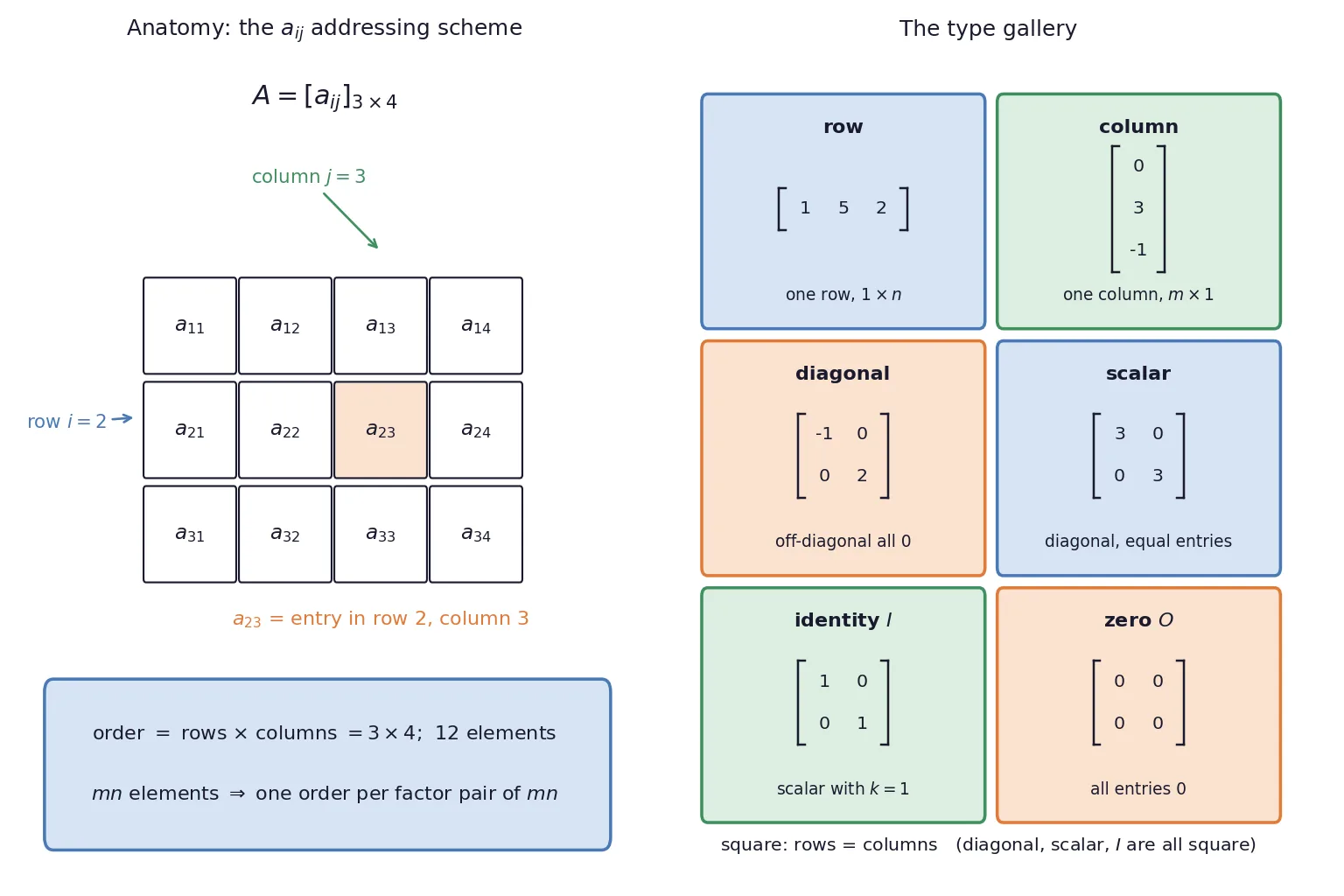
| Type | Definition |
|---|---|
| Row matrix | order |
| Column matrix | order |
| Square matrix | |
| Diagonal matrix | square, for |
| Scalar matrix | diagonal with all diagonal entries equal () |
| Identity matrix | diagonal with all diagonal entries |
| Zero matrix | every entry |
Equality: requires the same order and for every position.
The operations
Addition (same order only): entrywise; commutative and associative, with and .
Scalar multiple: , with and .
Multiplication ( is , is , product ): row-by-column, .
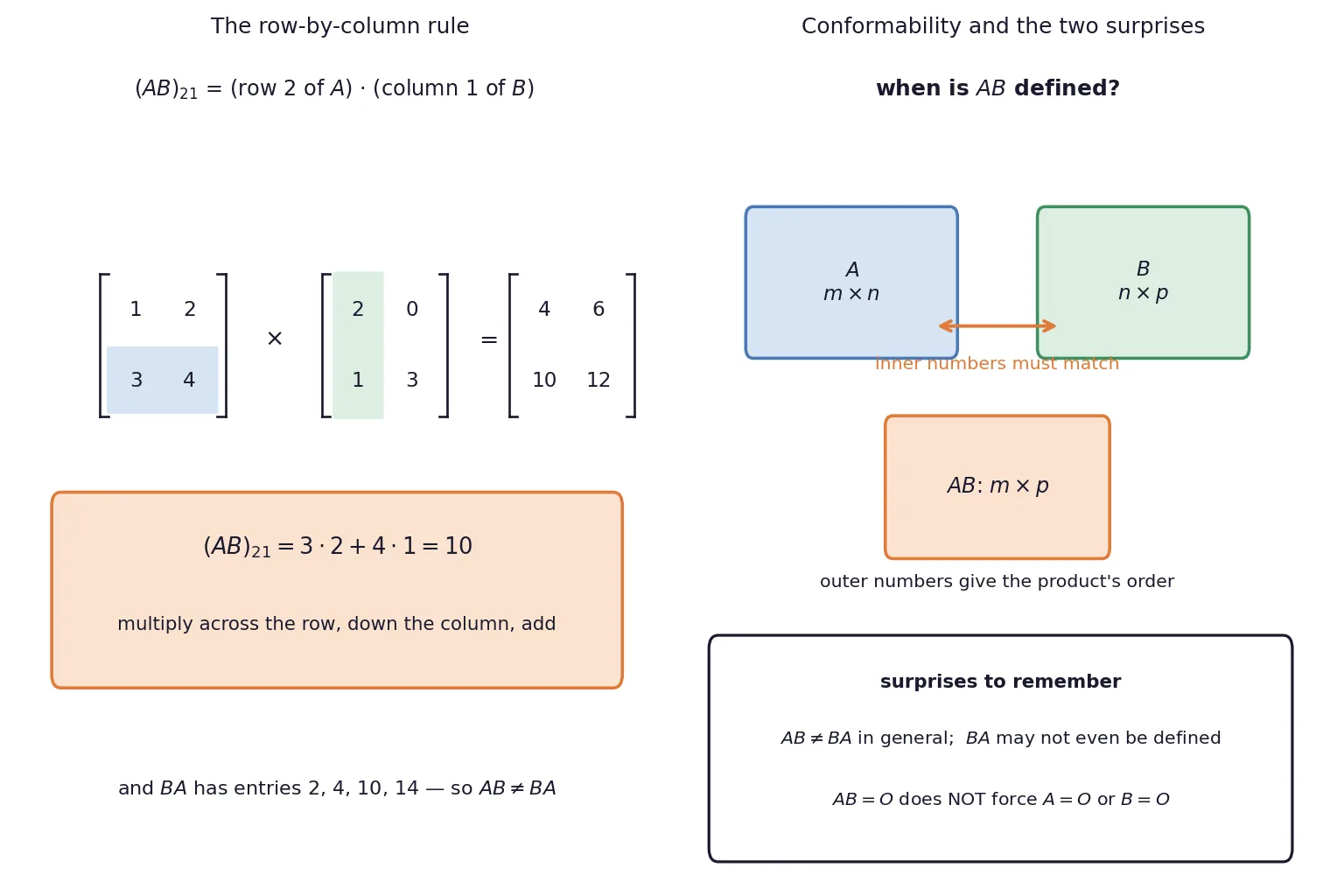
Multiplication is associative and distributes over addition, and — but two familiar rules break:
- in general — order matters.
- does not force or — nonzero zero divisors exist, so you cannot cancel a matrix factor.
Transpose, symmetric, skew-symmetric
(or ) swaps rows with columns: if is then is .
The reversal in the last law is the one students forget — it mirrors .
Symmetric: . Skew-symmetric: (forcing every diagonal entry to be ). Every square matrix splits uniquely as
Invertible matrices
If and are square matrices of the same order with , then (and ). The inverse, when it exists, is unique — proof in one line: .
JEE favourite: a polynomial identity like rearranges to , handing over with no formula.
Mistake checklist
Before the exam, make sure none of these can catch you:
- Writing for — always check which side a multiplication acts on; expanding as silently assumes .
- Cancelling matrices — from you may not conclude unless is invertible.
- Forgetting the reversal laws — and , both reversed.
- Adding matrices of different orders — undefined, even if it "looks close".
- Counting orders — a matrix with entries has possible orders (ordered pairs!), and a matrix with entries from can be built in ways.
- Diagonal of a skew-symmetric matrix — always all zeros; its entries sum to .
- Huge exponents — never multiply out ; hunt for , , or first.
The 15 questions below are a fast pass over the whole chapter — everything at recall level. If any of them feels shaky, the section named in its explanation is where to go back.