
Biotechnology in Crops and Medicine
Why genetic engineering was brought in. Agro-chemicals (fertilisers, pesticides) are often too expensive for farmers in the developing world, and further yield increases from existing varieties were not possible by conventional breeding. Genetically modified plants also increased the efficiency of mineral usage, which prevents early exhaustion of soil fertility.
Bt crops
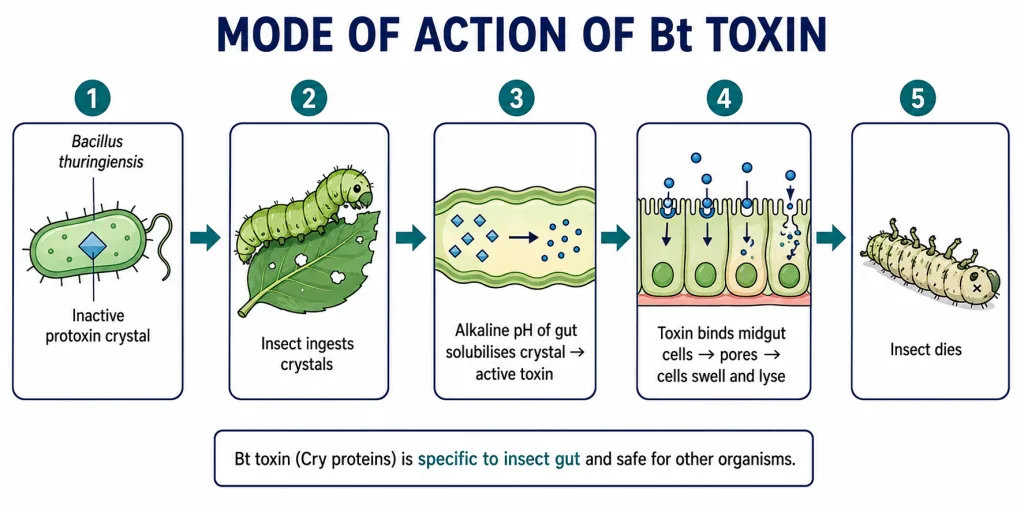
Some strains of Bacillus thuringiensis produce proteins that kill certain insects - lepidopterans (tobacco budworm, armyworm), coleopterans (beetles) and dipterans (flies, mosquitoes). During a particular growth phase the bacterium forms protein crystals containing this toxic insecticidal protein. The toxin does not kill the Bacillus itself, because inside the bacterium it exists as an inactive protoxin. Once an insect ingests it, the alkaline pH of the gut solubilises the crystals and converts the protoxin into the active toxin, which binds to the surface of midgut epithelial cells and creates pores causing cell swelling and lysis, killing the insect. The mammalian gut, in contrast, is acidic, and the crystal is not solubilised there.
The toxin is coded by a gene named cry. Most Bt toxins are insect-group specific, so the gene chosen depends on the crop and the targeted pest - cryIAc and cryIIAb control cotton bollworms, cryIAb the corn borer.
Silencing a pest's gene - RNA interference
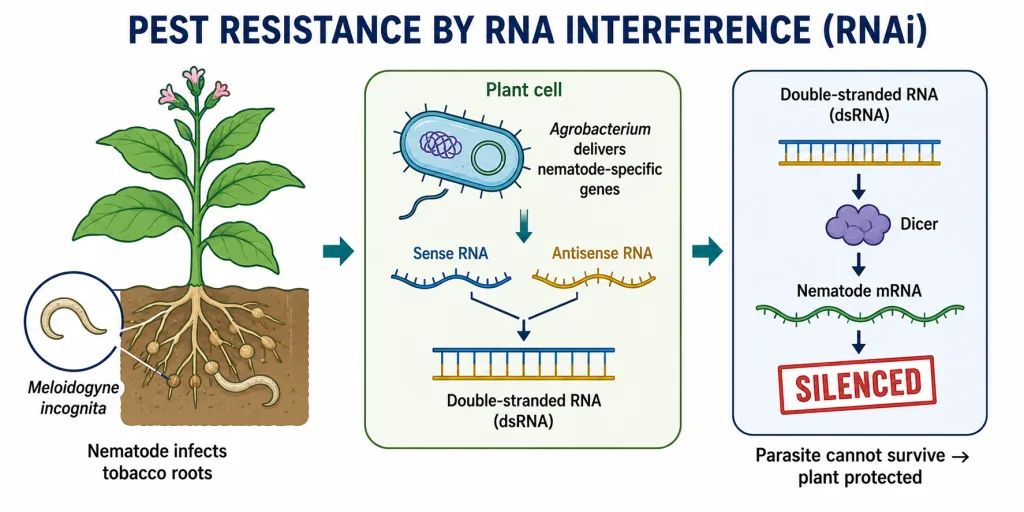
RNA interference (RNAi) takes place in all eukaryotic organisms as a method of cellular defence. It silences a specific mRNA using a complementary double-stranded RNA (dsRNA) that binds to it and prevents its translation. Naturally, this complementary RNA comes from viruses having RNA genomes, or from transposons - mobile genetic elements that replicate through an RNA intermediate. To protect tobacco from the nematode Meloidogyne incognita, which infects its roots and reduces yield, nematode-specific genes were introduced with Agrobacterium vectors so that host cells produced both sense and anti-sense RNA. Being complementary, these formed a dsRNA that initiated RNAi and silenced the nematode's specific mRNA, so the parasite could not survive in the transgenic host.
Human insulin
Insulin has two short polypeptide chains, A and B, linked by disulphide bridges, and in mammals is synthesised as a pro-hormone: like a pro-enzyme, pro-insulin must be processed before it is mature and functional, the extra C peptide being removed. DNA sequences for chains A and B were introduced into plasmids of E. coli; the chains were produced separately, extracted, and combined by creating disulphide bonds.
ADA deficiency
Adenosine deaminase deficiency arises from deletion of the gene for adenosine deaminase, an enzyme crucial for the immune system. Bone marrow transplantation cures some children and enzyme replacement therapy, injecting functional ADA, treats others, but neither is completely curative. Gene therapy puts a functional ADA cDNA into the patient's cultured lymphocytes with a retroviral vector, but those cells are not immortal and need periodic re-infusion. A permanent cure would need the gene from marrow cells producing ADA introduced at an early embryonic stage.
Molecular diagnosis, transgenic animals, biopiracy
A pathogen is usually suspected only after it produces a symptom, and by then its concentration is already very high. PCR amplifies nucleic acid present at very low concentration, and detects gene mutations in suspected cancer patients. A single-stranded DNA or RNA tagged with a radioactive molecule, the probe, hybridises with the patient's complementary DNA or RNA and is read by autoradiography. Transgenic animals are made to study how genes affect normal physiology and development, as with insulin-like growth factor. In biopiracy, bio-resources are used without authorisation or compensatory payment; industrialised nations are financially rich but poor in biodiversity and traditional knowledge, the developing world the reverse.
One-liners: mineral-use efficiency -> soil fertility spared; Bt kept as inactive protoxin; alkaline gut -> active toxin -> midgut pores; RNAi from RNA viruses / transposons; sense + anti-sense -> dsRNA; pro-insulin -> C peptide removed; A and B chains separate in E. coli -> disulphide bonds; probe hybridises -> autoradiography.