
Biotechnology and Its Applications - The Big Picture
Biotechnology essentially deals with the industrial-scale production of biopharmaceuticals and biologicals using genetically modified microbes, fungi, plants and animals. Its three critical research (application) areas are therapeutics, diagnostics and genetically modified crops for agriculture; it also gives us processed food, bioremediation, waste treatment and energy production. This chapter follows its work in agriculture and medicine.
Three options for increasing food production
Three routes can raise food production:
- Agro-chemical based agriculture - fertilisers and pesticides raise yields, but the inputs are costly and harm the environment.
- Organic agriculture - farming without synthetic chemicals.
- Genetically engineered crop-based agriculture - using genetically modified organisms.
The Green Revolution succeeded in tripling the food supply, yet it was still not enough to feed the growing human population. Those yields came partly from improved crop varieties but mainly from better management practices and agrochemicals - and since agrochemicals are beyond the reach of many farmers, the next rise in yield had to come from genetic engineering.
GMOs and the benefits of GM plants
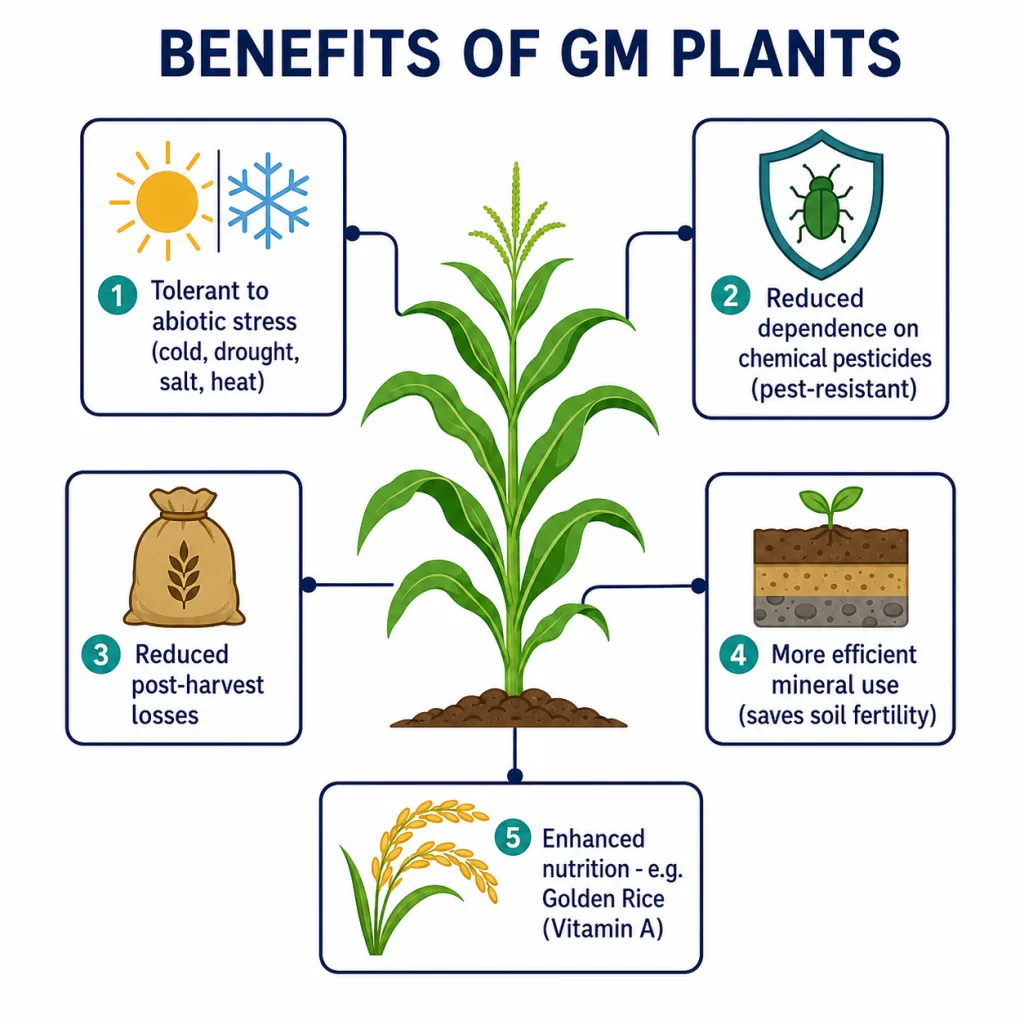
Plants, bacteria, fungi and animals whose genes have been altered by manipulation are called Genetically Modified Organisms (GMOs). Genetic modification has made crops more tolerant to abiotic stresses - cold, drought, salt and heat; less dependent on chemical pesticides, the plants being pest-resistant themselves; helpful in reducing post-harvest losses; and more efficient in the use of minerals, which prevents early exhaustion of soil fertility. It has also enhanced the nutritional value of food - Golden Rice, a Vitamin 'A' enriched rice, is the example; raising a crop's vitamin, mineral or protein content this way is biofortification. GM has further produced tailor-made plants supplying alternative resources to industry as starches, fuels and pharmaceuticals.
Two strategies for pest resistance
Bacillus thuringiensis forms protein crystals during a particular phase of its growth, and these crystals hold a toxic insecticidal protein. Moving the gene for this Bt protein into a crop lets the plant make its own insecticide - the basis of Bt cotton. A quite different strategy is RNA interference (RNAi), used against Meloidogyne incognita, a nematode that infects the roots of tobacco plants and badly cuts yield: the transgenic plant makes a double-stranded RNA that silences the nematode's specific mRNA, so the parasite cannot survive.
Biotechnology in medicine
Before recombinant DNA technology, insulin for diabetics was extracted from the pancreas of slaughtered cattle and pigs, and this animal insulin sometimes caused allergic reactions. Gene therapy is a collection of methods that allows correction of a gene defect diagnosed in a child or embryo; the first clinical gene therapy was given in 1990 to a four-year-old girl with adenosine deaminase (ADA) deficiency.
Early diagnosis
A pathogen is usually suspected only after it causes symptoms, when its concentration is already very high. PCR detects very low concentrations of a bacterium or virus by amplifying its nucleic acid. ELISA rests on a different principle - antigen-antibody interaction - picking up the pathogen's antigens or the antibodies made against it.
Transgenic animals and ethical concerns
Animals whose DNA has been manipulated to possess and express an extra (foreign) gene are transgenic animals. Rats, rabbits, pigs, sheep, cows and fish have all been made transgenic, but over 95 per cent of all existing transgenic animals are mice. Such work draws ethical objections: manipulation of living organisms cannot go unregulated, and genetic modification can have unpredictable results in an ecosystem - hence India's GEAC (Genetic Engineering Approval Committee).
One-liners: applications = therapeutics, diagnostics, GM crops; Green Revolution tripled food supply; GMO = organism with a manipulated gene; M. incognita = tobacco root nematode (RNAi); first gene therapy 1990, ADA-deficient girl of four; ELISA = antigen-antibody; over 95% of transgenic animals are mice.