
Tailor-Made Plants and Protected Crops
Genetic modification is not only about raising food production. It has also produced tailor-made plants that supply industry with alternative resources, engineered to yield starches, fuels and pharmaceuticals. Its other gains are distinct: tolerance of abiotic stresses, reduced reliance on chemical pesticides, more efficient mineral use, enhanced nutritional value (Golden Rice), and reduced post-harvest losses - the spoilage that sets in during storage and transport.
How the Bt toxin acts inside an insect
Bacillus thuringiensis stores its insecticidal protein as a crystal of inactive protoxin, so the bacterium itself comes to no harm. It turns dangerous only in the gut of a susceptible insect that eats it, because those gut contents are alkaline: the alkaline pH solubilises the crystal and converts the protoxin into the active toxin. The activated toxin binds to the surface of the midgut epithelial cells, and where it binds pores are created. The affected cells swell and lyse, and the insect dies.
Silencing a parasite from inside the plant
The nematode Meloidogyne incognita infests tobacco roots. Agrobacterium vectors introduce nematode-specific genes so that host cells make both sense and antisense RNA; being complementary, these pair into double-stranded RNA, which sets off RNA interference and silences the nematode's specific mRNA. The parasite cannot survive in a transgenic host expressing the interfering RNA.
Insulin, Gene Therapy and Molecular Diagnosis
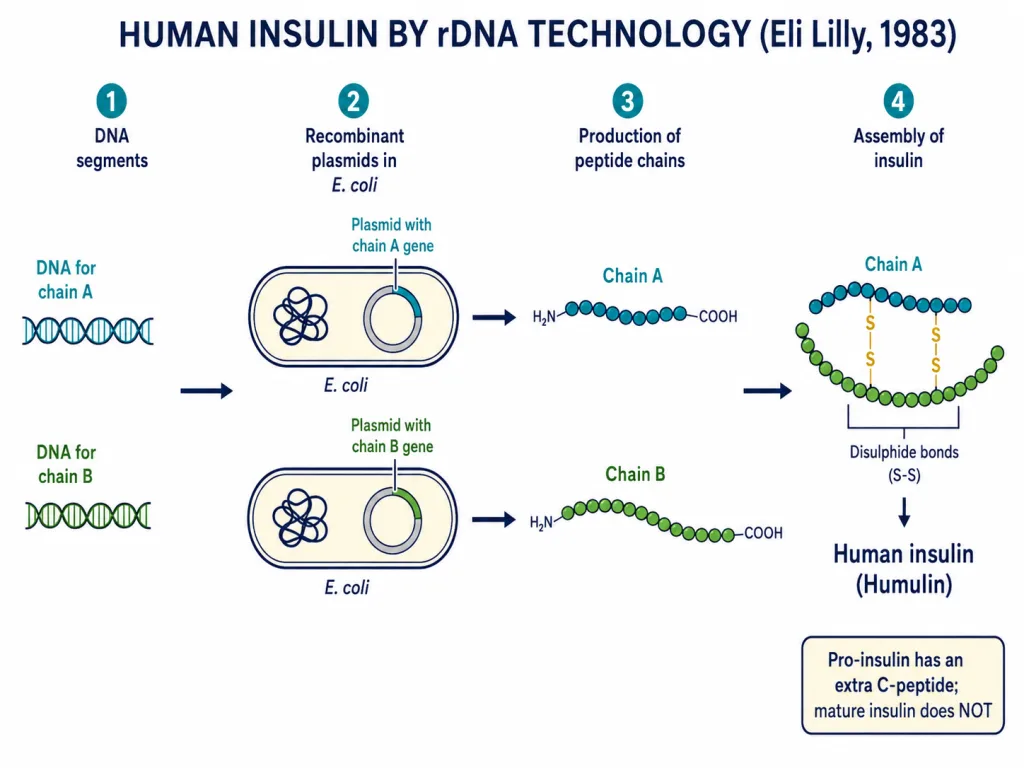
Mature insulin is two short polypeptide chains, A and B, held by disulphide bridges. In mammals it is first made as the pro-hormone pro-insulin, carrying an extra stretch called the C peptide, which is removed during maturation and is not present in mature insulin. The main challenge in producing insulin by rDNA technology was getting it assembled into the mature form - not making the chains, but joining them. In 1983, Eli Lilly prepared DNA sequences for chains A and B, introduced them into plasmids of E. coli, produced the chains separately, then extracted and combined them by creating disulphide bonds.
Gene therapy for ADA deficiency
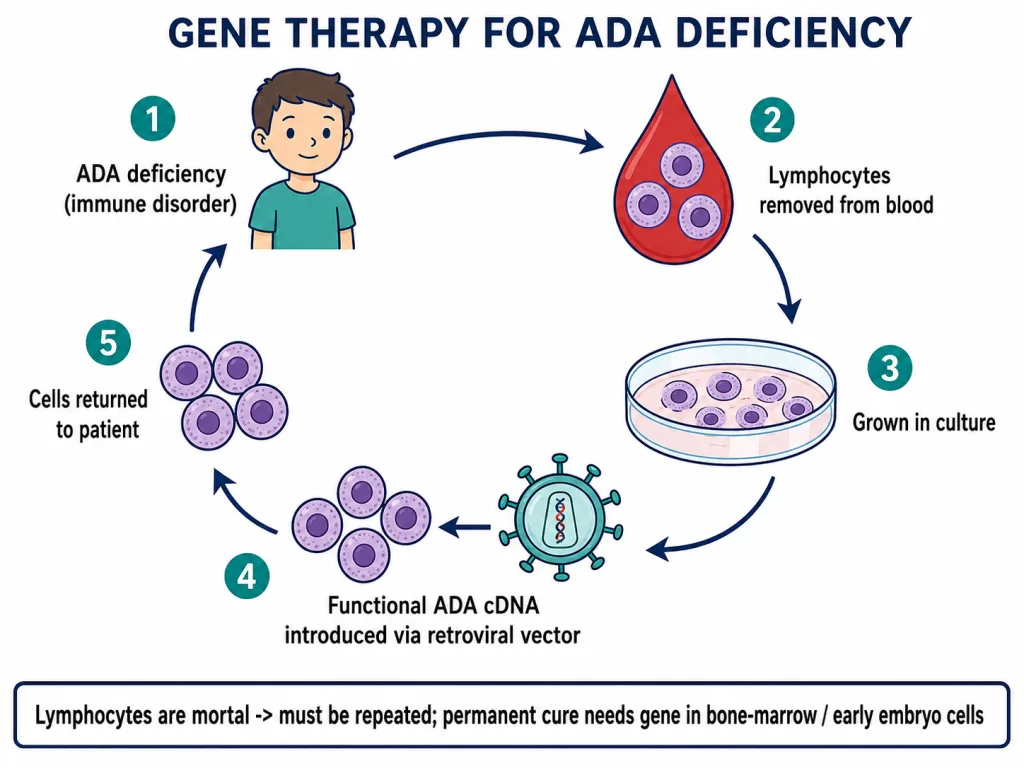
Adenosine deaminase (ADA) deficiency is caused by the deletion of the gene for adenosine deaminase, an enzyme the immune system cannot work without. Bone-marrow transplantation and enzyme-replacement therapy ease the condition but are not completely curative. In the first clinical gene therapy (1990), lymphocytes from the patient's blood were grown in culture outside the body, a functional ADA cDNA was introduced into them using a retroviral vector, and the corrected cells were returned to the patient. Such lymphocytes are not immortal, so periodic infusions are needed.
Reading a probe result
In molecular diagnosis a single-stranded DNA or RNA probe carrying a radioactive label is hybridised with DNA from a clone of cells and read by autoradiography. A clone carrying a mutated gene does not appear on the photographic film, because the probe finds no complementarity there.
Transgenic Animals and the Patent Issue
Medicines often contain biological products that are costly to make, so transgenic animals are created by introducing DNA that codes for a useful human protein - alpha-1-antitrypsin, used against emphysema, is the standard example. The first transgenic cow, Rosie, gave human protein-enriched milk, nutritionally more balanced for human babies than ordinary cow milk. In chemical (toxicity) safety testing, animals carry genes making them more sensitive to toxic substances than non-transgenic animals; exposed to the substance under test, they give results in less time.
There is also growing anger that patents have been granted in other countries on biological materials and on knowledge that farmers and indigenous people of a region had long identified, developed and used - taken without authorisation or compensatory payment, this is biopiracy.
One-liners: tailor-made plants = starches, fuels, pharmaceuticals; the Bt crystal needs an alkaline insect gut; toxin target = midgut epithelial cells; C peptide absent from mature insulin; ADA deficiency = deletion of the ADA gene; 1990 delivery = retroviral vector.