
Microbes in Sewage Treatment
Sewage is the municipal waste water; it carries large amounts of organic matter and microbes, many of them pathogenic. It cannot be discharged into rivers directly, so it is treated in Sewage Treatment Plants (STPs) using heterotrophic microbes.
Primary treatment (physical)
This is the physical removal of particles by filtration and sedimentation. Floating debris is filtered out, and grit (soil and small pebbles) is settled out. The settled solids form the primary sludge, and the supernatant is the primary effluent.
Secondary treatment (biological)
The primary effluent is passed into large aeration tanks where it is constantly agitated and air is pumped in. This lets useful aerobic microbes grow vigorously into flocs - masses of bacteria associated with fungal filaments forming mesh-like structures.
- As the microbes grow, they consume the major part of the organic matter, which reduces the BOD of the effluent.
- BOD (Biochemical Oxygen Demand) is the amount of oxygen that would be consumed if all the organic matter in one litre of water were oxidised by bacteria. It is a measure of the organic matter in the water: the greater the BOD, the more polluting the water.
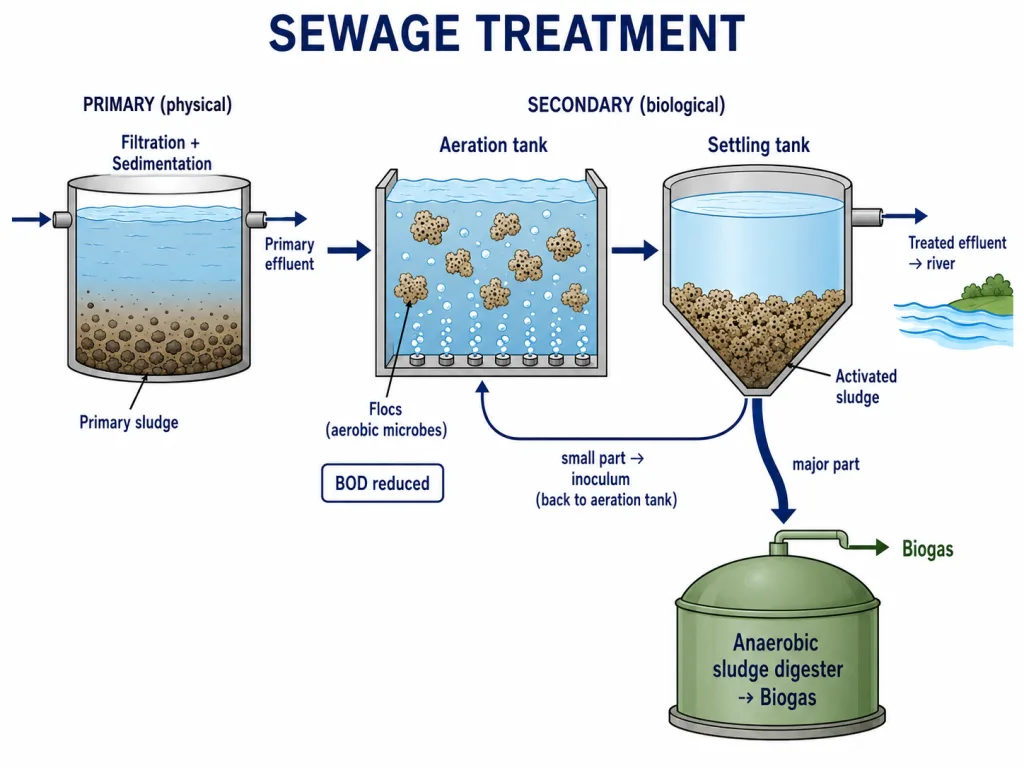
One-liners: primary treatment = physical (filtration + sedimentation -> primary sludge); secondary = biological (aeration tank -> aerobic flocs consume organic matter -> BOD falls); high BOD = more polluted.
From Activated Sludge to the Digester
Once the BOD of the sewage is greatly reduced, the effluent is passed into a settling tank where the bacterial flocs sediment; this sediment is the activated sludge.
- A small part of the activated sludge is pumped back into the aeration tank to serve as the inoculum.
- The major part of the activated sludge is pumped into large tanks called anaerobic sludge digesters. Here anaerobic bacteria digest the bacteria and fungi of the sludge and, during this digestion, produce a mixture of gases such as methane, hydrogen sulphide and carbon dioxide - which form biogas.
The effluent from the secondary treatment plant is finally released into natural water bodies (rivers and streams). Because sewage treatment is so important for clean rivers, the Government of India launched the Ganga Action Plan and the Yamuna Action Plan.
One-liners: flocs settle -> activated sludge; small part = inoculum (back to aeration tank), major part -> anaerobic digester (produces biogas); Ganga & Yamuna Action Plans protect rivers.
Microbes in the Production of Biogas
Biogas is a mixture of gases (predominantly methane) produced by microbial activity and used as a fuel.
- The methane is produced by a group of anaerobic bacteria called methanogens, for example Methanobacterium. They grow anaerobically on cellulosic material and produce large amounts of methane along with CO2 and H2.
- Methanogens are found in the anaerobic sludge of sewage and also in the rumen (a part of the stomach) of cattle, where they help in the breakdown of cellulose and so play an important role in the nutrition of cattle.
- Because the cattle dung ('gobar') is rich in these methanogens, it is used in biogas plants to generate biogas, commonly called gobar gas.
The biogas plant
A typical biogas plant has a concrete tank into which a slurry of dung is fed. A floating cover (gas holder) over the slurry rises as the biogas is produced and is connected through a pipe to supply the gas for cooking and lighting. The spent slurry is removed and used as fertiliser. In India, biogas-plant technology was developed largely by the IARI and the KVIC (Khadi and Village Industries Commission).
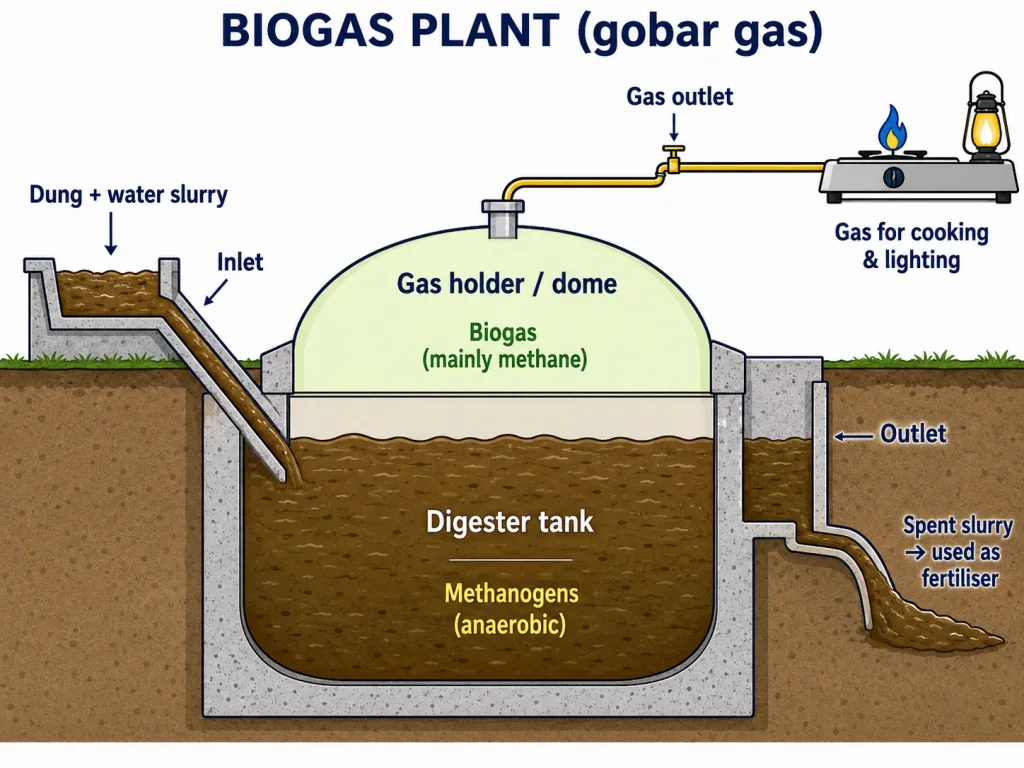
One-liners: biogas = mostly methane; produced by methanogens (Methanobacterium) - anaerobic; found in anaerobic sludge + rumen of cattle (break down cellulose); gobar gas from cattle dung; technology by IARI & KVIC.