
Semiconservative DNA Replication
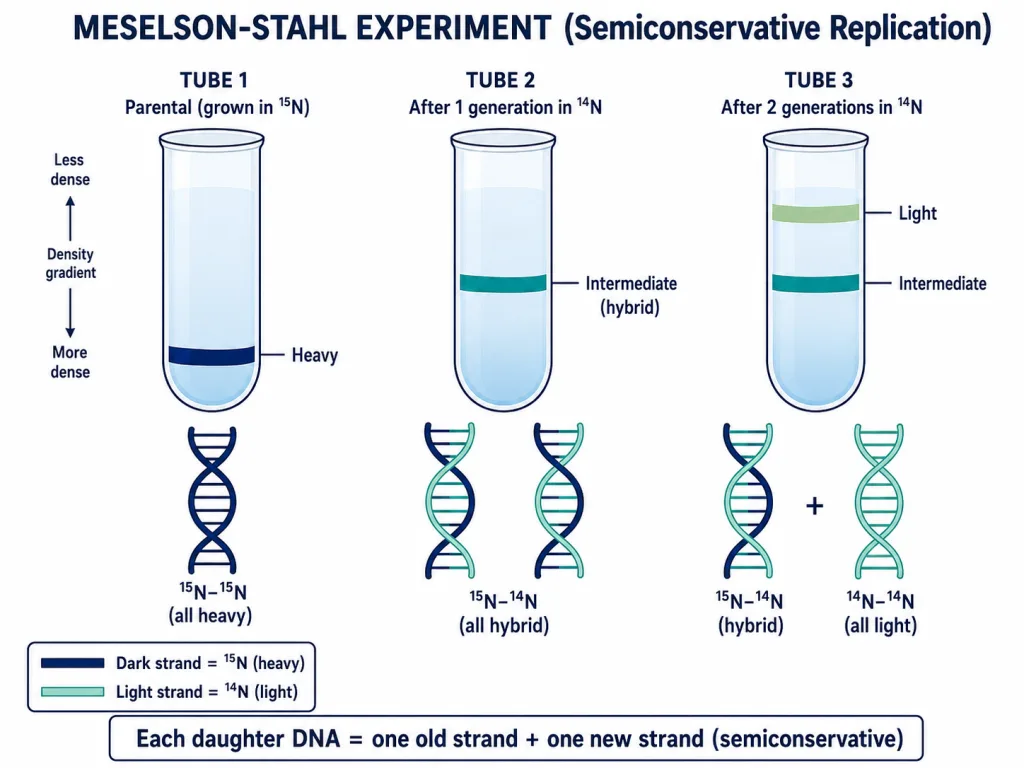
The Watson-Crick model immediately suggested how DNA copies itself: the two strands separate and each acts as a template for making a new complementary strand. Each daughter molecule thus has one old (parental) strand and one new strand - so replication is semiconservative.
The Meselson-Stahl experiment (1958)
Matthew Meselson and Franklin Stahl proved this in E. coli:
- They grew E. coli for many generations in a medium with heavy nitrogen (15N) as the only nitrogen source, so the DNA became uniformly heavy.
- The cells were then shifted to a medium with normal light nitrogen (14N), and DNA was extracted after each generation and spun in a caesium chloride (CsCl) density gradient.
- After one generation the DNA was all of intermediate (hybrid) density (one 15N strand + one 14N strand); after two generations, half was hybrid and half was light. This is exactly what semiconservative replication predicts.
A similar result was obtained by Taylor and colleagues on chromosomes of the broad bean, Vicia faba, using radioactive thymidine.
One-liners: replication is semiconservative (each daughter = 1 old + 1 new strand); Meselson & Stahl used 15N/14N + CsCl density gradient in E. coli; Taylor showed it in Vicia faba.
The Replication Machinery
In eukaryotes, replication happens in the S phase of the cell cycle. The main enzyme is the DNA-dependent DNA polymerase, which is remarkably fast and accurate.
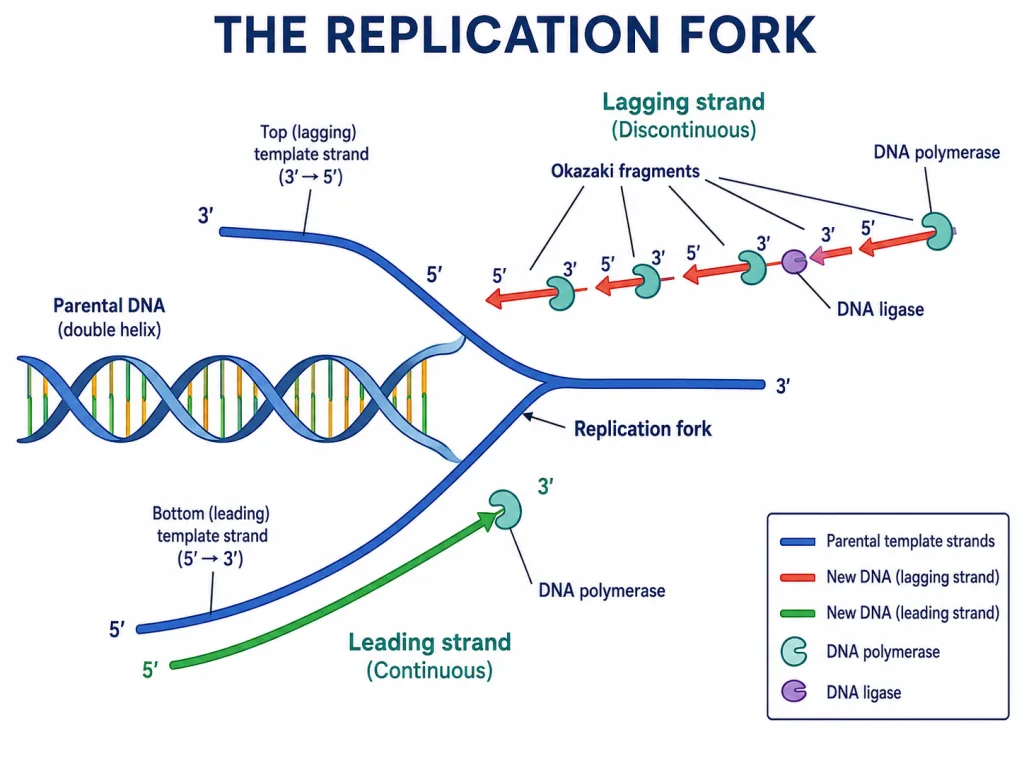
- Replication begins at a specific site, the origin of replication (ori), where the helix opens to form a replication fork.
- DNA polymerase can add nucleotides only in the 5' to 3' direction, reading the template 3' to 5'.
- Because of this one-way rule, the two template strands are copied differently:
- the strand whose template runs 3' to 5' towards the fork is made continuously - the leading strand;
- the other is made discontinuously as short Okazaki fragments - the lagging strand - which are later joined by DNA ligase.
- Replication also needs an RNA primer to start, and the deoxyribonucleoside triphosphates (dNTPs) act both as the substrates and as the source of energy for polymerisation.
One-liners: main enzyme = DNA-dependent DNA polymerase (adds only 5' to 3'); leading strand continuous, lagging strand = Okazaki fragments joined by DNA ligase; needs a primer; dNTPs = substrate + energy; replication in the S phase.
Transcription
Transcription is the copying of the information in one strand of DNA into RNA. Only a segment of DNA and only one of the two strands is copied - if both strands were copied, they would code for different proteins, and the two complementary RNAs would pair and not be translated.
- The strand that is copied (read 3' to 5') is the template strand; the other strand, which has the same sequence as the RNA (with T in place of U) and runs 5' to 3', is the coding strand.
- A transcription unit has three parts: a promoter (where RNA polymerase binds, upstream of the gene), the structural gene, and a terminator (downstream).
RNA polymerases
- In bacteria, a single RNA polymerase makes all types of RNA; the sigma factor helps initiation and the rho factor helps termination.
- In eukaryotes there are three RNA polymerases: RNA polymerase I makes rRNAs; RNA polymerase II makes the mRNA precursor (hnRNA); RNA polymerase III makes tRNA, 5S rRNA and small nuclear RNAs.
RNA processing in eukaryotes
In eukaryotes the primary transcript (hnRNA) is non-functional and must be processed in the nucleus:
- Splicing - the non-coding introns are removed and the coding exons are joined.
- Capping - a methyl-guanosine cap is added at the 5' end.
- Tailing - a poly-A tail is added at the 3' end.
The mature mRNA is then transported out. (Bacterial mRNA is often polycistronic; eukaryotic mRNA is monocistronic, and the genes are split into exons and introns.)
One-liners: only one strand (template, 3'->5') copied; coding strand = same as RNA (U->T); transcription unit = promoter + structural gene + terminator; bacteria one RNA pol (sigma = initiation, rho = termination); eukaryotes RNA pol I/II/III (rRNA / hnRNA-mRNA / tRNA); processing = splicing + capping + tailing.