
Growth Rates - Arithmetic vs Geometric
The growth rate is the increased growth per unit time. It can be arithmetic or geometric.
Arithmetic growth
- After mitosis, only one daughter cell continues to divide while the other differentiates and matures.
- The rate is constant and a plot of size against time is a linear (straight-line) curve.
- Formula: Lt = L0 + rt (Lt = length at time t, L0 = length at t = 0, r = growth rate per unit time). Example: a root elongating at a constant rate.
Geometric (exponential) growth
- Both daughter cells divide and continue to divide (common in early stages/unlimited nutrients).
- Growth is slow at first, then rapid (exponential), giving an exponential equation: W1 = W0 e^rt (W0 = initial size, r = relative growth rate = efficiency index, e = base of natural log).
- In reality nutrients become limiting, so exponential growth cannot continue - the overall plot is a sigmoid (S-shaped) growth curve with a lag phase, a log (exponential) phase and a stationary phase (the typical curve for a cell/tissue/organ/organism in its natural environment).
Absolute vs relative growth rate
- Absolute growth rate - the total growth per unit time.
- Relative growth rate - growth per unit time expressed on a common basis (per unit initial size). (Two leaves may add the same area - equal absolute rate - but the smaller leaf has the greater relative rate.)
One-liners: arithmetic = one daughter divides, linear, Lt = L0 + rt; geometric = both daughters divide, exponential, W1 = W0 e^rt; the natural growth curve is sigmoid (lag -> log -> stationary).
Visual - Growth Curves
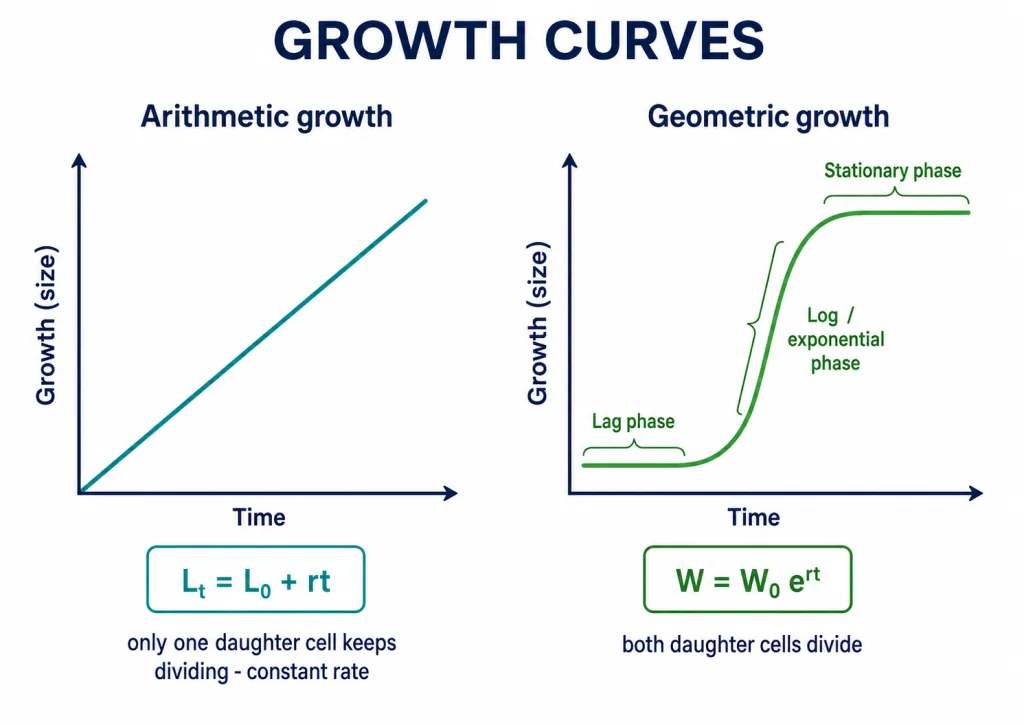
Arithmetic growth gives a straight line (Lt = L0 + rt); geometric growth gives a sigmoid (S-shaped) curve with lag, log (exponential) and stationary phases.
Differentiation, Dedifferentiation & Redifferentiation
- Differentiation - the process by which cells derived from the meristem mature to perform specific functions. It involves major structural changes in the cell wall and protoplasm; e.g., to form a tracheary element, a cell loses its protoplasm and develops a strong, lignified secondary wall.
- Dedifferentiation - mature/differentiated living cells that had lost the ability to divide regain it under certain conditions. Examples: formation of interfascicular cambium and cork cambium (phellogen) from mature parenchyma; callus formation from mesophyll cells in culture.
- Redifferentiation - the tissues produced by the dedifferentiated meristems mature again and lose the capacity to divide (e.g., secondary xylem, secondary phloem, cork from the cambia).
Trap: dedifferentiation = mature cells regain division; redifferentiation = they lose it again. Differentiation in plants is open - it depends on the cell's position (a cell's fate is decided by its location).
Development, Plasticity & Totipotency
- Development = the sum of growth and differentiation; it is all the changes an organism goes through from germination to senescence (seed to death).
- Development is controlled by both intrinsic (genetic, intracellular hormones) and extrinsic (light, temperature, water, oxygen, nutrition) factors.
- Plasticity - plants can follow different pathways to form different structures in response to the environment or phase of life. Examples: heterophylly - different leaf shapes in the juvenile vs adult (cotton, coriander, larkspur) or in aquatic vs land forms (buttercup).
- Totipotency - the capacity of a single cell to generate a whole plant - the basis of tissue culture.
One-liners: development = growth + differentiation (germination -> senescence); plasticity/heterophylly (cotton, coriander, larkspur; aquatic vs land buttercup); a plant cell's fate depends on its position; totipotency = whole plant from one cell.