
Ethylene & Abscisic Acid (the Inhibitors)
Ethylene
- The only gaseous plant growth regulator; largely an inhibitor but with several promotive roles.
- Effects/uses: promotes fruit ripening and senescence; promotes abscission of leaves, flowers and fruits; causes horizontal growth of seedlings, swelling of the axis and epinasty (the 'triple response'); breaks dormancy of potato tubers, and stimulates germination of peanut seeds; promotes root growth and root-hair formation (increasing absorption surface); initiates flowering in mango and pineapple and synchronises fruit-set. Ethephon is the most widely used ethylene source (ripens tomatoes/apples, accelerates female flowers in cucumbers).
Abscisic acid (ABA)
- A general growth inhibitor and the 'stress hormone'.
- Effects/uses: inhibits growth, metabolism and germination; promotes and maintains seed dormancy; is a key regulator of stomatal closure (it acts as an antitranspirant, closing stomata under water stress); helps the plant tolerate stresses. ABA antagonises gibberellins (dormancy vs germination).
One-liners: ethylene = gaseous, ripening/senescence/abscission/triple response/root-hair; ABA = stress hormone, stomatal closure, seed dormancy, antagonist of GA.
Photoperiodism & Vernalisation
Photoperiodism
Some plants flower only when the duration of light/dark (photoperiod) is right. By their photoperiodic response, plants are grouped as:
- Short-day plants (SDP) - flower when the day is shorter than a critical period (i.e., they need a long continuous dark period). e.g., Xanthium, rice, soybean, chrysanthemum.
- Long-day plants (LDP) - flower when the day is longer than a critical period (a short night). e.g., wheat, spinach, henbane.
- Day-neutral plants (DNP) - flowering is not affected by photoperiod. e.g., tomato, cucumber.
Key facts: the critical duration matters most; the leaves are the site of perception of the photoperiod (not the shoot apex where flowers form); a hormonal signal, hypothetically named florigen, is thought to move from the leaf to the shoot apex to induce flowering; the pigment phytochrome is involved in perceiving light/dark. In SDP, interrupting the long dark period with a brief flash of light prevents flowering - showing the dark period is decisive.
Vernalisation
- Vernalisation is the promotion of flowering by a period of low temperature (cold treatment).
- It prevents premature flowering and lets the plant flower only after it has passed a cold season. Examples: winter varieties of wheat, barley and rye (sown in autumn, exposed to winter cold); and biennials such as sugar beet, cabbage and carrot.
One-liners: SDP need a long dark period (interrupting the night stops flowering); the leaf perceives the photoperiod; florigen = the hypothetical flowering hormone; vernalisation = low temperature promotes flowering (winter cereals, biennials).
Visual - Photoperiodism (Short-day vs Long-day)
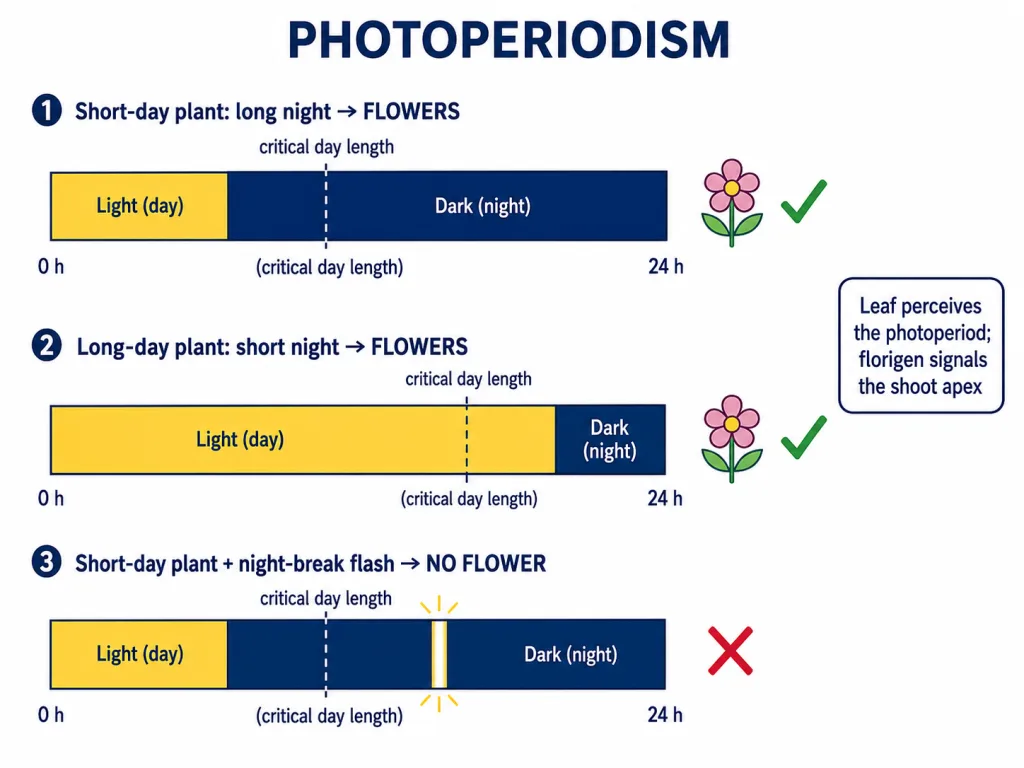
Short-day plants flower only when the dark period exceeds a critical length; a brief flash of light in the middle of the night (night-break) prevents their flowering, showing the dark period is decisive.