
Sex Determination
The sex of an individual is usually decided by special sex chromosomes. Three common chromosomal systems occur:
- XX-XY (humans, Drosophila) - the female is XX (homogametic) and produces only one type of egg (X); the male is XY (heterogametic) and produces two kinds of sperm (half carry X, half carry Y). In humans the father's sperm decides the sex of the child: an X-bearing sperm gives a girl (XX) and a Y-bearing sperm gives a boy (XY), in a 50 : 50 ratio. This is male heterogamety.
- XX-XO (grasshoppers, many insects) - the female is XX, the male is XO (a single X and no Y). The male makes two kinds of sperm - one with an X and one without any sex chromosome. Also male heterogamety.
- ZZ-ZW (birds, some reptiles) - here the female is heterogametic (ZW) and the male is homogametic (ZZ), so the type of egg (from the female) decides the sex of the offspring. This is female heterogamety.
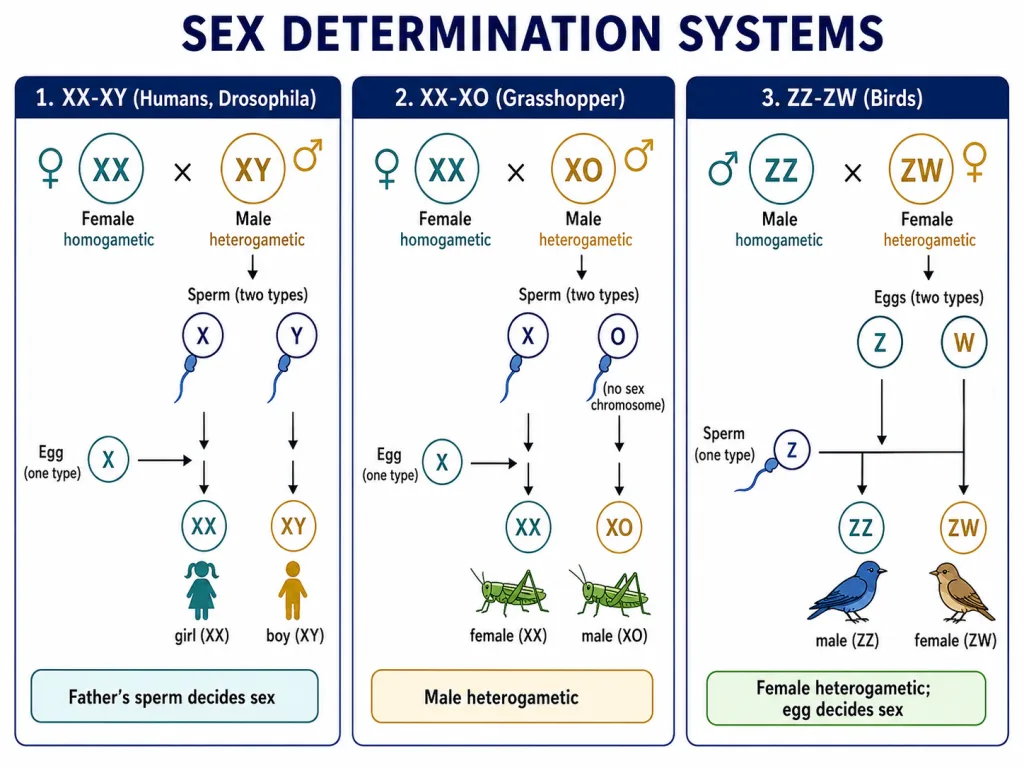
One-liners: XX-XY (human/Drosophila) - male heterogametic, father decides sex; XX-XO (grasshopper) - male XO, 50% sperm lack a sex chromosome; ZZ-ZW (birds) - female heterogametic, egg decides sex.
Mutation
Mutation is a sudden, heritable change in the genetic material (the DNA sequence or the chromosomes). It is a major source of variation and of new alleles.
- Point mutation - a change in a single base pair of DNA. Sickle-cell anaemia is the classic example, caused by the substitution of one base (glutamic acid replaced by valine at the sixth position of the beta-globin chain).
- Frameshift mutation - the insertion or deletion of base pairs shifts the reading frame of the codons that follow.
- Chromosomal aberrations - changes in chromosome structure (deletion, duplication, inversion, translocation) or in chromosome number. A change in the number of a single chromosome is aneuploidy (from failure of chromosomes to separate, i.e. non-disjunction), while gain of whole extra sets is polyploidy. Chromosomal aberrations are often seen in cancer cells.
- Mutagens are agents that cause mutations - UV light, X-rays and various chemicals.
One-liners: mutation = sudden heritable change in DNA/chromosome; point mutation = single base pair (sickle-cell); frameshift = insertion/deletion; aneuploidy from non-disjunction; mutagens = UV, X-rays, chemicals.
Genetic Disorders
Mendelian disorders (single-gene)
These are caused by an alteration in a single gene and are transmitted in a Mendelian pattern, traced by pedigree analysis.
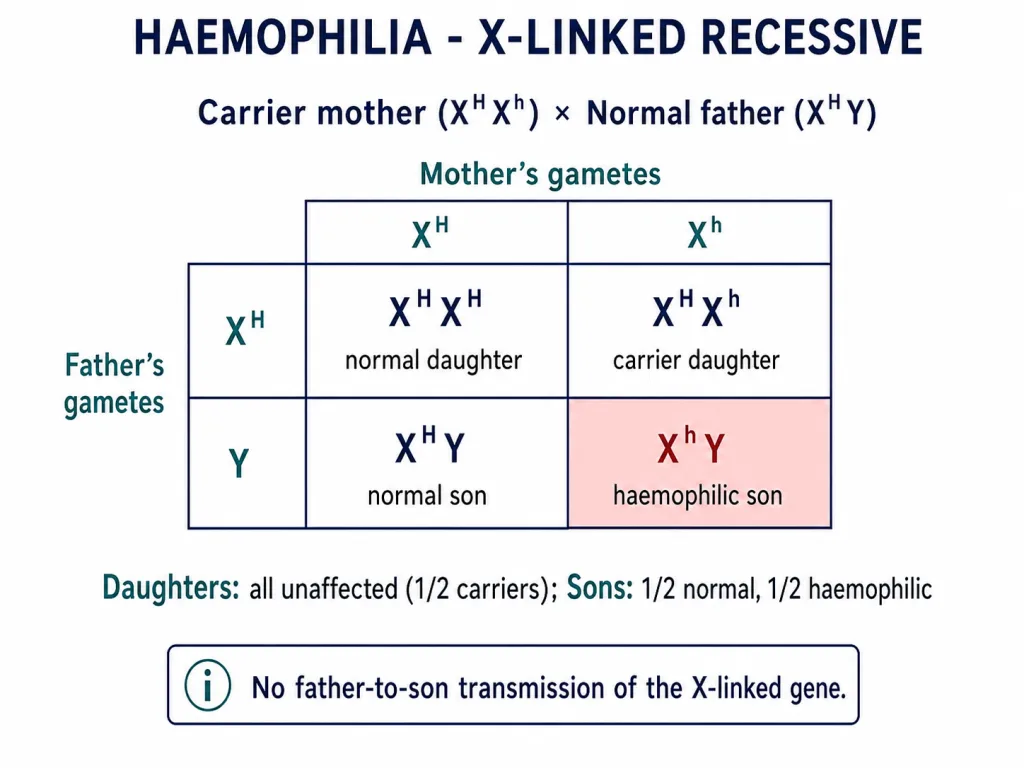
- Haemophilia - X-linked recessive; the blood fails to clot, so a simple cut bleeds for a long time. It mostly affects males; a carrier (heterozygous) mother can pass it to 50% of her sons. Known as the 'royal disease'.
- Colour blindness - X-linked recessive; a defect of red-green perception affecting about 8% of males but only about 0.4% of females.
- Sickle-cell anaemia - autosomal recessive; the mutant HbS allele (Glu -> Val at position 6 of the beta-globin chain) causes red cells to become sickle-shaped. HbS HbS individuals are diseased, while HbA HbS heterozygotes are unaffected carriers (sickle-cell trait).
- Thalassaemia - autosomal recessive; reduced or absent synthesis of one of the globin chains (alpha or beta) leads to anaemia. It is a quantitative defect (too little normal globin), in contrast to sickle-cell anaemia which is a qualitative defect (an abnormal globin).
- Phenylketonuria - autosomal recessive; a missing enzyme means phenylalanine cannot be converted to tyrosine, so phenylalanine accumulates and causes mental retardation.
Chromosomal disorders (abnormal chromosome number)
- Down's syndrome - trisomy of chromosome 21 (an extra 21, so 2n = 47); short stature, a small round head, a furrowed protruding tongue, and mental retardation.
- Klinefelter's syndrome - 47, XXY; an overall masculine build but with gynaecomastia (breast development) and sterility.
- Turner's syndrome - 45, X0 (one X missing); a sterile female with rudimentary ovaries and lack of other secondary sexual characters.
Pedigree analysis
Because controlled crosses are impossible in humans, the inheritance of a trait is studied by pedigree analysis - a chart of a family across generations using standard symbols (a square = male, a circle = female, a filled symbol = affected). It helps trace whether a trait is dominant or recessive, autosomal or sex-linked.
One-liners: X-linked recessive = haemophilia, colour blindness (mostly males); autosomal recessive = sickle-cell, thalassaemia, phenylketonuria; thalassaemia = quantitative, sickle-cell = qualitative; Down's = trisomy 21, Klinefelter's = XXY, Turner's = X0; pedigree square = male, circle = female, filled = affected.