
The Dihybrid Cross and Independent Assortment
A dihybrid cross follows two pairs of contrasting characters at once. Mendel crossed a pea giving round, yellow seeds (RRYY) with one giving wrinkled, green seeds (rryy):
- The F1 were all round and yellow (RrYy) - round and yellow are dominant.
- The F1 makes four kinds of gametes (RY, Ry, rY, ry) in equal numbers, so self-pollination gives a 16-box Punnett square and an F2 phenotypic ratio of 9 : 3 : 3 : 1 (9 round-yellow : 3 round-green : 3 wrinkled-yellow : 1 wrinkled-green).
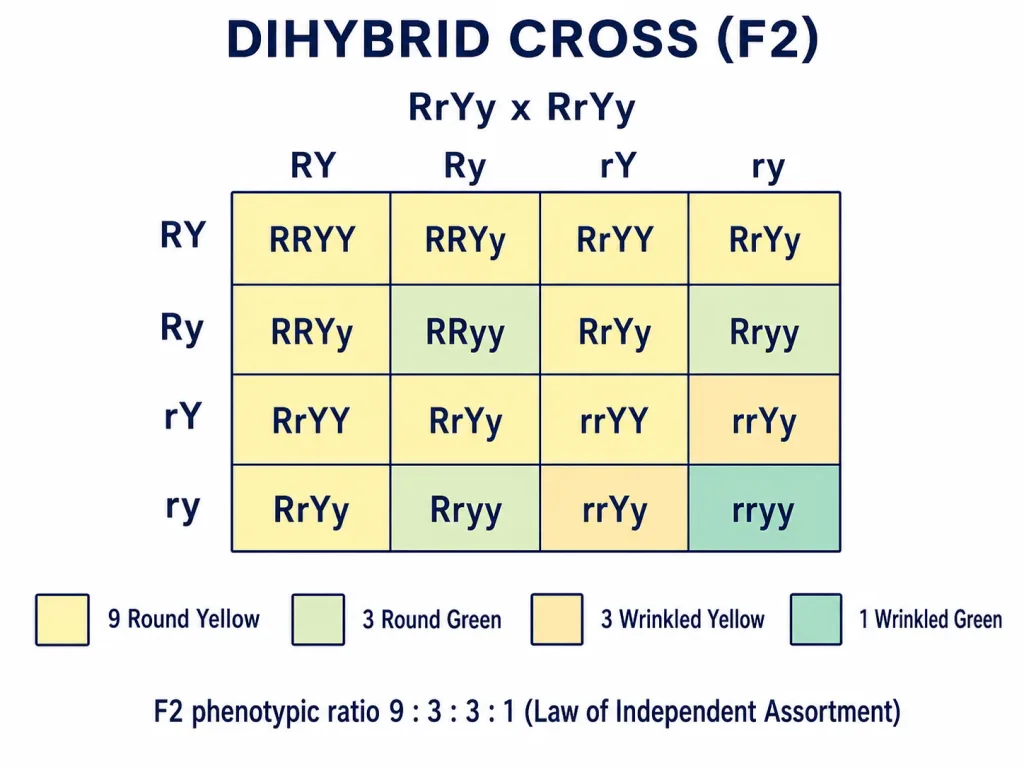
- Law of Independent Assortment - when two pairs of traits are combined in a hybrid, the segregation of one pair is independent of the other pair. Each gene's alleles assort into gametes independently, which is why new combinations (round-green, wrinkled-yellow) appear in the F2. Note that if the two genes lie on the same chromosome and are linked, this law does not hold (covered later).
One-liners: dihybrid F2 = 9 : 3 : 3 : 1; F1 dihybrid makes 4 gamete types; independent assortment = alleles of different genes segregate independently (holds only for genes on different chromosomes).
Incomplete Dominance
In some crosses the F1 is intermediate between the two parents - neither allele is completely dominant. This is incomplete dominance. In the snapdragon (Antirrhinum) and in Mirabilis jalapa (four-o'clock plant):
- Red (RR) x white (rr) gives an F1 that is pink (Rr) - a blend-like intermediate.
- Selfing the pink F1 gives an F2 of 1 red : 2 pink : 1 white - here the phenotypic ratio is the same as the genotypic ratio (1 : 2 : 1), because each genotype has its own distinct phenotype.
Importantly, the alleles themselves are not changed - the reappearance of pure red and pure white in the F2 shows the Law of Segregation still holds; only the dominance relationship is different (the heterozygote is intermediate).
One-liners: incomplete dominance -> heterozygote is intermediate (Antirrhinum, Mirabilis - pink); F2 = 1 : 2 : 1 (phenotype ratio = genotype ratio); segregation still applies.
Co-dominance and Multiple Alleles
Co-dominance
In co-dominance, both alleles express themselves fully and independently in the heterozygote (there is no blending and no intermediate). The classic example is the AB blood group, in which both A and B antigens are produced on the red cells.
Multiple alleles - the ABO blood-group system
When a gene exists in more than two allelic forms in a population, they are called multiple alleles. Human ABO blood groups are controlled by the gene I, which has three alleles - I^A, I^B and i:
- I^A produces antigen A, I^B produces antigen B, and i produces no antigen.
- I^A and I^B are dominant over i, but I^A and I^B are co-dominant with each other.
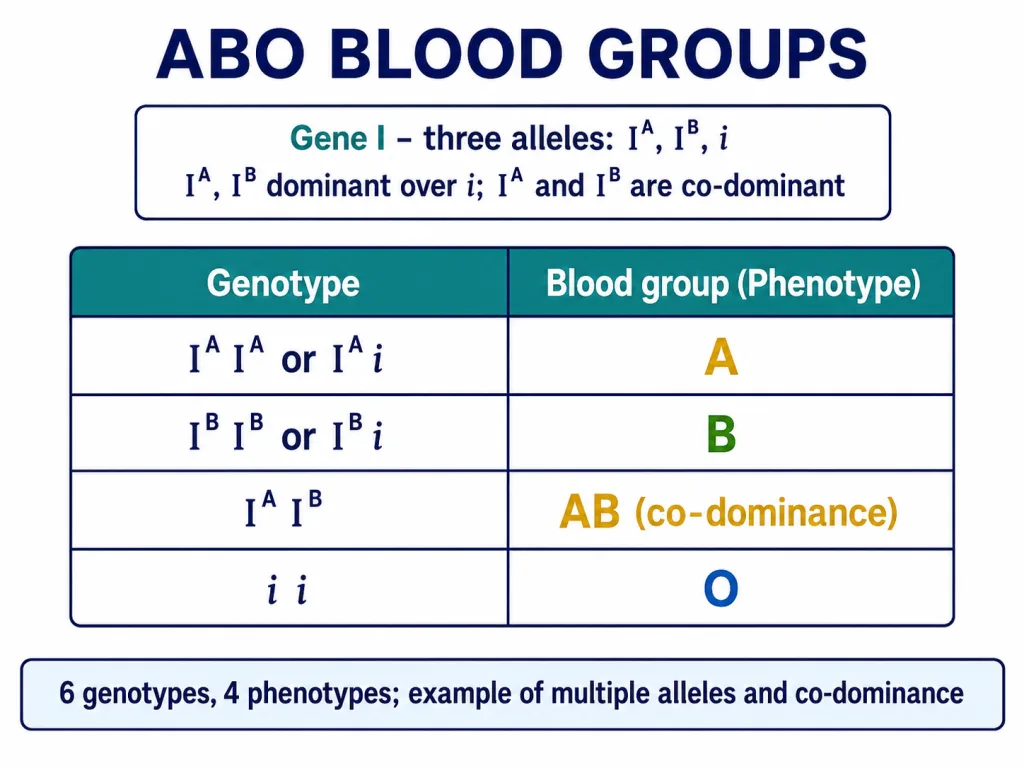
So there are six genotypes but only four phenotypes (blood groups):
- Blood group A - I^A I^A or I^A i
- Blood group B - I^B I^B or I^B i
- Blood group AB - I^A I^B (co-dominance)
- Blood group O - i i
Because a single gene (I) has three alleles, ABO also illustrates multiple allelism - though any one diploid individual still carries only two of the three alleles.
One-liners: co-dominance -> both alleles fully expressed (AB blood group); ABO gene I has 3 alleles (I^A, I^B, i) = multiple alleles; 6 genotypes, 4 phenotypes; I^A, I^B dominant over i, co-dominant with each other; O = ii.