
Mendel and the Garden Pea
Genetics is the branch of biology dealing with inheritance (the passing of characters from parents to offspring) and variation (the differences among individuals). Gregor Johann Mendel - the Father of Genetics - worked out the basic rules of inheritance between 1856 and 1863 through hybridisation experiments on the garden pea (Pisum sativum).
Why the garden pea was a good choice
- It has many true-breeding varieties with clear-cut contrasting traits.
- Its flowers are bisexual and normally self-pollinate, yet they can be cross-pollinated at will.
- It has a short life cycle, is easy to grow, and produces large numbers of offspring, allowing statistical analysis.
The seven pairs of contrasting characters
Mendel followed seven pairs of contrasting traits: seed shape (round/wrinkled), seed colour (yellow/green), flower colour (violet/white), flower position (axial/terminal), pod shape (inflated/constricted), pod colour (green/yellow) and stem height (tall/dwarf).
The Language of Genetics
- Gene - the unit of inheritance; a factor carrying the information for a character (e.g. the gene for height).
- Allele - one of the alternative forms of a gene (e.g. T for tall and t for dwarf). By convention a capital letter denotes the dominant allele and a lower-case letter the recessive one.
- Dominant allele - the one that expresses itself in the heterozygote; recessive - the one that is masked.
- Homozygous - both alleles alike (TT or tt); heterozygous - the two alleles different (Tt).
- Genotype - the genetic constitution (e.g. Tt); Phenotype - the observable character (e.g. tall).
- P generation = parents; F1 = first filial (offspring of P); F2 = second filial (offspring of F1 self-cross).
One-liners: Mendel = Father of Genetics, used Pisum sativum, seven contrasting traits; allele = alternative form of a gene; genotype (TT/Tt/tt) vs phenotype (tall/dwarf); capital = dominant, lower-case = recessive.
The Monohybrid Cross
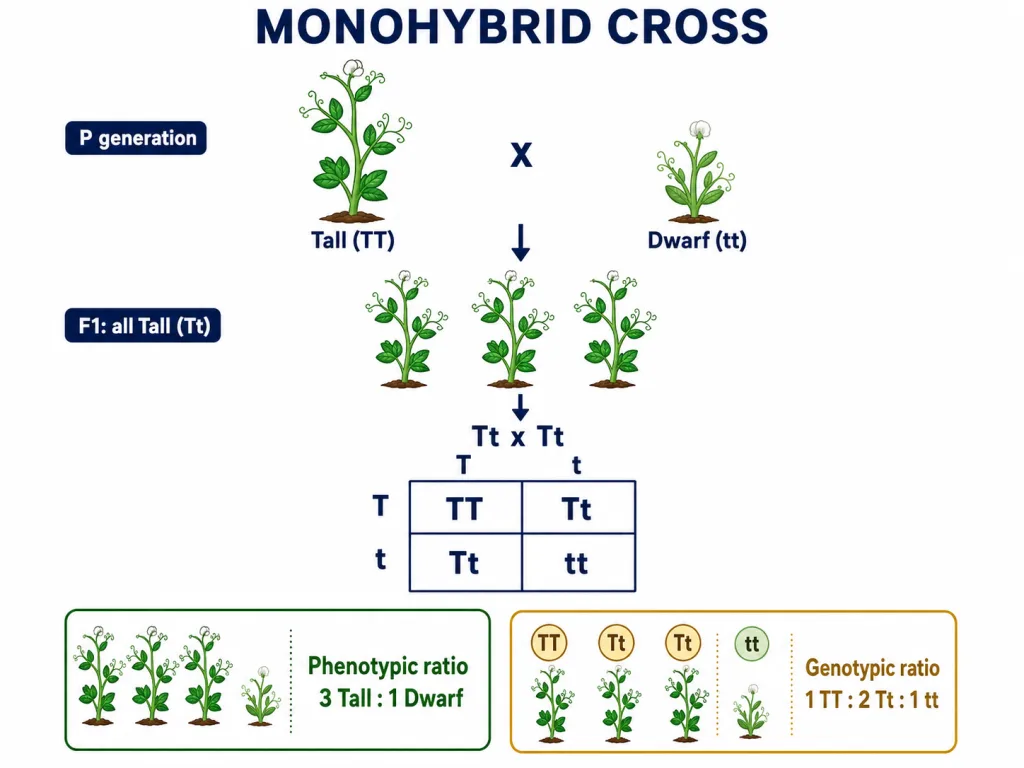
A cross that follows the inheritance of a single pair of contrasting characters is a monohybrid cross. When Mendel crossed a true-breeding tall (TT) pea with a true-breeding dwarf (tt) pea:
- All the F1 plants were tall (Tt) - the dwarf character disappeared.
- On self-pollinating the F1, the F2 showed both types in a 3 tall : 1 dwarf phenotypic ratio, and a 1 TT : 2 Tt : 1 tt genotypic ratio (1 : 2 : 1). The dwarf trait had reappeared, showing it was only hidden, not lost.
Mendel's first two laws
- Law of Dominance - characters are controlled by factors (genes) which occur in pairs; in a dissimilar pair of factors, one (dominant) expresses itself and the other (recessive) remains masked. It explains why the F1 resembles one parent and why the recessive trait reappears in the F2.
- Law of Segregation (Law of Purity of Gametes) - the two alleles of a pair separate (segregate) during gamete formation, so that a gamete carries only one allele of each pair. The alleles do not blend; they stay pure and are passed on unchanged. This is Mendel's only law with no exceptions.
The Punnett square, devised by R.C. Punnett, is a grid used to work out all the possible gamete combinations of a cross.
One-liners: monohybrid F2 = 3 : 1 phenotypic, 1 : 2 : 1 genotypic; Law of Dominance (one masks the other); Law of Segregation = purity of gametes (a gamete carries one allele; alleles stay pure); Punnett square predicts the cross.
Test Cross and Back Cross
A tall pea plant may be TT or Tt - its genotype cannot be told from its appearance. Two crosses help:
- Back cross - a cross of the F1 with either of its parents.
- Test cross - a cross of an individual of unknown genotype with the homozygous recessive (tt). It is used to find out whether the individual is homozygous or heterozygous.
- If the tall plant is Tt: Tt x tt gives 1 tall : 1 dwarf (a 1 : 1 ratio) - the appearance of dwarf offspring reveals the heterozygous genotype.
- If the tall plant is TT: TT x tt gives all tall offspring.
The 1 : 1 test-cross ratio is a quick diagnostic for the heterozygous condition, and the number of phenotypic classes in a test cross equals the number of gamete types made by the tested parent.
One-liners: test cross = cross with homozygous recessive to expose an unknown genotype; Tt x tt -> 1 : 1; TT x tt -> all dominant; back cross = F1 x a parent.