
What Makes a Contraceptive Ideal
No real method is perfect, so five properties are set out as the standard against which any method is judged. An ideal contraceptive should be user-friendly. It should be easily available. It should be effective and reversible. It should have no side effects, or the least possible. And it should in no way interfere with the sexual drive, the desire and the sexual act of the user.
That fifth property is the one most often dropped from a revision list, and it is not a footnote. A method that a couple finds unpleasant, or that dampens desire, is abandoned within weeks, and a contraceptive nobody uses protects nobody. Reversibility matters for the same practical reason: couples generally want to postpone children, not to give up the possibility of having them.
Methods That Use Neither Drug Nor Device
The natural or traditional approaches share one design idea: conception is avoided without any drug, any device or any surgery.
In periodic abstinence a couple avoids or abstains from coitus from day 10 to day 17 of the menstrual cycle, the stretch in which the chances of conception are highest. Treat this as a rule of the method; the two day numbers define the window.
In coitus interruptus, or withdrawal, the male partner withdraws the penis from the vagina just before ejaculation, so that insemination does not take place. The timing phrase is the whole of the method. An instant too late and nothing at all has been achieved.
Lactational amenorrhoea rests on the fact that ovulation, and therefore the cycle, does not occur during the period of intense lactation that follows parturition. The chances of conception during this phase are almost nil, but the protection holds only up to a maximum period of six months after delivery, and not beyond.
[NEET Important] This family has one shared virtue and one shared vice, and both must be remembered together. No drugs and no devices are used, so side effects are almost nil; but the chances of failure are high. The low side-effect profile is why these methods appeal; the high failure rate is why they are not leaned on alone.
Barriers and the Preparations That Support Them
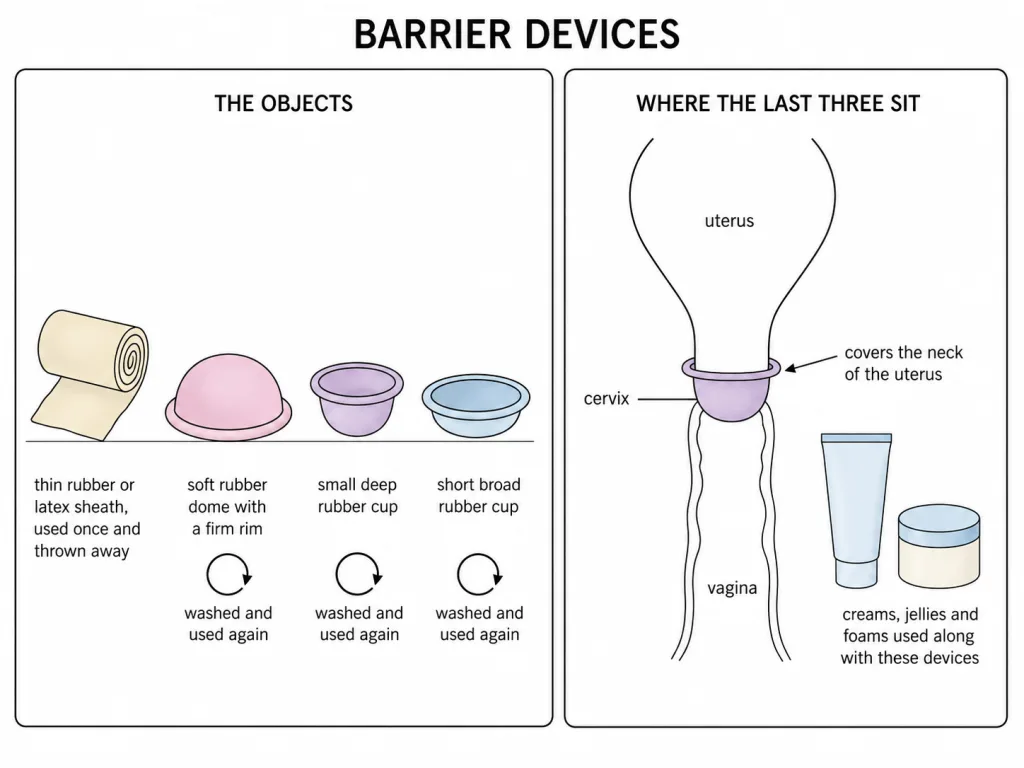
Barrier methods work by stopping sperms and the ovum from meeting physically. Condoms are thin sheaths of rubber or latex used to cover the penis in the male, or the vagina and cervix in the female, just before coitus, so that ejaculated semen does not enter the female reproductive tract. They are disposable, they can be self-inserted, and they give privacy to the user. The popular Indian brand name is Nirodh. They also help protect against sexually transmitted infections.
Diaphragms, cervical caps and vaults are barriers of rubber too. They are inserted into the female reproductive tract so as to cover the cervix during coitus, and unlike condoms they can be cleaned and used again. Reusability and the covered structure are the two things to hold on to.
Spermicidal creams, jellies and foams are not a method in their own right. They are used along with barrier methods to increase their contraceptive efficiency. That supporting role is precisely what they should be remembered for; on their own they are a thin defence.
A Choice, Not a Prescription
One closing caution deserves its own place. Contraceptives are not something a person uses for the good of their own health. They are used to avoid a pregnancy, or to delay or space children. Their use is therefore a considered decision taken by a couple, with medical advice where that helps, and not a treatment that anybody requires in order to stay well.
Devices Placed Inside the Uterus
Intrauterine devices are inserted in the uterus by doctors or by expert nurses, and they are at present among the most widely accepted methods of contraception in India. They are described as ideal for a female who wants to delay her first pregnancy, or who wants to space her children, because the device works only for as long as it stays in position.
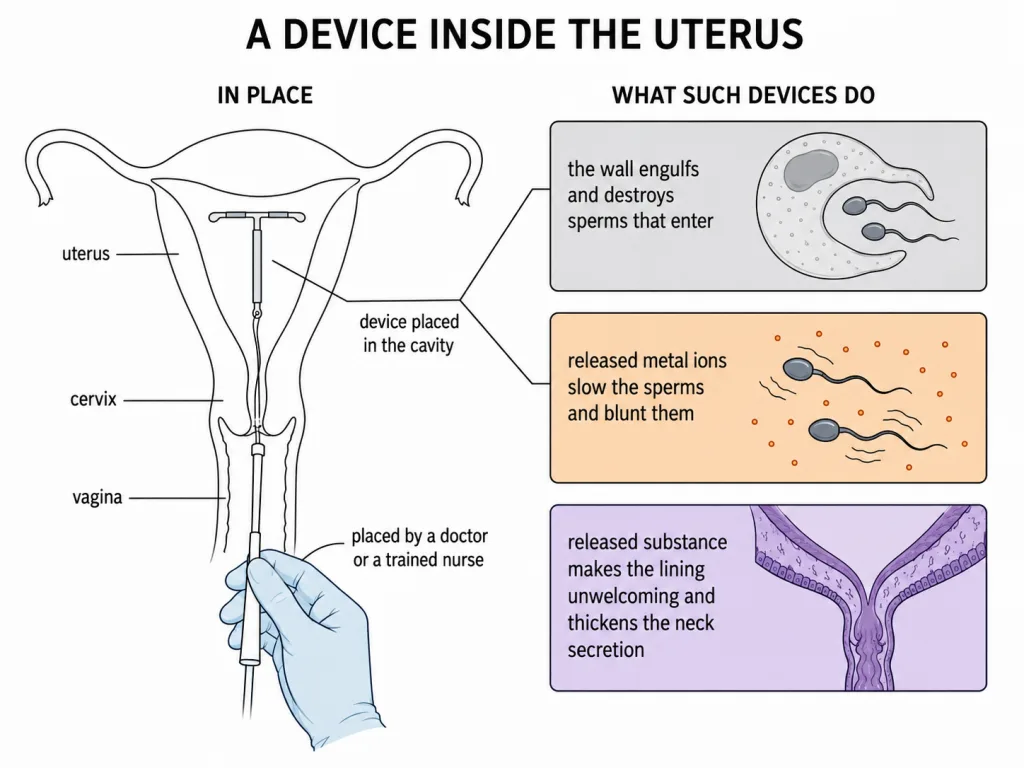
There are three classes and they do not all work in the same way. The one action they share is that the device increases the phagocytosis of sperms within the uterus. Beyond that shared action, each class adds something of its own.
A copper releasing device gives off copper ions inside the uterine cavity, and those ions have two separate effects on the sperms: they suppress sperm motility, and they suppress the fertilising capacity of the sperms. Note that these are two claims, not one. A sperm that swims poorly is a different failure from a sperm that cannot fertilise.
A hormone releasing device also adds two effects, but on two different structures. It makes the uterus unsuitable for implantation, and it makes the cervix hostile to the sperms. Non-medicated devices work on the shared phagocytic action alone.
Each class also carries its own device names, and those are asked as often as the mechanisms are. The non-medicated class is the Lippes loop. The copper-releasing class is the CuT, the Cu7 and the Multiload 375. The hormone-releasing class is the Progestasert and the LNG-20. Implants are usually listed alongside these three classes but are not intrauterine devices at all: they are progestogens, alone or with oestrogen, placed under the skin.
Two of those names give no clue at all to their class. Multiload 375 releases copper although nothing in its name says so, and LNG-20 releases a hormone although its name reads like a device code. The numerals encode nothing. Read the three classes as one shared action plus two additions, and then learn the names as a separate table, because neither one gives you the other.
[NEET Important] Learn the three classes as a set of five separate statements: phagocytosis of sperms for all devices; sperm motility and fertilising capacity for the copper class; unsuitability of the uterus and hostility of the cervix for the hormone class. Questions in this area routinely give a candidate one of a pair and withhold the other.
Tablets, Injections and Implants
The oral contraceptive is a combination of progestogens, or of progestogens with oestrogen. Its course has a fixed shape. The tablets are taken daily for a period of 21 days, preferably beginning within the first five days of the menstrual cycle. After that run there is a gap of 7 days, during which menstruation occurs, and then the same 21 day course is repeated. Treat the starting day and the 21 on, 7 off pattern as rules of the method, and do not try to derive them from the physiology of the cycle.
The tablet has three actions, and all three are worth memorising by name. It inhibits ovulation; it inhibits implantation; and it alters the quality of the cervical mucus so as to retard or prevent the entry of sperms. A candidate who can name only the first of the three has not learnt the topic.
Saheli is a different oral preparation. It is a non-steroidal preparation, it is taken once a week rather than once a day, it has very high contraceptive value with very few side effects, and it was developed at the Central Drug Research Institute, or CDRI, at Lucknow. The once a week schedule is what separates it from every other oral contraceptive in this chapter.
Progestogens alone, or progestogens in combination with oestrogen, can also be used by females as injections or as implants placed under the skin. Their effective periods are much longer than those of the oral tablets, which is the whole point of choosing them: one administration replaces a great many daily doses.
Emergency Measures, Surgery and Side Effects
Progestogens, or progestogen and oestrogen combinations, or intrauterine devices, can be used as emergency contraception within 72 hours of coitus. This measure is effective to avoid a possible pregnancy from rape, or from casual unprotected intercourse. It prevents a pregnancy from becoming established; it is not a way of ending one that already exists.
Surgical methods, also called sterilisation, are advised as a terminal method to prevent any more pregnancies. In the male the procedure is vasectomy: a small part of the vas deferens is removed or tied up through a small incision on the scrotum. In the female it is tubectomy: a small part of the fallopian tube is removed or tied up through a small incision in the abdomen, or through the vagina. Both block the transport of gametes and thereby prevent conception. Both are highly effective, but their reversibility is very poor.
[NEET Important] The side effects of contraceptive use are examinable in their own right. The recognised list runs nausea, abdominal pain, breakthrough bleeding, irregular uterine bleeding, and even breast cancer. Along with the list goes a balancing judgement: these effects are not very significant, but they should not be totally ignored. Both halves belong together; one half on its own misrepresents the chapter.
Finally, hold on to the axis that sorts this whole group. Devices and tablets delay or space children and can be discontinued whenever a child is wanted. Sterilisation ends the possibility of further children and is very poorly reversible. That distinction, and not the name of any product, is the clinical point of the section.