
One Group, Three Names
Diseases and infections passed on through sexual intercourse are collected under a single heading, and that heading carries three interchangeable names: sexually transmitted infections (STI), venereal diseases (VD) and reproductive tract infections (RTI). The commonest error here is to read the three names as three different families of illness. They are not. They are one group under three labels, and any of the three may turn up in a question. The group includes gonorrhoea, syphilis, genital herpes, chlamydiasis, genital warts, trichomoniasis, hepatitis-B and HIV, the last of which leads to AIDS. Both halves of that group are examinable: the roll-call itself, and what the chapter says about the group as a whole -- how it presents, why it is missed, how else it travels, and what it ends in.
The roster is a closed list, and membership is decided by the route of transmission and by nothing else. A disease can be infectious, communicable, serious and widespread and still have no place on it, which is where a question of this shape usually sets its trap.
Against those same eight names runs the curability rule. Most of these infections are completely curable if they are detected early and treated properly, and the condition attached to the cure is part of the rule rather than a qualification of it. There are three exceptions: hepatitis-B, genital herpes and HIV infection. Learn the exception list rather than the curable list, because it is short, fixed, and a question can be built from either direction out of it.
Two nearby abbreviations must not be mistaken for names of the group. PID is pelvic inflammatory disease, which is a consequence of an untreated infection. MTP is medical termination of pregnancy, which is a procedure. Neither is a label for the group itself.
Why So Many Infections Are Missed
The early symptoms are itching, fluid discharge, slight pain, and swellings in the genital region. What matters more than the list is how faint that list usually is. In most infected persons the early symptoms are minor, and in many they are absent altogether. This is especially so in females, who are frequently asymptomatic, meaning they show no outward sign at all while the infection is present and can still be passed on.
[NEET Important] "Frequently asymptomatic in females" is a statement about detection, not about incidence. Nothing in this chapter says that females contract these infections more often than males do. A student who has slid from one claim to the other will state the second with the confidence that belongs only to the first.
A second delay sits on top of the first. Because of the social stigma attached to these infections, infected persons often avoid going to a doctor even when they suspect something is wrong. Faint symptoms plus a reluctance to be seen means the infection is usually well advanced before anyone examines it.
What an Untreated Infection Ends In
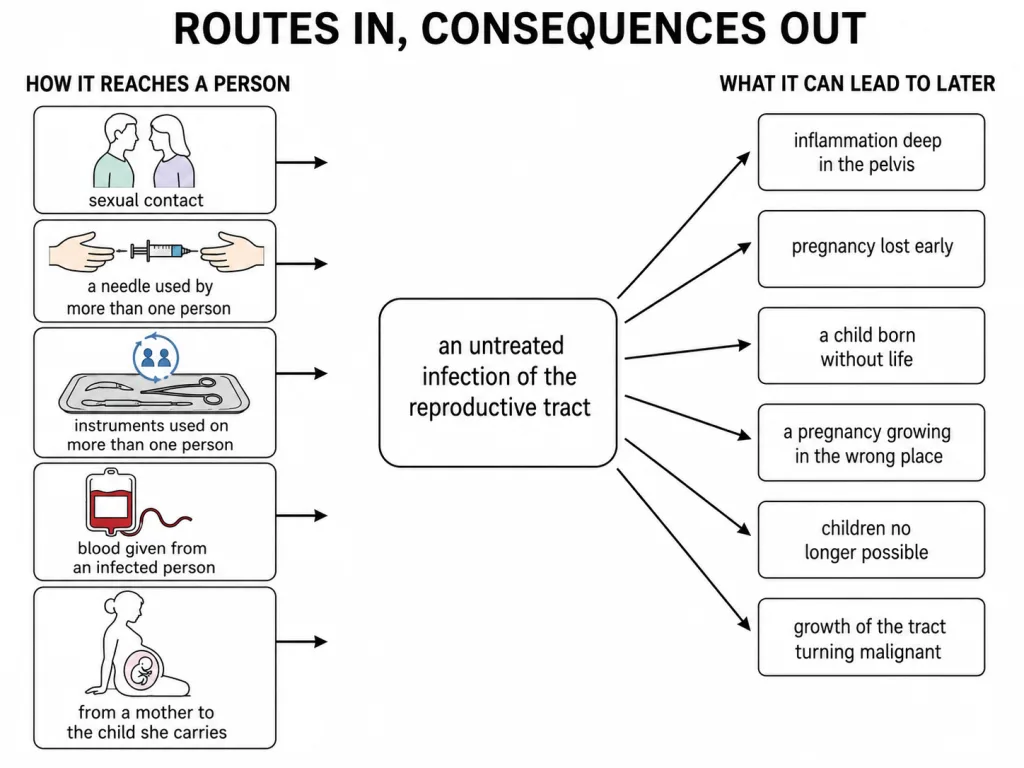
Left untreated, or treated too late, these infections can cause pelvic inflammatory diseases (PID), abortions, still births, ectopic pregnancies, infertility, and cancer of the reproductive tract. The two students least expect are still birth and ectopic pregnancy. Note that infertility appears here as a complication of infection; that is a different context from infertility as a condition treated by assisted reproduction, and the two should not be blurred together.
[NEET Important] Do not learn this as a number. Learn the individual members. A question will ask whether ectopic pregnancy or still birth belongs on the list, never how many entries the list has.
Routes Other Than Sexual Contact
Sexual intercourse is the defining route, but it is not the only one. These infections may also spread by sharing of injection needles, by sharing of surgical instruments with an infected person, and by transfusion of blood from an infected person. Infection may also pass from an infected mother to her foetus. Notice the shape of that set: two routes involve an object being shared between people, one moves infected blood itself, and one crosses from mother to unborn child before birth. HIV travels by all of these routes as well as by sexual contact, and it leads to AIDS in an infected person.
Equally worth knowing is what is not a route. Ordinary social contact, sharing a meal, or working beside an infected person does not pass these infections on. That misconception feeds the stigma described above, and the stigma in turn feeds the delay in treatment.
The Three Rules, and Who Needs Them Most
There are three plain rules for avoiding these infections:
- Avoid sex with unknown partners or multiple partners.
- Always try to use condoms during coitus.
- In case of doubt, go to a qualified doctor for early detection and get complete treatment if diagnosed with a disease.
Read the third rule carefully. It has two halves, and students routinely remember the first and drop the second. Early detection is not enough by itself; the treatment has to be complete. The second rule belongs here as a rule of prevention rather than as a description of any device.
Persons in the age group of 15-24 years are most vulnerable to these infections. That single figure is worth committing to memory. It explains why prevention advice, awareness drives and school-level education are aimed squarely at that band rather than spread evenly across all ages.
Because these infections are a major threat to a reproductively healthy society, their prevention, or early detection and cure, is one of the major thrust areas of the reproductive health care programmes. All persons are advised to be free of these infections so that a reproductively healthy society becomes possible.
When a Couple Cannot Have Children
Infertility is the inability of a couple to produce children in spite of unprotected sexual cohabitation. That qualifier matters more than students expect. A couple who have been using a contraceptive are not described as infertile, and no fixed span of time forms part of the description. What is required is that conception has failed although nothing was being done to prevent it.
The reasons are of several kinds: physical, congenital, disease-related, drug-related, immunological, and occasionally psychological. Not every one of them shows itself as a structural fault, which is why the list runs wider than students expect.
In India a childless couple is very often blamed on the female partner, yet in a large number of cases the problem lies with the male partner. Specialised health care units, the infertility clinics, exist to do two things: the diagnosis of these disorders, and the corrective treatment of some of them.
[NEET Important] The order of events is examinable in itself. Diagnosis first, correction wherever correction is possible, and only in those cases where corrective treatment cannot be given are the special child-bearing techniques taken up. Assisted reproduction is a fallback, never the opening move.
Fertilisation Outside the Body, and Where the Product Goes
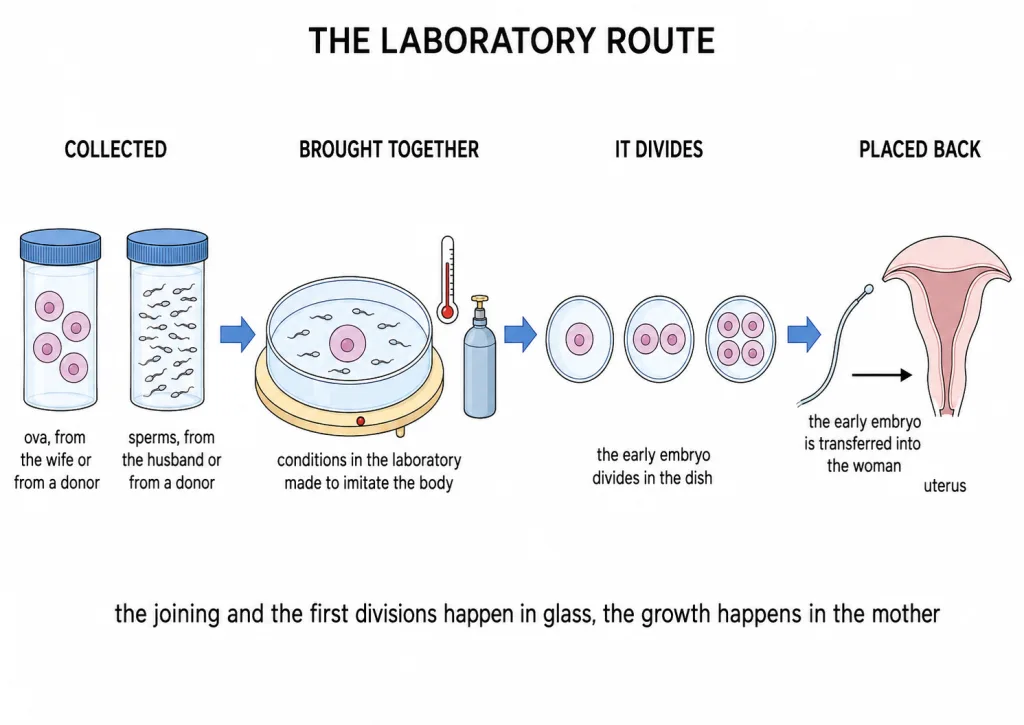
In in vitro fertilisation, ova from the wife or from a donor and sperms from the husband or from a donor are collected and induced to form a zygote under simulated conditions. Either cell may come from outside the marriage, and that is the point students routinely get only half right. The product is then moved into the female, and the whole sequence is popularly known as the test tube baby programme.
The popular name is a poor description of what happens. No child is grown in glassware. Only fertilisation and the first few divisions take place away from the mother; the pregnancy itself runs its normal course inside the female tract, to term, in the ordinary way.
The rule that decides where the material is put is a counting rule. A zygote, or an early embryo carrying up to eight blastomeres, is placed in the fallopian tube. An embryo that has gone past eight blastomeres is placed in the uterus, where it completes its further development. Learn the threshold together with both destinations; one half of that pair, remembered alone, is worth nothing in an examination hall.
[NEET Important] Embryos do not have to be made in a laboratory to be usable. Embryos formed by in-vivo fertilisation, that is by the fusion of gametes inside the female, may also be collected and used for transfer. Students tend to assume that the two halves of the process are inseparable, and they are not.
Introducing Semen Artificially, and the Practical Limits
Artificial insemination answers two situations. Either the male partner is unable to deposit sperms in the female tract, or the count of sperms in the ejaculate is very low. Semen collected from the husband or from a healthy donor is introduced either into the vagina or into the uterus of the female, the second of those being the intra-uterine route.
These methods reach very few couples, and the reason is a chain rather than a single fact. They demand extremely high precision handling by specialised professionals, and they demand expensive instrumentation. Because of those two requirements together, the facilities are presently available in only a very few centres of the country. Limited availability is the consequence; precision of handling and cost of equipment are the causes. Read the relationship in that direction and the point becomes hard to forget.
There is a second set of obstacles that has nothing to do with equipment at all. Emotional, religious and social factors act as deterrents in the adoption of these methods, so that even where a facility does exist a couple may still not use it. Poverty of information, family pressure and belief all belong here rather than in the technical account.
The closing point on the whole subject is a humane one, and it is a legitimate examinable fact in its own right. Couples who remain unable to have children are urged to consider the legal adoption of one of the many orphaned and destitute children who need parents and a home. Adoption is offered not as a consolation but as a real and recommended course, and a well prepared candidate can state it as readily as any of the technical detail above.
The assisted procedures, acronym by acronym
Six acronyms circulate here, and they are separated by exactly two questions: what is moved, and where it is put.
- IVF, in vitro fertilisation: ova and sperms are collected and induced to form a zygote outside the body.
- ET, embryo transfer: a zygote or early embryo -- formed in the laboratory, or formed inside the female and then collected -- is placed into the female tract.
- ZIFT, zygote intra fallopian transfer: a zygote, or an early embryo of up to 8 blastomeres, into the fallopian tube.
- IUT, intra uterine transfer: an embryo of more than 8 blastomeres, into the uterus.
- GIFT, gamete intra fallopian transfer: an ovum collected from a donor, into the fallopian tube of a female who cannot produce one herself but can support fertilisation and further development.
- ICSI, intra cytoplasmic sperm injection: a single sperm injected directly into an ovum in the laboratory.
[NEET Important] The blastomere count is the hinge of the whole table: up to eight goes to the tube, more than eight goes to the uterus, which mirrors where the embryo would naturally be at each stage. And note that one member of the list is not a transfer procedure at all: ICSI is a way of achieving fertilisation.