
Reproductive Health: What the Term Actually Covers
The World Health Organization (WHO) treats reproductive health as total well-being in all aspects of reproduction - physical, emotional, behavioural and social. Read that as four separate demands rather than one phrase. A person is not reproductively healthy merely because no organ is diseased; the definition also asks for emotional stability around reproduction, healthy behaviour and practices, and a social setting that does not shame or punish. Most students carry over the general definition of health, which is physical, mental and social well-being, and quietly lose the behavioural element. That element is the one that lets sex education, myths, misconceptions and social attitudes count as reproductive health matters at all.
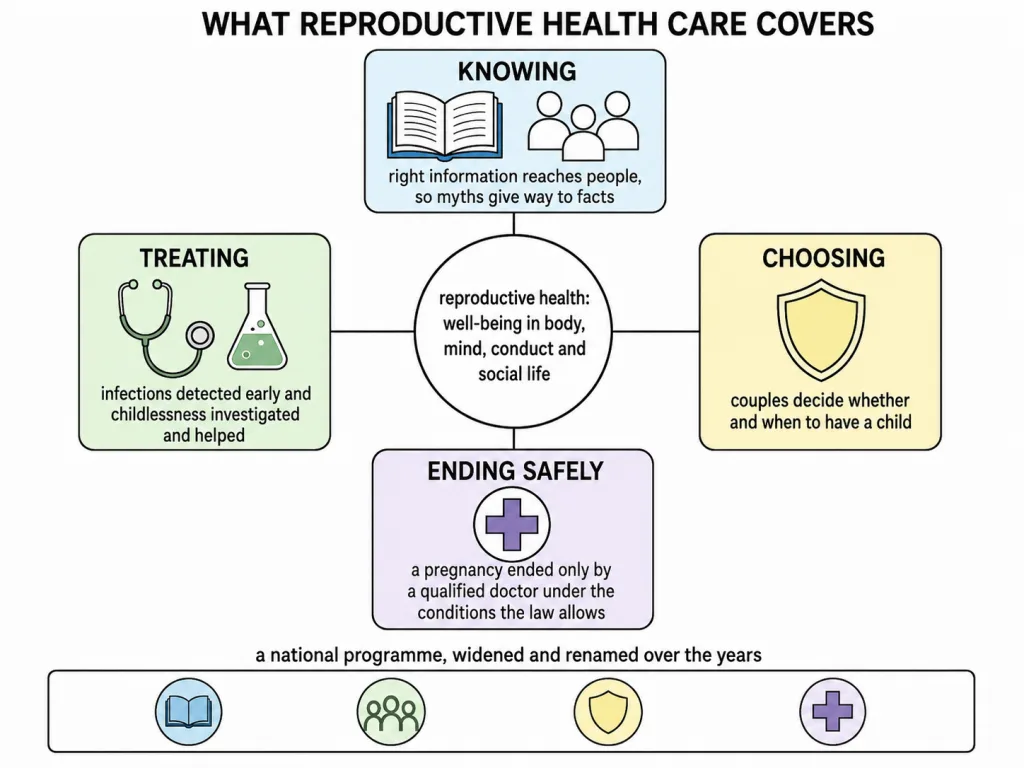
[NEET Important] The four adjectives are physical, emotional, behavioural and social. "Mental" belongs to the general health definition, not to this one.
India's Programme, from 1951 to Reproductive and Child Health Care
India was among the first countries in the world to initiate action plans and programmes at a national level to attain total reproductive health as a social goal. Family planning programmes were initiated in 1951. They were assessed periodically and improved, and the wider programmes in operation today cover far more reproduction-related areas. They run under the popular name Reproductive and Child Health Care, usually shortened to RCH.
Two major tasks sit at the centre of these programmes. The first is creating awareness among people about the various reproduction-related aspects. The second is providing facilities and support for building up a reproductively healthy society. Both halves matter: anyone who remembers only "awareness" has half the answer.
Awareness reaches people through several named channels. Audio-visual and print media carry the message widely; governmental and non-governmental agencies carry it institutionally; and parents, other close relatives, teachers and friends carry it at close range. Sex education in schools is encouraged as part of this effort. It should cover reproductive organs, adolescence and the changes that accompany it, safe and hygienic sexual practices, and sexually transmitted diseases including AIDS. Its purpose is to give young people the right information from a proper source, so as to discourage the myths and misconceptions that otherwise circulate freely.
People of reproducible age are to be made aware of fertility, birth control, pregnancy, post-natal care of the mother and the child, and the importance of breast feeding. The same list carries equal opportunity for the male and the female child - the point students most often forget, because it reads as a social claim planted inside a biology list.
Why Awareness Alone Is Not Enough
Information does not deliver care. Providing medical assistance and care for reproduction-related problems - pregnancy, delivery, sexually transmitted diseases, abortions, contraception, menstrual problems and infertility - requires strong infrastructure, professional expertise and material support. That is exactly why the second task exists beside the first. Massive child immunisation is one of the important components running under these programmes.
The improvements reported from all this are worth listing plainly: better awareness about sex-related matters; increased numbers of medically assisted deliveries with better post-natal care, and through them decreased maternal and infant mortality rates; an increased number of couples with small families; better detection and cure of sexually transmitted diseases; and an overall increase in medical facilities for sex-related problems.
[NEET Important] Do not memorise how many improvements are listed. Learn what is on the list and what is not.
Amniocentesis, and Why It Is in This Chapter
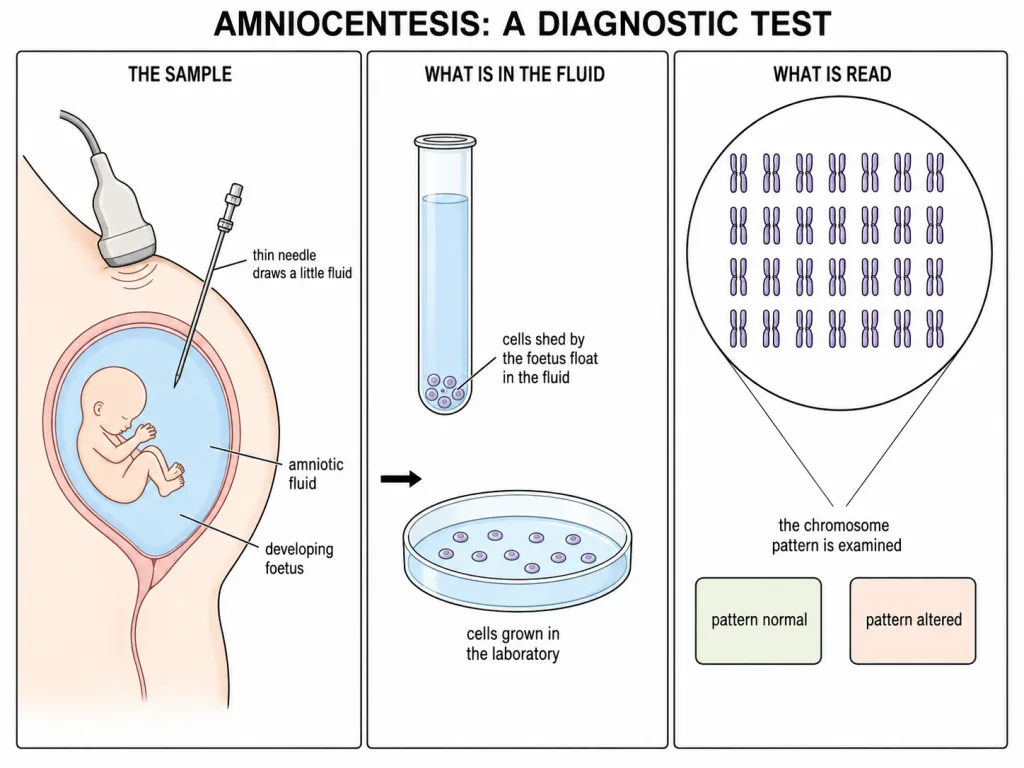
Amniocentesis is a foetal test: a sample of the amniotic fluid surrounding the developing foetus is drawn, and the chromosome pattern of the foetal cells suspended in that fluid is examined. It appears in a chapter on reproductive health not for what it was designed to do but for what it came to be used for. Because the same chromosome pattern also reveals the sex of the foetus, the test was misused to identify female foetuses, which were then aborted. Amniocentesis for sex determination is therefore statutorily banned in India, and the stated purpose of the ban is to check the increasing menace of female foeticide.
[NEET Important] Hold the practice and the programme apart. Amniocentesis used for sex determination is a misuse the state has banned, and it is not, and could not be, one of the strategies of the programme. Awareness of the ban, and of why it exists, is a different matter and does belong to the programme's awareness work.
Medical Termination of Pregnancy
MTP is the intentional or voluntary termination of pregnancy before full term. The Government of India legalised it in 1971, and did so with strict conditions attached, in order to prevent indiscriminate use of the provision.
The humanitarian grounds are specific and fully examinable. MTP is provided for unwanted pregnancies arising from casual unprotected intercourse, from failure of the contraceptive used during coitus, or from rape. It is also provided in cases where continuation of the pregnancy could be harmful, or even fatal, to the mother, to the foetus, or to both.
Two safety facts complete the picture. MTPs are considered relatively safe during the first trimester, that is up to 12 weeks of pregnancy; terminations performed in the second trimester are much more risky. And a majority of MTPs in the country are performed illegally by unqualified quacks, which is not only unsafe but could be fatal. That last statistic is the strongest argument for the awareness work described above: people need to know that a legal, medically supervised route exists.
Why Birth Control Became a National Priority
India's population did not grow because families suddenly wanted more children. It grew largely because fewer people died. A rapid fall in the death rate, in the maternal mortality rate (MMR) and in the infant mortality rate (IMR) meant that far more of those born survived into adulthood, and alongside these three declines came a steady increase in the number of people of reproducible age. Those are the four probable reasons, and notice their shape: three of them are falls and only one is a rise. Better medicine and better survival, rather than any change of intention, were the engine of the increase.
The pace can be carried in a single pair of numbers. The annual growth rate stands at about 1.7 per cent, which works out at roughly 17 additions for every 1000 people each year. That sounds modest until it is compounded: at that rate the population could double in another 33 years. Learn the rate and the doubling time; the absolute head-count is not what is asked.
[NEET Important] Three kinds of measure followed. The marriageable age was raised by statute to 18 years for females and 21 years for males. Incentives were offered to couples with small families. And awareness of contraception was spread as widely as possible. The two ages are very easy to swap in memory; fix it by remembering that the larger figure belongs to the male.